

NEWSLETTERS
ICT’s Tibet Roundup — January 1-31, 2026
TABLE OF CONTENTS
Tibet’s governance and the 15th Five-Year Plan
Tibet propaganda ministers’ conference aiming for international communication to promote the party’s “innovative theories”
Discipline session signals shift in regional governance
China reasserts its false claim on “southern Tibet”
Political loyalty prerequisite for Tibetan Buddhist scripture teachers
Religious leaders instructed to uphold party loyalty and Sinicization
Serthar county launches legal and ideological campaign to “modernize” Tibetan Buddhism
Kathmandu–Lhasa bus service to resume following high-level Nepal-China trade talks
POLITICS
On January 26, Tewo (Diebu) County in Kannan (Gannan) Prefecture, Kansu (Gansu), was struck by a 5.5 magnitude earthquake. Rather than focusing on the actual scale of damage or providing human-centric reporting, Chinese state media framed the disaster response through the lens of “fighting fortresses” and “assault teams,” a narrative that emphasizes Party-led mobilization as the core of crisis management.
The deployment of more than 2,000 Party members into 63 “assault teams” across 11 townships and 54 villages, alongside over 3,000 cadres and staff from more than 20 specialized units, highlights a governance system where disaster relief is utilized to validate Party legitimacy and reinforce hierarchical control. By positioning Party organizations as the primary “fighting fortresses” on the front lines, this state-centric framework prioritizes political visibility and organizational dominance over independent grassroots initiatives.
On January 26, Party Secretary Wang Junzheng presided over an enlarged meeting of the Standing Committee of the Party Committee of the Tibet Autonomous Region (TAR) to align regional leadership with central directives. The meeting focused on the “comprehensive, profound, and accurate” study of General Secretary Xi Jinping’s recent speeches and the spirit of the Fourth Plenary Session of the 20th CPC Central Committee.
During the meeting, Wang emphasized the consistent execution of the “four major tasks,” which consist of stability, development, ecology and border strengthening. These pillars are identified as essential for ensuring a “good start” to the 15th Five-Year Plan. The stated objective of these administrative efforts is to establish a solid foundation for the construction of a socialist modernized new Tibet, aligned with the strategic goals of the Chinese central government.
The Tibet Autonomous Region propaganda ministers’ conference was held in Lhasa on January 23 to study the National Propaganda Ministers’ Conference and to outline the region’s ideological and cultural priorities for 2026.
Reviewing the past year’s work, Party Secretary Wang Junzheng pointed out that in 2025, the propaganda, ideological and cultural front of the entire region thoroughly implemented Xi Jinping’s thoughts. Wang characterized 2026 as a “crucial period” for establishing a solid foundation for a socialist modernized new Tibet. He directed officials and the propaganda ministers of the seven prefectures to focus on “four major tasks” and “four creations,” emphasizing that Party committees at all levels must “firmly grasp the Party’s cultural leadership” and strictly implement the responsibility system for ideological work.
The conference reviewed the 2025 campaign that centered on the 60th anniversary of the establishment of the Tibet autonomous region and General Secretary Xi Jinping’s high-profile inspection. Officials highlighted reporting on the Dingri earthquake and the 2025 China Tibet Development Forum as key milestones that significantly enhanced the region’s international communication effectiveness.
Prefecture propaganda leaders outlined diverse local priorities aimed at “high-quality development.” Lhasa officials announced plans to transform the city into an “international tourist destination” while enhancing international communication and ideological security. In Lhoka (Shannan), the strategy involves “singing the main theme” through internet celebrities, short videos and cultural brands such as “One Night in Shannan.” Chamdo (Changdu) will operate under the theme of “Red Changdu Revitalizes and Advances” for industrial growth through culture.
Looking ahead to 2026, the mandate focuses on building a “shared spiritual home for the Chinese nation.” This strategy includes focus on the “three consciousnesses” —national, civic and rule of law—alongside the continued implementation of a culture digitalization strategy including the “Digital Potala” project. Internationally, the leaders aim to expand their influence through the Tibet International Communication Center.
Additionally, there is a push to enhance the effectiveness of international communication to promote the Party’s “innovative theories” globally. The meeting called for a systemic media reform to lead mainstream public opinion and the promotion of a “community of the Chinese nation” through the dissemination of core socialist values. Furthermore, the administration aims to transform the cultural tourism industry into a “strategic pillar industry” while reinforcing the “ideological security defense line” to ensure long-term regional stability.
The Sixth Plenary Session of the 10th Commission for Discipline Inspection of the TAR held in Lhasa from January 16 to 17 has established a rigorous political framework for Tibet’s transition into the 15th Five-Year Plan. Speaking to 27 members of the Discipline Inspection Commission of the TAR and 320 attendees, Party Secretary Wang Junzheng identified strict governance as the “strong guarantee” for building a socialist modernized new Tibet.
To consolidate power, the session mandated a “resolute purge” of former leaders Wu Yingjie and Che Drelha (Qi Zala) to eradicate “political ecological pollution.” Political supervision will now explicitly link enforcement to the “sense of community of the Chinese nation,” using oversight to drive national alignment. This mandate extends “full coverage” inspections to the village level, targeting “invisible mutations” of violations while institutionalizing the “Eight Provisions” as permanent regional customs to ensure a bureaucracy that is “always loyal.”
A recent Indian cultural conference on the sixth Dalai Lama in the Indian state of Arunachal Pradesh has brought the “South Tibet issue” back to the forefront, with the director of the Contemporary Research Institute of China Tibetan Studies Research Center citing the sixth Dalai Lama’s birth in the region as proof of Chinese sovereignty and illegality of the McMohan line drawn after the 1913 tripartite Simla convention.
In contrast to the author’s claim, the Simla Conference underscored the historical status of Tibet as a prominent diplomatic actor where Tibetan representatives participated as equal parties alongside Britain and China. During these negotiations, the Tibetan plenipotentiary, Lonchen Shatra, formally asserted Tibet’s sovereignty and claim of the area as Tibetan territory with historical taxation records as proof.
While the Chinese government ultimately refused to sign the final draft treaty, the proceedings highlighted Tibet’s capacity to conduct independent foreign policy. This was most evident in the secret exchange of documents between the Tibetan delegation and British representative Henry McMahon, which established the “McMahon Line” as the negotiated border between Tibet and British India. Despite the Chinese government’s objections, the Tibetan government continued to exercise full jurisdiction over the area following the conference.
Though China describes the McMahon line as a “fabricated” boundary, the Line represented a bilateral agreement between two of the three parties at Simla, reflecting a period where Tibet functioned as an independent state and negotiated its own borders.
RELIGION
The “Qualification Recognition and Appointment Measures for Tibetan Buddhist Sutra Teachers,” adopted by the Chinese Buddhist Association in June 2025, represents a significant move toward the bureaucratic institutionalization of religious education in Tibet according to the text published on January 9. By replacing traditional, decentralized methods of religious instruction with a state-supervised appointment system, the measures aim to ensure that the dissemination of Buddhist doctrine is strictly aligned with the political objectives of the state.
The measures establish a multi-tiered vetting process that effectively grants the state a veto over religious leadership. Applicants must not only possess religious degrees but must also “obey the management” of the temple and “accept the guidance and supervision” of the religious affairs department. Crucially, Buddhist associations are required to seek written opinions from government religious affairs departments at the county, municipal and provincial levels before any qualification is granted or revoked.
The role of the sutra teacher is explicitly redefined to serve the Party’s cultural strategy. Article 11 mandates that teachers must “adhere to the direction of Sinicization of Tibetan Buddhism.” This involves reinterpreting religious classics to ensure they meet “the requirements of social development and the progress of the times,” effectively subordinating traditional theology to contemporary socialist ideology.
Under these measures, sutra (scripture) teachers are expected to function for state security. Their duties include educating monks and nuns to be “patriotic and love religion” and guiding the religious masses to “safeguard the unity of the motherland” while “opposing division.” By tasking religious instructors with the “publicity of national policies and regulations,” the state integrates the monastic educational system into its broader stability-maintenance apparatus.
The measures provide broad legal grounds for the revocation of qualifications, allowing the state to purge teachers for “violating national laws,” “spreading separatist ideas,” or inciting “illegal and criminal activities”. By framing political loyalty as a prerequisite for scripture teachers, the state creates a legal pathway to remove influential teachers who deviate from the state’s political line.
Ahead of the Tibetan New Year (February 18-20), Kardze (Ganzi) Prefecture Party Secretary Zhao Bo visited prominent Tibetan religious leaders in Chengdu to deliver critical directives regarding political alignment and social stability. Zhao Bo emphasized that religious figures from Lithang Chode, Kardze Dargye and Lithang Ayusi Monasteries must “always feel grateful to the Party, listen to the Party, and follow the Party” while actively preaching Xi Jinping Thought.
The Party Secretary’s primary focus centered on the Sinicization of religions, emphasizing that leaders need to guide Tibetan Buddhism toward adapting to a socialist society. Key directives included strengthening the standardized management of monasteries in accordance with the law, deepening “three consciousnesses” and emphasizing “loving the Party, country and socialism” and fostering ethnic unity and religious harmony to safeguard social stability. The Secretary’s meetings with the religious leaders underscore the party-state’s ongoing effort to assimilate religious leaders and institutions into China’s national framework.
Local party-state officials summoned religious leaders in Serthar County for a meeting aimed at aligning Tibetan Buddhism with socialist principles and state law. The meeting, attended by the County Party Secretary and Deputy Secretary, launched the “Three Consciousnesses” activity, focusing on national, civic and rule of law consciousness, reported the Kardze (Ganzi) Prefecture Buddhist Association on January 20.
A central theme of the session was the reinforcement of the principle that “the law of the state is greater than religious precepts.” Clergy were instructed that being a citizen precedes being a religious practitioner, a move described as a “practical requirement” to promote the Sinicization of Tibetan Buddhism.
Beyond ideological alignment, the meeting introduced strict behavioral guidelines. Religious leaders were told to curb “excessive consumption” and wasteful dining within the religious community, advocating for thrift and abstinence as part of religious cultivation. Monasteries were further directed to establish “problem ledgers” for the “thorough rectification” of management systems. The officials told the clergy leaders that to uphold the four standards of “being politically reliable, religiously harmonious, morally able to convince the mass and playing a key role at critical moments,” the clergy must “unify thoughts and actions with the decision-making and deployments of the Central Committee, the Provincial Committee, the Prefecture Committee, and the County Committee.” The ultimate goal, officials stated, is to ensure the Buddhist community remains “politically reliable” while contributing to a “socialist modern Serthar.”

State media/propaganda handout of the party-state officials meeting with religious leaders.
DEVELOPMENT
Nepal and China have agreed to restart direct bus service connecting Kathmandu and Lhasa, reviving a cross-border link that has been dormant for nearly two decades. The decision was finalized during the Nepal–China Joint Meeting of Commerce Secretaries held in Lhasa on January 20 and 21.
The service previously operated under Sajha Yatayat nearly twenty years ago but collapsed within just two months due to “difficult road conditions” and “complicated visa procedures.”
The Nepal-China meeting covered a broad spectrum of bilateral interests including updating the 1981 Trade and Payment Agreement, maintaining China’s zero-tariff policy for Nepali exports and strengthening law enforcement coordination for border security. A follow-up meeting is scheduled for 2027 in Nepal.
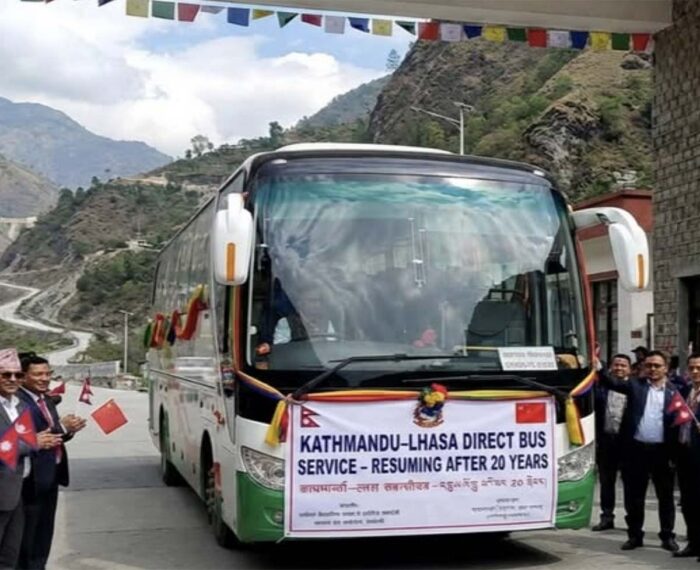
Travel Nepal social media post.
We welcome your feedback! Send any thoughts about ICT’s Tibet Roundup and ideas for future changes to [email protected].