
NEWSLETTERS
ICT’s Tibet Roundup — December 1-31, 2025
TABLE OF CONTENTS
State-controlled academic research group responds to Sixth Dalai Lama conference in Tawang
Political vetting over merit in recruitment announcement
Planting a “common value discourse system” with Nepal
Party Secretary pleased with ongoing ideological indoctrination in Tibetan monasteries
Party Secretary presides over summoned religious representatives meeting
China commemorates 30th anniversary of the installation of CCP selected 11th Panchen Lama
Policy propaganda in western Tibet mandates monastics to align with state doctrine
Buddhist Association congress mandates implementing Xi Jinping’s religious directives
Negative effects anticipated in Tibetan monasteries after Chinese Buddhist Association’s conference to accelerate a national campaign
CCP installed Panchen Lama pledges continued loyalty
Yebatan Hydropower Station put into production to generate electricity
POLITICS
In alignment with China’s drafting of the national 15th Five-Year Plan (2026-2030), the CCP committee of the Tibet Autonomous Region officially released the text of its guiding proposal adopted at the 10th TAR CCP Committee’s Ninth Plenary Session on November 26, 2025. The document titled “Proposal of the Tibet Autonomous Region Committee of the Communist Party of China on the formulation of the national economic and social development plan during the 15th Five-Year Plan period” released on December 13, 2025, focuses on “high-quality economic growth”, “ethnic unity”, “ecological safeguards” and “border security” aligned with China’s national blueprint.
The 15th Five-Year Plan proposal for Tibet emphasizes an intensified phase of state-led assimilation and strategic securitization under the banner of “socialist modernization”. The plan mandates the continuing “sinicization of Tibetan Buddhism” and the “forging of the sense of community of the Chinese nation,” policy frameworks that prioritize political loyalty and the “Five Identifications” over indigenous Tibetan identity. Economic development focuses on massive infrastructure—such as the Yaxia hydropower project and major railway expansions—designed to fortify Tibet as a “national security barrier” and “strategic resource reserve” for the Chinese state. Social policies enforce the “national common language” in education and utilize “ideological work” to “forge the soul” of the populace with party doctrine. The plan’s emphasis on “stability” and the “anti-separatist struggle” justifies pervasive surveillance, while border consolidation measures prioritize Beijing’s geopolitical dominance over the cultural autonomy of the Tibetan people.
China responded aggressively to the December 2025 international conference in Tawang (Arunachal Pradesh, India) on the life and legacy of the Sixth Dalai Lama, Tsangyang Gyatso (Cangyang Jiacuo), born in 1683 in the region known to Tibetans as Mon Tawang. Chinese state media framed India’s hosting of scholars, monks, and cultural events as “political provocation” and “cultural encroachment,” accusing New Delhi of blaspheming Tsangyang Gyatso’s sacred heritage to undermine China’s territorial claims over “southern Tibet” (Zangnan).
The Chinese media report exemplifies Beijing’s colonial strategy of weaponizing Tibetan culture to assert dominance. By establishing the Tibetan Tsangyang Gyatso Cultural Research Association in 2016 as a state-controlled entity, China co-opts the Sixth Dalai Lama into the “Chinese cultural system,” erasing his authentic Tibetan-Monyul roots. China is known to instrumentalize academic research and festivals to “defend national sovereignty”. The report’s vehement defense of historical “sovereignty” over Tawang while ignoring Tibetan agency and the McMahon Line, reveals insecurity over India’s symbolic assertion of cultural continuity with Tibet. Such propaganda not only distorts history but instrumentalizes Tibetan heritage to justify occupation, sinicization, and suppression of genuine Tibetan identity.
The Tibet Autonomous Region Development and Reform Commission’s 2026 announcement on December 4 for urgent recruitment of six permanent administrative positions outlines a rigorous process emphasizing graduates from top-tier Chinese universities, age limits (18–35), physical fitness for high-altitude conditions, and a mandatory 5-year service commitment in Tibet. Critically, eligibility demands unwavering political loyalty: applicants must “firmly establish correct views on state, history, ethnicity, culture, and religion,” oppose separatism, criticize the 14th Dalai Lama, safeguard national unity and uphold Xi Jinping’s core leadership and the “two establishments/two safeguards.”
By prioritizing political vetting over merit—requiring explicit denunciation of the Dalai Lama and alignment with sinicization—it targets educated professionals to implement CCP development agendas that exploit Tibetan resources, displace locals, and advance assimilation.
State media China Tibet Network reported the release of new “achievements” in Pan-Himalayan regional collaboration during the Fourth China-Nepal Media Summit in Kathmandu, Nepal, on December 18, 2025. It highlights the establishment of the Pan-Himalayan Regional Media Public Welfare Collaboration Alliance and the launch of a research report, Intelligent Communication Empowering Glacier Protection, which proposes media strategies for ecological protection, cultural dissemination, and cross-border cooperation under the Belt and Road Initiative.
The “Himalayan Regional Media Public Welfare Collaboration Alliance” represents a sophisticated expansion of state-led narrative control beyond Tibet’s borders. This initiative represents Beijing’s strategic soft-power expansion to legitimize its dominance over Himalayan geopolitics, including occupied Tibetan territories. By leveraging the “Potala Comprehensive Communication Platform,” Beijing seeks to institutionalize a “common popular culture” and “common value discourse system” to build an “emotional resonance matrix” that subordinates indigenous Himalayan voices to state-defined interests. This alliance, embedded within the Belt and Road Initiative, utilizes “intelligent communication” and a multilingual “toolkit” to penetrate regional media landscapes and bypass perceived “information cocoons”. Ultimately, this framework seeks to export Beijing’s model of ideological management, transforming media into a tool for geopolitical dominance and cross-border stability.

China developing a “common value discourse system” with Nepal.
RELIGION
State media Tibet Daily article reported on December 4, 2023, a commendation conference in Lhasa where Wang Junzheng, Party Secretary of the Tibet Autonomous Region, praised “advanced collectives and individuals” for adhering to the “four standards” in religious affairs. The event, attended by top officials including Yan Jinhai and others, highlighted deepening sinicization of Tibetan Buddhism, implementing Xi Jinping’s directives on religion and Tibet work, strengthening “two establishments” and “two safeguards,” promoting the “five identifications,” and guiding monks toward political reliability, moral exemplarity, and contributions to stability, development, ecology, and border defense. CCP’s “Three Consciousnesses” and “Four Standards” frameworks prioritize socialist loyalty over spiritual lineage, subordinating Tibetan Buddhism to the CCP’s “long-term security” and “national reunification” agenda. This conference exemplifies Beijing’s authoritarian grip on Tibetan religious life, transforming monasteries into instruments of state control and ideological indoctrination.
On December 29, 2025, the Tibet Autonomous Region held a symposium for religious representatives, presided over by Party Secretary Wang Junzheng. The event served as a platform to reinforce the Chinese Communist Party’s assertive religious policies, particularly the “Sinicization” of Tibetan Buddhism to subordinating religious doctrine and practice to socialist ideology and Party authority.
According to state media, the participants affirmed loyalty to the Party, vowed to combat “separatism,” and committed to instilling state-approved national and legal consciousness among believers. Such declarations underscore the ongoing intensification of ideological control over Tibetan religious institutions and instrumentalization of religion to legitimize political dominance and suppress dissent in Tibet.
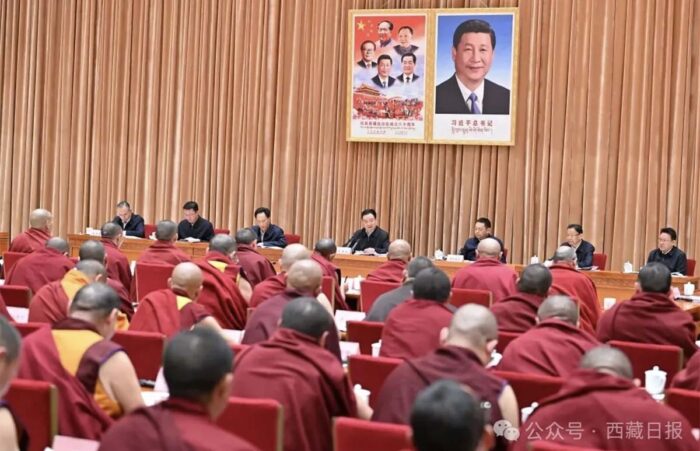
Party secretary giving instructions to the monastic community representatives.
Chinese state media reportage on the 30th anniversary of the installation of the CCP selected 11th Panchen Lama’s enthronement highlights China’s comprehensive framework for the institutional co-optation of Tibetan Buddhism. State media reports reveal a narrative where spiritual legitimacy is strictly derived from “State Council approval” and the “Golden Urn Lottery,” mechanisms used to assert “historical authority” over reincarnation while rejecting independent religious choice.
The state mandates that the Panchen Lama serve as a primary agent for the “sinicization of Tibetan Buddhism,” explicitly linking the continuation of the lineage to “political reliability” and “patriotism”. By enforcing the “forging of the sense of community of the Chinese nation,” the policy framework subordinates traditional Tibetan Buddhism to the “core values of socialism” and the “four standards” of state loyalty. The celebratory milestone underscores the CCP’s strategy of religious securitization, where the clergy’s primary role is to ensure “social stability” and “border peace” for the Chinese state.
Chinese state media report on government cadres “policy lectures” and “comfort visits” activities to monasteries in Tsamda (Zanda) County in western Ngari (Ali) prefecture reveal the systemic state penetration of Tibetan religious spaces under the guise of social welfare. According to the report, government cadres utilize “policy propaganda” to mandate that monks align their “thoughts and actions” with the CCP Central Committee’s decisions, effectively subordinating Buddhist practice to state doctrine.Such mandatory “policy” sessions indoctrinate monastics with state ideology, suppress genuine Tibetan Buddhist practices, and monitor for “separatist” sentiments—especially relevant as China asserts authority over the Dalai Lama’s future incarnation while the true Panchen Lama, Gedhun Choekyi Nyima, remains disappeared for over 30 years. These visits, masked as welfare, advance sinicization, erode monastic autonomy, and reinforce colonial surveillance in sensitive border areas near India. By framing religious life through the lens of “border stability” and the “fine tradition of patriotism,” the state forces Tibetan spiritual practitioners to serve as agents of the Party which it has failed so far.
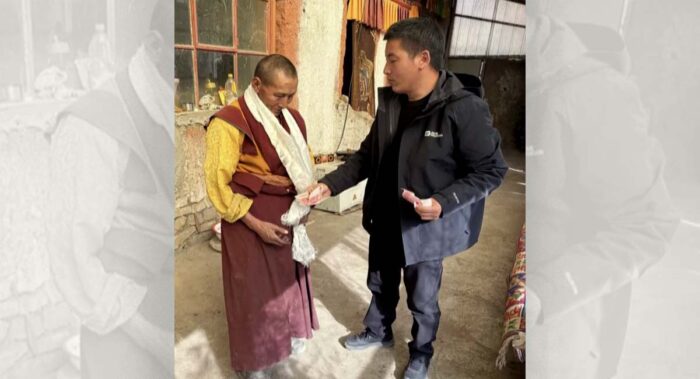
A cadre handing cash to a monastic as “social welfare”.
State media outlet, China Tibet Network with an affiliated report from Yushul (Yushu) United Front details the Ninth Congress of the Yushul Prefecture Buddhist Association, held December 19–20, 2025, in Qinghai’s Yushul Tibetan Autonomous Prefecture. Attended by 112 representatives, the event reviewed five years of work under the Eighth Council. The congress emphasized implementing Xi Jinping’s religious directives, deepening “three consciousnesses” education, advancing “four advancements” in religious sites, guiding “five identifications,” and strictly governing religion while serving ecological protection, rural revitalization, and social harmony. This congress exemplifies Beijing’s intensified grip on Tibetan Buddhism through state-orchestrated “associations” that function as surveillance and indoctrination mechanisms.
By mandating political education, “strict governance,” and contributions to state development goals, the congress prioritizes sinicization, forcing monastics to align with CCP ideology, loyalty to the Chinese state by “forging a sense of community of the Chinese nation”, and socialist adaptation over authentic Tibetan spiritual traditions.
The Chinese Buddhist Association convened to accelerate a national campaign focused on strengthening the rule of law and enforcing strict adherence to religious precepts, reported state media China Tibet Network on December 2. Led by the Association President Yanjue, the meeting reviewed initial progress, studied Xi Jinping’s speech on religious work from the 20th Central Political Bureau, and deployed intensified efforts to advance sinicization of Buddhism, strict governance, precept observance, frugality, and rectification of violations—explicitly calling to “seriously handle rule-breaking behaviors and clean up harmful elements”. The conference aims to align the faith with political directives and sinicization goals. With the association’s leadership mandating a rigorous process of self-examination and institutional reform, explicitly calling to “seriously handle rule-breaking behaviors and clean up harmful elements”, negative effects are anticipated in the monastic community in Tibet.
Tibet Autonomous Region Party Secretary Wang Junzheng inspected religious work in Shigatse City, including visits to Sakya Monastery and Ngor Monastery. According to state media on December 8, he engaged with monks on monastery management, “three consciousnesses” education (national, civic, and rule-of-law awareness), and innovative governance. Wang met the state-installed Panchen Lama (Gyaltsen Norbu, installed after the disappearance of the Dalai Lama-recognized Gedhun Choekyi Nyima), praising his alignment with Xi Jinping Thought, leadership in sinicization of Tibetan Buddhism, promotion of Marxist religious views, adherence to “four standards,” and contributions to national unity, anti-separatism, and Tibet’s “four major tasks” (stability, development, ecology, border defense). The Chinese Panchen Lama pledged continued loyalty and adaptation of Buddhism to socialism.
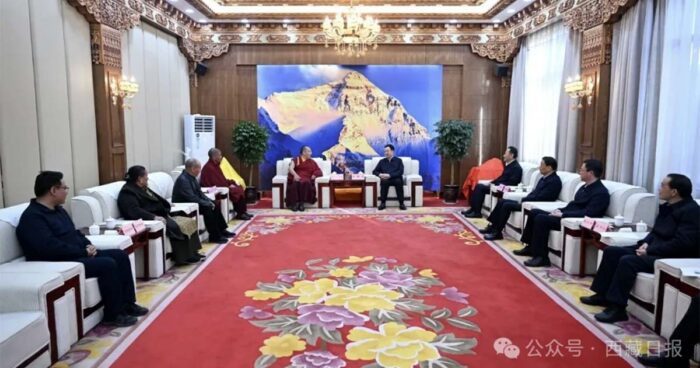
State media/propaganda handout of the party secretary and party installed Panchen Lama.
DEVELOPMENT
The Yebatan Hydropower Station, a landmark project of the “14th Five-Year Plan” situated on the Drichu (Jinsha) River near to Garje (Chinese: Gaiyu) Township in Palyul (Baiyu) County, Kardze (Ganzi) Tibetan Autonomous Prefecture (TAP) in Sichuan Province and Gonjo (Gongjue) County, Chamdo (Changdu) city in the TAR, has been officially put into production to generate electricity on December 27, reported Chinese state media. Yebatan station, seventh in a series of 13 dams on Drichu, adds new momentum to the construction of a new energy system and the construction of an energy powerhouse, according to Chinese state media. This 2.24 million kW project—the largest in the upper Sichuan-Tibet section—boasts a 217-meter ultra-high arch dam, touted for innovations in high-altitude construction and annual output of 10.2 billion kWh, to export power to Central China to optimize China’s energy structure.
While Chinese state media emphasizes “green” energy, the hydrostation represents a colonial-style economic model where the Tibetan plateau is treated as a “strategic resource reserve” to power China’s industrial core. Ultimately, Yebatan reinforces Beijing’s dominance by framing the exploitation of Tibetan water resources as essential for “national energy security,” prioritizing state-defined stability over Tibetan self-determination.
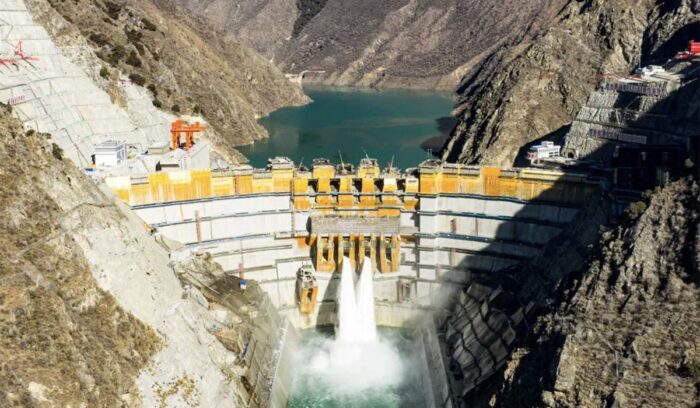
Yebatan Dam
We welcome your feedback! Send any thoughts about ICT’s Tibet Roundup and ideas for future changes to [email protected].