
NEWSLETTERS
ICT’s Tibet Roundup — March 1-31, 2026
TABLE OF CONTENTS
Weaponizing Tibetan cultural narratives to justify territorial claims over Monyul in India
Potala palace ticket discount disconnects Tibet
Forging a strong sense of community for the Chinese nation, central policy theme in Tibet
Leveraging international conflict to smear the Dalai Lama
Tibetan delegates to the “Two Sessions”
Sichuan CPPCC leader directs implementation of Xi Jinping’s speeches on religious work
United Front Work Department leader instructs using law for political responsibility of religious work
“Law enters monasteries” for Sinicization of Tibetan Buddhism in Tsome County
Chinese Panchen subordinates Tibetan Buddhism to the Party-State at the “Two Sessions”
POLITICS
Framing assimilationist policy as ethnic unity, Chinese state media highlights Puna village in Chewa township, Rinpung county, Shigatse City, Tibet Autonomous Region (TAR), PRC, as a model village of “Chinese family.” State media report spotlights three interethnic marriages (two Chinese-Tibetan and one Hui-Tibetan) out of nine interethnic marriages in the village of 234 people or 60 households.
In the official narrative promoted by China Tibet Network, Puna Village is framed as a harmonious model where Tibetan, Chinese, Hui, Yi and other ethnic groups live as one big “Chinese family.” Stories of inter-ethnic marriages, shared businesses and festive celebrations are showcased to illustrate the success of Beijing’s ethnic unity campaign.
However, beneath the imagery of “pomegranate flowers” and “unity willows” lies a clear state-driven agenda. The Chinese state media report reveals that the village branch of the Chinese Communist Party (CCP) has written “national unity” into village regulations and civil contracts; a top-down requirement rather than purely organic coexistence. China’s broader policy in Tibet has long emphasized the “Sinicization” of Tibetan Buddhism, heavy promotion of Chinese over Tibetan language, and promotion of inter-ethnic marriages. These measures, although presented as multiculturalism in “Chinese-nation,” are in effect a long-term strategy to dilute distinct Tibetan identity and tighten political control even in a small rural village.
Beijing is increasingly weaponizing cultural narratives to justify its territorial claims over the Monyul region; territory under India in the disputed eastern sector of Tibet’s frontier with India. By promoting Tibetan academics such as Dr. Dorje Phuntsok as part of its strategy to make use of Tibetan talent, the PRC attempts to reframe Tibetan history as a subset of Chinese statehood.
Chinese state media on March 30 strategically paraphrases Dr. Phuntsok to assert that the Sixth Dalai Lama, Tsangyang Gyatso’s legacy, is an “integral part of Chinese culture” and Monyul—the sixth Dalai Lama’s birthplace—is an “inseparable part” of the Chinese nation. To substantiate this, Chinese state media cites the “Water Sheep Register”, a census conducted by the Tibetan government in the 1940s, framing historical Tibetan governance as a “direct evidence of Monyul’s place within China’s local administrative system.”
While the Chinese state media warns that culture should not be a “tool in political disputes,” Dr. Phuntsok’s academic work is used explicitly to rebut “foreign forces” and bolster Chinese sovereignty claims. By tracing cultural routes from Monyul to Inner Mongolia, the Chinese state media via Dr. Phuntsok promotes a narrative of “national unity” intended to “tell China’s story well.” This transformation of academic research and historical Tibetan governance into a vehicle for geopolitical expansionism exploits the Sixth Dalai Lama’s legacy and influence as permanent Chinese jurisdiction while dismissing international scrutiny as “hype and sensationalism.”
The Potala Palace Administration’s recent announcement on March 29 of a 50 percent ticket discount for tourists shows Chinese authorities cultural and religious disconnect with Tibet. While the site is the historic residence of the Dalai Lamas of Tibet, the new ticket policy exclusively targets predominantly China’s national and international holidays like China’s National Day, Chinese Spring Festival, Qingming Festival, Labor Day, Dragon Boat Festival, Mid-Autumn Festival and New Year’s Day. Conspicuously absent from the list are any Tibetan religious or traditional festivals. By restricting the 50 percent discount to state-sanctioned and international holidays, the Chinese authorities dismiss the Potala palace’s Tibetan historical and cultural significance.
As China begins implementing its 15th Five-Year Plan in 2026, Yao Yu, a researcher at the Chinese Academy of Social Sciences’ Research Center for Xi Jinping Thought and director of the Research Center for Strengthening the Sense of Community of the Chinese Nation in the Tibet Autonomous Region, published an article on March 26 outlining Beijing’s renewed commitment to its Tibet policy.
According to Yao, CCP General Secretary Xi emphasized the need to focus on the four major tasks of stability, development, ecology and border strengthening to build a “united, prosperous, civilized, harmonious, and beautiful socialist modern new Tibet.” The document outlines five core principles guiding Beijing’s approach: governing Tibet according to law, revitalizing Tibet through high-quality development, pursuing long-term construction across generations, driving people’s hearts and minds and strengthening foundational work at the grassroots level. These elements are presented as an interconnected system designed to ensure both “stability” and “progress” in Tibet. A central theme is the forging of a “strong sense of community for the Chinese nation,” which Yao describes as the main guiding principle for all ethnic work in Tibet. As the new five-year planning period begins, the Chinese leadership is calling for deeper implementation of Xi’s Tibet strategy to achieve “long-term stability” and “development” in Tibet.
Chinese state media is actively leveraging international conflicts to launch a coordinated smear campaign against the 14th Dalai Lama, portraying him as a “hypocritical tool of the west.” By highlighting civilian casualties from US and Israeli airstrikes in Iran, the China Tibet Network on March 20 frames the Dalai Lama’s “silence” as a “cowardice in the face of hegemony” and a betrayal of his Nobel Peace Prize status.
Chinese narrative seeks to discredit the Dalai Lama through manipulative tactics by characterizing the global statesman as a “pawn” who must “obey the chess player” claiming his silence as being bought by “long-term funding” and a need for “political asylum.” To undermine the Dalai Lama’s religious and moral authority, Chinese narrative pushes to link him to controversial figures like Jeffrey Epstein alleging that he has “lost the bottom line and ethics” of Buddhist precepts in exchange for financial benefits although the Dalai Lama’s office in February “unequivocally confirm that His Holiness has never met Jeffrey Epstein or authorized any meeting or interaction with him by anyone on His Holiness’s behalf.”
China is using global events to mirror its own official campaign against the Dalai Lama’s alleged “hypocrisy,” attempting to shift his international image from a global religious leader to a “Western anti-China tool.”
In March 2026, the “Two Sessions” of China were held in Beijing. Based on the officially announced list of attendees to the 4th Session of the 14th National People’s Congress, the total number of Tibetan delegates participating in the 2026 National People’s Congress session from the TTAR, Qinghai, as well as from Tibetan areas in Sichuan, Gansu, and Yunnan is approximately 29.
The Tibet Autonomous Region has 25 delegates, with 15 being Tibetan.
Qinghai Province has 24 delegates, with 3 being Tibetan.
Gansu Province has 50 delegates, with 2 being Tibetan.
Sichuan Province has 143 delegates, with 7 being Tibetan.
Yunnan Province has 82 delegates, with 2 being Tibetan.
RELIGION
Song Li, Sichuan provincial Chinese People’s Political Consultative Conference (CPPCC) Vice Chairman led a delegation comprising of provincial bureau of economic and information bureau, provincial bureau of finance, CPPCC People’s Law Group Committee to Tsarong town, Sholung town, Shel Od township and other places including two Tibetan monasteries in Mili (Muli) Tibetan Autonomous County in Sichuan between March 23-24, according to the Mili County CPPCC portal.
During her supervision tour of the monasteries, she issued directives emphasizing implementing Xi Jinping’s important speeches on religious work, the “Sinicization of Tibetan Buddhism.” She instructed monks to “listen to, feel the favor of, and follow the Party” while strengthening national and rule-of-law consciousness. Li mandated standardized temple management, specifically targeting fire safety and financial regulation. In rural townships, she instructed officials to capitalize on cultural tourism by leveraging “traditional Chinese village” status to integrate agriculture and tourism.
Li Ganjie, Minister of the United Front Work Department of the CCP, concluded a tour in Yunnan between March 18-21 aimed at tightening state control over religious and ethnic affairs through the “Sinicization of religion.” Although the sites he visited are not Tibetan inhabited areas, his instructions to the Buddhist religious sites reflect the broader Chinese policy on religion.
During his inspection of Buddhist colleges and religious sites in Xishuangbanna and Kunming, Li emphasized governing religious affairs according to the rule of law to “deal with the chaos” in the religious field and ensure the masses “consciously resist illegal activities.”
Li focused on “forging the sense of community of the Chinese nation.” His mission to supervise “national unity and progress” instructed officials to use the law to promote “extensive exchanges and integration” and to “resolutely shoulder the political responsibility of religious work.”
Tsomed (Cuomei) County United Front’s the “Law Enters Monasteries” campaign in Tsome County, Lhoka (Shannan) prefecture, TAR, launched on March 16 demonstrates a more intrusive form of control to subordinate Tibetan religious life to the Chinese state. By deploying a massive team, “including the County People’s Court, the Procuratorate, the Bureau of Justice, the Traffic Police Brigade of the Public Security Bureau, the Cyber Security Brigade, the County Cyberspace Administration, the Civil Affairs Bureau, the Fire and Rescue Brigade, and other relevant units” authorities are forcing the “Sinicization of Tibetan Buddhism” into monastic life.
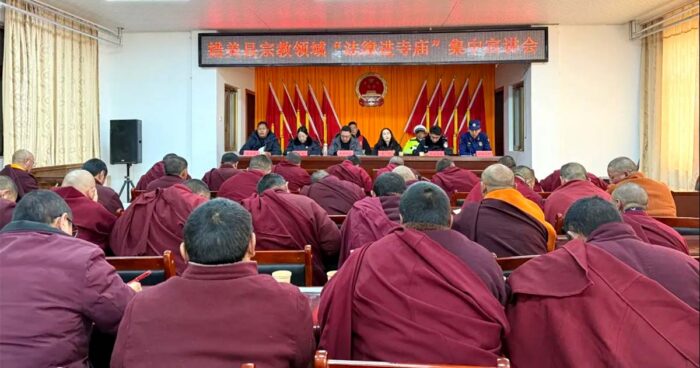
During the campaign, the party-state officials explicitly ordered monks to “steadfastly listen to, appreciate, and follow the Party” while acting as “models of patriotism.” This directive mandates that the monastic community prioritize “national consciousness” over religious tradition, effectively attempting to push monks as agents of “social governance” and “rural revitalization.”
The Chinese state utilizes a rigorous legal framework to restrict religious activities and ensure monks “consciously resist” foreign influence. Control extends even to the digital realm, where monks must adhere to the “Twenty Prohibitions” for online communication and strict “Internet Religious Information” regulations. By embedding the rule of law into “daily practice and life,” the state is transforming monasteries into highly regulated administrative units where religious autonomy is being swept for state-sanctioned “harmony” and “stability”.
On March 8, the 14th National Committee of the Chinese People’s Political Consultative Conference (CPPCC) held its third plenary session, where the CCP-appointed Panchen Lama, Gyaltsen Norbu, holding the official designation of Vice Chairman of the National Committee of the Chinese People’s Political Consultative Conference, Vice President of the China Buddhist Association and President of the Tibet Branch of the China Buddhist Association, delivered a speech. Norbu’s speech topic was set as “Vigorously Promote Social Harmony Between Religion and Socialism and Make Contributions to the Great Rejuvenation of the Chinese Nation.” Norbu delivered his speech on five points, all of which were praises and alignments with the thoughts of Xi Jinping and the Central Committee of the CCP as expected. He called for the total “adaptation of religion to socialist society,” framing it as “the only way for healthy inheritance,” demanding that religious doctrines be systematically rewritten to “conform to the requirements of contemporary China” and “core socialist values.” Monks are tasked as “active builders of Chinese-style modernization” who must prioritize the “national common language” and Chinese history over traditional religious education and “unify their spiritual practice with dedication” to the Party’s goals.
We welcome your feedback! Send any thoughts about ICT’s Tibet Roundup and ideas for future changes to [email protected].