


On August 26, 2026, a catastrophic chain of glacier collapse and debris flows roared down from the high Himalayas, unleashing a wall of rock, ice, mud, and water that devastated valleys, villages, and infrastructure across western Tibet and northern Nepal while simultaneously obliterating the Kyidong (སྐྱིད་གྲོང་།) Port at the international border between Nepal and Tibet. The disaster left hundreds dead or missing in Nepal and Tibet, and reduced China’s primary trading port to South Asia to ruins in minutes.
For decades, the Chinese slogan rending shengtian 人定胜天 (“human determination can conquer nature”) had justified large-scale engineering and development projects in Tibet and China that sought to overcome difficult terrain and assert mastery over the environment. Yet, the recent flooding in Tibet and Nepal demonstrated the limits and at times catastrophic failures of this development model. While the world debates whether the causal factor was climate change or a geological event, this disaster has made clear that nature can challenge and upend even the most ambitious and well-resourced development drives.
In contrast to Beijing’s model, Tibetan communities across the plateau for centuries have recognized the importance of environmental stewardship and cultivating a symbiotic relationship with Tibet’s geography and resources. That resilient and sustainable model was overturned with China’s occupation of Tibet. With the occupation came the imposition of Beijing’s ideology that humans can control nature, and what closely followed was a relentless infrastructure push across the Tibetan highlands which in many respects destabilized the Tibetan plateau’s sensitive ecosystem and raised the probability of more frequent and severe natural disasters.
The Nepal-Tibet floods are a tragic reminder of the Himalaya’s immense power to release the elements of nature and the importance of harnessing and working with these elements in a way that advances environmental resilience and sustainability. In contrast to Beijing’s top-down approach, centuries of Tibetan stewardship at the grassroots level offer an alternative and affirmative model of environmental risk management that China must urgently heed.
China’s 人定胜天 model increases environmental risks in Tibet and the broader region
Rooted in the Maoist slogan “man must conquer nature” (人定胜天), this worldview treats the Tibetan Plateau not as a sensitive high-altitude ecosystem or sacred landscape, but as a frontier to be subdued, engineered, and integrated into the modern Chinese state. Since the 1950s, and accelerating dramatically after 2000, Beijing has poured resources into transformative infrastructure projects. The Golmud-Lhasa Railway, completed in 2006 and later extended to Shigatse, pierced the plateau’s permafrost and high passes through 36 tunnels (7 between Golmud-Lhasa and 29 on the Lhasa-Shigatse stretch). Highways now crisscross the region, while hundreds of hydropower dams harness the headwaters of Asia’s major rivers. Airports, high-voltage power lines, mining facilities, and urban sprawl have proliferated. These projects are framed officially as poverty alleviation, modernization, national security and ecology protection, yet in reality they serve to tighten political control, facilitate resource extraction, and alter traditional Tibetan ways of life. Additionally, they create significant environmental risks for downstream countries.
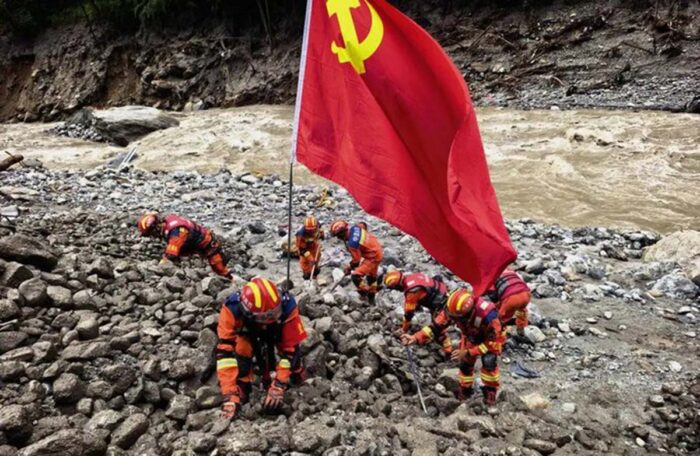
Chinese state media propaganda handout featuring the CCP flag as the focal point of post-disaster road recovery efforts.
The environmental costs of Beijing’s infrastructure building are significant. Construction disrupts sensitive alpine ecosystems, accelerates permafrost thaw, and increases the risk of landslides, glacier collapse and glacial lake outburst floods. Culturally, the scale of change has marginalized Tibetan wisdom that long emphasized harmony with nature. Unlike the traditional Tibetan knowledge systems, the Chinese party-state operates on the deep conviction that technology and state power can and should dominate nature. In Tibet, this ideology continues to shape one of the most intensive infrastructure campaigns on earth, leaving lasting marks on both the landscape and the Tibetans who inhabit it.
The reach of China’s 人定胜天 ethos extends beyond its borders and exacerbates risks to the larger Himalayan ecosystem. The immediate vicinity of Langtang Lirung in Nepal is a prime example, having become an active hydropower development zone that contracts Chinese companies for their technical expertise. This area features multiple hydropower projects and extensive tunneling throughout the Rasuwa–Bhotekoshi–Trishuli corridor. The multi-billion-dollar China–Nepal Railway (or Kyidong–Kathmandu Railway), proposed under China’s Belt and Road Initiative, is designed to slice through the Himalayan mountain ranges. According to the Nepali Times, citing a Chinese prefeasibility study, the route will run beneath Nepal’s Langtang National Park through a vast system of tunnels to connect Kyidong and Kathmandu. In the wake of the Nepal-Tibet flood, experts should raise questions as to the risks presented by such an ambitious and environmentally intrusive project, yet the dictates of Beijing’s development model may unfortunately override any concerns.
While the world is still processing the shock of the recent Nepal-Tibet flood, China announced on August 31 that it has officially commenced operations at the Shuangjiangkou Hydropower Station. Touted as the world’s tallest dam, the megaproject is built on the Gyalmo Ngulchu (Dadu) River in Barkham, Sichuan. The systemic risks of this infrastructure chain were dramatically highlighted on November 11, 2025, when the collapse of the 758-meter cantilever Red Flag (Hongqi) Bridge made headlines worldwide. The collapse was caused by landslides triggered by water impoundment at the Shuangjiangkou reservoir—the fifth in a massive cascade of 28 dams planned along the Gyalmo Ngulchu.
Early Chinese social media clip showing Kyidong Tibetans on higher ground watching in disbelief as the flood rises at the source.
Tibetan stewardship offers an urgent and reliable alternative
Traditionally, Tibetan stewardship of the plateau operated as a form of “living infrastructure”, a highly sophisticated, decentralized system of resource governance that managed the landscape without the need for disruptive physical barriers. For millennia, pastoral nomads and monastic communities maintained the delicate ecological balance of the plateau through fluid, mobile systems of rotational grazing rather than permanent divisions. By moving herds of yaks and sheep seasonally, they prevented soil compaction, aerated the earth, and allowed grasslands to naturally regenerate. Water sources and forests were protected through sacred designations as neri (sacred mountain), which functioned as culturally enforced conservation zones. This harmonious approach protected the headwaters of Asia’s major rivers and sustained the rangelands without the deployment of invasive concrete engineering, proving that ecological stability relies on working with natural geography rather than attempting to cage it.
In stark contrast, the Chinese state-led approach treats the plateau as a canvas for rapid infrastructure projects that physically fracture this delicate ecosystem. Under the guise of modernization and “ecological migration,” Beijing has sought to conquer the landscape through mega-dams, extensive grid fencing, tunneling through mountains for roads and railways, and building static concrete border defense settlements dubbed as “Xiaokang villages”. By forcing nomadic herders off their traditional pasturelands and confining them to fixed housing colonies, the state has replaced a highly successful system of mobile land management with rigid physical and economic boundaries. The results have been ecologically disastrous: relocation of hundreds of thousands of pastoralists and restricting livestock movement with wire fencing has caused localized soil erosion and desertification, while massive engineering projects like the Shuangjiangkou Hydropower Station and the extensive tunneling for Himalayan railways disrupt hydrological flows and trigger devastating landslides, as exemplified by the dramatic collapse of the Red Flag Bridge. This heavy-handed reliance on construction over ecological wisdom demonstrates how top-down infrastructure projects can quickly destabilize a globally crucial environment.
Amid global debate over the causality of the flood, China’s declaration that the disaster was induced by global warming along with its commitment to “working with Nepal and the rest of the international community to strengthen cooperation and prevent and mitigate the negative impact of climate change” may have come as a surprise to many. However, this does not imply Beijing will halt the construction of dams and infrastructure on the Tibetan Plateau. Instead, it likely signals a shift toward framing these projects as necessary measures to combat climate change. Indeed, this climate-mitigation narrative serves as the raison d’être for building cascading dams on the eastern edge of the Tibetan plateau, ostensibly to protect mainland Chinese citizens living downstream, even while placing Tibetan communities on higher ground at risk. Looking ahead, even the proposed Medog Dam on the Yarlung Tsangpo (Brahmaputra) River, which is slated to be the world’s largest, may be framed as a climate-resilience project under Beijing’s “community with a shared future for mankind” vision, supposedly designed to protect downstream countries.
The alternative to China’s heavy-handed 人定胜天 model – Tibetan stewardship of the land at the grassroots level – has demonstrated success over centuries in increasing sustainability and environmental resilience, while still being able to harness the benefits of Tibet’s ecosystem and resources. The devastating flooding that occurred last week is a tragic reminder that the environmental risks are only growing in the Himalayan region. It also demonstrates the importance of China recalibrating its development approach across the plateau and throughout the region. Beijing only needs to look to the proven Tibetan model to reduce environmental risks and ensure the sustainable use of Tibet’s resources. The international community, and particularly countries in the region, must call on China to change their approach, increase transparency, and have the humility to engage with Tibetan communities and communities across the Himalayas who have the know-how to manage the incredible power of the Himalayan terrain. As the August 26 event demonstrate, this call has never been more urgent.