

China’s Second Tibet International Communication Conference, convened in Lhasa on June 16, 2026, represents a significant escalation in the Chinese state’s efforts to institutionalize and technologize its official narrative on Tibet, as provisioned in the new Ethnic Unity and Progress Law. The conference outlined an integrated system that combines the use of emotional storytelling, artificial intelligence, historical revisionism, and institutional coordination to “proactively” shape the global narrative on Tibet, operationalizing several provisions of the new law.
While framed under the benign theme of “Understanding and Support, Empathy and Connection,” the conference advanced a sophisticated framework, designed to stage a highly managed, “proactive” propaganda system that seeks not merely to defend official positions but to dominate the global conversation and hide China’s human rights abuses in Tibet.
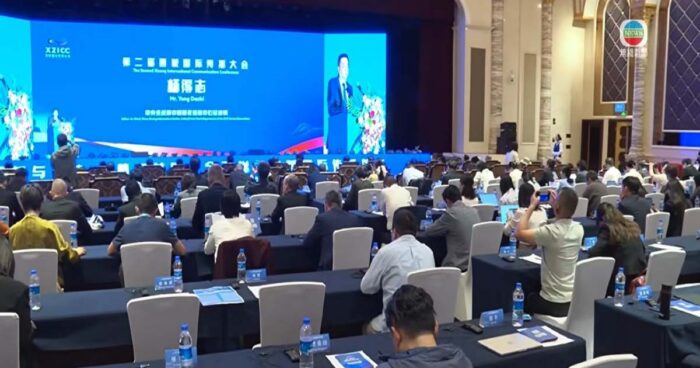
The second Tibet International Communication Conference in session at Lhasa on June 16, 2026.
Empathy as a tool of propaganda
A central focus of the conference was the move toward “narrative innovation,” specifically through the use of “cross-cultural empathy.”
Li Yafang, president of the Academy of Contemporary China and World Studies, explicitly argued that effective communication requires illustrating developments through “ordinary people’s experiences”. By focusing on curated “authentic details” and individual anecdotes of “solidarity,” the Chinese state seeks to create an emotionally persuasive alternative reality of Tibet that resonates with the international community while bypassing scrutiny.
This approach is legally provisioned under Article 19 of the Ethnic Unity and Progress Law (EUPL), which stipulates that “News media such as newspapers, radio, and television, as well as publishing units and online providers, shall carry out work such as publicity reporting and presentations of the accomplishments of forging a strong sense of the community of the Chinese people and advancing the establishment of the community of the Chinese people”.
This approach aligns with Party Secretary Wang Junzheng’s directive, issued in adherence with Article 2 of the EUPL, that “the Tibet International Communication Conference is an important measure to implement Xi Jinping’s thought on culture, his important instructions on Tibet-related work, and the Party’s strategy for governing Tibet in the new era.” Wang’s instruction reveals that “empathy” is intended not as a means of achieving mutual understanding, but as a propaganda tool to create favorable international sentiment for the Chinese state’s governance strategy.
Proactive disinformation
Yang Dezhi, editor-in-chief of China’s Tibet magazine, stated that the responsibility of the current era is to “break through false narratives” by grounding communication in “historical and legal reasoning”. This strategy aims to move beyond “passive responses” to external criticism by proactively using state manufactured “historical facts and evidence” to shape international public opinion around the official CCP narrative.
For instance, in mid-May, Sonam Nyima, the Minister of the United Front Work Department of the Tibet Autonomous Region, during an inspection tour of four Tibetan counties in Ngari (Ali) near the India-Tibet boundary, called for archaeological research to be used to promote a history of Tibet’s integration with the “motherland.”
Similarly, Li Ganjie, the head of the CCP Central Committee’s United Front Work Department, during the 40th anniversary of the China Tibetology Research Center held in Beijing on June 2, instructed the state-controlled “Tibetologists” to produce research that would “prove” the state’s official narrative that “Tibet is an integral part of China” and that Tibetan “folk culture” is part of Chinese culture.
To provide a veneer of international objectivity, the recent Tibet International Communication conference highlighted “foreign experts” who validated the state’s narrative. For instance, Chinese state media Global Times carried visuals of Indian Professor Manukonda Rabindranath stating that his observations of Tibet were “completely different” from Western media reports. Similarly, Nepali Professor Kundan Aryal said that “Xizang Province [sic] is not less than any modern city of the world,” while Sri Lankan academic Gayan Madushanka said “some western countries make narratives to push down Asian countries.”
Such testimonials are integral to Beijing’s strategy of using international voices to lend credibility to a system that is, at its core, a top-down implementation of national diplomatic goals.
Leveraging Chinese techno-feudalism
Perhaps the most significant aspect of the conference was its focus on “technological empowerment,” which is provided for in Article 31 of the EUPL.
Participants explored how emerging technologies can be leveraged to improve effectiveness of communication in an “algorithm-driven era”. This includes the use of “AI and new means” to reshape the communication landscape and establish “scientific mechanisms” for evaluating how well state messages are being received.
This focus on technology suggests a shift toward targeted audience segmentation which utilizes foreign content creators. Officials called for “regionalized, segmented, and precise expression” to meet the specific needs of diverse overseas audiences.
By utilizing “new media technologies” and “international content co-creation,” most likely with foreign propagandist hires like Daniel Dumbrill, Andy Boreham, Jason Smith, the state aims to saturate global digital spaces with its preferred narratives, effectively using algorithms to amplify state-approved voices while marginalizing authentic Tibetan voices.
Institutional consolidation
The conference also served to formalize a network of “coordinated participation” and consolidation of the propaganda platforms spreading misinformation on Tibet.
The signing of the “Framework Agreement on Coordinated Cooperation for International Communication on Xizang” by ten organizations which includes the China International Communications Group (CICG), as provisioned in Article 17 of the EUPL, signals a move toward a centralized propaganda industry.
This institutional consolidation is bolstered by the appointment of seven “Think Tank” experts and the formal unveiling of the “China Today Xizang Salon,” creating a self-reinforcing echo chamber of compliant academics and regime-friendly media operatives. The “Salon,” presented as a “dedicated platform for regular international cultural exchanges,” has already been launched in nine cities in China and abroad, including in Cairo, Egypt and Madrid, Spain.
With this formal unveiling of the “China Today Xizang Salon” in Lhasa, a proliferation of similar “salons” is expected in the coming years.
Conclusion
The Second Tibet International Communication Conference serves as a blueprint for a new era of narrative management. By combining “human-centric” storytelling with aggressive historical revisionism and leveraging Chinese techno-feudalism, the Chinese state is attempting to construct an emotionally persuasive “Xizang story” in line with President Xi Jinping’s directive to “tell a good Chinese story.”
However, the party-state’s efforts to shape international public opinion on Tibet has thus far fallen short of their objectives. Acknowledging this, Ye Hailin of the Chinese Academy of Social Sciences lamented in his keynote speech that, “International communication efforts regarding Xizang have faced a challenge. Even with plenty of facts and figures to share, we still find it hard to shake deep-rooted stereotypes and show the world the real picture.”
The fact remains that ultimately, no amount of financial investment, narrative engineering, or propaganda sophistication has succeeded in obscuring the reality and truth of Tibet. In an age of global connectivity, facts prove far more resilient than lies.
Background
Timeline of the Development of China’s organized external propaganda system on Tibet:
- May 2021: Collective study session of the Political Bureau of the CCP Central Committee on strengthening international communication capacity.
- Fall 2021: Launch of a campaign to replace the internationally recognized name “Tibet” with the Sinicized term “Xizang” in external propaganda and diplomacy.
- September 2, 2024: Inauguration of the Tibet International Communication Center in Lhasa during a roundtable meeting on “Building a more effective international communication system for Tibet,” jointly organized by the Propaganda Department of the Tibet Autonomous Region Party Committee and the China Foreign Languages Publishing Administration.
- October 29, 2025: First Tibet International Communication Conference, themed “Building a hub for global dialogue,” held in Nyingtri, Tibet Autonomous Region.
- June 16, 2026: Second Tibet International Communication Conference, themed “Understanding and support, empathy and connection,” held in Lhasa, Tibet Autonomous Region.