


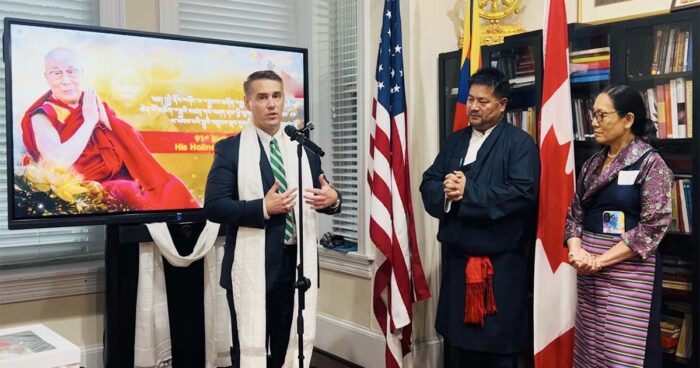
US Special Coordinator for Tibetan Issues, Riley Barnes, pays personal tribute to His Holiness the Dalai Lama at 91st birthday celebrations in Office of Tibet, Washington, DC on Thursday July 9.
The US Special Coordinator for Tibetan Issues, Riley Barnes, honored His Holiness the Dalai Lama with a personal tribute at a celebration marking the Tibetan spiritual leader’s 91st birthday in Washington, DC, on Thursday, July 9. The event was organized by the Office of Tibet in Washington, DC, with support from the International Campaign for Tibet.
In his address, Barnes reflected on how the compassion, generosity and hospitality he witnessed in the Dalai Lama have been consistently emulated by Tibetan communities around the world and have left a lasting impression on his own family.
“It’s an honor to be here celebrating (His Holiness), his life. I hope and pray that we have many more years to have gatherings like this. So, Trunkhar Tashi Delek to His Holiness, and I look forward to celebrating with all of you,” said Barnes, who serves as the Assistant Secretary of State for Democracy, Human Rights, and Labor.
The celebrations, held at the Office of Tibet in Washington DC, brought together members of the Tibetan community, Tibet supporters, diplomats, and representatives from government and civil society organizations to honor the Dalai Lama’s lifelong contributions to peace, compassion, secular ethics, and human dignity.
Speakers included Barnes, Dr. Namgyal Choedup, Representative of His Holiness the Dalai Lama for North America, Tencho Gyatso, President of the International Campaign for Tibet, and Ryan Fioresi, Executive Director of the International Campaign for Tibet.
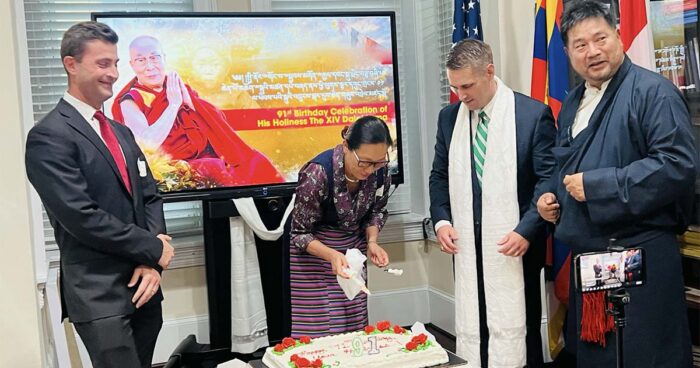
US Special Coordinator for Tibetan Issues, Riley Barnes, joins celebrations for the Dalai Lama’s 91st birthday, organized by Office of Tibet, Washington, DC with support from the International Campaign for Tibet.
Honoring Lobga Rangzen’s memory
In his welcome address, ICT Executive Director Ryan Fioresi invited attendees to observe a moment of silence to honor the memory of Tibetan activist Lobsang Palden, widely known as Lobga Rangzen, who died after he self-immolated outside the UN in New York on July 2, a day after China’s new Ethnic Unity and Progress Law went into effect.
“While tonight presents an important opportunity to celebrate His Holiness and reaffirm his inspirational vision of kindness, compassion, and non-violence, we also come together at a solemn moment for the Tibetan community, here in the United States and worldwide,” Fioresi said.
Expressing solidarity with Lobga Rangzen’s family, friends, and the broader Tibetan community, Fioresi added, “Let this evening also be an opportunity to commemorate Lobga’s legacy by carrying forward his lifelong commitment and devotion to seeking freedom, justice, and dignity for the Tibetan people.”
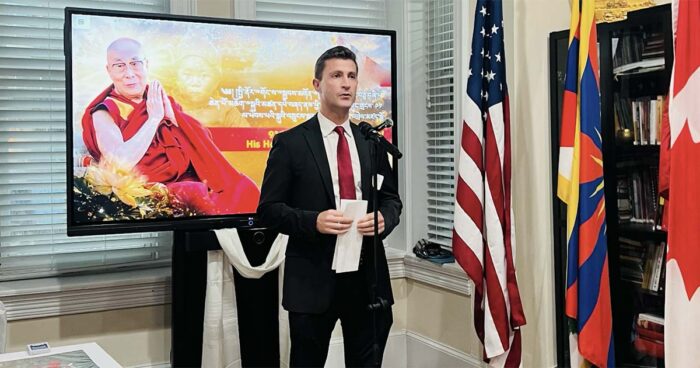
Ryan Fioresi, Executive Director of the International Campaign for Tibet, invites participants to observe a moment of silence to honor the memory of Tibetan activist Lobga Rangzen.
The Dalai Lama’s enduring message
Dr. Namgyal Choedup, Representative of His Holiness the Dalai Lama to North America, said the significance of the celebration extends beyond honoring the Dalai Lama.
“The celebration matters not because it is about His Holiness the Dalai Lama but it is about sharing with the rest of the world his messages of universal values and compassion, something that is direly needed in our world today, in which we continue to witness never-ending man-made human conflicts in addition to natural calamities and the resultant humanitarian crisis.”
He also noted that, as part of the Central Tibetan Administration’s Year of Compassion initiative, the US Congress and many states and cities across the United States have proclaimed the Dalai Lama’s birthday as a ‘Day of Compassion,’ underscoring the universal relevance of his message of compassion, non-violence, interfaith harmony, and human values.
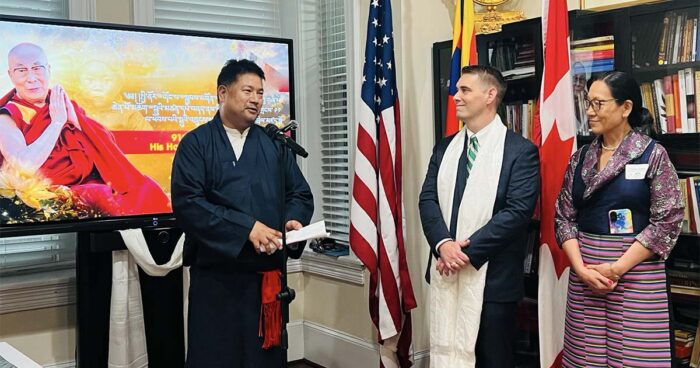
Dr. Namgyal Choedup, Representative of His Holiness the Dalai Lama to North America, addresses the gathering at the Dalai Lama’s 91st birthday celebrations in Washington, DC.
Addressing the self-immolation of Tibetan activist Lobga Rangzen, Choedup echoed the appeal made by Sikyong Penpa Tsering in his July 3 statement, where the democratically elected leader of the Tibetan government in exile urged Tibetans to cherish and preserve their precious lives to continue the long-term struggle of the Tibetan people.
At the recent public memorial service for Lobga Rangzen in New York, Choedup reminded the Tibetan community that “…for every self-immolator who perishes calling for the long life of the Dalai Lama and freedom to Tibet, there are countless other Tibetans inside Tibet who are even more determined to choose a life-affirming path for remaking the Tibetan world.” He also stressed that Tibetans inside Tibet, guided by His Holiness’ vision, are preparing themselves “to become the best stewards of their homeland,” while following His Holiness’ example of dignity and moral resilience.
Reflecting on the Dalai Lama’s enduring global impact, Choedup said, “The Tibetan people lost their country in 1959, but the world gained the Dalai Lama.”
“Under His Holiness’s compassionate and visionary leadership, the Tibetan people have not only survived, but they also continue to preserve their identity, their language, their religion, and most importantly the moral clarity of their struggle and resistance. The Tibetan leadership urges the international community not to view Tibetans as helpless victims but as partners and allies in bringing about positive change and lasting peace,” Choedup said.
Drawing strength from His teachings
Thanking attendees for their continued support of Tibet and His Holiness, ICT President Gyatso said, “Your presence here is a powerful expression of friendship, solidarity, and support—not only for His Holiness, but also for the Tibetan people and for the universal values that His Holiness has championed throughout his life and continues to do so still.”
“For more than seven decades, His Holiness has shown the world that compassion is a source of strength, that dialogue is the path to lasting peace, and that true leadership is rooted in humility, wisdom, and service to others. His moral example continues to inspire millions of people across cultures, faiths, and nations,” she added.
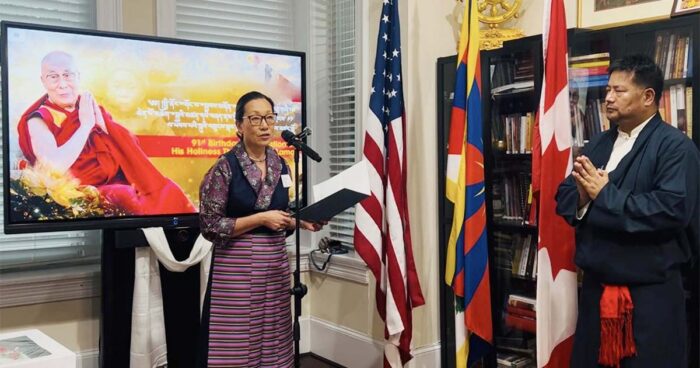
Tencho Gyatso, President of the International Campaign for Tibet, addresses the gathering at the Dalai Lama’s 91st birthday celebrations in Washington, DC.
Gyatso noted that this year’s celebration was marked by both joy and sorrow, reflecting on the recent passing of Lobga Rangzen, which “…has left a profound mark on Tibetans around the world and serves as a painful reminder of the suffering and despair that continue to be endured by so many Tibetans.”
“At moments like these, we draw strength from the teachings of His Holiness. He has always urged us not to respond to suffering with hatred or hopelessness, but with compassion, courage, and an unwavering commitment to truth and nonviolence. As we mourn, we also renew our determination to pursue the peaceful path that His Holiness has dedicated his life to advancing,” she added.
Personal tribute to the Dalai Lama
Reflecting on those same values of compassion, Barnes recalled his own encounters with the Dalai Lama and the Tibetan community, including his first meeting with the Dalai Lama in 2019 while serving in the Office of International Religious Freedom alongside then-Ambassador-at-Large Sam Brownback.
During that visit to Dharamsala, he said he witnessed firsthand the Tibetan spiritual leader’s compassion, generosity, humor and hospitality. Returning to Dharamsala for the Dalai Lama’s 90th birthday celebrations last year, Barnes said he once again experienced the warmth of the Tibetan community, receiving a traditional khata, the white ceremonial scarf that symbolizes honor and welcome.
Earlier this year, US Secretary of State Marco Rubio appointed Barnes as the US Special Coordinator for Tibetan Issues, succeeding former Under Secretary of State Uzra Zeya. He is the eighth official to hold the position, since it was established under the Tibetan Policy Act of 2002.
The Office of the US Special Coordinator for Tibetan Issues is responsible for coordinating US government policies, programs, and projects related to Tibet, including efforts to promote dialogue between Chinese authorities and Tibetan representatives, safeguard Tibet’s unique cultural and religious heritage, counter China’s disinformation campaign on Tibet, and support the human rights of the Tibetan people.
A US State Department spokesperson on Wednesday, July 8 reiterated the US government’s position on Tibet in a response to a media query regarding the recent passing of Lobga Rangzen. In its response, the spokesperson told Reuters that the US remains committed to “…supporting the unalienable human rights and aspirations of Tibetans to celebrate and preserve their unique culture, language, and religion without fear of interference.”
“The United States will continue to call on China to return to direct dialogue, without pre-conditions, with the Dalai Lama and his representatives, and with the democratically elected Tibetan leaders, to resolve differences and achieve meaningful autonomy for Tibetans,” the spokesperson added.