


On July 1, 2026, the International Campaign for Tibet (ICT) offices in Washington, D.C., and Brussels joined Tibetan communities in demonstrations against China’s so-called Ethnic Unity and Progress Law (EUPL), which came into effect on Wednesday.
ICT President Tencho Gyatso described the law as a dangerous escalation in China’s campaign of forced assimilation and a tool of identity erasure, and additional statements against the law came from lawmakers around the world.
View this post on Instagram
Global reaction
Demonstrations were held outside the Chinese Embassy in Washington, D.C., and in cities and towns across the United States, India and Europe, where Tibetans were joined by Uyghurs, Hong Kongers, Chinese dissidents and other non-Chinese communities in calling for the law’s repeal. At the protests held at the European Parliament in Brussels, several Members of the European Parliament condemned the law and voiced support for the Tibetan people.
In the U.S., U.S. Senators Jeanne Shaheen (D-NH) and Jim Risch (R-ID), Ranking Member and Chairman of the Senate Foreign Relations Committee (SFRC), along with a bipartisan group of lawmakers, issued a joint statement on July 1 condemning the EUPL and warning that it further institutionalizes the Chinese Communist Party’s (CCP) campaign to erase the religious, cultural, and linguistic identities of ethnic minority groups located both inside and outside China.
“In particular, we are deeply concerned by language in the law that demands ideological compliance with the CCP, mandating that even people outside China deemed to be undermining ‘ethnic unity and progress’ by the Chinese government can be held legally responsible in China,” they wrote in the joint statement.
“This sweeping legislation gives Beijing near limitless authority to prosecute those who would speak out against Beijing’s oppression and only continues its development of a legal framework to legitimize its transnational repression,” they added.
The joint statement was also signed by Senators John Curtis, Jeff Merkley, Jacky Rosen, Ted Budd, Tim Kaine, Tammy Duckworth and Lindsey Graham, and House Select Committee Chairman John Moolenaar (R-MI), Ranking Member Ro Khanna (D-CA) and Representative Young Kim (R-CA) also joined the statement.
“We will continue to push back against the CCP’s efforts to undermine the sovereignty of other countries and support the internationally recognized human rights of Tibetans, Uyghurs and other ethnic and minority groups. All people deserve to have a say in their own future, preserve their culture and freely express their religious beliefs,” they added.
Calls for global action
On June 20, 2026, Sikyong Penpa Tsering, the democratically elected leader of the Central Tibetan Administration in exile, urged global governments and international organizations to oppose the law and press for its repeal, warning that it will further accelerate forced assimilation of Tibetans while expanding extraterritorial repression.
In a June 28, 2026 op-ed in the Wall Street Journal, ICT Chairman Richard Gere urged U.S. policymakers recognize the Ethnic Unity and Progress Law for what it is: “a declaration that Beijing’s ideological jurisdiction extends beyond its borders,” and warned that the oppression in Tibet is at the fulcrum of the larger struggle between liberty and autocracy.
Chairman Gere also keynoted a Baltic parliamentary conference in Riga on June 3, where participants described the law as a serious turning point codifying the forced assimilation of Tibetans, Uyghurs, and Mongolians and urged coordinated EU action.
At a hearing last month before Canada’s House of Commons human-rights subcommittee (SDIR), ICT President Gyatso raised concerns about Article 15 of the law which prioritizes Chinese over Tibetan and warned it reduces Tibetan language and identity to “a subordinate status.”
At a similar hearing on the law at the European Parliament in May 2026, Gyatso also warned of the risk of arrest, arbitrary detention, or ill-treatment of Tibetans living in exile worldwide, as Article 63 enables the Chinese authorities to target people outside China for broadly defined acts such as “undermining ethnic unity.”
Tibetans protest new law
Participating at the demonstrations staged outside the Chinese embassy in Washington D.C. on July 1, D.C., ICT President Tencho Gyatso said, “These policies are not new. Tibetans have been experiencing them for decades through restrictions on our education, religion, and cultural expression. But what makes today so alarming is that this law gives those policies a formal legal framework and justifies the actions of the CCP. It attempts to legitimize what Tibetans have long known: a systematic effort to silence identities that do not fit the CCP’s vision.”
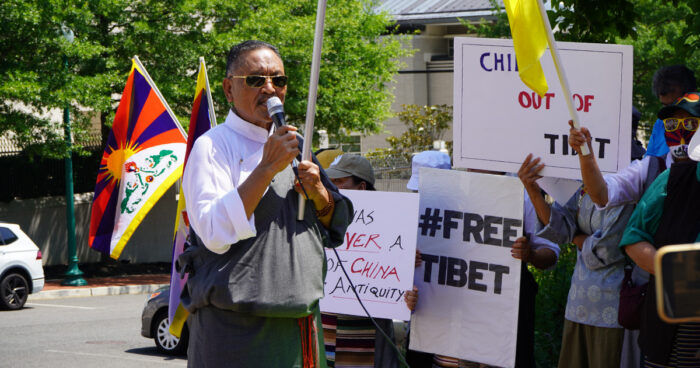
Capital Area Tibetan Association President Namkha Tenzin speaks at the July 1, 2026 protest in front of the Chinese embassy in Washington, DC.
At the protests in Washington, D.C., organized by the Capital Area Tibetan Association, its President Namkha Tenzin echoed Gyatso’s statement. “This law is not new for us Tibetans. This has been China’s long-standing tactic of erasing the identities of Tibetans and all other non-Chinese nationalities under Chinese occupation. So, we join Tibetans all over the world in opposing this law and call on China to repeal this law,” he said.
Other speakers at the protests included Tsultrim Gyatso, China Liaison Officer at the Office of Tibet, Washington D.C., Omer Kanat, Executive Director of the Uyghur Human Rights Project, Rushan Abbas, Executive Director of Campaign for Uyghurs, and human rights advocates Dr. Yang Jianli and Anna Wang, among others.
“Let us be clear about the law itself. It is not the rule of law. It is lawlessness dressed in legal language. It violates international human rights standards, and it also violates China’s own constitution, which in Article 4 promises ethnic equality and freedom for preserved minority languages,” Tsultrim Gyatso, China Liaison Officer at the Office of Tibet, Washington D.C., said.
In a coordinated Global Day of Action to oppose the enactment of this new law, activists from four Tibetan non-governmental organizations, including Tibetan Women’s Association, Students for a Free Tibet, and Tibetan Youth Congress, also converged in Dharamshala, India on July 1 to raised urgent appeals for international action, including calling on the Indian government to condemn the law.

Tibetans stage protest outside the Chinese embassy in Washington, DC on July 1, 2026.
Global condemnation of this new law had been mounting ahead of its July 1 enactment into force. Below is an overview of responses in the United States and internationally, as well as ICT’s diplomatic, advocacy, and media efforts to oppose the new ethnic unity law.
U.S. RESPONSE
- Bipartisan Senate Resolution: On June 26, 2026, U.S. Senators Rosen (D-NV), Curtis (R-UT), Merkley (D-OR), and Banks (R-IN) introduced a bipartisan resolution condemning the law and expressing support for Tibetans, Uyghurs, and other ethnic and religious minorities in China.
- Bipartisan Senate Letter to Amb. Feng: In a June 25, 2026 bipartisan letter addressed to the Chinese Ambassador to the U.S., Xie Feng, Senators Graham (R-SC) and Whitehouse (D-RI) called for the law’s repeal or significant revision. They warned the law’s implementation would be closely monitored and vowed to take legislative action if individuals on U.S. soil or U.S. citizens abroad are targeted under the law.
- Bipartisan Senate and House Statement: On July 1, 2026, a bipartisan group of 12 Members of Congress, including the leadership of the Senate Foreign Relations Committee and the House Select Committee on the Chinese Communist Party, issued a statement condemning the law.
- Representative McCaul Introduces Amendment: At a June 10, 2026 House Foreign Affairs Committee markup, Chairman Emeritus McCaul (R-TX) introduced an Amendment to Support Tibetans’ religious freedom and ability to select Dalai Lama successor, drawing attention to what he described as the “Orwellian-named Law.”
- House Select CCP Committee Statement: On June 29, U.S. House Select Committee on the CCP Chairman John Moolenaar issued a statement condemning the EUPL as codifying forced assimilation of Tibetans, Uyghurs, and other ethnic and religious minorities, while warning it could facilitate transnational repression.
- Bipartisan House Letter to Secretary Rubio: The June letter, signed by 14 members of the U.S. house of representatives, urges the Department of State to respond to the law before it goes into effect.
- CECC Report on PRC TNR: The Congressional-Executive Commission on China released a report on PRC transnational repression on June 4, 2026 documenting the targeting of Tibetans and Uyghurs abroad, directly relevant to the law’s overseas-accountability clause. (CECC)
- U.S. Representative Chris Smith Op-Ed: In a joint June 15 2026 Catholic Herald Op-Ed, Rep. Chris Smith and Slovak Member of Parliament Miriam Lexmann called for renewed congressional scrutiny of China’s policies in Tibet, arguing they may constitute genocide or crimes against humanity and urging consideration of stronger accountability measures including sanctions and increased diplomatic pressure. Smith and Lexmann argue Catholics should readily recognize this pattern, as the Chinese Communist Party already heavily monitors, manages, and restricts the public life of the Church to serve state politic
INTERNATIONAL RESPONSE
- European Union: The European Parliament adopted a resolution on April 30, 2026 condemning the law, urging its repeal, and calling for targeted EU sanctions, the release of detained Tibetans, and rejection of Chinese interference in the Dalai Lama’s succession. (European Parliament)
- Australia: A spokesperson for Australia’s Department of Foreign Affairs and Trade said it had raised concerns about the law “directly with China and at the UN Human Rights Council”.
- Belgium: On June 23, a parliamentary question on the law was tabled by MP Deborsu to the Minister of Foreign Affairs Maxime Prévot asking whether the Belgian government has raised concerns with the Chinese authorities, particularly regarding the potential impact of this law on Belgian citizens, including the risks of intimidation or transnational repression.
- The Baltic States (Estonia, Latvia, Lithuania): Parliamentary foreign affairs leaders from the Baltics issued a joint statement demanding a unified, pan-European diplomatic response. They cited the law as an aggressive vehicle for forced demographic and linguistic engineering.
- Czech Republic: The Czech Senate passed a resolution condemning the law, warning it amounts to cultural genocide against Tibetans and defending the Tibetan people’s right to determine their own spiritual succession.
- France: On May 27, the Chair of the International Information Tibet Group of the French Senate sent a letter to French President Macron, urging him to raise EUPL concerns with the Chinese authorities.
- Italy: Members of the Italian Parliament and former Foreign Minister Giulio Terzi rejected the law. Italian lawmakers described the statute as a tool of “destructive, homogenizing unity.”
- Switzerland: On June 29, 2026, the Swiss Parliamentary Group for Tibet condemned the law, and said its representatives will bring the issue before the Swiss Parliament’s Foreign Affairs Committee and press the Federal Council to remind Beijing of its obligation to protect Tibetans’ fundamental rights, including language, religion, and cultural identity. The group warned that without such an intervention, Tibetan identity risks being “wiped out within a single generation.”
- Taiwan: Cross-strait security officials and the Mainland Affairs Council issued formal warnings regarding the law’s timing and intent. Taiwanese officials stated that by transforming “ethnic unity” into a mandatory, globally enforceable legal obligation for anyone deemed to have Chinese ancestry, Beijing is attempting to legally invalidate the cross-strait status quo. They formally cautioned Taiwanese citizens and Hong Kongers residing in Taiwan that they face heightened risk of targeting under this long-arm statute.
- United Kingdom: The UK All-Party Parliamentary Group (APPG) on Tibet issued a statement on June 30 expressing “grave concern” over the legislation and describing it as “a dangerous legal instrument” that entrenches Beijing’s assimilationist policies despite its benign title.
- United Nations: UN High Commissioner for Human Rights Türk called for the law’s repeal in his global update to the Human Rights Council’s 62nd session on June 15, 2026. (OHCHR)
- United Nations: Eight UN special rapporteurs sent China a joint communication (OL CHN 5/2026) on April 16, 2026 warning the law could turn experimental regional measures into binding nationwide obligations, citing China’s commitments under the ICESCR and CRC (both ratified) and the ICCPR (signed). (OHCHR)
INTERNATIONAL CAMPAIGN FOR TIBET RESPONSE
Media:
- On July 1, 2026, ICT Chair Richard Gere was interviewed by BBC Radio on impacts of the law.
- On June 28, 2026 ICT Chairman Richard Gere, writing in The Wall Street Journal, warned Article 63 makes the law “repression without borders,” asserting Beijing’s authority to pursue critics—Americans included—abroad, and pointing to Tibet as the testing ground for China’s export of social control. (WSJ)
- On July 1, 2026, Tencho Gyatso published an op-ed in the German daily Frankfurter Allgemeine Zeitung (FAZ) and in French paper Libération, arguing the law institutionalizes the erasure of Tibetan identity through education, language, and cultural policies, while urging Germany, France, and the EU to respond before it enters into force.
- On June 17, 2026, ICT President Tencho Gyatso published a co-authored op-ed with Belgian human rights lawyer Alexis Deswaef in EUobserver, “Tibetans in Europe risk persecution in China under new ethnic unity law,” warning that Article 63 gives the legislation a transnational dimension by exposing Tibetans and other critics in Europe to potential prosecution for speech or advocacy conducted abroad.
- On May 29, 2026, ICT President Tencho Gyatso published an op-ed in La Libre Belgique, “Les Tibétains en grand danger avec la loi sur l’unité ethnique chinoise,” warning that the new law codifies the forced assimilation of Tibetans and calling on Europe to respond before it enters into force.
Diplomatic Engagement:
- On June 8, 2026, ICT President Tencho Gyatso testified before Canada’s House of Commons human-rights subcommittee (SDIR) that the law lays “a blueprint for the erasure of Tibetan language, culture and identity” and could see criticism voiced in Ottawa or Washington punished as “undermining ethnic unity.” (Parl. of Canada)
- On June 3, 2026, ICT Chairman Richard Gere keynoted a Baltic parliamentary conference in Riga where participants described the law as a serious turning point codifying the forced assimilation of Tibetans, Uyghurs, and Mongolians and urged EU coordination before it took effect. (ICT)
- On May 6, 2026, Tencho Gyatso addressed the European Parliament’s human-rights subcommittee (DROI), flagging Article 63’s transnational reach and urging the EU to issue a unified 27-state condemnation and appoint an EU Special Representative for Tibet. (ICT)
- At the UN Human Rights Council’s 62nd session in June 2026, ICT warned the law further restricts freedom of expression in Tibet and beyond and violates the rights of Tibetan children. At a well-attended side-event to the session organized by the Helsinki Foundation for Human Rights, ICT’s Head of Research and Monitoring Bhuchung Tsering joined Tibetan and Uyghur experts in warning the law further entrenches repressive policies and threatens Tibetan identity.
- ICT published its foundational analysis on March 13, 2026, the day after adoption, calling the law “the culmination of a decades-long CCP effort to dilute the unique identity of the Tibetan people.” (ICT)