


Longtime Tibet advocate and International Campaign for Tibet (ICT) Board Chair Richard Gere urged Tibetans to carry forward the legacy of Tibetan activist Lobga Rangzen by embracing the message he asked the world never to forget: “ང་བོད་པ་ཡིན། I am Tibetan.” Speaking to around 2,000 people gathered in New York’s Times Square on Aug. 1, one month after Lobga Rangzen self-immolated outside the United Nations, Gere called on Tibetans to make His Holiness the Dalai Lama proud by taking action for Tibet; standing up for their identity; and continuing the Tibetan struggle with unity, courage and purpose.
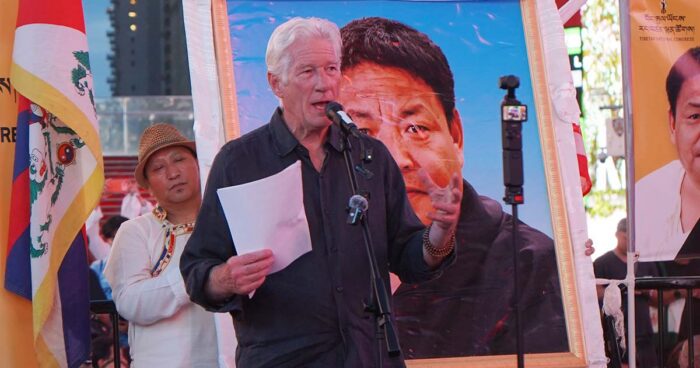
ICT Chairman Richard Gere addresses Tibetans and Tibet supporters at Times Square, New York during the vigil to honor Tibetan activist Lobga Rangzen on Aug. 1, 2026. (Source: ICT)
The August 1 vigil, organized by a coalition of eight Tibetan organizations led by the Tibetan National Congress, brought together Lobga Rangzen’s family, prominent Tibetan leaders and activists, elected officials, and representatives of the Uyghur, Southern Mongolian, Hong Kong and Taiwanese communities in a powerful tribute to the life and sacrifice of the longtime Tibetan activist.
The evening combined remembrance with renewed calls for international action in response to China’s escalating repression in Tibet and its implementation of the so-called Ethnic Unity and Progress Law, which codifies the forced assimilation of Tibetans by targeting their language, religion and culture. Lobga Rangzen’s self-immolation, the first Tibetan self-immolation on US soil, took place a day after China’s repressive new law came into effect on July 1, 2026.
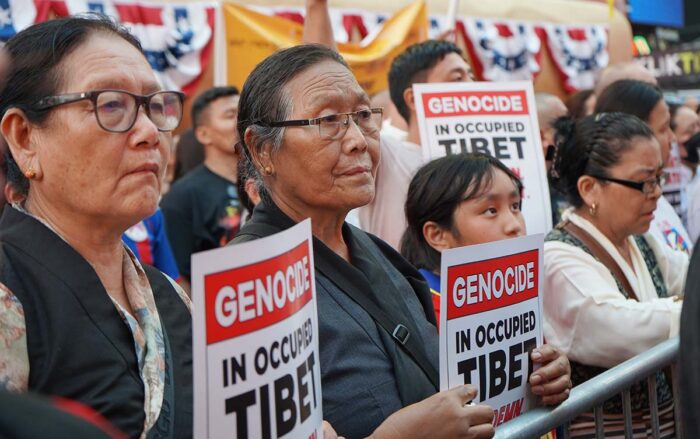
Tibetan community members of all ages gathered in Times Square to honor Pawo Lobga Rangzen on Aug. 1, 2026. (Source: ICT)
Standing before a sea of Tibetan national flags and hundreds of candles in the heart of Times Square, Gere described Lobga Rangzen as a man “whose message now asks something of every one of us: to stand together for Tibet and be a voice for those inside Tibet.”
“He loved Tibet so deeply he refused to let its suffering remain invisible. He wanted the world to understand that Tibet is not simply occupied. It is a civilization at risk,” Gere said.
Warning that China’s policies threaten the very survival of one of the world’s oldest civilizations, Gere said the Tibetan language, Buddhist religion and centuries-old culture are living traditions that survive only if someone is free to pass them on. “When a civilization loses the freedom to teach its children, humanity loses something it can never replace,” he added.
Quoting His Holiness the Dalai Lama’s teaching that “my religion is kindness,” Gere reminded the crowd that kindness is never passive and instead demands action.
“Real kindness is standing beside those punished for speaking their language or practicing their faith,” he said. “Real kindness is our refusal to look away when China’s injustice seeks to dismantle Tibetans’ centuries-old culture and push an entire civilization toward extinction.”
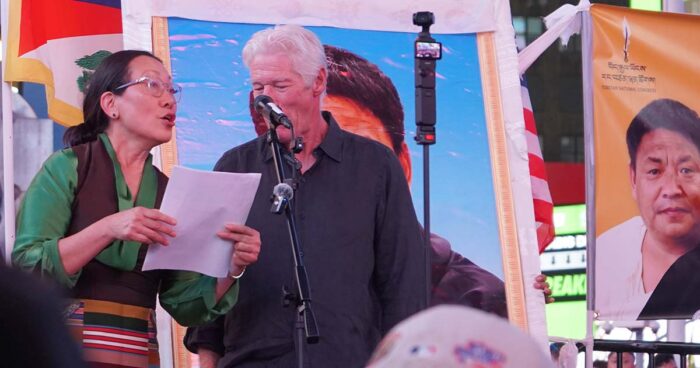
ICT Chair Gere and President Tencho Gyatso urge the gathering to call on Congress to take action for Tibet by supporting pro-Tibet legislation and demanding the repeal of China’s ethnic unity law.
Gere, along with ICT President Tencho Gyatso, urged participants to take meaningful action for Tibet, asking them to record videos calling on members of Congress to support the Assuring the Future of Tibet Act (AFTA), bipartisan legislation that seeks to strengthen US support for the Tibetan people and the Central Tibetan Administration and demand the repeal of China’s Ethnic Unity and Progress Law, using the hashtags #SupportAFTA and #RepealEthnicUnityLaw on social media.
Lobga Rangzen’s family: “Tibet was his life’s purpose”
Making their first public appearance since Lobga Rangzen’s funeral, members of his family delivered emotional tributes to the activist whose advocacy and final message has galvanized Tibetans around the world.
His niece, Sonam Choedon, described her uncle as a man who devoted every day of his life to Tibet’s freedom. “For my uncle, Tibet was not a cause; it was his life’s purpose,” she said. “He lived for Tibet every single day, and in the end, he gave his life for Tibet.”
She recalled how Lobga Rangzen walked to the United Nations carrying the Tibetan national flag before planting it firmly in the ground and throwing into the air leaflets that said “Free Tibet” and “China out of Tibet” as flames engulfed his body.
“Through his final act, my uncle awakened something powerful. He reminded Tibetans everywhere that we share one homeland, one history, and one responsibility,” she said.
Calling on the international community not to remain silent, she said more than 170 Tibetans had self-immolated crying out for freedom and begging the world to witness what is happening inside Tibet. Turning to Tibetans gathered in Times Square, she urged them to continue protecting their identity and carrying forward the struggle “to bring His Holiness the 14th Dalai Lama back to the Potala Palace in a free and independent Tibet.”
Speaking before the crowd gathered at Times Square, Tashi Palmo, friend of late Lobga Rangzen and member of the Tibetan National Congress, read the final message Lobga Rangzen posted on Facebook in which he called for Tibetans to be united in their struggle for Tibet and to heed His Holiness’s guidance to serve as the voice for Tibetans inside Tibet.
(Read the full translated text message here or watch the video message here.)
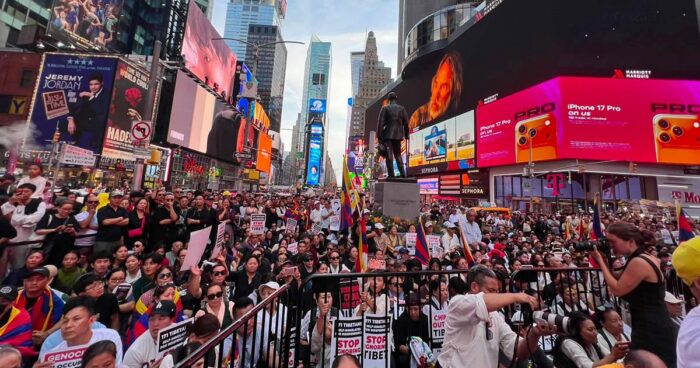
Around 2000 Tibetans gathered at Times Square, New York on Aug. 1, 2026 to honor Lobga Rangzen at a vigil organized by a coalition of eight Tibetan organizations led by Tibetan National Congress. (Source: ICT)
ICT leaders: Lobga Rangzen’s call was for unity
ICT President Tencho Gyatso said Lobga Rangzen’s sacrifice must become a rallying point for renewed unity among Tibetans worldwide. “When we remember him today, we also remember the message he left us,” she said. “He called on Tibetans to stand together in unity, to do what each of us can, in whatever way we can, for Tibet.”
Warning that China’s Ethnic Unity and Progress Law seeks to dismantle Tibetan identity by targeting language, culture and history, she said, “A people, a nation cannot survive if they are separated from their language, their history, and who they are.”
“The greatest way we can honor Pawo Lobga Rangzen is not only by remembering his sacrifice,” she said, “but by answering his call.”
ICT Executive Director Ryan Fioresi said Lobga Rangzen had left behind not a message of despair but of determination. “He did not want our mourning,” Fioresi said. “He wanted us to redouble our effort, strengthen our unity, and raise our voices to the international community to proclaim that Tibet can no longer be ignored.”
Noting that Lobga Rangzen’s self-immolation came one day after China’s Ethnic Unity and Progress Law took effect, Fioresi called on the United Nations and governments around the world to condemn the legislation, demand its repeal and press Beijing to resume dialogue with His Holiness the Dalai Lama’s representatives.
Fioresi said Tibet’s struggle cannot be viewed in isolation. “The Tibetan struggle is bound to the Uyghurs, the Hong Kongers, the Southern Mongolians, the Taiwanese, and to every person of conscience who refuses to accept that a government may erase a people,” he said.
Tibetan leaders and allies pledge to continue the struggle
Jigme Ugen, president of the Tibetan National Congress, praised the Tibetan youth organizers for bringing Tibet’s message to “the loudest and busiest pedestrian crossing in the world.”
“For more than 70 years, Tibetans have been told to accept the unacceptable,” he said.
“We waited. And while we waited, China used that time to kill over 1.5 million Tibetans, separate more than one million children from their language, identity and families, control our monasteries, rewrite our history, erase our language and every foundation of the Tibetan way of life.”
He said Lobga Rangzen believed that “the loss of independence was the root of Tibet’s suffering,” and sacrificed his life to restore Tibet’s freedom.
NYC Taxi and Limousine Commission (TLC) Commissioner Midori Valdivia also paid tribute to Lobga Rangzen, a beloved member of the TLC driver community, by lighting an honorary candle in his memory.
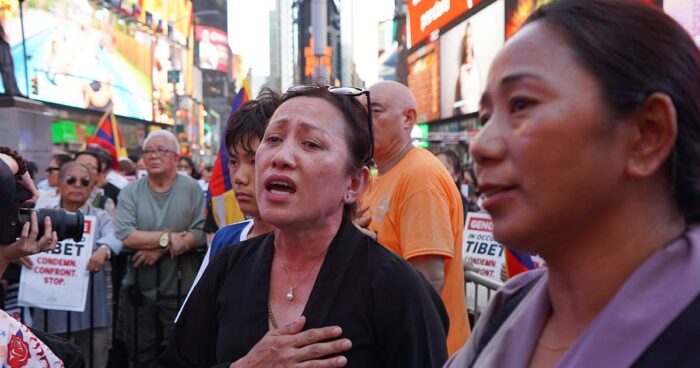
Tibetan community member in the audience.
Paying tribute to his longtime friend, Tibetan National Congress Founder Jamyang Norbu read I Will Burn Myself Again and Again by the Tibetan Amdo poet Zung Chu Kyi.
Written during the wave of Tibetan self-immolations that began in 2011, the poem mourned the destruction of Tibet’s land, language and culture while affirming an unwavering commitment to freedom and dignity. Its words echoed across Times Square as hundreds stood in silence while Norbu read the poem:
Take care the of the purity of my land and environment
Respect the life force of my mother tongue
Give freedom to all my humble brothers and sisters
This is my last testament written with my blood
Because of necessity it is my goal to burn myself forever
So let me accomplish this!”
Representatives from other communities facing repression under the Chinese government emphasized that Lobga Rangzen’s sacrifice resonated far beyond Tibet.
Uyghur activist Rushan Abbas said Tibetans had inspired oppressed peoples around the world through their resilience and refusal to surrender their identity. “Lobga Rangzen’s sacrifice must not be forgotten,” she said. “His message was not only for Tibetans; it was for every person who believes that human dignity is worth defending.”
Enghebatu Togochog, Director of the Southern Mongolian Human Rights Information Center, remembered Lobga Rangzen as “a man of unwavering courage, compassion and conviction” who had stood beside other oppressed peoples at protests and demonstrations for years. Calling his self-immolation “a desperate call for humanity not to look away,” he expressed hope that the world would eventually confront Chinese colonialism and authoritarian expansion before it is too late.
Hong Kong democracy activist Alex Chow, Tibet Action Institute founder Lhadon Tethong, son of late Taktser Rinpoche Kunga Norbu, and New York Assemblymembers Steven Raga and Catalina Cruz also called on supporters to continue Lobga Rangzen’s struggle by fighting for Tibet and ensuring that the sacrifices of Tibet’s self-immolators are never forgotten.
A day of prayer, remembrance and peaceful protest
The evening’s vigil included acts of devotion and nonviolent protest that transformed New York City into a powerful expression of solidarity with Tibet.
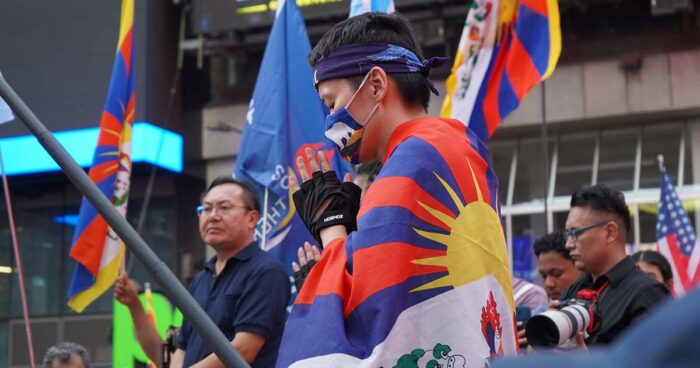
Tibetan youth volunteers performing full-body prostrations from Brooklyn Bridge arrive in Times Square to honor Pawo Lobga Rangzen on Aug. 1, 2026.
Throughout the day, Tibetan youth volunteers performed full-body prostrations from the Brooklyn Bridge to Times Square, while Tibetan students staged a performative die-in representing the more than 170 Tibetans who have self-immolated in protest against China’s occupation of Tibet. Tibetan children from the DC Capital Area Tibetan Association also paid tribute by reading the names of the over 170 Tibetan activists who had self-immolated in protest against China’s rule of Tibet.
Following the vigil, hundreds of participants marched peacefully from Times Square to United Nations Headquarters – the site where Lobga Rangzen tragically self-immolated on July 2. Wearing white ceremonial scarves over their mouths, the marchers created a striking visual symbol of both the voices silenced inside Tibet and the silence of the international community in the face of China’s repression.
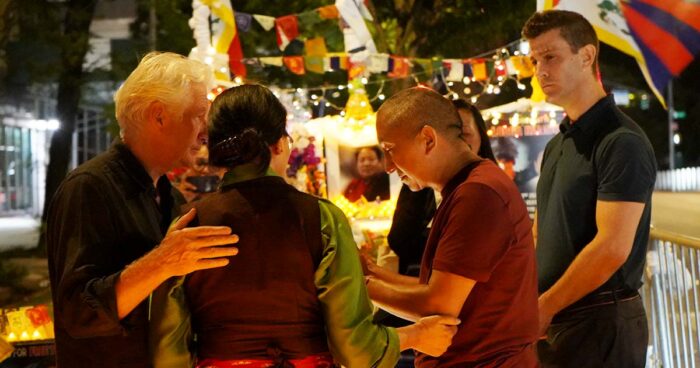
ICT leadership speaks with local Tibetan community members at the memorial site outside UN, New York on Aug. 1, 2026.
ICT Chair Gere, President Gyatso, and Executive Director Fioresi also visited the memorial outside UN Headquarters, where Tibetans have maintained a continuous, round-the-clock vigil at the site where Lobga Rangzen self-immolated one month earlier. There, the ICT leadership honored the late activist by offering flowers, katag, and butter lamps. As they met with Tibetans keeping vigil at the memorial, Gere and the ICT leadership reaffirmed their commitment to the Tibetan cause. The vigil participants expressed their gratitude to Gere for his decades of steadfast support and advocacy for Tibet.
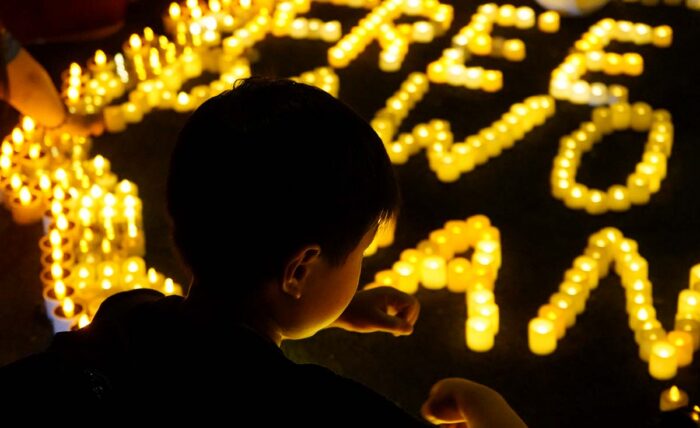
A young community member offers a candle at the memorial site.
As thousands walked toward the United Nations carrying candles and Tibetan flags, the message that echoed throughout the evening – from Richard Gere, Lobga Rangzen’s family, Tibetan leaders and allied human rights defenders – was unmistakable: the greatest tribute to Lobga Rangzen would be carrying forward his life’s work together, united in ensuring that every Tibetan can proudly say, “ང་བོད་པ་ཡིན། I am Tibetan.”