
Tibetan Culture
Tibet’s History
Tibet has a distinct history spanning more than two millennia.
What you need to know
Tibet developed a distinct political, religious and cultural civilization on the Tibetan Plateau. Its history includes an expansive empire, centuries of changing relations with neighboring powers, de facto self-government after 1912, the People’s Liberation Army’s entry in 1950, and the 1959 uprising that sent the Dalai Lama into exile.

THE TIBETAN EMPIRE
From the seventh to ninth centuries, Tibet was a major Central Asian empire that negotiated treaties and fought wars with neighboring powers, including China’s Tang dynasty.
1912–1950: SELF-GOVERNMENT
After the Qing dynasty collapsed, Tibetan authorities expelled remaining Chinese troops and exercised de facto self-government from Lhasa for nearly four decades; Tibet’s international legal status during this period remained contested.
1950–1959: A TURNING POINT
The People’s Liberation Army entered eastern Tibet in 1950 and defeated Tibetan forces; the 1951 Seventeen Point Agreement followed, and tensions culminated in the 1959 uprising and the Dalai Lama’s flight to India.
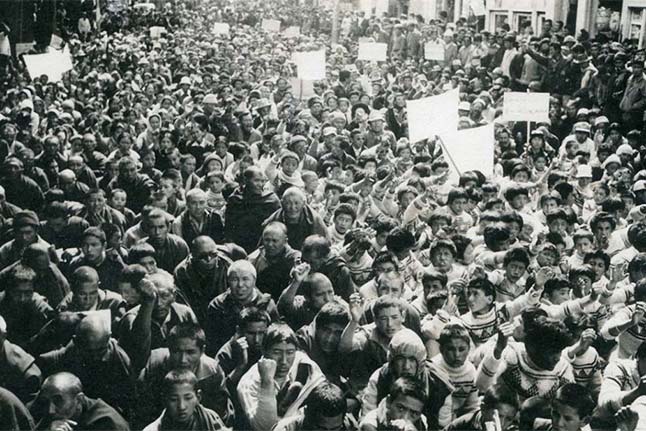
March 10, 1959: The Tibetan National Uprising
On March 10, 1959, tens of thousands of Tibetans gathered in Lhasa around the Norbulingka Palace amid fears for the Dalai Lama’s safety. What began as an effort to protect him quickly became a mass uprising against Chinese rule, reflecting years of mounting resistance to the PRC. Demonstrations and resistance continued over the following days as tensions escalated across the capital. On March 17, the Dalai Lama escaped Lhasa and began his journey to India; Chinese forces subsequently crushed the uprising and dissolved the Tibetan government in Lhasa. March 10 has since become an enduring symbol of Tibetan resistance.
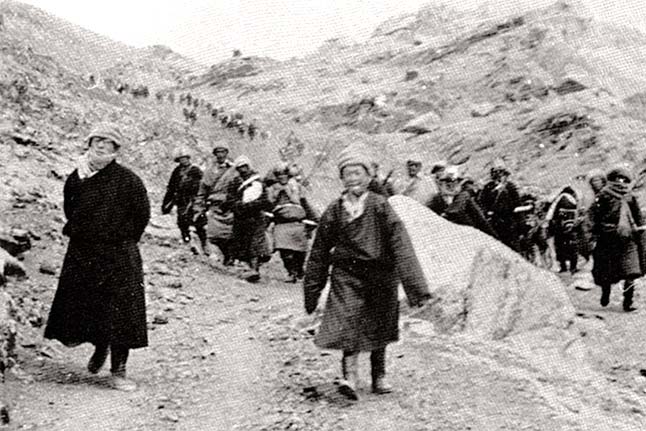
The Dalai Lama’s escape and the beginning of exile
After Chinese forces suppressed the uprising, the Dalai Lama escaped Lhasa on March 17, 1959 and crossed into India, where he was granted asylum. Thousands of Tibetans followed into exile, beginning a new chapter in which Tibetan political, religious and cultural institutions were rebuilt outside Tibet.
823
When the treaty between the Tibetan Empire and Tang China was recorded in Lhasa
17
Points Agreement of 1951 signed by representatives of the PRC and Tibet
3
UN General Assembly resolutions on Tibet adopted in 1959, 1961 and 1965
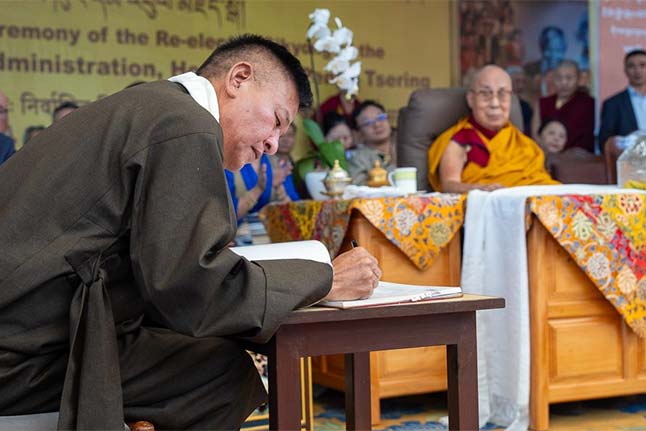
Tibetan institutions rebuilt in exile
After 1959, Tibetan refugees rebuilt schools, monasteries, cultural institutions and an administration in India. Over subsequent decades, the exile political system was gradually democratized. In 2011, the Dalai Lama formally transferred his political authority to elected Tibetan leadership, separating his spiritual role from the administration’s political leadership.

Figures who shaped Tibetan history
THE THREE DHARMA KINGS & THONMI SAMBHOTA
The Three Dharma Kings—Songtsen Gampo, Trisong Detsen and Tri Ralpachen—are remembered for strengthening the Tibetan state and making Buddhism a central force in Tibetan civilization. During Songtsen Gampo’s reign, Thonmi Sambhota is traditionally credited with developing the Tibetan script and early grammatical tradition, helping establish the written foundations for Tibetan literature, government and Buddhist scholarship.
THE 10TH PANCHEN LAMA
The 10th Panchen Lama, Choekyi Gyaltsen, became one of the most consequential Tibetan leaders inside Tibet under PRC rule. His 1962 70,000-Character Petition documented repression, famine and the destruction of Tibetan religious and cultural life. After his rehabilitation, he championed Tibetan language, education and monasteries. In 1989, shortly before his death, he publicly criticized Chinese policies, saying Tibet had lost more than it had gained, and declared his loyalty to the Dalai Lama.
LODI GYARI RINPOCHE
Lodi Gyari Rinpoche helped shape Tibet’s modern diplomatic history. A senior Tibetan exile leader and longtime President and Executive Chairman of ICT, he served as the Dalai Lama’s Special Envoy and lead interlocutor with Beijing. From 2002 to 2010, he led the Tibetan delegation in sustained talks with Chinese officials and presented the Memorandum on Genuine Autonomy for the Tibetan People as a framework for a negotiated solution.
OUR Impact
- Documenting Tibet’s history and political conditions since 1988: ICT’s research and reporting preserve evidence about Tibet’s distinct historical identity, modern political developments and the policies that have reshaped Tibetan life under PRC rule.
- 2002 — Helping establish a lasting U.S. Tibet policy: ICT helped lead advocacy for the Tibetan Policy Act, which made support for Tibet’s distinct identity and promotion of negotiated dialogue central elements of U.S. policy.
- 2002–2010 — Supporting direct Tibet-China dialogue: Lodi Gyari, the Dalai Lama’s Special Envoy and a longtime ICT President and Executive Chairman, led the Tibetan delegation through repeated rounds of dialogue with Chinese officials.
- 2024 — Challenging historical disinformation through U.S. law: ICT helped mobilize support for the Resolve Tibet Act, which directs U.S. policy to counter PRC disinformation about Tibet’s history and strengthen efforts toward a negotiated resolution.
Common Questions
Was Tibet historically independent?
Tibet’s political status changed across different historical periods. From the seventh to ninth centuries, the Tibetan Empire was an independent regional power. Later, Tibet experienced varying degrees of Mongol and Qing influence. After the Qing dynasty collapsed in 1911, Tibetan authorities expelled Chinese troops and exercised de facto self-government for nearly four decades, maintaining their own government and armed forces, issuing currency, and conducting foreign contacts.
Formal international recognition was limited, and governments differed in how they described Tibet’s legal status. The PRC today maintains that Tibet has been part of China since ancient times; the Tibetan side rejects that account. Historical disagreement over these periods remains central to the modern Tibet-China dispute.
What was the Seventeen-Point Agreement?
The Seventeen-Point Agreement was signed in Beijing in May 1951 after the People’s Liberation Army had defeated Tibetan forces in eastern Tibet. It placed Tibet under the “unified leadership” of the PRC central government and provided for PLA entry, while promising regional autonomy, continuity of Tibet’s existing political system and the Dalai Lama’s status, and respect for religious belief.
The PRC describes the agreement as the foundation of Tibet’s “peaceful liberation.” The Tibetan side maintains that its representatives signed under duress and lacked authority to conclude the agreement. After the 1959 uprising and his flight to India, the Dalai Lama formally repudiated it.
Why is 1959 so important in Tibetan history?
In March 1959, a major uprising erupted in Lhasa against Chinese rule. The crisis developed after years of growing tension following the PLA’s arrival and the expansion of PRC control. Chinese forces suppressed the uprising, and the Dalai Lama escaped across the Himalayas to India, where he was granted asylum.
The events of 1959 divided modern Tibetan history into two trajectories: intensified Chinese rule inside Tibet and the development of a Tibetan refugee community and political administration in exile. The date remains central to Tibetan historical memory and is commemorated annually on March 10.
Have Tibetan and Chinese leaders tried to negotiate a settlement?
Yes. Contacts were renewed after 1979, and representatives of the Dalai Lama held exploratory talks with Chinese officials in the 1980s. A more sustained dialogue began in 2002, with repeated meetings between Tibetan envoys and Chinese officials through January 2010. The Tibetan delegation ultimately presented a detailed proposal for genuine autonomy under the Middle Way Approach.
The talks did not produce an agreement, and no formal dialogue has resumed since January 2010, although Tibetan exile officials have reported informal or back-channel contacts in recent years. The Tibetan leadership continues to advocate a negotiated solution, while U.S. law calls for direct dialogue without preconditions.