Updated: November 18, 2026
The Chinese Communist Party (CCP)’s mandatory incorporation of a role for itself into all aspects of Tibetan Buddhist practice aims to establish a new framework for governance of Tibet in the post-14th Dalai Lama period. An analysis of Chinese government statements, research studies and rules and regulations passed in recent years show that China is making this effort to break the traditionally strong teacher-student and lama-disciple relationship that have sustained Tibetan Buddhism for centuries and is seen as a continued threat to the CCP.
In the process, the CCP is diluting Tibetan Buddhism and transforming its centuries-old framework into one that is driven by Beijing’s interests, and subordinate to its authority.
As part of its implementation, Tibetan Buddhist teachings are being to made to fit CCP guidelines restricting their practice strictly within state-approved channels. This impacts the Tibetan monastic administration, academic and clergy management systems, and the management of the reincarnation system, which support study and practice in the monastic institutions.
The report documents the CCP’s efforts to drive a fundamental transformation in Tibetan Buddhism from a spiritual tradition governed by its own religious institutions and lineages into one increasingly subordinated to the CCP’s political objectives. This report outlines how the CCP and the Chinese government are implementing this strategy and what it means for the future of Tibetan Buddhism, including its deeply spiritual reincarnation system. It explains the Tibetan monastic tradition that was prevalent before the Chinese takeover and how this is now being replaced with a CCP-dominated framework, similar to how China has been approaching Christianity.
At a Glance
- Traditional monastic management systems: Explains how Tibetan Buddhism developed through autonomous monasteries, nunneries, and spiritual lineages that independently managed religious education, administration, and spiritual leadership. These institutions preserved Buddhist teachings through centuries of scholarship and teacher-disciple transmission without political interference.
- Uprooting the foundational structure of Tibetan Buddhism: Traces the evolution of Chinese policies from the destruction and suppression of religious institutions to the establishment of long-term mechanisms for political control. The report highlights how the CCP’s response to the 1995 Panchen Lama recognition and the 2008 pan-Tibetan demonstrations accelerated efforts to weaken independent monastic authority.
- How China controls Tibetan Buddhism: Examines how the United Front Work Department and the Buddhist Association of China implement the CCP’s political objectives. The Buddhist Association’s amended charter explicitly requires support for CCP leadership, while its 2026–2030 work plan calls for strengthened ideological guidance and institutional management.
- Controlling who can be a Buddhist practitioner: Details how regulations introduced in 2025 and 2026 require political allegiance from lay practitioners, monks, nuns, religious teachers, and monastic administrators. Prospective monks and nuns must be at least 18 years old and obtain approval through state-supervised procedures. Religious teachers require political certification, while Buddhist academic degrees and monastic curricula are subject to government oversight.
- Reincarnation with Communist Characteristics: Analyzes China’s efforts to control the recognition of reincarnated lamas through mandatory government approval, certification, and registration. China’s 2026–2030 policy framework promotes domestic searches, the Golden Urn procedure, and Beijing’s approval for major reincarnations, laying the groundwork for interference in the Dalai Lama’s succession.
- Preparing for the post-Dalai Lama governance of the Tibetan people: Examines Chinese research and policy documents revealing Beijing’s preparations for the period following the 14th Dalai Lama. A September 2026 study identifies the possibility of a prolonged competition over religious authority and highlights the continued influence of Tibetan religious institutions, exile organizations, and cross-border connections.
- Tibetan Buddhist clergy in the Xi Jinping era: Explores the CCP’s efforts to cultivate a new generation of politically compliant clergy. The Party’s 2026–2030 plans emphasize ideological supervision and the development of personnel tasked with ensuring that religious institutions conform to socialist objectives.
Buddhism first spread to Tibet in the seventh century through Tibetan royal patronage. Thereafter, between the eighth and 13th centuries, Buddhist philosophical scriptures, particularly those derived from the famed Nalanda University of India, were translated into Tibetan. They became the foundation of Tibetan Buddhist study and practice and in the process developed the institutional system of Tibetan monastic institutions.
Tibet’s governance system before the Chinese invasion blended spiritual and temporal rule (ཆོས་སྲིད་ཟུང་འབྲེལ། Choesi Zungdrel) with the Dalai Lama commonly accepted as the supreme head of Tibetan Buddhism. Nevertheless, the administrative structure of the monasteries and nunneries was decentralized and autonomous. Each of the major Tibetan Buddhist traditions (Sakya, Gelug, Kagyu and Nyingma) and their sub-lineages, as well as the Bon tradition, had monasteries that functioned largely as self-administered entities without any state control. This was the case even with the small population of Tibetan Muslims, which enjoyed freedom without any official interference.
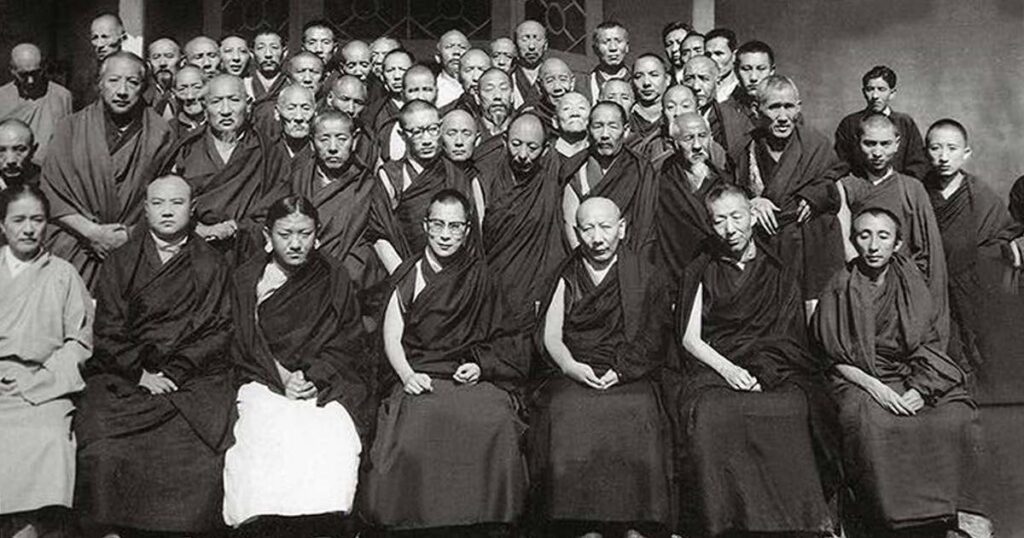
Traditionally, the different Tibetan Buddhist lineages and the monasteries under them were the decision makers in all aspects of the administration. They all have different governance structures based on their respective backgrounds. Larger monasteries in the Gelug tradition are subdivided into groups based on regional affiliation known as “khangtsen” (ཁང་ཚན།), which had the freedom to decide their own activities.
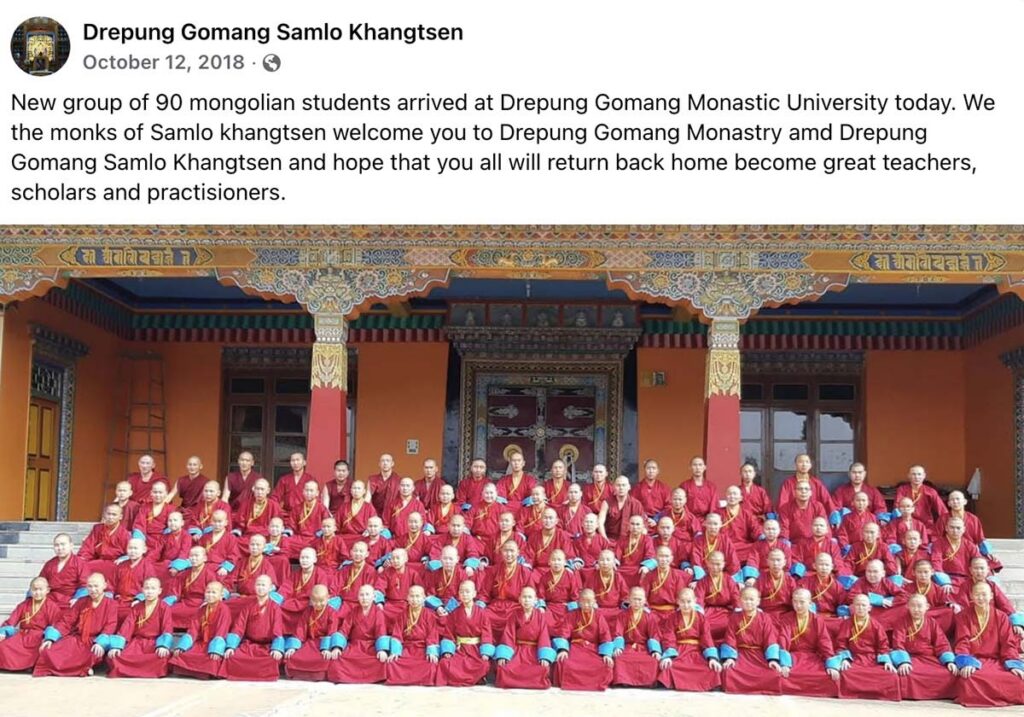
The fact that the monastic community was composed of members not only from all areas of Tibet but also from the Indian Himalayas and Mongolia, is reflected in the categorization of the khangtsen. The Tehor Khangtsen in Sera, Drepung and Gaden housed monks from the Tehor region in Kham in present-day Kardze (Ganzi) Tibetan Autonomous Prefecture. There were specific Khangtsen like Sokpo and Samlo that historically hosted ethnic Mongol monks from Mongolia as well as the Republics of Kalmykia, Buryatia, and Tuva in present-day Russian Federation. Interestingly, non-Gelug monks coming to study in major Gelug monasteries (which was prevalent) would be housed in specific khangtsen affiliated with their specific homeland, thus navigating a fluid academic boundary.
Tibetan monastic education encompasses three fundamental stages of study, reflection, and meditation practiced as an inseparable triad. The education includes study of scriptures from the 108 volumes of Buddha’s teachings known as Kagyur (“The Translated Words”) and 223 volumes of commentaries of Indian scholars, known as Tengyur (“The Translated Treatises”). The exhaustive literature in Tibetan language makes Tibetan Buddhism the most complete form among existing Buddhist traditions. In addition to this fundamental knowledge base, Tibetan Buddhism also includes external ritualistic elements evolved through centuries of practice in the Tibetan cultural space.
The various aspects of monastic administration include recruitment of monks and nuns, formulation of a curriculum of study, selection of teachers, bestowing of appropriate religious titles upon completion of basic studies, and providing avenue for further study and practice. These activities were handled by the management committee composed of their own members. Monks and nuns were admitted at an early age so that they complete their more than two decades of study and have more time for the more important spiritual practice thereafter. Although in Tibet there was no option for studying modern/non-religious subjects in the monasteries, in exile in India, the Tibetan monastic institutions all provide facilities for the novices to study in parallel and even graduate under the Indian education system.
In the case of monasteries like Sera, Drepung and Gaden they had their respective “lachi” (བླ་སྤྱི།) which serves as the overarching administrative, judicial, and governing body. All monasteries had their administrative personnel coming from the monastic community itself with no political appointees. Most monasteries generally had their own charter, or chayig (བཅའ་ཡིག་), that governed their management. The monasteries also had a Principal-Subordinate Monastery System (Magon dang bugon, མ་དགོན་དང་བུ་དགོན་) with the smaller monasteries being connected with a larger monastic institution, including following its academic curriculum. For example, the famous Labrang Tashi Khyil Monastery in Amdo, Kanlho (Gannan) Tibetan Autonomous Prefecture in Gansu has 138 subordinate monasteries. Regarding the more important issue of religious education curriculum, the monasteries and nunneries follow their respective “principal” monasteries and lineages. The monastic education curriculum did not incorporate any political subjects with the choice of text or subjects being the decision of the institution. Lamas traveled all over Tibet to teach and whoever wanted to receive the teachings could do so without any restrictions placed on them. Monks and nuns, similarly, had the freedom to receive teachings anywhere from any lama.
Scholars and lamas have traveled to India for studies and have translated many pieces of Buddhist literature into Tibetan. Similarly, at various times in Tibetan history, Indian Buddhist masters mainly from the famed Nalanda University have been invited to Tibet, where their teachings and activities led to the establishment of major Tibetan Buddhist traditions.
Through such an intense system of study and practice over centuries, Tibet has produced a rich collection of Buddhist knowledge and highly realized lamas and scholars.
These have enabled the Tibetan people to preserve, promote and develop the Tibetan Buddhist tradition over many years. In fact, the Dalai Lama says, “Tibet is almost the only place where on the world stage the entirety of the Mahayana, Hinayana and Tantric teachings of Buddhism could be fully preserved, and where in this world the religious heritage of the Great Nalanda University could be fully kept, defended and spread without a whiff of contamination.”
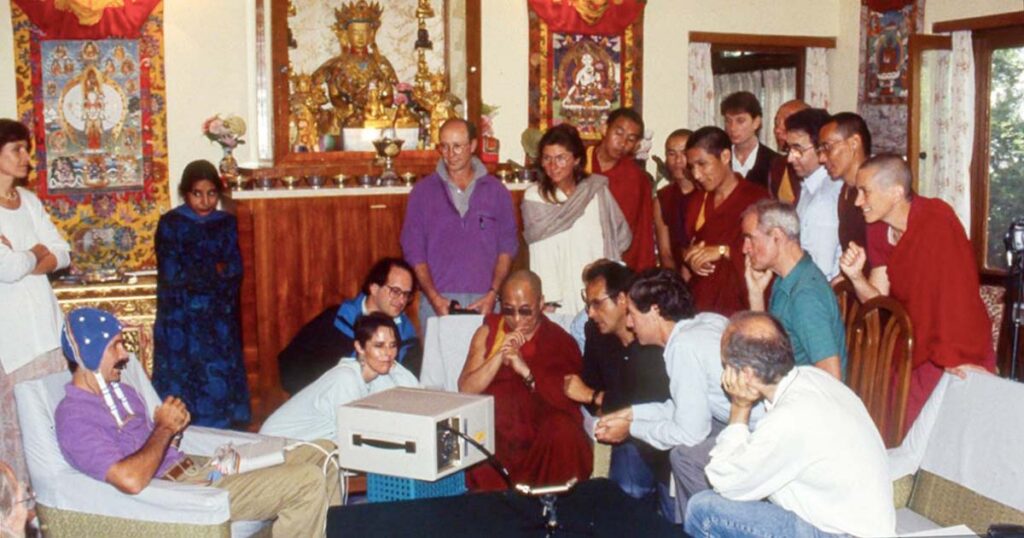
This tradition has not only enriched the lives of the Tibetan Buddhists but is also contributing to the global preservation of advanced contemplative science, and ethics of universal compassion. The Dalai Lama categorizes Tibetan Buddhism into three facets: Buddhist religion, Buddhist science, and Buddhist philosophy. He has also been highlighting how Buddhist contemplative tradition is contributing to development of modern science and initiated a series of dialogues between scientists and Buddhist scholars in 1987 under the auspices of the Mind & Life series. All three categories have shown their potential to enrich global knowledge. Even the former Chinese president, Jiang Zemin, is believed to have been interested in Tibetan Buddhism.
Chinese policies on Tibetan Buddhism have evolved from destruction to severe suppression, to constitutional protections, followed by a period of cautious liberalization, and finally to strict state control and forced “Sinicization” under current leadership.
The initial Chinese policy of total destruction led to authorities destroying or damaging several thousand Tibetan Buddhist institutions. For example, the 10th Panchen Lama in his 70,000-character petition in 1962 to the Chinese government said, “Of the 2,500 monasteries which had once existed [in what is now the Tibet Autonomous Region] only 70 were left,” and 98-99 percent of the estimated 1,900 monasteries in Kham and Amdo were also destroyed.” The situation in Tibet was further exacerbated during the Great Cultural Revolution (1966–1976), which had attempted to eradicate religion entirely through violent suppression.
A major change in Chinese policy on religion in general and Tibetan Buddhism in particular took place after 1978 in an apparent recognition that the violent suppression of the previous decade had failed to eliminate religion and had instead alienated large segments of the population. Following the Third Plenary Session of the 11th CPC Central Committee in December 1978, there was a shift toward a more pragmatic approach, laying the groundwork for a comparatively lenient policy on Tibetan Buddhism.
The session paved the way for Chinese leader Deng Xiaoping to reach out to the Dalai Lama through his Hong Kong-based brother Gyalo Thondup leading to a period of “delegation diplomacy” with the Tibetan leadership in exile. Similarly, China also ordered the reopening of religious institutions and the rehabilitation of persecuted religious leaders.
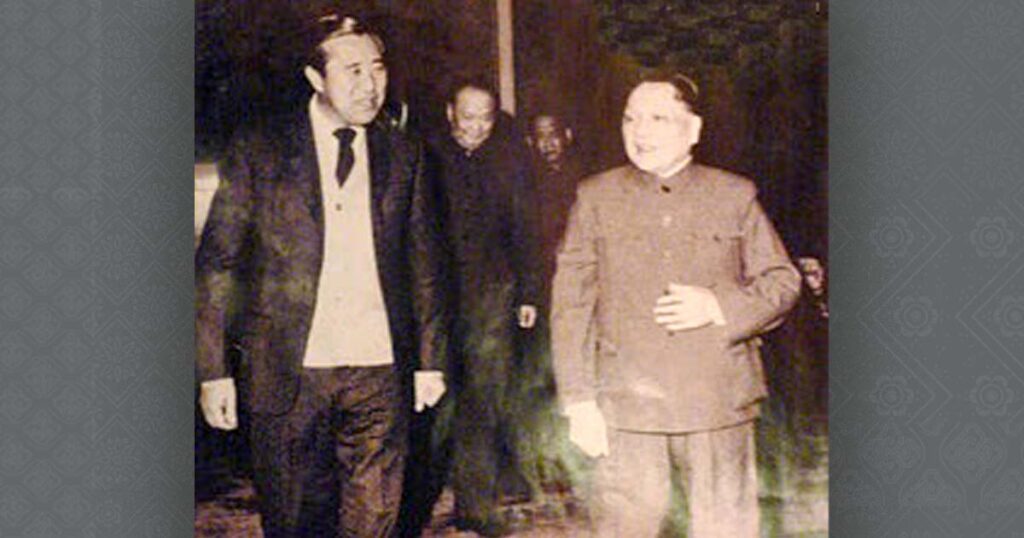
Thus, in 1979, in Tibet, the Jokhang Temple and Drepung Monastery in Lhasa, and Labrang Tashi Khyil were among the Tibetan Buddhist institutions reopened to the public and monks. Similarly, some of the long incarcerated Tibetan Buddhist masters were released in 1979 and thereafter. They include the Sixth Gungthang Rinpoche, Jigme Tenpai Wangchuk, one of the heads of Labrang Tashi Khyil monastery who had undergone more than 20 years of imprisonment.
The CCP followed up on the 1978 the ideological and political policy shifts on religion by issuing Document 19 “The Basic Viewpoint and Policy on the Religious Question During Our Country’s Socialist Period” in 1982. It assured “respect for and protection of the freedom of religious belief.” Similarly, in the same year, a revised Constitution for the PRC was passed and included protection of “normal religious activities” which was in stark contrast to the 1978 edition of the Constitution, not to speak of the previous versions.
Although these were incremental positive changes, China’s ultimate objective was clear as even the 1982 Document 19 also explained the CCP policy on protecting religious freedom saying, “This is a long-term policy, one which must be continually carried out until that future time when religion will itself disappear.” Equally important is that even while religion was given restrictive permits its objective, as outlined in Document 19, was to ensure CCP survival and China’s stability by institutionalizing state control of religion.
Some developments led the CCPto alter the framework of Tibetan Buddhism. After the passing of the 10th Panchen Lama in 1989 and the search for his reincarnation in the 1990s, the CCP found that monastic leadership of the Tashi Lhunpo monastery in Tibet headed by its own appointee Chadrel Rinpoche was deferring to the Dalai Lama. The third Tibet Work Forum in 1994 saw Chinese leader Jiang Zemin telling the attendees that stability is a prerequisite for development and that “the Dalai clique” is a “factor of instability.” This Forum was followed up by initiatives to seek to end the influence of the Dalai Lama “on Tibetan monastic and secular society; make use of legal measures to establish greater control over Tibetan Buddhist institutions; reduce the number of monks, nuns, monasteries and nunneries.”
The Dalai Lama’s announcement of his recognition of the 11th Panchen Lama in May 1995 was a setback for the Chinese Government, which realized that the monastic community in Tibet was still not politically aligned with the CCP. The atheist Chinese government took drastic counter measures, not only detaining the 11th Panchen Lama but also disappearing Chadrel Rinpoche in 1995 and eventually selecting its own Panchen Lama in November that year. Both the 11th Panchen Lama and Chadrel Rinpoche have not been seen since then.
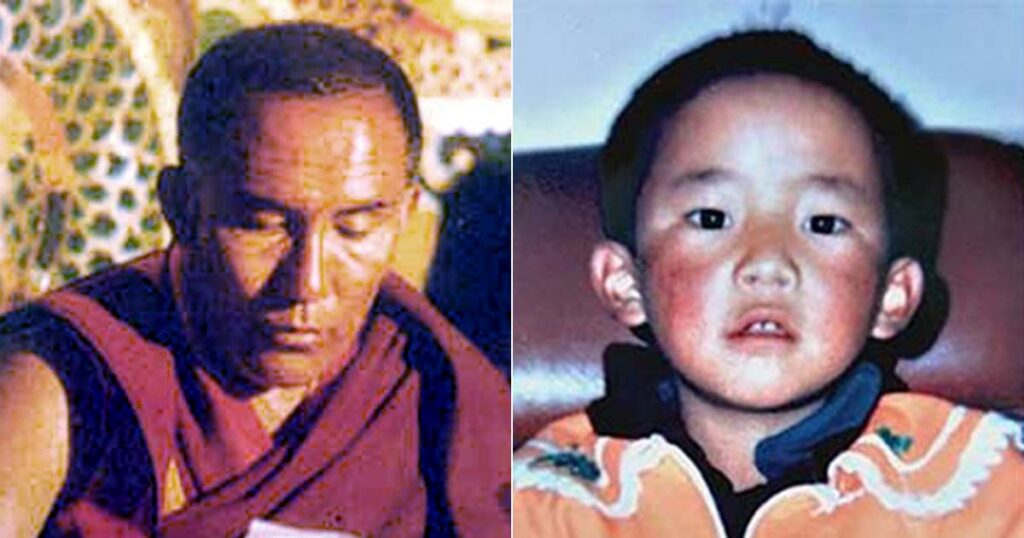
The CCP followed up by unleashing series of restrictive measures. In 1996, Beijing launched a “Patriotic Education” campaign in Tibet subjecting the monastic community to intensive propaganda sessions, at the heart of which was attacks on the Dalai Lama. The objective was to teach them that loyalty to the state is pre-requisite to being a good monk or nun.
The 2008 pan-Tibetan demonstrations in which monks and nuns were seen to be playing leading roles showed that the monastic community, not just in the Tibet Autonomous Region but also in all other Tibetan areas that together constitute traditional Tibet, were not aligning with the CCP. Alarmed at this development, the CCP instituted a research team from the China Tibetology Research Center, led by Zhu Xiaoming, who was one of the CCP experts on Tibetan affairs, to look into the issue. The research team eventually prepared a report, “Constructing a Long-Term Mechanism for the Management of Tibetan Buddhist Temples.”
The National Committee of the Chinese People’s Political Consultative Conference (CPPCC), which is the advisory body to the CCP, also conducted study in 2016 on “The Construction of a Long-Term Mechanism for the Management of Tibetan Buddhist Temples,” led by Zhu Weiqun, a senior CCP official who had been the point person on Tibet when he was working as a deputy minister in the United Front Work Department. Zhu Xiaoming also was a member of this CPPCC research team. During the research team’s study tour of the restive eastern Tibetan area of Ngaba (Aba) Tibetan & Qiang Autonomous Prefectures in Sichuan, Chinese state media quoted Zhu Weiqun as saying, “The establishment of a long-term mechanism for the management of Tibetan Buddhist temples not only involves the question of how Tibetan Buddhism can adapt to socialist society but also relates to the development and long-term stability of Tibetan areas.”
Thereafter, institutional changes were made with the objective of coercing the monastic system and the monks and nuns to be spiritually subservient to the CCP.
Today, a combination of administrative changes and directives are giving shape to this diluted framework of Tibetan Buddhism. At the top of this administrative structure is the United Front Work Department, the CCP agency tasked with winning over non-Communists, including the international community. The State Ethnic Affairs Commission and the State Administration for Religious Affairs, which were both reorganized under the UFWD in 2018, are the vehicles being used in the implementation. SARA supervises the Buddhist Association of China (BAC), which in turn has a Tibetan Buddhism Working Committee (its current Director is 56-years old Gomangtsang Lobsang Gyatso, a Lama from Kanlho (Gannan) Tibetan Autonomous Prefecture in Gansu Province).
Since President Xi Jinping’s announcement in 2012 of his goal of “great rejuvenation of the Chinese nation” which meant the forced Sinicization of all peoples, including their religion, the BAC has been mandated as the tool to implement it in connection with Tibetan Buddhism. This is somewhat similar to what the CCP has been trying to do with Christianity whose believers are being controlled through state-run bodies like the “Three-Self Patriotic Movement” and the Chinese Catholic Patriotic Association.
The BAC was entrusted by the CCP to assume a formal role in all matters regarding Tibetan Buddhist activities. Its new council (appointed in December 2025 for a five-year term) include eight Tibetans as vice presidents: 1) Thupten Nyingpo (Tudan Ningbu), 2) Sharnor Trungpa (Dongbao Zhongba), 3) Tashi Gyaltsen (Zhaxi Jiancai), 4) Gomangtsang Lobsang Gyatso (Guo Mangcang), 5) Rakho Lobsang Tenpay Wangchuk (Lako Luosang Danbei Aangxiu), 6) Kuchar Yonten Gyatso (Gejiao Yundeng Jiacuo), 7) Jedrung Tenpay Gyaltsen (Jizhu Danbai Jiangcun), and 8) the CCP selected Panchen Gyaltsen Norbu. Phakpalha Gelek Namgyal continues as BAC’s honorary president while Jamyang Shepa (Jiamu Yang Luosang Jiumei Tudan Queji Nima) has become the chairman of the advisory committee.
In 2020 BAC’s objectives were amended with the inclusion of the political objective “to support the leadership of the Communist Party of China and the socialist system, to study and implement Xi Jinping Thought on Socialism with Chinese Characteristics for a New Era, to adhere to the direction of Sinicization of Buddhism in China, and to assist the Party and the government in implementing the Party’s basic policy on religious work.”
The amended Charter also outlined the main task of the BAC as being to “assist” not only the government but the CCP in implementing laws, regulations and rules and to “guide Buddhist clergy and religious citizens to fulfill their civic obligations.” The Five-Year Work Plan (2026-2030) of the Tibetan Buddhism Working Committee approved at its second meeting in Lhasa on September 19, 2026, committed to “improve the internal management rules and regulations of Tibetan Buddhism.” Highlighting BAC’s clear political mandate, the TBWC meeting in Lhasa “emphasized that it is necessary to improve the political position and strengthen ideological guidance.”
The historical development of Tibetan Buddhism that has made it a repository of the complete and living Buddhist knowledge came about after centuries through the following institutions that had no interference from successive Tibetan governments: monastic institutions, study curricula, well-educated and qualified teachers, an ecclesiastical community and the Tulku (reincarnations) community.
At the broader level, Tibetan Buddhists are now governed by the Regulation on Religious Affairs (passed by the State Council in 2004 and revised in 2017) and regulations in the Tibetan areas, which have tighter operational measures. The Regulations on Religious Affairs of the Tibet Autonomous Region passed by its People’s Congress in February 2026 outlines the role and tasks of religious organizations, personnel and venues. Its Article 6 categorically says, “The autonomous region implements a governance structure for religious affairs that is led by the Party Committee, managed by the government, coordinated by society, and subject to religious self-discipline.”
The 2026 TAR regulations ban the restoration of “any feudal privileges that have been abolished or the subordinate relationship between places of religious activity.” This means the traditional principal-subordinate relationship in many of the monasteries is now illegal.
The regulations define at the fundamental level as to who is a Buddhist. Traditionally, the only pre-qualification for a lay Tibetan to be a Buddhist was belief in the Kunchok Sum ( དཀོན་མཆོག་གསུམ། Triple Gem) of Buddha, his scriptures and the monastic community, and to seek refuge with them. If one wanted to engage in deeper study and practice, then there were spiritual precepts dealing with moral conduct and ethical behavior of abstaining from vices and cultivating merits. If one wanted to formally join the monastic institutions children were admitted at a young age because spiritual education generally lasted for more than two decades and then followed by an equally important task of practicing as a monk. Novice monks and nuns take thirty-six vows. Fully ordained (bhikshus and bhikshunis) among them have to uphold 227 to 354 vows depending on the school and tradition. These rules are contained in the Vinaya, the collection of the Buddha’s teachings on monastic discipline, and none of these involved any political and non-spiritual beliefs.
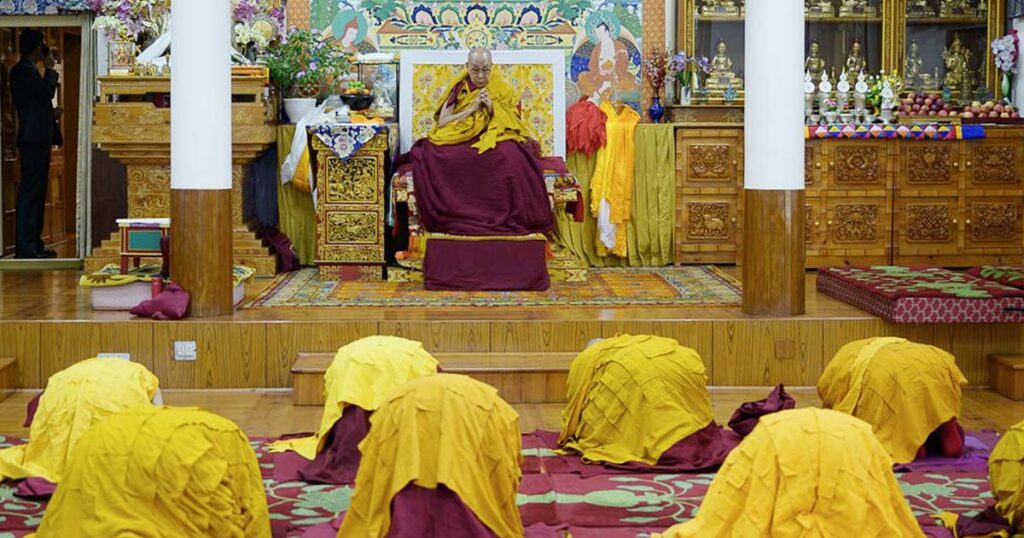
Despite the Chinese Constitution’s promise of freedom of religion, now even lay Tibetan Buddhist practitioners have to follow Buddhist Layman’s Code of Conduct, adopted by the BAC in December 2025. Article 1 of the code clearly mandates that practitioners, “Uphold the Party and love the country, abide by the law and regulations. Support the leadership of the Communist Party of China, uphold the socialist system, adhere to the path of socialism with Chinese characteristics”
As for those Tibetans who wish to become monks and nuns, unlike the traditional admission at a young age, now aspirants have to “be 18 years of age or older” and also be “patriotic,” according to the the Measures for the Administration of Tibetan Buddhist Temples which came into force on January 1, 2025. According to the same Regulations, before the monastic institution admits a new member “it must obtain the collective approval of the temple’s management organization, be reviewed by the local Buddhist Association, and be filed with the county-level religious affairs department.” Each institution also has an “authorized” quota of membership that cannot be exceeded.
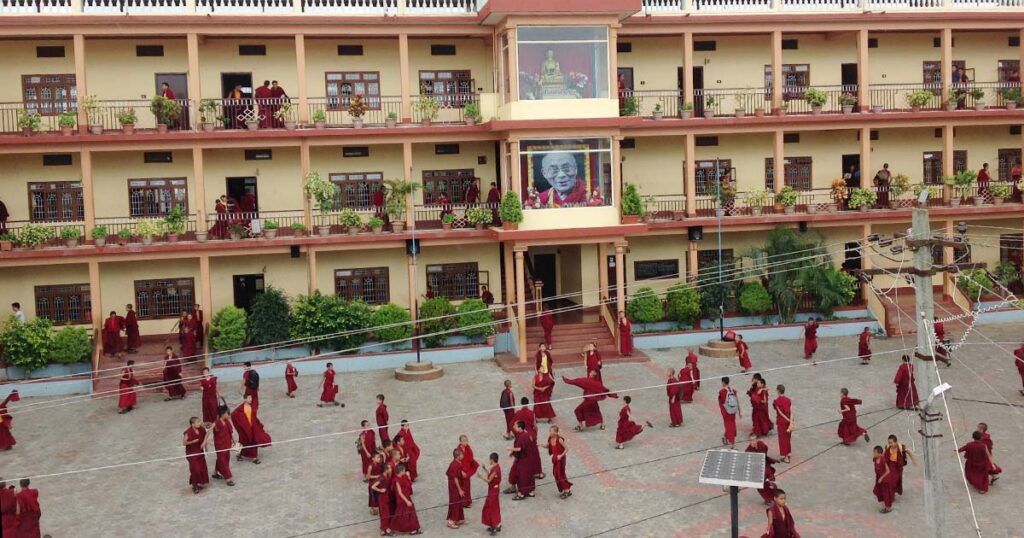
Once students are admitted into the monastic institutions, the Chinese government has replaced the traditional monastic-run administration authority with a concept called the Democratic Management Committee. The membership of this committee (which has a term of five years) includes officials from the government-run “neighborhood committees” in addition to some selected clergy. The members all have to “Love the motherland and support the leadership of the Communist Party of China and the socialist system.” To further ensure that the CCP agenda is strictly adhered to by the Democratic Management Committee, all of its proceedings have to be recorded and if any of the decisions violate “national policies” then the meeting minutes are to be reviewed and except for those who have been found to have opposed to the decision, the others have to “bear responsibility.”
The Chinese authorities have made sure that even those members of the clergy who oversee the ritual aspects of Tibetan Buddhist practice toe the official line. The monastic leadership, including the Abbot, Gekoe (disciplinarian) and Umze (Chant Master), whether they are members of the Democratic Management Committee, have to commit to “Support the leadership of the Communist Party of China and the socialist system,” as per “Measures for the appointment of main teaching positions in Tibetan Buddhist monasteries.”
Having qualified teachers for the monks and nuns is an important element of Tibetan Buddhist study and practice with the traditional sole criteria being well versed in Buddhist philosophy. A Teacher is known as Lama and “Such persons are fully capable of guiding disciples along the entire Buddhist path, all the way to enlightenment, by virtue of the qualities implied by the connotations of guru, la, and ma.”
But now “the basic requirements” for being “certified” as Tibetan Buddhist teachers adopted by BAC in June 2025 is to “Love the motherland, support the leadership of the Communist Party of China, support the socialist system, abide by the Constitution, laws, regulations and rules, practice the core socialist values, adhere to the principle of independence and self-governance, adhere to the direction of Sinicization of religion in China, and safeguard national unity, ethnic solidarity, religious harmony and social stability.” To ensure the teachers’ continued political allegiance, the “certificates” are valid for five years with required extensions thereafter.
As for the study curriculum, whether or not quality scriptural study is being undertaken, the regulations say that the monks and nuns’ “courses include ideological and political theory, laws, regulations and policies, strengthening the sense of community of the Chinese nation, excellent traditional Chinese culture, the national common language and script, the history of the Party, the history of New China, the history of reform and opening up, the history of socialist development, the history of the development of the Chinese nation, the history of the relationship between Tibet and the motherland, and modern scientific knowledge.”
Traditionally, upon completing their studies, the monastic community determined the appropriate degrees to be conferred to the monks and nuns based on their respective traditions. The most well-known among the degrees is “Geshe” which is mainly within the Gelug lineage. Tashi Lhunpo Monastery has its own degree known as Kachen. In the Sakya, Kagyu and Nyingma traditions, there are positions confirmed that include Khenpo and Khenchen. These degrees are awarded to both monks and nuns. These are all decisions made by the respective traditions. Given the nature of the Tibetan Buddhist framework there has not been a centralized degree that covers all the traditions.
The Chinese have now centralized the process by introducing three levels of degrees for all traditions of Tibetan Buddhism, which is being supervised by a UFWD-affiliated entity in Beijing. The revised Measures for Conferring Academic Degrees in Tibetan Buddhism that came into force on May 10, 2026, states that “The State Administration for Religious Affairs and the religious affairs departments of provinces and autonomous regions shall supervise and guide the granting of academic degrees in Tibetan Buddhism.” Monastic members of a steering committee to oversee the provision of the degree have to pass a selection test not only in their knowledge of Buddhism, but also on their political position, thereby preventing those who are not loyal to the CCP from receiving a degree.
More importantly, the first requirement for those aspiring for a degree as mentioned in the same regulations is not spiritualism but political. The regulations say, “Applicants for academic degrees should love the motherland, support the leadership of the Communist Party of China, strengthen their sense of community of the Chinese nation, adhere to the direction of Sinicization of religion in China, safeguard national unity, oppose ethnic separatism, abide by the Constitution and laws; strictly observe the precepts, practice correct faith and conduct; diligently study and practice, possess corresponding Buddhist theoretical knowledge and the ability to preach and expound the Dharma, complete the teaching plan or corresponding courses with satisfactory grades, and meet the application requirements for the corresponding academic degree.”
In traditional Tibetan Buddhist practice, reincarnated teachers play an important role in the education and practice process for practitioners. Known as Tulku (Emanation Body), they act as focal points of devotion and are holders of an unbroken chain of lineage transmissions essential for practice. The function of the lineage is to ensure that practitioners have access to the authentic teachings of the Buddha and learn to practice them according to the instructions of an experienced teacher.
Ever since the first ever recognition in Tibetan Buddhist history in the 13th century when the second Karmapa was recognized, the spread and development of the Tulku system has been organic and internal to the Tibetan Buddhist community. Depending on the nature of the Tulku, recognition was bestowed by senior lamas within the lineage, with the Dalai lama conferring recognition to the seniormost level. Given the nature of reincarnation, there were no geographical or political boundaries. No non-religious criteria and requirements were imposed on the individuals concerned before, during or after recognition.
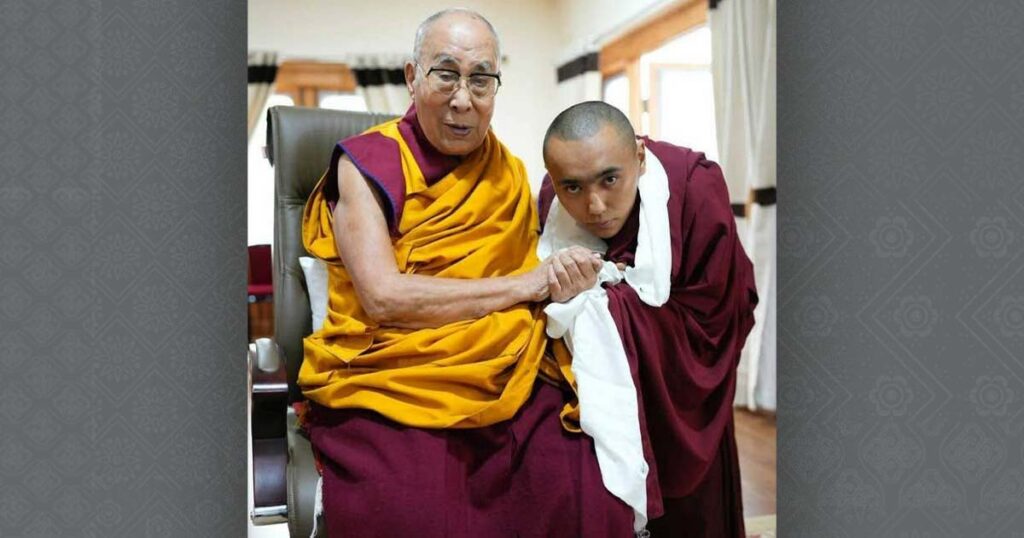
The only political interferences on matters concerning Tulku system have been from the rulers of China. One case is the controversial Golden Urn system that the Manchu emperor imposed in 1793. As the Dalai Lama explains, “During the conflict between Tibet and the Gurkhas (1791-93) the Tibetan Government had to call on Manchu military support. Consequently, the Gurkha military was expelled from Tibet, but afterwards Manchu officials made a 29-point proposal on the pretext of making the Tibetan Government’s administration more efficient. This proposal included the suggestion of picking lots from a Golden Urn to decide on the recognition of the reincarnations of the Dalai Lamas, Panchen Lamas and Hutuktus, a Mongolian title given to high Lamas. Therefore, this procedure was followed in the case of recognizing some reincarnations of the Dalai Lama, Panchen Lama and other high Lamas.” Even then, this procedure was dispensed with in determining recognition of the Ninth, Thirteenth and the current the Fourteenth Dalai Lama indicating that Tibetans followed their own traditional spiritual process.
Similarly, subsequent rulers of China, including the current CCP, have been engaged in various means in their efforts to use Tibetan Buddhism, Buddhist masters and Tulkus as tools to fulfil their political ends.
Following the developments relating to the search process for the 11th Panchen Lama in the 1990s mentioned above, the CCP realized that the only way it could fulfil its political objectives is by inserting a role for itself in this deeply spiritual system. As a result, a series of orders and regulations were passed beginning with The “Management Measures for the Reincarnation of Living Buddhas in Tibetan Buddhism” (Order No. 5) passed by the State Administration of Religious Affairs on July 18, 2007, that came into force on Sept. 1, 2007 (“Living Buddha” is the Chinese term (huófó, 活佛) supposed to be a translation of Tulku, but it is incorrect because Tulkus have not yet achieved Buddhahood). This order detailed the selection, installation and education of reincarnate lamas. It mandates that all Tulkus must receive Chinese government approval without which they would be declared “illegal.”
Further, it bans reincarnations for non-religious reasons in situations where “in city-level people’s governments and above with delineated districts, which ordered no reincarnations to be permitted.” A Tulku is mandated by this order to “protect the principles of the unification of the state, protecting the unity of the minorities.” The Order also says the Buddhist Association of China should be involved in the “verification and authorization” of a Tulku and also is the one that will issue the “Living Buddha certificate.” The certificate, which is the size of an ID card, includes the lay name, religious name, sect and name of the monastery to which the individual belongs. Each certificate has a unique 14-digit number.
It is obvious that the CCP wants to use such regulations to serve its agenda for a future Dalai Lama. The Ethnic Unity and Progress Law that came into effect in July 2026 also includes clauses that ban “interference by external forces” in the name of religion and warning of consequences for people outside of the PRC who are determined to have violated this law. In this regard, even before the ethnic unity law was passed, in July 2025, a joint Communication by UN Special Rapporteur in the field of cultural rights, the UN Working Group on Enforced or Involuntary Disappearances, the UN Special Rapporteur on the promotion and protection of the right to freedom of opinion and expression, the UN Special Rapporteur on minority issues and the UN Special Rapporteur on freedom of religion or belief expressed their “grave concern at the alleged interference by the Government of China into the eventual succession process of the 14th Dalai Lama.” They informed the Chinese Government that they are “particularly concerned that the regulation of reincarnation of ‘Tibetan living Buddhas’, including by restricting the legitimacy of any reincarnation who might have been born or reside outside of the territory of the People’s Republic of China, may interfere with and possibly undermine, in a discriminatory way, the religious traditions and practices of the Tibetan Buddhist community.”
Today, the CCP is laying out a new framework for identifying reincarnation, as outlined in its Five Year Plan for the Tibet Autonomous Region (2026-2030): “We must widely propagate the principles—namely ‘domestic search, drawing lots from the Golden Urn, and approval by the Central Government’—governing the reincarnation of major Living Buddhas, as well as the associated religious rituals and historical precedents.”
China also is ensuring that only those individuals selected under its rules are able to play a role in the Tibetan Buddhist community through the maintenance of a database of authorized Tulkus. This database, managed by BAC, includes name, photo and certificate details of the individuals. In 2016, it announced the listing of 1,311 officially sanctioned names in the database. In order to make this clear to the Tibetan public the CCP also instituted an online “Tibetan Buddhism Living Buddha Inquiry System” through which people can know who the CCP authorized individuals are.
The CCP’s political objective behind this seemingly religious matter was made clear in 2016 by Zhu Weiqun, a Chinese official who was at one time the point person on Tibetan affairs for Beijing. Zhu was quoted by Chinese state media as saying, “The system will strike a heavy blow to the Dalai Lama, as he has been utilizing his religious status to ratify Living Buddhas at will—which is against religious tradition—in an attempt to control Tibetan monasteries and divide the country.”
An analysis of the policy initiatives launched by the CCP in recent years with particular reference to Tibetan Buddhism reveals that they have two broad political objectives: to effectively control the Tibetan people by using religion to bring them under total subjugation and secondly to establish a new framework of governance in the future, particularly in a post-14th Dalai Lama period.
In 2010, Gong Xuezeng, Professor at the Central Party School, wrote an article “Tibet — From Patriotic Education to Building Long-term Monastery Management Mechanisms.” Gong discusses in detail how even while being outside of Tibet, the Dalai Lama continues to play a major role in the Tibetan monastic activities inside Tibet and why this needs to be challenged by the CCP. It explains how to bring Tibetan monks and nuns who follow the Dalai Lama under control, detailing monastery control methods implemented over the past decade. Gong asks the CCP “to further explore the laws of temple management and establish a sound long-term mechanism for the management of Tibetan Buddhist temples.”
More importantly, a study published in China in September 2026 with the lofty subject, “Observations on Religious Transmission and Social Governance in Tibetan-Inhabited Areas” reflects the thought process of the CCP leadership that is leading to the dilution of the Tibetan Buddhist framework outlined in this report. The study shows how closely the Chinese authorities are monitoring developments in the Tibetan exile community, particularly on matters of religion. While not directly mentioning the Dalai Lama, the study clearly outlines the possible implications of his continued strong moral authority over the Tibetans in Tibet. It analyzes the impact of his devolution of political authority to the elected Central Tibetan Administration, his announcements about his reincarnation and his identifying the Gaden Phodrang Trust (the study refers to “a religious trust institution registered abroad”) as the authority to deal with matters concerning his reincarnation.
The study’s focus on the post 14th Dalai Lama developments and the recommendations for remedial action are significant. Referring to the two possible scenarios that might play out then, it says, “One view holds that as the key figure—who has long resided abroad [clearly referring to the Dalai Lama] —eventually exits the scene, overseas political activities related to Tibet will naturally wane. The other posits that any disagreement regarding the identification of the reincarnation will inevitably trigger immediate, serious unrest within Tibetan areas.” It suggests that the Chinese government should look beyond these two possibilities by saying, “Based on currently verifiable public information, both assessments are overly simplistic. What truly warrants attention is perhaps not the sudden disappearance of problems or a sudden eruption of risks, but rather a structural shift in the issues themselves: matters previously concentrated on the religious and political influence of a single central figure may gradually disperse across multiple dimensions—including the reincarnation system, monastic allegiances, overseas organizations, international politics, online dissemination, youth identity, and cross-border social ties.”
The study warns that unless the institutional framework of Tibetan Buddhism is under its control the issue of the 15th Dalai Lama “will turn from a simple religious inheritance to a competition of religious authority that may last for a long time.”
The goal of the policies and regulations on religion and the monastic community is to cultivate a new generation of Tibetan Buddhist monks and nuns whose primary motivation for joining the clergy is to serve the need of the CCP rather than Buddha Dharma. This is being ensured through the four compulsory standards introduced in 2018 —“political reliability,” “profound in religious knowledge,” “moral integrity capable of impressing the public” and “to play an active role at critical moments”— which in essence require the monks and nuns to be party and government propagandists. Recruiting monastics to promote the party and government is more effective, according to Xiong Kunxin, an expert quoted by Chinese state media, because “they have a better understanding of the thoughts and habits of their own group.”
Our analysis of the outlines of China’s 15th Five Year Plan (2026-2030) shows that the CCP intends to continue going forward on strengthening this new framework of Tibetan Buddhism through the Sinicization process. The plan specifically mentions the nurturing of “Three Teams” of personnel to “actively guide religions to adapt to socialist society,” namely a team of Party and government cadres, a team of representatives in the religious field, and a team of researchers in religious studies.” The “Three Teams” framework is a direct outcome of Xi Jinping’s call to intensify outreach on religious work in order to implement the CCP’s Sinicization of religion.
China has been claiming that “lawful religious activities” of the Tibetan people are being permitted. Until the measures mentioned in this report, the definition of what is “lawful” was vague. Now, its scope has been expanded by the CCP to include total adherence to the CCP policies with any activities contradicting them liable to be considered unlawful. This transformation of Tibetan Buddhism, which has potential to contribute to the development of global society, is of concern not just to followers of Tibetan Buddhism, but to the world at large.
In 2007 when China passed Order No. 5 controlling Tibetan Buddhist reincarnation system, Lodi Gyari, then Special Envoy of H.H. the Dalai Lama, expressed his concern, saying, “These stringent new measures strike at the heart of Tibetan religious identity. They will only create further resentment among the Tibetan people and cannot override the Party’s lack of legitimacy in the sphere of religion.” Nearly 20 years later, his words are ringing true as the CCP struggles to still find legitimacy among the Tibetan people.
The framework of party-state management of Tibetan Buddhism cannot be the solution. More recently, United Nations High Commissioner for Human Rights Volker Turk, in his updates to the Human Rights Council on September 7, 2026, made a specific call to China on Tibet saying, “In China, tightening restrictions on the rights of the Tibetan people, including their freedom of religion, are deeply troubling. I appeal for an urgent U-turn on these policies.” The High Commissioner’s appeal cannot come at a more urgent time.