
IN TIBET, CHINA’S 15TH FIVE-YEAR PLAN DRIVES ENFORCED ASSIMILATION UNDER THE GUISE OF DEVELOPMENT
IN TIBET, CHINA’S 15TH FIVE-YEAR PLAN DRIVES ENFORCED ASSIMILATION UNDER THE GUISE OF DEVELOPMENT
Chinese state media alluded to the political objective of the 15th Five-Year Plan by quoting Xi Jinping: “As long as we maintain strategic resolve, forge ahead step by step, and advance steadily from one stage to another, we will continue to turn small victories into great success in advancing the cause of the Party and the country, and our goals will surely be achieved.” China believes the 15th Five-Year Plan period is critical to achieving “socialist modernization” by 2035. “Its focus on high-quality development prioritizes innovation, sustainability, and making domestic demand a more prominent economic driver,” according to Chinese state media.“For Beijing, the logic behind this approach is straightforward. Over the past decade, Chinese policymakers have become increasingly convinced that globalization – once the engine of the country’s meteoric growth – is becoming a source of vulnerability,” says Dr. Yu Jie, senior research fellow on China in Chatham House’s Asia-Pacific program.
Dual-faceted objectives dominate plan’s projects in Tibet
The 15th Five-Year plan, both at the national level and in Tibetan areas, shows that no major new developmental projects have been proposed for Tibet. Rather, the projects outlined are mainly existing ones with the dual-faceted objectives of strengthening national security and furthering enforced assimilation of Tibetans.Several listed projects are directly or indirectly aimed at fulfilling the security needs of Beijing (primarily integrated transportation networks and energy), with any developmental benefits accruing to the Tibetan people being an accidental byproduct. In the plans for the Tibet Autonomous Region and other Tibetan areas, “Chinese-style modernization” is a common euphemism for enforced assimilation of Tibetans into a CCP-prescribed, Chinese-centric identity.
Strategic backbone corridors along Tibet’s border with India
The National 15th Five-Year Plan envisages perfecting “the main backbone of the national integrated three-dimensional transportation network, construct with high quality coastal, border, and river-based strategic backbones and breakthroughs into Tibet.” The CCP seeks to diversify routes for various future strategic needs such as transportation of international cargo and rapid movement of troops and equipment in the event of conflict. The plan also seeks to more fully integrate Tibet into Chinese economy. Tibet, which forms the PRC’s southern border with India, Nepal and Bhutan, would be used by the PRC to augment military-civilian logistics infrastructure. The plan also says, “We will improve the national security system and mechanisms, resolutely safeguard the security of state power, system, and ideology.”
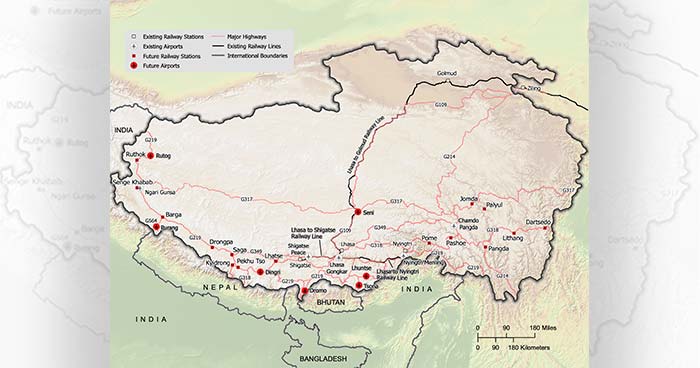
Air, road and rail network along the Indo-Tibetan border. (Cartography by Tsering Wangyal Shawa)
The Plan calls for advances in construction of the rail network from Yaan in western Sichuan to Nyingtri (Linzhi) in Tibet, which is close to the Indian state of Arunachal Pradesh, as well as the construction of the new east and west sections of the “Xinjiang-Tibet Railway” (Xinjiang is known as East Turkestan by the Uyghur people), the electrification upgrade of the Golmud to Lhasa section and the Pome (Bomi) to Rawok (Ranwu) section in southeastern Tibet.
Improvements in the road network envisioned by the national Plan include completing Highway G219 (running through Ngari (Ali) and Shigatse (Rikaze) along the entire southern border of Tibet), upgrading Highway G109 (connecting Beijing with Lhasa via Inner Mongolia, Ningxia, entering Tibet by way of Xining and continuing from there to Golmud and Lhasa), finishing G317 (running from Chengdu, Sichuan to Gar county, Ngari, in western Tibet) and completing Highway G318 that runs east-west from Shanghai to Dram (Zhangmu) on the Tibet-Nepal border. All of these highways run parallel to Tibet’s southern border with India and Nepal.
Feeding China’s increasing power supply needs
The Plan proposes to advance the construction of the controversial Yarlung Tsangpo hydropower project. The project, situated in the southern region of Nyingtri in Tibet, includes five cascade power stations and is expected to generate around 300 billion kilowatt-hours of electricity annually, roughly three times that of the Three Gorges Dam.
The environmental implications are alarming. Experts say that the Yarlung Tsangpo basin lies along the seismically active southern margin of the Tibetan plateau where the river flows through the intersection of two major tectonic suture zones — the Tsangpo suture and the Eurasian-Indian suture.
Even if implemented, this project will not improve electricity availability in Tibet. The plan specifies that its goal is to “achieve west-to-east power transmission” and references Tibet as one of its sources. The plan can thus be seen as a means to provide more power to Chinese provinces, sending electricity to China’s east coast to fuel economic growth, according to the China Yajiang Group, an entity established in Tibet to build and operate the hydropower plant. In its report on the Yarlung Tsangpo Hydropower Project, the Washington DC-based think tank Jamestown Foundation said, “Beijing wants renewable energy sources in western China to power a surge of computing power and data centers as it seeks technological primacy, something Tibet could assist with.” In 2025, a computing center, Yajiang 1 (雅江1号), was established in Nedong which is believed to be part of “Eastern Data, Western Computing” (东数西算), the 2022 initiative to fill the data processing needs of “the energy-hungry eastern provinces.” In June 2025, Yajiang 1, the first major AI computing center on the Tibetan plateau, was inaugurated in Shannan City, using 256 high-performance servers to handle massive AI training and data processing tasks.
In addition, one recruitment announcement says that the Yarlung Tsangpo project will need over 100,000 workers with more than 60 percent of these being “technical roles.” As there may not be enough workers in the Tibetan community, this could lead to an influx of non-Tibetans into the region in the coming period, which may be reflected in the 8th census in 2030 if the project rolls out as planned. Despite China’s claim of empowering Tibetans for the past six decades, Tibetans still do not have the technical know-how for Tibetan workers to be self-reliant in this field.
The Tibetan Autonomous Region (TAR) plan envisions constructing the Jomda (Jiangda) Hydropower Station (江达水电站) but gives no details. Jomda is a region in eastern Tibet under Chamdo Tibetan Autonomous Prefecture. There is also a mention of the Ya’an-Xiamen Hydropower Project.
The plan also calls for exploiting the Changthang (Qiangtang) oil and gas energy resources in Nagchu (Naqu), which is reported to be the largest petroleum-bearing basin on the Tibetan plateau. In 2001, Chinese state media reported that the basin’s “reserves of gas and oil would be around 4 billion to 5.4 billion tons.” This is roughly equivalent to 80% of the entire proven oil reserves of the United States in 2023-2024. The proposed railway and road network could serve as critical infrastructure to tap into this untapped reserve. China already taps into the Tsaidam basin for its energy needs.
Environmental projects on the Tibetan plateau
The Plan calls for advancing ecological protection of the Qinghai-Tibet plateau (the Chinese word for the Tibetan plateau as a whole.) This is further expanded in the Qinghai Province plan under a section on Qinghai-Tibet Plateau Ecological Barrier Zone Protection and Restoration that calls for improving the protection support system of the headwaters for Drichu (Yangtze), Machu (Yellow), and Dza Chu (Lancang) rivers, referred to as “China’s Water Tower”. Even the Ecological and Environmental Code passed by the PRC National People’s Congress in March 2026 included a reference to the need to strengthen ecological restoration work on the Tibetan plateau, calling it “an ecologically fragile and sensitive area.”
Scientists have recognized the important role that the Tibetan plateau plays in maintaining biodiversity and ecosystem services in Asia, and the plan appears on its surface to pay lip service to this goal. The Dalai Lama has also highlighted the vital role of the Tibetan plateau, as the largest reservoir of snow and ice outside the North and the South Poles (hence why it’s called “the Third Pole”). However, Chinese laws are often weaponized to serve political agendas, causing serious problems for Tibetans. For example, China’s grassland policies on the Tibetan plateau, including forced sedentarization of Tibetan nomads, fencing projects and grazing bans, have been recognized as misguided and ill-conceived.
National security considerations dominate projects in Tibet
The national plan outlines efforts to “strengthen the national security system and capacity building.” It calls for strengthening “coordination mechanisms for key national security areas and important special projects and improve emergency response and adaptation effectiveness.”
This is concretized in projects in Tibetan areas. Whether it is hydropower plants or transportation networks, they connect to the overarching security objectives of the CCP. For example, while launching the Yajiang Group in July 2025, Vice Premier Zhang Guoqing mentioned that the project was “a strategic move to safeguard both national energy security and overall national security.” Similarly, CSIS, an American think tank, said in 2025, “The proximity of new and under-construction railways to the Indian border raises significant security concerns as they offer an additional route for the rapid deployment of military assets in the event of a border dispute or conflict along the LAC [Line of Actual Control] near Arunachal Pradesh.”
In the TAR plan document, the national security aspect is mentioned along with deepening “the fight against separatism,” indicating how the CCP interconnects these two issues. The plan also refers to strengthening the “construction of the Skynet Project (天网),” as outlined by the Center for Security and Emerging Technology in 2021. The “Skynet Project” is an AI-powered nationwide surveillance network, using advanced facial recognition and behavior analysis to track individuals in real-time. “Chinese state-run media has claimed Skynet can scan the entire Chinese population in one second with 99.8 percent accuracy, yet such claims ignore glaring technical limitations,” according to Dahlia Peterson, a research analyst at Georgetown University’s Center for Security and Emerging Technology in Washington, DC.
The Kanlho (Gannan) Prefecture plan calls for continuing “the fight against separatism and resolutely safeguard national political security” indicating that even in the far eastern corner of Tibet, Chinese authorities are not confident about the loyalty of Tibetans to the CCP.
Assimilation, including through economic integration
CCP documents reveal that the CCP is using the 15th Five Year Plan to fulfill its objective of forcibly assimilating Tibetans. The CCP proposal says, “We will forge a strong sense of community for the Chinese nation and advance the construction of the Chinese nation community.” Similarly, the plan for the Kanlho Tibetan Autonomous Prefecture in Gansu Province, says, “We will integrate the requirement of forging a strong sense of community for the Chinese nation into all aspects of economic and social development.”
The TAR plan not only calls for “forging a strong sense of community for the Chinese nation,” but also to “[p]romote the historical facts, archaeological artifacts, and cultural heritage to propagate that Tibet has, since ancient times, been an inseparable part of the great motherland, as well as the history of interaction, exchange, and integration among its various ethnic groups.”
The Qinghai plan mentions the aim to implement the Red Gene Inheritance Project (红色基因), a campaign by the CCP to strengthen ideological loyalty and national identity. In embracing the concept, Xi Jinping called for integrating “the red gene into the blood of the officers and soldiers and pass it on from generation to generation.” This can be seen as an attempt by the CCP to embellish its historical accomplishments in order to strengthen the party’s grip on power, inside and outside of Tibet.
Assimilation through mandatory use of the Chinese language is also clearly a goal. The TAR plan asks students as well as “village and community cadres, farmers and herdsmen” to be “proficient in and use the national common language and script.”
Economic integration is envisioned both within Tibetan areas as well as between Tibetan areas and neighboring Chinese provinces. Within Tibetan areas, the plan calls for developing Shigatse and Chamdo as “sub-center cities” in order to create an important node and hub for integration into the surrounding economic circle. Likewise, the CCP seeks to improve border towns, including making Lhoka (Shannan) “a border corridor.”
In the eastern border, Qinghai’s plan calls for strengthening the connectivity of backbone transportation facilities with the Belt and Road Initiative and the Western Land-Sea New Corridor connecting western China with global markets via Chongqing-based rail-sea intermodal services.
The Kanlho plan calls for the expansion and renovation of Xiahe Airport that serves the famed Labrang Monastery in that part of traditional Amdo province, now administered by Gansu province. It also calls for advancing construction on the Tsoe (Hezuo) high-speed rail comprehensive passenger transport hub, which would improve regional connectivity with neighboring provinces.
Tibet as gateway to South Asia to counterbalance India?
While the national plan does not directly reference the Indian subcontinent, the TAR plan details the CCP’s vision for Tibet to become “an important channel for opening up to South Asia.” The TAR plan says, “We will further expand domestic and international openness, actively integrate into the unified national market, and enhance our level of openness to South Asia.” It further adds, how “the important role of the plateau as an important gateway to South Asia and an important strategic pivot of the Belt and Road Initiative has become more prominent.” The TAR plan hopes to make Ngari (Ali), a town near the Tibetan border with Nepal, “an important node for opening up to South Asia, and a major mining and energy base in western Tibet.”
The CCP’s use of “South Asia” could demonstrate its intent to target Nepal, Bhutan and other neighbors to pull them further from India’s sphere of influence. With India, China has not achieved normalization to gain any major forward movement in relations. However, China has been trying to curry influence in Bhutan for several years, including through exploitation of spiritual and cultural commonalities with Tibetans and even bringing to Bhutan performing artists for “Happy Chinese New Year” events. While attending the 2026 event in Bhutan, Chinese Ambassador to India Ambassador Xu Feihong said, “China and Bhutan are connected by mountains and rivers. Our friendship is as pure as the snow. Together, let us protect our heritage like our own eyes, and nurture our friendship like our own kin.” When Bhutan hosted the very visible Global Peace Prayer Festival in November 2025 and included participation by prominent Tibetan lamas in exile, interestingly, China still opted to send its representatives to attend, indicating a persistent effort to maintain a foothold.
In the case of Nepal, China continues to exploit the fluid political situation and strengthen its influence by courting certain politicians and media outlets to drive its narrative. Even though Tibet was not an issue in the 2025 Gen Z movement or the general elections in March 2026, there were baseless allegations of Tibetan involvement in the protests. A prominent politician blamed Tibetans and even the Dalai Lama for their party’s defeat in the elections. China has also been dangling the carrot of economic development to Nepal, most recently in a March 2026 op-ed in the Kathmandu Post by Ambassador Zhang Maoming enticingly entitled, “Embracing China, embracing opportunities.” Zhang wrote, “As we embark on the 15th Five-Year Plan, we welcome Nepal to join us in seizing ‘China Opportunity 2.0.’”
The TAR plan specifically mentions strengthening the existing six entry points to Tibet along Nepal’s borders: Kyirong (Jilong), Dram (Zhangmu), and Purang (Burang) land ports that currently permit entry for passengers as well as cargo, and Lektse (Lizi), Drenthang (Zhentang) and Riwog (Riwu) land ports for commercial cargo only. The plan calls for improving the custom clearance facilities at Lektse on the Mustang border and including Drenthang and Riwog ports in the national port opening plan, indicating that they might permit passenger traffic.
The mention in the TAR plan about a “border trade corridor” in Dromo (Yadong), close to the border with Sikkim in India as well as Bhutan, also merits attention. Currently, there is limited trade that takes place from three points along the Indo-Tibetan border: through Lipulekh pass (opened in 1992), Shipki La (opened in 1994), and Nathu La, Sikkim (opened in 2006). In 2025, India and China agreed to reopen trade after it had been suspended for many years. Dromo is close to Sikkim; the plans in Dromo could mean there would be expanded trade relations between India and China from that route.
Tourism as a vehicle for assimilation
The 15th Five-Year Plan indicates that China intends to continue using tourism into Tibet, primarily from within the PRC, as a vehicle to further integrate and assimilate Tibetans. The TAR plan says this clearly — “We will adhere to the principle of promoting tourism through culture and culture through tourism.”
The TAR plan calls for creation of “cultural symbols and visual image projects with distinctive Chinese cultural characteristics” which means that the promotion of “Red Tourism” contained in the 14th Five-Year Plan will continue. The “Red Gene” project mentioned in the Qinghai plan also serves a similar purpose, namely to create a new normal where Tibetans are subtly made to change their perception of “Chinese” from the “other” to being one of them.
Interestingly, the TAR plan mentions “implementation of visa services at Lhasa Gongkar International Airport” the implication of which is not clear. If it means creating a visa-on-arrival facility, then it would be a major change from the existing “Tibet Travel Permit” (西藏旅游批准函) that is mandatory for all foreign visitors to the TAR in addition to their PRC visa. Today PRC authorities prohibit foreigners from visiting all Tibetan areas including those Tibetan areas that do not officially require a special permit.
Commercializing traditional Tibetan medicine
Traditional Tibetan medicine (sowa rigpa) is accepted as a viable alternative form of treatment internationally and has been promoted primarily by the Dharamsala-based Tibetan Medical and Astro Institute. In recent decades, China has been trying to stake its ownership of the system. The TAR plan calls for establishing a “standardization” (规范化) of Tibetan medicine and the Dechen (Diqing) Prefecture plan talks of promoting the “traditional Chinese and Tibetan medicine industry.” The Kanlho plan includes references to promoting Tibetan medicine while the Qinghai plan mentions “traditional Chinese (Tibetan) medicine” (中(藏)医药). The Ngaba (Aba) prefecture plan talks of promoting “traditional Chinese (Tibetan and Qiang) medicine.” The Yunnan plan, even though it has a Tibetan prefecture under it, only mentions “ethnic minority medicine” (少数民族医药).
Promoting the Sinicization of Tibetan Buddhism
The fact that a document that is supposed to be devoted to economic development expands on Tibetan Buddhism and particularly on the deeply spiritual issue of the reincarnation system clearly shows that China wants the 15th Five-Year Plan to further the CCP agenda of Sinicization of Tibetan Buddhism. In fact, the national plan and some of the plans in Tibetan areas call for adherence to the direction of Sinicization of religion in China. The TAR plan devotes a separate chapter to “Improving the Level of Ethnic and Religious Work.” Within that chapter, there is a section on Sinicization of Tibetan Buddhism wherein the CCP says of reincarnation, “We must widely propagate the principles—namely “domestic search, drawing lots from the Golden Urn, and approval by the Central Government”—governing the reincarnation of major Living Buddhas, as well as the associated religious rituals and historical precedents.” China is blatantly claiming authority to select Tibetan Buddhist lamas, including the Dalai Lama.
In terms of implementation of its agenda on Tibetan Buddhism, the plan specifically mentions the nurturing of “Three Teams” of personnel to “actively guide religions to adapt to socialist society,” namely a team of Party and government cadres, a team of representatives in the religious field, and a team of researchers in religious studies.” The “Three Teams” framework is a direct outcome of Xi Jinping’s call to intensify outreach on religious work in order to implement the CCP’s Sinicization of religion.
Economic integration as part of assimilation strategy
The TAR plan indicates that economic integration is part of the broader Chinese strategy of assimilation. This integration is not only with neighboring Chinese provinces, but more interestingly across international borders. The plan calls for improving “Lhasa’s airport and logistics hub, strengthen international cultural exchanges, and continuously expand foreign economic and trade cooperation.” It also calls for accelerating the development of the Lhasa Cross-border E-commerce Comprehensive Pilot Zone, part of China’s pilot zones announced in 2022 to foster foreign trade growth, specifically focusing on connecting to international markets.
If this expansion of trade is to be implemented internationally, it would mean that the restrictions on access to Tibet will have to be lifted. Currently, there is only minimal access to Tibet for foreigners.
Xi Jinping’s tools for Sinicization
If we look at the 15th Five-Year plan in conjunction with the previous two plans, namely the 13th (2016-2020, the first plan after Xi Jinping assumed control) as well as the 14th (2021-2025), Xi Jinping’s long-term plan for the Sinicization of the Tibetan people becomes evident. Across these plans, economic policies, growth and resource allocation have been used as tools by the CCP to maintain power, control the Tibetan people, ensure stability in Tibet and achieve its ideological goal of assimilating Tibetans.
The 13th Five-Year Plan in 2016 said China’s main tasks in Tibet were to “hold high the great banner of socialism with Chinese characteristics” and to “thoroughly implement the spirit of the 18th National Congress of the Communist Party of China, the 3rd, 4th, and 5th Plenary Sessions of the 18th Central Committee of the Communist Party of China, and the 6th Central Tibet Work Forum.”
The reference to the Tibet work forum in the 13th Tibet plan is significant given that these forums have become important policy-making platforms. To date, seven such meetings on Tibet have been held and each of them has come at a significant milestone in modern Tibetan history.
The first Forum was held in 1980, followed by meetings in 1984, 1994, 2001, 2010, 2015 and 2020, the last two held during Xi Jinping’s tenure. The first Forum in 1980 was an acknowledgement by Hu Yaobang, one of the highest-ranking leaders of the CCP, that the Party’s Tibet policy had failed and needed to be reviewed. The Third Tibet Work Forum in 1994 set the hardline policies on Tibet that are still in place today. Since the 5th Forum in 2010, China has expanded its scope to cover all Tibetan areas and not just the TAR, an indication that China acknowledges that its policy failures in Tibet are not geographically isolated. The 6th Central Tibet Work Forum held in 2015 emphasized that the struggle against “separatism” be given more importance than economic development and that ethnic unity and social stability be the focus of governance. This emphasis was continued in the 7th Tibet Work Forum in 2020 with Xi laying out a “strategy of governing Tibet in the new era” that includes “Sinicization” of Tibetan Buddhism and improving the ability of CCP organizations and members at all levels “to deal with major struggles and prevent major risks.” There was considerable emphasis on ensuring “national security” and “ethnic solidarity.”
Given that the previous three forums have been held at five-year intervals, ICT believes that Chinese authorities may hold the 8th Tibet Work Forum in 2026 or 2027. The 13th Five-Year Plan came one year after the 6th Tibet Work Forum and expectedly outlined the task in Tibet as: “Adhere to the principle of fighting against the 14th Dalai Lama clique, having strict precautions and strictly crack down on all types of separatist and sabotage activities. Continue to deepen ten measures for stability maintenance.” This was the first Five Year Plan with Xi Jinping as the CCP general secretary, and the plan called for implementing an ethnic policy that promotes exchanges and integration of people of all ethnic groups. Tibet was identified as a model area for ethnic unity.
The 14th Five-Year Plan (2021-2025) stressed building a “Modern Socialist Country.” It asserted the language of “Sinicizing” religion, “resisting foreign interference” in internal affairs and “maintaining stability” with a strong military approach. These goals were implemented in Tibet through assimilationist objectives behind outwardly developmental projects. Chinese state media reported that with the 14th Five-Year Plan, “[t]he influence of the Chinese culture will be increased, and the Chinese nation’s cohesiveness will be further strengthened.” Indeed, the 14th Plan period saw displacement of Tibetans in the name of “poverty alleviation.” Tibetans lost their traditional lifestyle in large numbers, Chinese tourists flocked to Tibet and Tibet was further militarized. In 2022, China said it would invest 140.4 billion yuan (about $22 billion) in 181 projects, including construction of railways, highways, airports, tourism, and border trade logistics. These projects were framed as benefiting Tibetans economically but in reality were engineered to meet Xi Jinping’s political objectives.
CCP agenda amplified through 15th Five-Year slogans
In China, political slogans are indispensable communication tools for the CCP to meet its political agenda and ideological control. The 15th Five-Year Plan documents contain several such slogans that give an understanding of the direction of Chinese policy on Tibet.
The following is a list of slogans found in the plans for Tibetan areas:
Understand importance of “Two Establishments” (两个确立)
- Establishing Xi Jinping as the core of the Party Central Committee and the core position of the entire Party; and
- Establishing the guiding position of Xi Jinping Thought on Socialism with Chinese Characteristics for a New Era.
Safeguard the “Two Upholds” (两个维护)
- Upholding Xi Jinping’s core position in the CCP Central Committee, and
- Upholding CCP’s centralized, unified leadership.
Implement the “Four Major Tasks” (四件大事)
- Ensuring stability,
- Promoting development,
- Protecting the ecological environment, and
- Strengthening border defense.
Educate religious circles on Three Consciousnesses (三个意识)
- National consciousness emphasizing a citizen’s political identity and allegiance;
- Civic consciousness highlighting the specific role a citizen assumes within the national framework; and
- Rule of Law Consciousness on how citizens should effectively fulfill that role to ensure social harmony and stability.
Chinese leaders have emphasized that educating, particularly in the Tibetan monastic community, on the “Three Consciousnesses” is an essential requirement for countering the infiltration and subversive activities of the “Dalai Clique.”
Promote the Five Identifications (五个认同)
- Enhancing the sense of identification among people of all ethnic groups with
- the great motherland;
- the Chinese nation,
- Chinese culture,
- the Communist Party of China, and
- Socialism with Chinese Characteristics.
Focus on Six Key Areas and implement Six Major Initiatives (突出“六个聚焦”、实施“六大行动”)
- Focus on unity and harmony, and implement a major initiative to create stability;
- Focus on beautiful mountains and rivers, and implement a major initiative to protect the ecology;
- Focus on project support, and implement a major initiative to achieve breakthroughs in transportation;
- Focus on green development, and implement a major initiative to increase industrial efficiency;
- Focus on people’s well-being, and implement a major initiative to improve people’s lives; and
- Focus on building consensus and strengthening morale, and implement a major initiative to transform work style. (This slogan is in the Kanlho Prefecture plan)
Implement Three Initiatives (三项计划)
- The Youth Exchange Initiative Among Ethnic Groups,
- The Initiative for Integrated Development Among Ethnic Communities, and
- The Initiative for Promoting Interethnic Interaction, Exchange, and Integration Through Tourism. (Kanlho Prefecture Plan)
Adhere to Three Endowments, One Benefit (三个赋予一个有利于)
- All development initiatives must be endowed with significance for ethnic unity and progress;
- they must be endowed with significance for safeguarding national unity and opposing separatism; and
- they must be endowed with significance for improving livelihoods and rallying the people.
- Furthermore, they must all serve to enhance the sense of gain, happiness, and security among people of all ethnic groups. (Kanlho Prefecture Plan)
Coordinate Four Comprehensives (四个全面)
- Comprehensive building of a moderately well-off society (changed in 2020 to Comprehensive building of a modern socialist country);
- Comprehensive deepening of reform;
- Comprehensive promotion of governing the nation in accord with the law; and
- Comprehensive strict governance of the Party. (Qinghai Plan)
ICT’s research concludes that the CCP intends to convey to Tibetans a clear political message: economic development projects planned for Tibet are designed to prioritize Xi Jinping’s political agenda. Almost all of the Tibet-related projects, including the Yarlung Tsangpo hydropower project, the expansion of the highways and rail network, were part of the 14th Five-Year Plan. Thus, China is leveraging the 15th Five-Year Plan to cement Xi Jinping’s political agenda, including socio-political control of Tibet.
Endnote:
Tibet is traditionally comprised of three regions: Amdo (northeastern Tibet), Kham (eastern Tibet) and U Tsang (central and western Tibet). The Tibet Autonomous Region was established in 1965 and covers the area west of the Drichu (Yangtse River), including part of Kham. The rest of Kham have been incorporated into Chinese provinces of Sichuan and Yunnan with Amdo incorporated in Qinghai, Sichuan and Gansu. The term “Tibet” is used to refer to all of these Tibetan areas currently under the jurisdiction of the People’s Republic of China.
Chinese state media alluded to the political objective of the 15th Five-Year Plan by quoting Xi Jinping: “As long as we maintain strategic resolve, forge ahead step by step, and advance steadily from one stage to another, we will continue to turn small victories into great success in advancing the cause of the Party and the country, and our goals will surely be achieved.” China believes the 15th Five-Year Plan period is critical to achieving “socialist modernization” by 2035. “Its focus on high-quality development prioritizes innovation, sustainability, and making domestic demand a more prominent economic driver,” according to Chinese state media.“For Beijing, the logic behind this approach is straightforward. Over the past decade, Chinese policymakers have become increasingly convinced that globalization – once the engine of the country’s meteoric growth – is becoming a source of vulnerability,” says Dr. Yu Jie, senior research fellow on China in Chatham House’s Asia-Pacific program.
Dual-faceted objectives dominate plan’s projects in Tibet
The 15th Five-Year plan, both at the national level and in Tibetan areas, shows that no major new developmental projects have been proposed for Tibet. Rather, the projects outlined are mainly existing ones with the dual-faceted objectives of strengthening national security and furthering enforced assimilation of Tibetans.Several listed projects are directly or indirectly aimed at fulfilling the security needs of Beijing (primarily integrated transportation networks and energy), with any developmental benefits accruing to the Tibetan people being an accidental byproduct. In the plans for the Tibet Autonomous Region and other Tibetan areas, “Chinese-style modernization” is a common euphemism for enforced assimilation of Tibetans into a CCP-prescribed, Chinese-centric identity.
Strategic backbone corridors along Tibet’s border with India
The National 15th Five-Year Plan envisages perfecting “the main backbone of the national integrated three-dimensional transportation network, construct with high quality coastal, border, and river-based strategic backbones and breakthroughs into Tibet.” The CCP seeks to diversify routes for various future strategic needs such as transportation of international cargo and rapid movement of troops and equipment in the event of conflict. The plan also seeks to more fully integrate Tibet into Chinese economy. Tibet, which forms the PRC’s southern border with India, Nepal and Bhutan, would be used by the PRC to augment military-civilian logistics infrastructure. The plan also says, “We will improve the national security system and mechanisms, resolutely safeguard the security of state power, system, and ideology.”
Air, road and rail network along the Indo-Tibetan border. (Cartography by Tsering Wangyal Shawa)
The Plan calls for advances in construction of the rail network from Yaan in western Sichuan to Nyingtri (Linzhi) in Tibet, which is close to the Indian state of Arunachal Pradesh, as well as the construction of the new east and west sections of the “Xinjiang-Tibet Railway” (Xinjiang is known as East Turkestan by the Uyghur people), the electrification upgrade of the Golmud to Lhasa section and the Pome (Bomi) to Rawok (Ranwu) section in southeastern Tibet.
Improvements in the road network envisioned by the national Plan include completing Highway G219 (running through Ngari (Ali) and Shigatse (Rikaze) along the entire southern border of Tibet), upgrading Highway G109 (connecting Beijing with Lhasa via Inner Mongolia, Ningxia, entering Tibet by way of Xining and continuing from there to Golmud and Lhasa), finishing G317 (running from Chengdu, Sichuan to Gar county, Ngari, in western Tibet) and completing Highway G318 that runs east-west from Shanghai to Dram (Zhangmu) on the Tibet-Nepal border. All of these highways run parallel to Tibet’s southern border with India and Nepal.
Feeding China’s increasing power supply needs
The Plan proposes to advance the construction of the controversial Yarlung Tsangpo hydropower project. The project, situated in the southern region of Nyingtri in Tibet, includes five cascade power stations and is expected to generate around 300 billion kilowatt-hours of electricity annually, roughly three times that of the Three Gorges Dam.
The environmental implications are alarming. Experts say that the Yarlung Tsangpo basin lies along the seismically active southern margin of the Tibetan plateau where the river flows through the intersection of two major tectonic suture zones — the Tsangpo suture and the Eurasian-Indian suture.
Even if implemented, this project will not improve electricity availability in Tibet. The plan specifies that its goal is to “achieve west-to-east power transmission” and references Tibet as one of its sources. The plan can thus be seen as a means to provide more power to Chinese provinces, sending electricity to China’s east coast to fuel economic growth, according to the China Yajiang Group, an entity established in Tibet to build and operate the hydropower plant. In its report on the Yarlung Tsangpo Hydropower Project, the Washington DC-based think tank Jamestown Foundation said, “Beijing wants renewable energy sources in western China to power a surge of computing power and data centers as it seeks technological primacy, something Tibet could assist with.” In 2025, a computing center, Yajiang 1 (雅江1号), was established in Nedong which is believed to be part of “Eastern Data, Western Computing” (东数西算), the 2022 initiative to fill the data processing needs of “the energy-hungry eastern provinces.” In June 2025, Yajiang 1, the first major AI computing center on the Tibetan plateau, was inaugurated in Shannan City, using 256 high-performance servers to handle massive AI training and data processing tasks.
In addition, one recruitment announcement says that the Yarlung Tsangpo project will need over 100,000 workers with more than 60 percent of these being “technical roles.” As there may not be enough workers in the Tibetan community, this could lead to an influx of non-Tibetans into the region in the coming period, which may be reflected in the 8th census in 2030 if the project rolls out as planned. Despite China’s claim of empowering Tibetans for the past six decades, Tibetans still do not have the technical know-how for Tibetan workers to be self-reliant in this field.
The Tibetan Autonomous Region (TAR) plan envisions constructing the Jomda (Jiangda) Hydropower Station (江达水电站) but gives no details. Jomda is a region in eastern Tibet under Chamdo Tibetan Autonomous Prefecture. There is also a mention of the Ya’an-Xiamen Hydropower Project.
The plan also calls for exploiting the Changthang (Qiangtang) oil and gas energy resources in Nagchu (Naqu), which is reported to be the largest petroleum-bearing basin on the Tibetan plateau. In 2001, Chinese state media reported that the basin’s “reserves of gas and oil would be around 4 billion to 5.4 billion tons.” This is roughly equivalent to 80% of the entire proven oil reserves of the United States in 2023-2024. The proposed railway and road network could serve as critical infrastructure to tap into this untapped reserve. China already taps into the Tsaidam basin for its energy needs.
Environmental projects on the Tibetan plateau
The Plan calls for advancing ecological protection of the Qinghai-Tibet plateau (the Chinese word for the Tibetan plateau as a whole.) This is further expanded in the Qinghai Province plan under a section on Qinghai-Tibet Plateau Ecological Barrier Zone Protection and Restoration that calls for improving the protection support system of the headwaters for Drichu (Yangtze), Machu (Yellow), and Dza Chu (Lancang) rivers, referred to as “China’s Water Tower”. Even the Ecological and Environmental Code passed by the PRC National People’s Congress in March 2026 included a reference to the need to strengthen ecological restoration work on the Tibetan plateau, calling it “an ecologically fragile and sensitive area.”
Scientists have recognized the important role that the Tibetan plateau plays in maintaining biodiversity and ecosystem services in Asia, and the plan appears on its surface to pay lip service to this goal. The Dalai Lama has also highlighted the vital role of the Tibetan plateau, as the largest reservoir of snow and ice outside the North and the South Poles (hence why it’s called “the Third Pole”). However, Chinese laws are often weaponized to serve political agendas, causing serious problems for Tibetans. For example, China’s grassland policies on the Tibetan plateau, including forced sedentarization of Tibetan nomads, fencing projects and grazing bans, have been recognized as misguided and ill-conceived.
National security considerations dominate projects in Tibet
The national plan outlines efforts to “strengthen the national security system and capacity building.” It calls for strengthening “coordination mechanisms for key national security areas and important special projects and improve emergency response and adaptation effectiveness.”
This is concretized in projects in Tibetan areas. Whether it is hydropower plants or transportation networks, they connect to the overarching security objectives of the CCP. For example, while launching the Yajiang Group in July 2025, Vice Premier Zhang Guoqing mentioned that the project was “a strategic move to safeguard both national energy security and overall national security.” Similarly, CSIS, an American think tank, said in 2025, “The proximity of new and under-construction railways to the Indian border raises significant security concerns as they offer an additional route for the rapid deployment of military assets in the event of a border dispute or conflict along the LAC [Line of Actual Control] near Arunachal Pradesh.”
In the TAR plan document, the national security aspect is mentioned along with deepening “the fight against separatism,” indicating how the CCP interconnects these two issues. The plan also refers to strengthening the “construction of the Skynet Project (天网),” as outlined by the Center for Security and Emerging Technology in 2021. The “Skynet Project” is an AI-powered nationwide surveillance network, using advanced facial recognition and behavior analysis to track individuals in real-time. “Chinese state-run media has claimed Skynet can scan the entire Chinese population in one second with 99.8 percent accuracy, yet such claims ignore glaring technical limitations,” according to Dahlia Peterson, a research analyst at Georgetown University’s Center for Security and Emerging Technology in Washington, DC.
The Kanlho (Gannan) Prefecture plan calls for continuing “the fight against separatism and resolutely safeguard national political security” indicating that even in the far eastern corner of Tibet, Chinese authorities are not confident about the loyalty of Tibetans to the CCP.
Assimilation, including through economic integration
CCP documents reveal that the CCP is using the 15th Five Year Plan to fulfill its objective of forcibly assimilating Tibetans. The CCP proposal says, “We will forge a strong sense of community for the Chinese nation and advance the construction of the Chinese nation community.” Similarly, the plan for the Kanlho Tibetan Autonomous Prefecture in Gansu Province, says, “We will integrate the requirement of forging a strong sense of community for the Chinese nation into all aspects of economic and social development.”
The TAR plan not only calls for “forging a strong sense of community for the Chinese nation,” but also to “[p]romote the historical facts, archaeological artifacts, and cultural heritage to propagate that Tibet has, since ancient times, been an inseparable part of the great motherland, as well as the history of interaction, exchange, and integration among its various ethnic groups.”
The Qinghai plan mentions the aim to implement the Red Gene Inheritance Project (红色基因), a campaign by the CCP to strengthen ideological loyalty and national identity. In embracing the concept, Xi Jinping called for integrating “the red gene into the blood of the officers and soldiers and pass it on from generation to generation.” This can be seen as an attempt by the CCP to embellish its historical accomplishments in order to strengthen the party’s grip on power, inside and outside of Tibet.
Assimilation through mandatory use of the Chinese language is also clearly a goal. The TAR plan asks students as well as “village and community cadres, farmers and herdsmen” to be “proficient in and use the national common language and script.”
Economic integration is envisioned both within Tibetan areas as well as between Tibetan areas and neighboring Chinese provinces. Within Tibetan areas, the plan calls for developing Shigatse and Chamdo as “sub-center cities” in order to create an important node and hub for integration into the surrounding economic circle. Likewise, the CCP seeks to improve border towns, including making Lhoka (Shannan) “a border corridor.”
In the eastern border, Qinghai’s plan calls for strengthening the connectivity of backbone transportation facilities with the Belt and Road Initiative and the Western Land-Sea New Corridor connecting western China with global markets via Chongqing-based rail-sea intermodal services.
The Kanlho plan calls for the expansion and renovation of Xiahe Airport that serves the famed Labrang Monastery in that part of traditional Amdo province, now administered by Gansu province. It also calls for advancing construction on the Tsoe (Hezuo) high-speed rail comprehensive passenger transport hub, which would improve regional connectivity with neighboring provinces.
Tibet as gateway to South Asia to counterbalance India?
While the national plan does not directly reference the Indian subcontinent, the TAR plan details the CCP’s vision for Tibet to become “an important channel for opening up to South Asia.” The TAR plan says, “We will further expand domestic and international openness, actively integrate into the unified national market, and enhance our level of openness to South Asia.” It further adds, how “the important role of the plateau as an important gateway to South Asia and an important strategic pivot of the Belt and Road Initiative has become more prominent.” The TAR plan hopes to make Ngari (Ali), a town near the Tibetan border with Nepal, “an important node for opening up to South Asia, and a major mining and energy base in western Tibet.”
The CCP’s use of “South Asia” could demonstrate its intent to target Nepal, Bhutan and other neighbors to pull them further from India’s sphere of influence. With India, China has not achieved normalization to gain any major forward movement in relations. However, China has been trying to curry influence in Bhutan for several years, including through exploitation of spiritual and cultural commonalities with Tibetans and even bringing to Bhutan performing artists for “Happy Chinese New Year” events. While attending the 2026 event in Bhutan, Chinese Ambassador to India Ambassador Xu Feihong said, “China and Bhutan are connected by mountains and rivers. Our friendship is as pure as the snow. Together, let us protect our heritage like our own eyes, and nurture our friendship like our own kin.” When Bhutan hosted the very visible Global Peace Prayer Festival in November 2025 and included participation by prominent Tibetan lamas in exile, interestingly, China still opted to send its representatives to attend, indicating a persistent effort to maintain a foothold.
In the case of Nepal, China continues to exploit the fluid political situation and strengthen its influence by courting certain politicians and media outlets to drive its narrative. Even though Tibet was not an issue in the 2025 Gen Z movement or the general elections in March 2026, there were baseless allegations of Tibetan involvement in the protests. A prominent politician blamed Tibetans and even the Dalai Lama for their party’s defeat in the elections. China has also been dangling the carrot of economic development to Nepal, most recently in a March 2026 op-ed in the Kathmandu Post by Ambassador Zhang Maoming enticingly entitled, “Embracing China, embracing opportunities.” Zhang wrote, “As we embark on the 15th Five-Year Plan, we welcome Nepal to join us in seizing ‘China Opportunity 2.0.’”
The TAR plan specifically mentions strengthening the existing six entry points to Tibet along Nepal’s borders: Kyirong (Jilong), Dram (Zhangmu), and Purang (Burang) land ports that currently permit entry for passengers as well as cargo, and Lektse (Lizi), Drenthang (Zhentang) and Riwog (Riwu) land ports for commercial cargo only. The plan calls for improving the custom clearance facilities at Lektse on the Mustang border and including Drenthang and Riwog ports in the national port opening plan, indicating that they might permit passenger traffic.
The mention in the TAR plan about a “border trade corridor” in Dromo (Yadong), close to the border with Sikkim in India as well as Bhutan, also merits attention. Currently, there is limited trade that takes place from three points along the Indo-Tibetan border: through Lipulekh pass (opened in 1992), Shipki La (opened in 1994), and Nathu La, Sikkim (opened in 2006). In 2025, India and China agreed to reopen trade after it had been suspended for many years. Dromo is close to Sikkim; the plans in Dromo could mean there would be expanded trade relations between India and China from that route.
Tourism as a vehicle for assimilation
The 15th Five-Year Plan indicates that China intends to continue using tourism into Tibet, primarily from within the PRC, as a vehicle to further integrate and assimilate Tibetans. The TAR plan says this clearly — “We will adhere to the principle of promoting tourism through culture and culture through tourism.”
The TAR plan calls for creation of “cultural symbols and visual image projects with distinctive Chinese cultural characteristics” which means that the promotion of “Red Tourism” contained in the 14th Five-Year Plan will continue. The “Red Gene” project mentioned in the Qinghai plan also serves a similar purpose, namely to create a new normal where Tibetans are subtly made to change their perception of “Chinese” from the “other” to being one of them.
Interestingly, the TAR plan mentions “implementation of visa services at Lhasa Gongkar International Airport” the implication of which is not clear. If it means creating a visa-on-arrival facility, then it would be a major change from the existing “Tibet Travel Permit” (西藏旅游批准函) that is mandatory for all foreign visitors to the TAR in addition to their PRC visa. Today PRC authorities prohibit foreigners from visiting all Tibetan areas including those Tibetan areas that do not officially require a special permit.
Commercializing traditional Tibetan medicine
Traditional Tibetan medicine (sowa rigpa) is accepted as a viable alternative form of treatment internationally and has been promoted primarily by the Dharamsala-based Tibetan Medical and Astro Institute. In recent decades, China has been trying to stake its ownership of the system. The TAR plan calls for establishing a “standardization” (规范化) of Tibetan medicine and the Dechen (Diqing) Prefecture plan talks of promoting the “traditional Chinese and Tibetan medicine industry.” The Kanlho plan includes references to promoting Tibetan medicine while the Qinghai plan mentions “traditional Chinese (Tibetan) medicine” (中(藏)医药). The Ngaba (Aba) prefecture plan talks of promoting “traditional Chinese (Tibetan and Qiang) medicine.” The Yunnan plan, even though it has a Tibetan prefecture under it, only mentions “ethnic minority medicine” (少数民族医药).
Promoting the Sinicization of Tibetan Buddhism
The fact that a document that is supposed to be devoted to economic development expands on Tibetan Buddhism and particularly on the deeply spiritual issue of the reincarnation system clearly shows that China wants the 15th Five-Year Plan to further the CCP agenda of Sinicization of Tibetan Buddhism. In fact, the national plan and some of the plans in Tibetan areas call for adherence to the direction of Sinicization of religion in China. The TAR plan devotes a separate chapter to “Improving the Level of Ethnic and Religious Work.” Within that chapter, there is a section on Sinicization of Tibetan Buddhism wherein the CCP says of reincarnation, “We must widely propagate the principles—namely “domestic search, drawing lots from the Golden Urn, and approval by the Central Government”—governing the reincarnation of major Living Buddhas, as well as the associated religious rituals and historical precedents.” China is blatantly claiming authority to select Tibetan Buddhist lamas, including the Dalai Lama.
In terms of implementation of its agenda on Tibetan Buddhism, the plan specifically mentions the nurturing of “Three Teams” of personnel to “actively guide religions to adapt to socialist society,” namely a team of Party and government cadres, a team of representatives in the religious field, and a team of researchers in religious studies.” The “Three Teams” framework is a direct outcome of Xi Jinping’s call to intensify outreach on religious work in order to implement the CCP’s Sinicization of religion.
Economic integration as part of assimilation strategy
The TAR plan indicates that economic integration is part of the broader Chinese strategy of assimilation. This integration is not only with neighboring Chinese provinces, but more interestingly across international borders. The plan calls for improving “Lhasa’s airport and logistics hub, strengthen international cultural exchanges, and continuously expand foreign economic and trade cooperation.” It also calls for accelerating the development of the Lhasa Cross-border E-commerce Comprehensive Pilot Zone, part of China’s pilot zones announced in 2022 to foster foreign trade growth, specifically focusing on connecting to international markets.
If this expansion of trade is to be implemented internationally, it would mean that the restrictions on access to Tibet will have to be lifted. Currently, there is only minimal access to Tibet for foreigners.
Xi Jinping’s tools for Sinicization
If we look at the 15th Five-Year plan in conjunction with the previous two plans, namely the 13th (2016-2020, the first plan after Xi Jinping assumed control) as well as the 14th (2021-2025), Xi Jinping’s long-term plan for the Sinicization of the Tibetan people becomes evident. Across these plans, economic policies, growth and resource allocation have been used as tools by the CCP to maintain power, control the Tibetan people, ensure stability in Tibet and achieve its ideological goal of assimilating Tibetans.
The 13th Five-Year Plan in 2016 said China’s main tasks in Tibet were to “hold high the great banner of socialism with Chinese characteristics” and to “thoroughly implement the spirit of the 18th National Congress of the Communist Party of China, the 3rd, 4th, and 5th Plenary Sessions of the 18th Central Committee of the Communist Party of China, and the 6th Central Tibet Work Forum.”
The reference to the Tibet work forum in the 13th Tibet plan is significant given that these forums have become important policy-making platforms. To date, seven such meetings on Tibet have been held and each of them has come at a significant milestone in modern Tibetan history.
The first Forum was held in 1980, followed by meetings in 1984, 1994, 2001, 2010, 2015 and 2020, the last two held during Xi Jinping’s tenure. The first Forum in 1980 was an acknowledgement by Hu Yaobang, one of the highest-ranking leaders of the CCP, that the Party’s Tibet policy had failed and needed to be reviewed. The Third Tibet Work Forum in 1994 set the hardline policies on Tibet that are still in place today. Since the 5th Forum in 2010, China has expanded its scope to cover all Tibetan areas and not just the TAR, an indication that China acknowledges that its policy failures in Tibet are not geographically isolated. The 6th Central Tibet Work Forum held in 2015 emphasized that the struggle against “separatism” be given more importance than economic development and that ethnic unity and social stability be the focus of governance. This emphasis was continued in the 7th Tibet Work Forum in 2020 with Xi laying out a “strategy of governing Tibet in the new era” that includes “Sinicization” of Tibetan Buddhism and improving the ability of CCP organizations and members at all levels “to deal with major struggles and prevent major risks.” There was considerable emphasis on ensuring “national security” and “ethnic solidarity.”
Given that the previous three forums have been held at five-year intervals, ICT believes that Chinese authorities may hold the 8th Tibet Work Forum in 2026 or 2027. The 13th Five-Year Plan came one year after the 6th Tibet Work Forum and expectedly outlined the task in Tibet as: “Adhere to the principle of fighting against the 14th Dalai Lama clique, having strict precautions and strictly crack down on all types of separatist and sabotage activities. Continue to deepen ten measures for stability maintenance.” This was the first Five Year Plan with Xi Jinping as the CCP general secretary, and the plan called for implementing an ethnic policy that promotes exchanges and integration of people of all ethnic groups. Tibet was identified as a model area for ethnic unity.
The 14th Five-Year Plan (2021-2025) stressed building a “Modern Socialist Country.” It asserted the language of “Sinicizing” religion, “resisting foreign interference” in internal affairs and “maintaining stability” with a strong military approach. These goals were implemented in Tibet through assimilationist objectives behind outwardly developmental projects. Chinese state media reported that with the 14th Five-Year Plan, “[t]he influence of the Chinese culture will be increased, and the Chinese nation’s cohesiveness will be further strengthened.” Indeed, the 14th Plan period saw displacement of Tibetans in the name of “poverty alleviation.” Tibetans lost their traditional lifestyle in large numbers, Chinese tourists flocked to Tibet and Tibet was further militarized. In 2022, China said it would invest 140.4 billion yuan (about $22 billion) in 181 projects, including construction of railways, highways, airports, tourism, and border trade logistics. These projects were framed as benefiting Tibetans economically but in reality were engineered to meet Xi Jinping’s political objectives.
CCP agenda amplified through 15th Five-Year slogans
In China, political slogans are indispensable communication tools for the CCP to meet its political agenda and ideological control. The 15th Five-Year Plan documents contain several such slogans that give an understanding of the direction of Chinese policy on Tibet.
The following is a list of slogans found in the plans for Tibetan areas:
Understand importance of “Two Establishments” (两个确立)
- Establishing Xi Jinping as the core of the Party Central Committee and the core position of the entire Party; and
- Establishing the guiding position of Xi Jinping Thought on Socialism with Chinese Characteristics for a New Era.
Safeguard the “Two Upholds” (两个维护)
- Upholding Xi Jinping’s core position in the CCP Central Committee, and
- Upholding CCP’s centralized, unified leadership.
Implement the “Four Major Tasks” (四件大事)
- Ensuring stability,
- Promoting development,
- Protecting the ecological environment, and
- Strengthening border defense.
Educate religious circles on Three Consciousnesses (三个意识)
- National consciousness emphasizing a citizen’s political identity and allegiance;
- Civic consciousness highlighting the specific role a citizen assumes within the national framework; and
- Rule of Law Consciousness on how citizens should effectively fulfill that role to ensure social harmony and stability.
Chinese leaders have emphasized that educating, particularly in the Tibetan monastic community, on the “Three Consciousnesses” is an essential requirement for countering the infiltration and subversive activities of the “Dalai Clique.”
Promote the Five Identifications (五个认同)
- Enhancing the sense of identification among people of all ethnic groups with
- the great motherland;
- the Chinese nation,
- Chinese culture,
- the Communist Party of China, and
- Socialism with Chinese Characteristics.
Focus on Six Key Areas and implement Six Major Initiatives (突出“六个聚焦”、实施“六大行动”)
- Focus on unity and harmony, and implement a major initiative to create stability;
- Focus on beautiful mountains and rivers, and implement a major initiative to protect the ecology;
- Focus on project support, and implement a major initiative to achieve breakthroughs in transportation;
- Focus on green development, and implement a major initiative to increase industrial efficiency;
- Focus on people’s well-being, and implement a major initiative to improve people’s lives; and
- Focus on building consensus and strengthening morale, and implement a major initiative to transform work style. (This slogan is in the Kanlho Prefecture plan)
Implement Three Initiatives (三项计划)
- The Youth Exchange Initiative Among Ethnic Groups,
- The Initiative for Integrated Development Among Ethnic Communities, and
- The Initiative for Promoting Interethnic Interaction, Exchange, and Integration Through Tourism. (Kanlho Prefecture Plan)
Adhere to Three Endowments, One Benefit (三个赋予一个有利于)
- All development initiatives must be endowed with significance for ethnic unity and progress;
- they must be endowed with significance for safeguarding national unity and opposing separatism; and
- they must be endowed with significance for improving livelihoods and rallying the people.
- Furthermore, they must all serve to enhance the sense of gain, happiness, and security among people of all ethnic groups. (Kanlho Prefecture Plan)
Coordinate Four Comprehensives (四个全面)
- Comprehensive building of a moderately well-off society (changed in 2020 to Comprehensive building of a modern socialist country);
- Comprehensive deepening of reform;
- Comprehensive promotion of governing the nation in accord with the law; and
- Comprehensive strict governance of the Party. (Qinghai Plan)
ICT’s research concludes that the CCP intends to convey to Tibetans a clear political message: economic development projects planned for Tibet are designed to prioritize Xi Jinping’s political agenda. Almost all of the Tibet-related projects, including the Yarlung Tsangpo hydropower project, the expansion of the highways and rail network, were part of the 14th Five-Year Plan. Thus, China is leveraging the 15th Five-Year Plan to cement Xi Jinping’s political agenda, including socio-political control of Tibet.
Endnote:
Tibet is traditionally comprised of three regions: Amdo (northeastern Tibet), Kham (eastern Tibet) and U Tsang (central and western Tibet). The Tibet Autonomous Region was established in 1965 and covers the area west of the Drichu (Yangtse River), including part of Kham. The rest of Kham have been incorporated into Chinese provinces of Sichuan and Yunnan with Amdo incorporated in Qinghai, Sichuan and Gansu. The term “Tibet” is used to refer to all of these Tibetan areas currently under the jurisdiction of the People’s Republic of China.