

BEYOND ‘NEITHER GOAT NOR SHEEP’[1]
Eroding Tibetan language to forcibly advance Chinese national identity
BEYOND ‘NEITHER GOAT NOR SHEEP’[1]
Eroding Tibetan language to forcibly advance Chinese national identity
“The Central Government has frequently talked about the importance of learning and using the Tibetan language in Tibet. But it has done nothing to ensure its implementation.”
-10th Panchen Lama, TAR delegation session at the National People’s Congress in Beijing, 1987
“How should the death of a language and script be understood?
In gist, initially not even one person remains who is utilizing both the language and script and there is permanent death. Consequently, the entire culture of that nationality gradually disappears. Eventually, even that nationality itself completely transforms into something else, with not even a trace of the past being visible, thus becoming a major cultural disaster.”
-Khenpo Tsultrim Lodrö (Tibetan Buddhist teacher at Larung Gar in Serthar in eastern Tibet). The History of the World’s Eastern and Western, Ancient and Modern Philosophy – the birth and death of world’s languages and scripts, 2013 (ཚུལ་ཁྲིམས་བློ་གྲོས། འཛམ་གླིང་ཤར་ནུབ་ཀྱི་གནའ་དེང་རིག་པའི་རྣམ་གཞག་དང་འཛམ་གླིང་གི་སྐད་ཡིག་སྐྱེ་འཆིའི་ལོ་རྒྱུས། ༢༠༡༣ ལོར ཀན་སུའུ་མི་རིགས་དཔེ་སྐྲུན་ཁང་།)
“The autonomous region shall comprehensively promote the popularization of the national common language and characters…”
-Regulations on the Creation of a Model Region of National Unity and Progress in the Tibet Autonomous Region, 2025, Article 12.
The Tibetan language is undergoing an alarming transformation that is threatening its very survival in Tibet. Subtle changes in official Chinese policies over the years have resulted in the marginalization of the Tibetan language, narrowing scope for further studies for Tibetans, limitations on academic disciplines, and reducing their employment prospects. These Chinese policies and their direct and indirect impacts are discouraging Tibetans not only from studying Tibetan but also endangering the continuation of Tibetan as their medium of communication in their daily lives.
The bipartisan United States Commission on International Religious Freedom (USCIRF) in its 2025 annual report in fact asserts that there is ongoing “cultural genocide of Tibetan Buddhists” under the Chinese government.
The threat was perceived initially at the social level when Tibetans in Tibet noted the increasing insertion of Chinese words in Tibetan conversations. They dubbed this development as Ramalug. Today, there are public discussions even within the restrictive atmosphere in Tibet that show the situation has gone beyond the state of Ramalug and a combination of official policy and social development are posing a clear threat to the very survival of the Tibetan language. The fact that many Tibetans inside Tibet are courageously speaking out publicly despite the risks of reprisals from the Chinese authorities indicate the critical nature of the situation.
An analysis by the International Campaign for Tibet (ICT) shows there are significant shifts and reversals of comparatively favorable language policies in Tibet and that the Chinese authorities are aggressively implementing President Xi Jinping’s political agenda of a new Chinese national identity through direct and indirect imposition of Chinese (Mandarin), leading to an adverse transformation of Tibetan language and identity. This is being done through rule by law, breaching Beijing’s own constitutional and related legal provisions or negating them by passing measures making the Tibetan language less relevant to the Tibetan people themselves. Additionally, Chinese policies are creating an environment in Tibet that is demotivating Tibetans, particularly the younger generation, from utilizing Tibetan in their daily lives.
This report details the nature of this transformation: from the period when Deng Xiaoping and Hu Yaobang made efforts to respect Tibetan culture and institutionalized the promotion of Tibetan language to the period of Xi Jinping, which is characterized by the Chinese Communist Party’s (CCP) systematic policies to undermine and eventually eliminate the use of the Tibetan language in the education system; forcibly impose Chinese; and create an environment that increasingly encourages Tibetans to adopt Chinese as the medium of communication in their lives. The report shows how Beijing is amending existing legislation that was designed to protect the Tibetan language or passing new laws that actively undermine its use. The development is happening in such a way as to provide no choice to the Tibetan people while superficially allowing the Chinese authorities to continue to claim that they are promoting use of the Tibetan language even while they consistently undercut and marginalize it.
Despite Tibet being under Chinese occupation for many decades, China still feels the need to seek international legitimacy and validation by attempting to project its policies on Tibet and Tibetans as a success story, particularly more so during this 60th year of the establishment of the so-called Tibet Autonomous Region (TAR). The TAR comprises around half of the area of traditional Tibet, the rest being incorporated in Sichuan, Yunnan, Qinghai and Gansu provinces. Throughout these Tibetan areas, the Chinese propaganda approach continues to compare the Tibetan people’s economic and social situation in 2025 to life in Tibet before the Dalai Lama fled to make the case that independent Tibet was worse. Even if we acknowledge this unequal comparison, the legality of political occupation of a territory is not founded on how the inhabitants were governing it before foreigners took it upon themselves to “liberate” them.
China is creating a new normal in Tibet that poses an existential threat to the Tibetan people: the very survival of Tibetan identity. This is a change from an initial policy of physical destruction (during the period of Mao Zedong) when CCP authorities did not aggressively target the Tibetan language. That policy was subsequently changed to one of control, which is transforming the fundamental nature of Tibetan identity to fit the reshaped Chinese national identity under President Xi Jinping. This is most visible in the field of Tibetan language education and usage. Through a combination of initiatives, the CCP is altering the role of the Tibetan language in the people’s daily lives, even while forcing the use of Chinese (Mandarin) upon Tibetans. This engenders in the Tibetan people a feeling of disconnection from their own linguistic identity, which could lead to the language’s gradual erasure.
Tibet has a unique and diverse linguistic heritage composed of dozens of dialects and additional “minoritized” languages spoken in particular communities. From this rich foundation, it is clear that the CCP’s vision of Tibet is one in which these languages are slowly and steadily replaced by Chinese.
Tibetan Language as Cultural Heritage
There is a saying in Tibetan highlighting the important role of language for the Tibetan people: “Pure father tongue is one’s life and soul” (ཕ་སྐད་གཙང་མ་རང་གི་བླ་སྲོག་ཡིན།).
In a substantive 2020 report, “China’s ’Bilingual Education’ Policy in Tibet: Tibetan-Medium Schooling Under Threat,” Human Rights Watch says that international human rights law obligates China to provide Tibetan-language instruction to Tibetans. The United Nations Convention on the Rights of the Child (UNCRC), which China ratified in 1992, states that “a child belonging to a … minority … shall not be denied the right … to use his or her own language.” The International Covenant on Civil and Political Rights (ICCPR), which China has signed but not ratified, contains similar language.
In its message for the 2025 International Mother Tongue Day, the UN categorically highlighted “the importance of language preservation in safeguarding cultural heritage, improving education, and fostering more peaceful societies.” According to UNESCO, while the practice and transmission of living heritage contribute to the vitality, strength and well-being of indigenous communities, language is the principal vehicle through which such living heritage is kept alive.
This is also supported by several UN measures, including the Convention for the Safeguarding of the Intangible Cultural Heritage, which was ratified by China in 2004 and refers to “oral traditions and expressions, including language as a vehicle of the intangible cultural heritage.”
Tibetan language is not just a medium of communication but is the most important attribute of the Tibetan people’s identity. The Dalai Lama has said that this is “not a matter of attachment to one’s own nationality.” Rather, he says, the Tibetan language is the one that has best preserved the entirety of the Buddha’s teachings. Through centuries Tibetan language literary works in history, medicine, and philosophy have shaped Tibetan civilization.
Given this significance, the preservation of the Tibetan language is among the utmost priorities of the Dalai Lama. In addition to him publicly highlighting the importance of Tibetan language, the Tibetan side also raised its importance during the dialogue process with the Chinese government between 2002 and 2010, saying, “The protection, use, and development of the Tibetan language are one of the crucial issues for the exercise of genuine autonomy by Tibetans.”
Evolution of China’s Tibetan language policy
Constitutional basis and early assaults in the 1950s and 60s
China spares no efforts in claiming that it is protecting and promoting the Tibetan language. In 1959, soon after the Tibetan uprising demanding China respect Tibetan rights, the official New China News Agency (the then name of Xinhua), reported, “Most of the documents of the Preparatory Committee were written in the Tibetan language” and referred to this as evidence of respect China had “for the right of the people of Tibet.” As recently as February 2023, the State Commission of Nationalities Affairs-run GONGO (“Government Organized Non-Governmental Organization”), China Ethnic Minorities’ Association for External Exchanges, claimed in a document submitted to the UN Human Rights Council that “The study, use and development of Tibetan language and characters are protected by law.”
The two main legal documents that the Chinese cite are the Constitution of the People’s Republic of China and the Law on Regional National Autonomy, the legislative document that promises special considerations for people like the Tibetans. Article IV of the Constitution does recognize all “ethnic groups” as being equal and that “all ethnic groups shall have the freedom to use and develop their own spoken and written languages and to preserve or reform their own traditions and customs.” Even in the 17-Point Agreement with Tibet in 1951, China did say that “The spoken and written language and school education of the Tibetan nationality will be developed step by step in accordance with the actual conditions in Tibet” (Article 9).
Following its takeover of Tibet, however, the Chinese authorities did not take any proactive measures to promote Tibetan language. On the contrary, as the 10th Panchen Lama mentions in his 70,000 character petition of 1962 to the Chinese Premier, “The Tibetan language, dress and personal adornment, good customs and habits and other such important national characteristics which should have been respected were also included in the “Three Greats” revolutionary work of “great destruction, great exposure, great construction.” In short, Tibetan language was projected as being inferior.
Nevertheless, on account of the absence of any economic development support in the initial decades of occupation, the Chinese authorities had to rely on the Tibetan language as a vehicle to control the Tibetan people.
Limited protection in the late 70s and 80s
Beginning in the late 1970s, during the period of comparatively liberal policies, there were efforts to promote Tibetan language and Tibetan education in general, including inviting Tibetans in exile to play a role in the process. The Dalai Lama mentioned these efforts in his communication to the Chinese leadership after establishment of his contact with China’s paramount leader Deng Xiaoping in 1979. The communications were made public subsequently, and among the first understandings they had was that the Dalai Lama would send 50 Tibetans educated in exile to help teach in Tibet.
Following the resumption of contact with the Dalai Lama, Deng invited fact-finding delegations from the Dalai Lama’s side to study the situation in Tibet. The third such delegation, led by then president of the Tibetan Children’s Villages, Jetsun Pema, traveled extensively across Tibet in 1980 and focused on the status of Tibetan education. Participating in an event in Washington, DC, she said the delegation toured 59 Tibetan villages and towns in 105 days and returned confirming that the standard of education in Tibet was deplorably low.
Simultaneously, Deng set up a four-member working group, headed by liberal leader Hu Yaobang who had by then become CCP General Secretary, “to assess the situation and formulate correct policies for Tibet.” The other members were vice premier Wan Li, Ngapo Ngawang Jigme (who was then a vice-chairman of the National People’s Congress), and Yang Jingren, head of the State Commission of Nationalities Affairs.
Hu in turn convened the first-ever Tibet Work Forum meeting, from March 14 to 15, 1980, which produced a series of recommendations in the form of “Minutes of the Tibet Work Forum.” In order to establish the importance of the minutes, the CCP Central Committee formally approved and circulated them to the Party, Government and Military leadership of all provinces. A key directive of this Forum was to “attach importance to the use of Tibetan and Tibetan languages” and that students, “must learn Tibetan.” The Forum also said, “Tibetan textbooks should be compiled and published to improve teaching quality.” Highlighting the need to put Tibetan language into daily use by the authorities, the Forum said, “Documents issued by party and government organs in the autonomous region must be written in both Tibetan and Chinese. We should train translators and establish translation and printing institutions.”
Thereafter, Hu led the working group delegation, the first-ever CCP delegation of this kind, on an inspection trip to Lhasa from May 22 to 31, 1980 during which he publicly reprimanded the officials for neglecting the welfare of the Tibetan people. Amongst other findings, Hu believed that “Education has not progressed well in Tibet” and confirmed the need for “more extensive use of Tibetan language.”
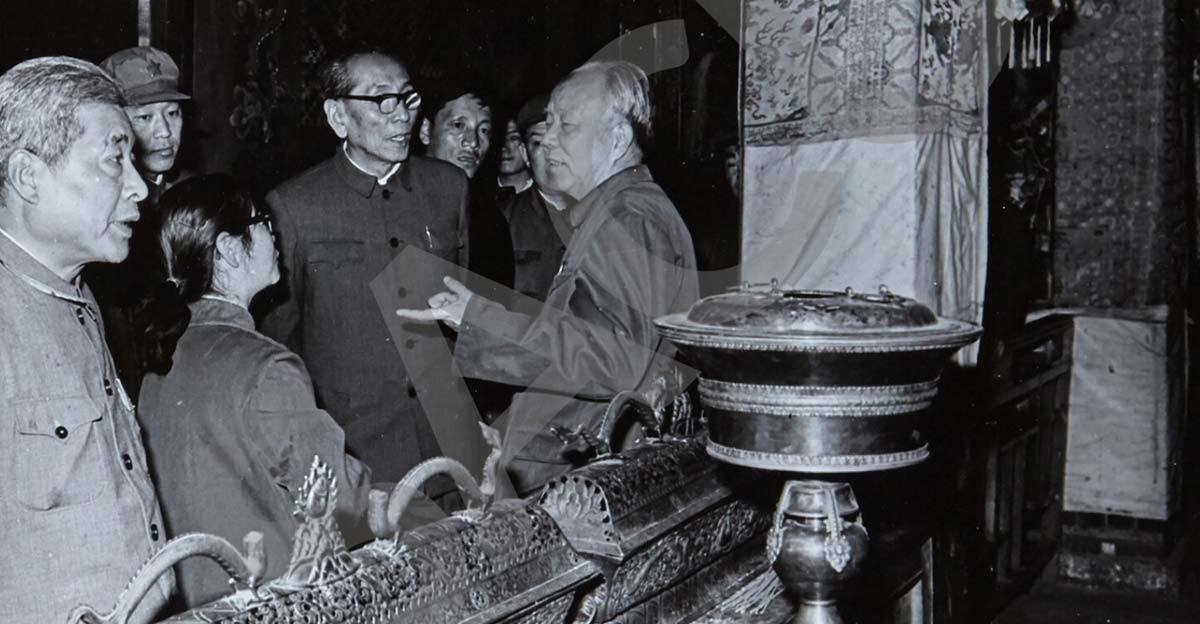
Hu Yaobang, seen here with Ngapo Ngawang Jigme, during his visit to Lhasa in May 1980.
The visit resulted in a six-point reform policy initiative on Tibet known as “Six Major Issues” in which the importance of the Tibetan language was highlighted, specifically making the learning of it mandatory for Chinese cadres in Tibet. It said, “…otherwise they will be divorced from the masses. Cherishing the people of minority nationalities is not empty talk. The Tibetan people’s habits, customs, history and culture must be respected.”
Legislation institutionalizing promotion of the Tibetan language during the late 80s and 90s
Subsequently, there was the enactment of legislation, both in Beijing and in the Tibetan capital Lhasa, which promised to protect and promote the Tibetan language. In 1984, the national-level Law on Regional National Autonomy was passed, which guaranteed rights to communities like the Tibetans, including the freedom “to use and develop their own spoken and written languages” (Article 10) and mandated this in the education system by having Tibetans “use textbooks in their own languages and use their languages as the medium of instruction” (Article 37) (emphasis added).
Specifically, in 1987, the Tibet Autonomous Region saw the adoption of “Several Provisions of the Tibet Autonomous Region on the Study, Use and Development of the Tibetan Language” that institutionalized the promotion of Tibetan language, at least on paper. Its Article 2 clearly said, “State organs at all levels shall implement the policy of using Tibetan as the main language and Tibetan and Chinese languages in conjunction with all activities of performing their duties.” In the schools, Article 3 said, “Tibetan students in schools of all levels and types in the autonomous region must list Tibetan language as a primary subject, and other courses must, in principle, be taught primarily in Tibetan.” (emphasis added). It further said, “All Tibetan primary school students will be taught in the Tibetan language. Chinese language courses will be added starting from the upper grades without affecting Tibetan language instruction.” In the judicial field, Article 12 mandated that courts in TAR “must guarantee the right of Tibetan citizens to use their own spoken and written language in litigation.”
This was the period when the 10th Panchen Lama had been rehabilitated and began actively addressing the concerns of the Tibetan people. In his public remarks in the 1980s until his death in 1989, he was critical of Chinese policies in Tibet, including on the Tibetan language. Therefore, he would certainly have had a hand in the developments, particularly relating to Tibet.
Similarly, in 1993, in north-eastern Tibet, the Malho (Huangnan) Tibetan Autonomous Prefecture in Qinghai Province enacted its Regulations on Tibetan Language Work in Malho Tibetan Autonomous Prefecture, which legalized the promotion of Tibetan language. Its Article 4 said, “The autonomous prefecture adheres to the principle of combining popularization with improvement in Tibetan language work, inherits and promotes the excellent historical and cultural heritage of the Tibetan people, promotes the development of the Tibetan language, and enhances its role in the reform, opening up, and economic construction of the autonomous prefecture.”
In 1994, the Measures for the Implementation of the Compulsory Education Law of the People’s Republic of China in the Tibet Autonomous Region was passed. Its Article 20 mandated “Tibetan language as the primary language” in the schools and that “Schools should ensure that minority students first master the local ethnic language and writing system, and then master Chinese.” It also said that TAR should “gradually improve the Tibetan and Chinese language teaching system.”
This and other developments in the 1980s offered a hopeful future for the Tibetan language.
Five Provinces and Autonomous Regions establish Tibetan Education Collaboration Leading Group
The Chinese authorities’ establishment of a Leading Group in the 1980s focused on the Tibetan language demonstrated the seriousness with which Beijing took its promotion and preservation during that period. In the Chinese system, Leading Groups are interagency coordinating bodies that address important policy areas, cutting across the government, party, and military leadership. Taking into consideration the reality of the situation that the Tibetan people inhabit not just their own demarcated Tibet Autonomous Region, but also areas incorporated into the four provinces of Sichuan, Yunnan, Qinghai and Gansu, the Leading Group set out to promote and standardize Tibetan language education throughout the Tibetan regions.
Therefore, in 1982, “The Five Provinces Tibetan Textbook Collaboration Group” was established to coordinate the compilation of Tibetan-language syllabi, textbooks, and reference books for various subjects in primary and secondary schools, and to promote the development of basic education in all Tibetan areas. This was an important development as until then the five Tibetan areas were individually compiling and producing textbooks in Tibetan for their students.
The absence of a coordinated approach resulted in an imbalanced output from the students. As an indication of the importance of the issue, the scope of the group was expanded in 1988, and the authority upgraded to that of a leading group, named the Five Provinces and Autonomous Regions Tibetan Education Collaboration Leading Group (成立五省区藏族教育协作领导小组 Chénglì wǔ shěng qū zàngzú jiàoyù xiézuò lǐngdǎo xiǎozǔ). According to Chinese state media, the group’s members included vice governors and vice chairmen in charge of education in the five provinces and autonomous region; vice directors in charge of ethnic education in the education commissions and education departments; and relevant officials from the State Education Commission and the State Ethnic Affairs Commission.
The Leading group met regularly in the different areas and came out with initiatives to improve education in the Tibetan language.
The Chinese government-run China Education and Research Network wrote positively about the Leading Group. Quoting Sun Youlin, an official of the then Qinghai Provincial Ethnic Textbook Compilation Office, the Network said, “The establishment of the five-province Tibetan Textbook Collaboration Leading Group has built a bridge for communication and exchange in Tibetan education, ushering in a new era for the development of Tibetan textbooks, moving from a fragmented and isolated approach to collaborative development.” It continued that the group had completed the compilation of two sets of textbooks in just seven years, “1,353 Tibetan textbooks covering nine categories and 26 subjects for use in all levels of schools, from elementary school, junior high school, and high school to secondary normal school.”

A meeting of the Five Provinces and Autonomous Regions Tibetan Education Collaboration Leading Group in Pari (Tianzhu) in Kanlho (Gannan) Tibetan Autonomous Prefecture, Gansu, in July 2006.
These developments led to flourishing Tibetan studies and literature in general. There was an increase in the number of Tibetan language writers with people even crediting the 1980s as the time when the history of modern Tibetan literature began.
Bilingual education with Tibetan as the medium of instruction codified in the 90s
When the Chinese authorities introduced bilingual education formally in the Tibetan schools, the Model 1 was implemented and this version prioritized Tibetan as the medium of instruction and Chinese as an additional language. (The Model 2 version prioritized Chinese as the medium of instruction with Tibetan as an additional language and is now being implemented.) This was reflected in the compulsory education law of 1994 referenced above. On paper, several measures were passed guaranteeing the right of Tibetans to use their own language as the medium of instruction in schools.
At the national level, the Chinese Ministry of Education, while issuing a general notice in June 2000 on the preparation of Chinese language textbooks to be used in schools for Tibetans, explained that, “the Chinese textbooks for Tibetan primary and secondary schools are primarily intended for Tibetan students in a model where instruction is primarily in Tibetan, with additional Chinese instruction in selected subjects.” (emphasis added). China’s White Papers on Tibet, including those in 2004 and 2013 also boasted that “Bilingual education, with Tibetan as the principal language, is widespread in Tibet.” The 2004 White Paper even claimed that China has put the “work of using and promoting Tibetan spoken and written language on a legal basis.” It further said, “Both Tibetan and Chinese languages are used in all schools in Tibet, with the Tibetan as the major one, and the textbooks and teaching reference books from primary to high school have been edited, translated into and published in Tibetan language.” (emphasis added)
Even in the “Outline of the National Plan for Medium- and Long-Term Education Reform and Development” for 2010-2020, Chinese authorities categorically committed to, “Respect and guarantee the right of ethnic minorities to receive education in their own spoken and written languages”. It further affirms that “State support shall be given to bilingual faculty training, teaching research, and textbook compilation and publication.”
In 2021, China’s Ministry of Education amended the Education Law, which mentioned that schools and institutions in ethnic autonomous regions and ethnic minorities should use indigenous languages to implement bilingual education while the government provides additional support for minority learners.
Also, as good as these were on paper, in practice the Chinese authorities were gradually marginalizing the study of the Tibetan language. In fact, in 1987, the 10th Panchen Lama presciently said, “The Central Government has frequently talked about the importance of learning and using the Tibetan language in Tibet. But it has done nothing to ensure its implementation.”
Legal imposition of Chinese as medium of instruction in the 2000s
Beginning in the 2000s an aggressive push began to impose Chinese on the Tibetan people. This was accompanied by direct and indirect measures that are now leading to a situation where the Tibetan language is facing a crisis of survival in its own homeland.
In the process, Chinese authorities are amending existing laws and enacting new legislation in order to fulfill the objective of making Tibetans embrace Chinese.
In January 2001, the Law on the National Standard and Spoken Language that came into effect mandated local governments at various levels and the relevant departments under them to take measures to popularize Chinese.
In 2002, the Regulations of the Tibet Autonomous Region on the Study, Use and Development of the Tibetan Language of 1987 was amended to do away with the mandatory requirement making Tibetan the medium of instruction. The amended Article 2 “the principle of equality of all ethnic groups’ languages and scripts” must be adhered to. Similarly, Article 3 mandated that Chinese will have an equal role with Tibetan saying, “When state organs at all levels in the autonomous region perform their duties, the Tibetan language and the national standard spoken and written language have equal validity.”
In 2008, the TAR repealed the 1994 Compulsory Education Law replacing it with a revised version that no longer mandated Tibetan as the medium of instruction while making the promotion of Chinese mandatory. Its Article 32 said, “Article 32 During the compulsory education stage, the Tibetan language and the national standard language shall be used as the basic educational and teaching terms and characters, and Mandarin teaching shall be promoted.”
In the volatile Ngaba (Aba) region in Amdo, even while attempts were made to promote Tibetan, it was now placed in the same level as Mandarin Chinese when it came to the medium of instruction. The Regulations on the Tibetan Language and Writing System in Ngaba Tibetan and Qiang Autonomous Prefecture adopted by the Sichuan People’s Congress in June 2018, Article 8 said, “Preschool education may use the national common language and the Tibetan language for bilingual education in language, art, health, social studies, and science. Primary and secondary schools in Tibetan-populated areas shall use the national common language and Tibetan as the basic medium of instruction.”
Then in 2020, when schools reopened in Ngaba for the academic session that year in the wake of the coronavirus outbreak, Radio Free Asia reported that the parents learned, through announcements during meetings, that Tibetan will no longer be the medium of instruction for primary and middle schools in Ngaba.
In Tibetan areas in Qinghai, the “Outline of the Medium- and Long-Term Education Reform and Development Plan of Qinghai Province (2010-2020)” clearly said, “Use the national standard language as the medium of instruction.” It further stated, “By 2015, primary schools will implement “bilingual” instruction, with the national standard language as the primary medium and the ethnic minority language as the supplementary medium.”
Systematic Dismantling of Tibetan Language Schooling in the 2010s and 20s
In a notable 2015 incident, authorities in Yushul (Ch: Yushu), historically part of the Tibetan province of Kham, forced the closure of a monk-operated private kindergarten teaching the Tibetan language. Chinese officials extended this prohibition to other monasteries and private educational schools and institutions in the region.
Since 2021, authorities have forcibly closed numerous private schools and primary schools in monasteries that specialized in Tibetan language education. On July 12, 2024, the Chinese government ordered the forcible closure of the award-winning Jigme Gyaltsen Nationalities Vocational High School in Golog, Amdo. Previously in June, the Taktsang Lhamo Kirti Monastery school, which had about 500 students, faced increasingly strict restrictions until it was forced to close. On October 31, 2021, not only was the Drakgo Monastery’s Gedhen Nangten (Eng: Buddhist) School closed, but the classrooms, dormitories and other facilities were demolished. Others affected were the Sengdruk Taktse School in Darlag County of Golog Prefecture, followed by the closure of Machen County’s Cherished Children School.
The crackdown intensified in 2022, when three additional schools were forced to cease operations across Kardze prefecture: The Phende Care School in Dzakhog County, the Private Primary School in Chaktsang Center, and the Gyalten Foundation School in the Trehor Dargye Rongpatsa area. Speaking to Radio Free Asia under condition of anonymity, a Tibetan teacher revealed that these institutions were targeted specifically because they offered specialized Tibetan language education programs. This occurred despite the schools having previously secured all necessary governmental approvals and permits for their operations.
According to information released by the Ngaba Prefecture’s Nationality and Religious Affairs Committee in July 2024, before the closure of the Taktsang Lhamo Kirti Monastery school, 69 primary schools throughout Ngaba Prefecture had been completely closed, 8 schools were merged with other schools, and 33 primary schools had their educational systems changed in accordance with the 14th Five-Year Plan of Ngaba Prefecture. Following these events, the PRC government has further intensified its crackdown on Tibetan language schools in monasteries.
Tibetan no longer core college entry subject as of 2026
Chinese officials justify the new education policy in Tibet that reduces the emphasis on core Tibetan language education (while promoting the study of Chinese language) by arguing that this will “provide more opportunities for students to become talents, and provide more choices for students to enter higher education institutions.” For example, the head of the TAR Government, Karma Tseten, cited this as a reason for eliminating Tibetan as one of the core subjects for the critical college entrance examinations from 2026 onwards. While announcing this at a press conference in Beijing on August 5, 2025, Tseten also confirmed the political agenda of undermining the distinct Tibetan identity by saying that “this will help students of all ethnic groups enjoy more equitable high-quality education.”
Since at least 2021, the TAR had been dividing the college entrance examination candidates into two categories, A and B. For candidates who follow the A-type curriculum plan, the unified college entrance examination subjects are Chinese, Tibetan, mathematics, and foreign languages. Chinese and Tibetan each account for 50% of the total score, and the score will be presented in the Chinese subject. For students taking the B-type curriculum plan, the unified college entrance examination subjects are Chinese, mathematics, and a foreign language.
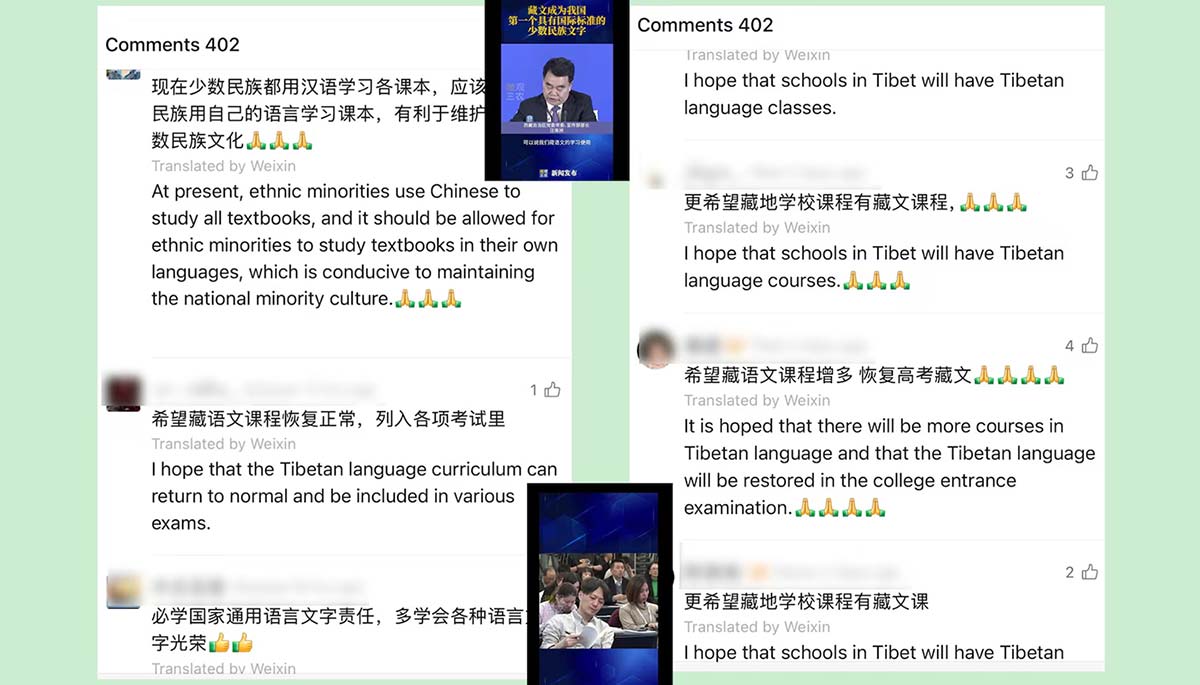
Netizens (their names blurred for security reasons) demanding the Tibetan language to be reinstated as a requirement in college entrance exams, taught in schools, and used in workplaces on a Chinese social media platform, March 31, 2025.
By the time a journalist queried TAR chairman Karma Tseten (Gama Cedain) at a press briefing in Beijing on August 5, 2025 about China’s plans to remove Tibetan from being a core subject in the national college entrance exam, it had already spread among Tibetans in Tibet who came forward to post criticism even on restrictive Chinese social media platforms.
In the beginning of 2025, there were netizens demanding the reinstatement of Tibetan language as a requirement in college entrance exams. “Language and culture are the most precious wealth in the world… Restore Tibetan language in college entrance exams,” one posting said.
“No matter which nationality, as long as there is a language, it needs to be supported by the government and included in textbooks so that children can learn their mother tongue,” wrote another Tibetan.
Boarding schools leading to Tibetan language erosion in recent years
Reacting to this development, three independent UN human rights experts, Fernand de Varennes, Special Rapporteur on minority issues; Farida Shaheed, Special Rapporteur on the right to education, and Alexandra Xanthaki, Special Rapporteur in the field of cultural rights, said in February, “We are alarmed by what appears to be a policy of forced assimilation of the Tibetan identity into the dominant Han-Chinese majority, through a series of oppressive actions against Tibetan educational, religious and linguistic institutions.”
One month later, in March 2023, the United Nations Committee on Economic, Social and Cultural Rights, in its concluding observations on the third periodic report of China demanded that China “abolish immediately the coerced residential (boarding) school system imposed on Tibetan children and allow private Tibetan schools to be established.”
2020 Ethnic Unity Law and marginalization of the Tibetan language
For the first time, the regulations explicitly depart from the principle of preferential treatment for Tibetans, as stipulated in the Regional Ethnic Autonomy Law, which was supposed to guarantee that Tibetans could maintain their culture and way of life under Chinese rule. While Tibetans have faced systematic discrimination even under the preferential treatment policy, the new regulations, along with policies like the residential boarding school system, heighten fears that they will be forced to assimilate into Chinese culture even more rapidly.
The regulations articulate long-held policy goals that seek to reduce ethnic differences in the People’s Republic of China to achieve a stable, Chinese-centric society and consolidate the Communist Party’s grip on Tibet.
The regulations reflect Xi Jinping’s focus on consolidating power in the party and eliminating threats, as well as the ideas of a new generation of ethnic policy thinkers who advocate for the dilution of ethnic differences. These thinkers seek to force the assimilation of Tibetans and therefore further undermine Tibetans’ inherent freedom to preserve their unique culture, language, religion and way of life.
An analysis by ICT of the ethnic unity law in TAR concluded that it violates international human rights standards, such as the Convention on the Elimination of All Forms of Racial Discrimination (CERD), which China ratified in 1981, and in view of provisions regulating education, the Convention on the Rights of the Child, which China ratified in 1992. The regulations also violate the right to freely pursue social and cultural development, pursuant to Article 1 of the Convention on Economic, Social and Cultural Rights, which China ratified in 2001.
In the Two Sessions in 2025, implementation of Xi Jinping’s strategy of a common Chinese identity was voiced by different leaders and included a legislative initiative by the NPC. In his work report to the NPC on March 8, 2025, its Chairman Zhao Leji announced the plan to have a new national “ethnic unity” law saying, “We will formulate a law on promoting ethnic unity and progress to forge a strong sense of national identity, reinforcing the Chinese people as one cohesive community.”
A draft of the legislation has now been made public by the Chinese government. The draft further advances Xi’s and the CCP’s goal to forcibly impose Chinese on Tibetans. Article 15 of the draft says, “The state shall comprehensively promote the popularization of the national standard spoken and written Chinese language, encouraging preschoolers to learn Chinese and adolescents who have completed compulsory education to master the national standard spoken and written Chinese language. No organization or individual may hinder citizens from learning and using the national standard spoken and written Chinese language. State organs shall use the national standard spoken and written Chinese language for official business. Where, in accordance with relevant laws, documents need to be issued in minority languages and scripts, versions in the national standard spoken and written Chinese language shall also be provided. Where, in public settings, state organs, social groups, enterprises, institutions, and other social organizations need to use both the national standard spoken and written Chinese language and the minority languages and scripts, they shall give priority to the national standard spoken and written Chinese language and script in terms of placement and order.”
The political significance of this proposed national legislation on ethnic unity and progress can be understood when we look at the fact that in January 2020, “Regulations on the Creation of a Model Region for National Unity and Progress in the Tibet Autonomous Region” was enacted in Lhasa. The regulations, revised in January 2025, are the first such legislative initiative by China and formalizes CCP powers to enforce a Chinese-centric way of life and represents an explicit legal departure from the principle of preferential treatment for people like the Tibetans, as stipulated in the Regional Ethnic Autonomy Law.
Outside of the PRC, enduring support for Tibetan language rights
Similarly, in May 2020, the then High Representative of the European Union for Foreign Affairs and Security Policy/Vice-President of the European Commission Josep Borrell responded to a question by MEP Isabel Santos on the TAR ethnic unity law saying, “The EU has repeatedly raised its strong concerns about restrictions on freedom of religion or belief and on the rights of minorities in Tibet, both in EU-China bilateral meetings and publicly, including in multilateral fora.” MEP Santos’ question was prefaced with, “The International Campaign for Tibet revealed how the ‘ethnic unity’ legislation recently adopted in Tibet will further erode the fundamental liberties of Tibetans and infringe their human rights.”
In 2023, the German government expressed its concern about the increasingly deteriorating human rights situation in Tibet. A representative of the Foreign Office stated during a meeting of the Committee on Human Rights and Humanitarian Aid that the government expressly supports the UN Committee on Economic, Social and Cultural Rights’ demand for an end to forced boarding schools for Tibetan children and the forced resettlement of Tibetan nomads. The representative stressed that the opportunities for schooling in Tibet have been systematically reduced through the closure of schools. As a result, Tibetan children are forced to attend boarding schools in the cities during the week, where they are taught almost exclusively in Mandarin. The goal is clear, according to the government representative: to suppress Tibetan language and culture.
Erosion of Tibetan Sign Language
The introduction of the TibSL (a project which has been running since 2000) has been a boon to those Tibetans who were otherwise devoid of a common vehicle of communication on account of their disability. According to the Lhasa-based Tibetan Deaf Association, the TibSL compiled several volumes of TibSL dictionaries. It said signs are collected according to the cultural background of deaf Tibetans to make it more practical. TibSL’s creation was a bottom-up approach initiated by a group of deaf and hard-of-hearing Tibetans. They collected sign languages among Tibetan deaf-mutes, turned the signs into images with Tibetan explanations and unified a standardized sign language after prolonged, repeated trial use.
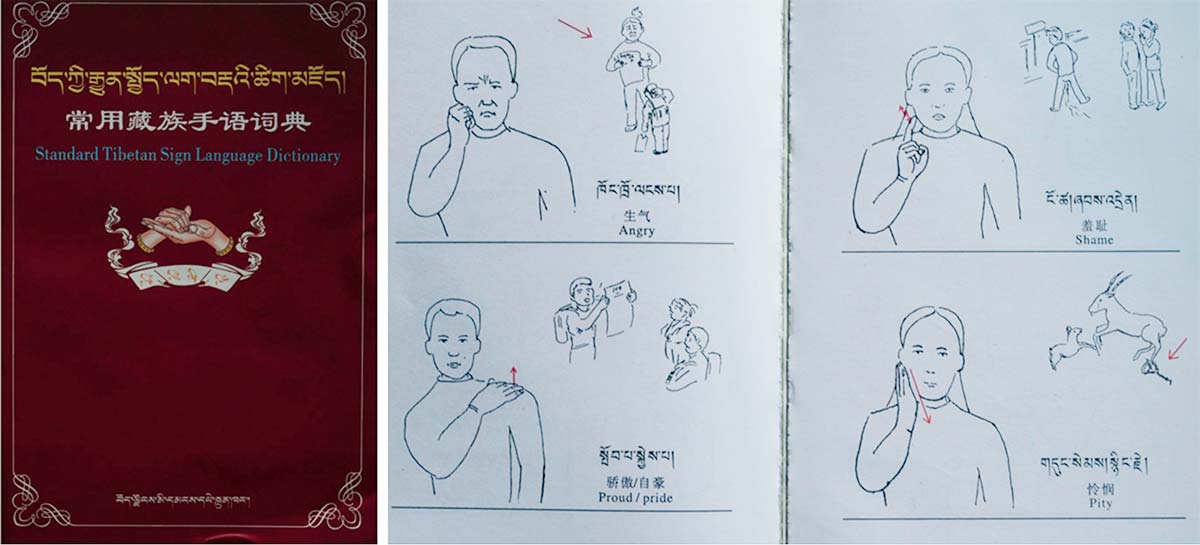
Front cover of the Standard Tibetan Sign Language Dictionary and a sample from a textbook.
In 2004, China appears to not only recognize the introduction of Tibetan Sign Language when Chinese state media reported, “This is the first sign language system designed for deaf-mutes of a minority ethnicity in China,” but more importantly acknowledged its uniqueness in comparison to CSL saying, “This dactylology system differs from the one being used nationwide as the latter is basically a kind of Chinese characters conversion whereas many Tibetans can neither read nor write the Chinese characters.”
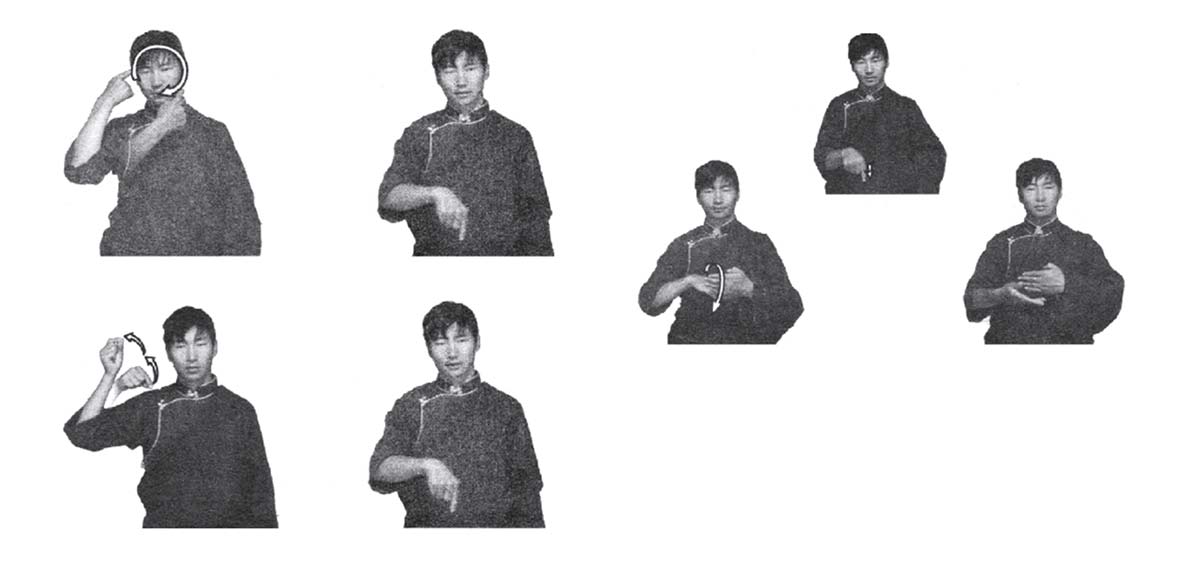
Sample of TibSL SAKOR DI ‘this week’ (upper left), DAWA DI ‘this month’ (upper right) and LO DI ‘this year’ (lower left).
(TDA 2011: 433, 436, 424)
Chinese authorities highlighted the impact of TibSL saying in 2007, “The development of standardized Tibetan sign language has effectively promoted the education and social integration of the deaf and mute people and reduced communication barriers.”
However, now even TibSL is facing the challenge of survival with Chinese authorities now promoting Chinese Sign Language (CSL) as the nominal “national language”. The problem here, according to sign language experts, is that CSL follows spoken Chinese and contains many signs related to Chinese pictograms. In short it is incompatible with the Tibetan language. Nevertheless, CSL enjoys a dominant position as the medium of education in Tibetan schools for the deaf. A researcher on Tibetan sign language says this “exerts pressure on the growth and use of TibSL in that Tibetan deaf graduates from the Lhasa school sign more CSL than TibSL and have in recent years apparently connected little with the wider TibSL community after leaving school.”
While deaf activists in China are able to defend regional sign varieties and dialects of CSL, deaf Tibetan advocates are facing an increasingly difficult work environment. In a highly charged and repressive political environment, they often fear repercussions if officials interpret their activities as “politically sensitive,” that is, if they are construed as contested aspects of the Tibetan identity and language nexus.
The TibSL researcher concludes, “Deaf Tibetans in Lhasa find themselves in a complex and dynamic linguistic and socio-political situation. Linguist Gerald Roche has also rightly observed that minority language speakers in the Chinese Tibetosphere tend to be “minorities twice over”, that is, they are classified as part of a minzu (an ethnic minority, or ‘minority nationality’) within the Han-dominated PRC state, as well as a linguistic minority within the Tibetan minzu (2014: 21).” Roche suggests that, as a result, some of the TibSL signers are “minorities thrice over.” In addition to being members of the two minorities mentioned by Roche, they also belong to a minority sign community within a vast state-sponsored CSL and Chinese domains which exert dominance in whatever little exists of deaf activism and sign language-based deaf education within the PRC.
Smaller languages and dialects of Tibet suppressed altogether by State policy
A Tibetan student who comes from a household that speaks standard Amdo Tibetan may, therefore, see Amdo Tibetan spoken on television and receive a minimal amount of classroom hours on Amdo Tibetan instruction. While this is clearly insufficient and falls within the broader CCP plan to undermine and eliminate the use of Tibetan, a Tibetan student who speaks a minoritized language will never hear their language in news programs nor receive any education in it at school. As far as the state is concerned it does not exist, resulting in an even greater breach of China’s responsibilities under international law and the PRC constitution.
Scholars such as Gerald Roche have dedicated considerable time and effort to mapping these languages and documenting how they have been essentially marked for immediate destruction by Chinese policy.
Impact of Chinese policy on Tibetan language
Similarly, Prof. David Germano of the University of Virginia testified that “in two or three decades, we are looking at the possible disappearance of Tibetan where reading and writing becomes the province of a few isolated monasteries. When urban Tibetans rarely speak Tibetan, and even in rural Tibet, spoken Tibetan comes under increasing pressure.”
Prof. Germano further contends that the loss of the Tibetan language would create “a traumatic discontinuity with the 1,300-year history of their own literary culture, with different intellectual disciplines, professional environments, ways of life.”
In a study published in 2019 two researchers, Lubei Zhang and Linda T. H. Tsung, who examined Tibetan bilingual education policy and family language practice in Qinghai between 2013 and 2016 found “that conflicts exist between the top-down government language policies and bottom-up family language practice.”
In its concluding observations in March 2023 on the third periodic report of China, the UN Committee on Economic, Social and Cultural rights expressed concerns about “reports of the large-scale campaign to eradicate Tibetan culture and language, as well as the general undermining of the linguistic identity of ethnic minorities by the assimilation policy of the State party, known as Sinicization, including the coercive residential (boarding) school system imposed on Tibetan children.” Up to 1 million Tibetan children are systematically alienated from their language and culture in compulsory boarding schools.
Language advocacy inside Tibet
In 2010, Tibetan students in Amdo region in present-day Qinghai as well as at the Minzu (Chinese: Nationality) University of China in Beijing took to the streets to protest over plans to restrict the use of Tibetan language. The demonstrations in Amdo were to express opposition to new measures under discussion there about further downgrading Tibetan as a medium of instruction in schools.
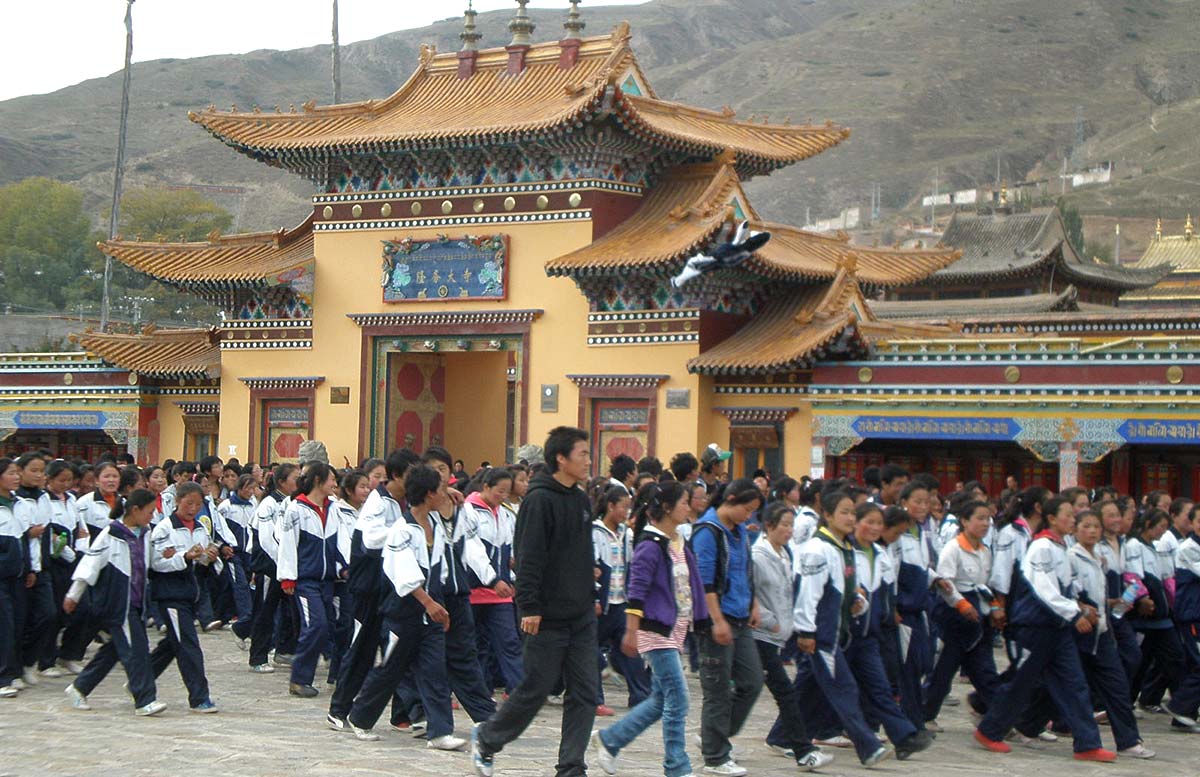
Students in Amdo protesting downgrading of Tibetan language education in October 2010.
Demonstrators carried placards in both Tibetan and Chinese, that urged “Equality Among Nationalities” and “Expand the Use of the Tibetan Language.”
More than 300 Tibetan teachers and students in Qinghai signed a petition to the Chinese authorities setting out the reasons why the teaching medium should remain Tibetan rather than Chinese, following proposed education reforms that sparked protests by Tibetans in Amdo.
Similarly, Tashi Wangchuk, a Tibetan from the Kham region of Yulshul (Yushu) in present-day Qinghai launched a petition campaign for the protection of Tibetan language. This was subsequently documented by the New York Times in November 2015. In the video that accompanied the report, Tashi Wangchuk spoke about his anxiety over the survival of Tibetan culture, linked to the erosion of the language. As a result, he was given a five-year prison term from 2016 to 2021 on charges of “inciting separatism.” Even after his release upon the completion of his sentence, he continues to face persecution from the Chinese authorities.
In 2018, a teacher in a school in a small town in Tibet wrote about how the quality of education in Tibetan language has deteriorated since his days as a student, around the late 1990s. At that time there was emphasis on the study of Tibetan language among students. He now sees students conversing with each other in “another language”. He realizes that this situation has been created because the students learn their subjects, other than Tibetan language, in “another language”.
In the first quarter of 2020, Voice of America noted there were at least 40 posts on social media by Tibetans arguing for the continuation of Tibetan as a language of instruction pointing to the provisions in China’s laws; the Tibetan language’s place as the bedrock of Tibetan identity, religion, and culture; Tibetan children facing a disadvantage for higher education if taught in Chinese; and the need for effective education in one’s native language.
In May 2024, Chinese authorities detained Khenpo Tenpa Dhargye, a Tibetan educator, along with 20 other villagers from Amdo, for their connection to the “Language Protection Association,” an initiative led by Khenpo Dhargye to preserve the Tibetan language. One of the Tibetans, Gonpo Namgyal, a village leader from Ponkor village, succumbed to injuries sustained during his seven months in custody on December 18, 2024, just three days after his release.
In recent times, individual Tibetans have been taking to Chinese social media to spread awareness about the importance of Tibetan language. Some postings include footage of young Tibetans reciting poems or making statements in Tibetan as a way to inspire more people to speak in Tibetan. Many other postings voice their concern over the erosion of the Tibetan language in Tibet. They blame the environment in present-day Tibet whereby Tibetans are opting to use Chinese rather than their own mother tongue.
However, even while utilizing the available space on Chinese social media, Tibetan netizens have been facing challenges while opting to use the Tibetan language in today’s social media dominated society. Online platforms and service providers have not been providing full access to the Tibetan language thereby reducing the opportunity for Tibetans, particularly for getting critical online medical services or to avail themselves of the online sales targeting Tibetans. Livestreaming has become the most popular online retail sales avenue in the People’s Republic of China, but Tibetans are facing discrimination from platforms which, like Douyin, restrict the usage of Tibetan. The list of these platforms includes major Chinese sites such as Kuaishou, Bilibili, and Talkmate.
In 2024, one Tibetan medical practitioner expressed frustration at not being able to use Tibetan in online consultations and was forced to shut down his online medical practice. The doctor is quoted by the Dharamsala-based Tibetan Centre for Human Rights and Democracy as saying, “I may be a small-time Tibetan doctor, but my medical expertise has never been in question. I encounter numerous patients who self-medicate for headaches and other illnesses with painkillers without seeking medical advice. Many seriously ill individuals and those with health issues seek my guidance. With the prohibition on using the Tibetan language, I am forced to use Chinese, and since my patients are Tibetan, especially the elderly and illiterate youth, including farmers and nomads, they struggle to understand me when I speak in Chinese. What purpose does speaking Chinese serve if they cannot comprehend it? As a result, I have stopped my online broadcasts.”
Although Tibetan netizens have been vocal about the restrictions they face for more than a year on Chinese social media, the usually alert Chinese authorities have not been moving to make the platforms accessible to netizens using the Tibetan language without any obstacles. In June-July 2025, a popular Tibetan singing competition ཁྱེད་རང་གླུ་པ་རེད། “You are the Singer” was livestreamed on the Douyin platform, which is the Chinese version of TikTok. Although the competition was targeted to a Tibetan-speaking audience, the host and the judges of the competition were speaking in Tibetan only intermittently while also using Chinese. On a few occasions in the course of the month-long competition, the host explained this by saying that if they only spoke in Tibetan Douyin was shutting down the livestream. Douyin merely seems to be following “advice” issued by the Chinese Ministry of Commerce in 2021 for using Chinese in livestreams.

The judges of the competition “You are the Singer” performing a piece. Douyin had been forcing them to use Chinese even for the Tibetan audience.
In contrast, education policy of Tibetans in exile prioritizes well-rounded Tibetan education
The cover of the Basic Education Policy for Tibetans in Exile.
After coming into exile in 1959, the Dalai Lama prioritized education of Tibetan children and established the Tibetan Department of Education in 1960. As India generously supported Tibetan education, the Dalai Lama requested the establishment of separate schools for Tibetan refugee children so that they can be provided with quality modern education and traditional Tibetan education, including in Tibetan language and culture.In the initial period, there was no alternative but to model an education system for Tibetans on the structure that exists in India even though study of Tibetan language and other traditional subjects did not exist within that curriculum. New textbooks in Tibetan were compiled and teachers trained to teach them. As years passed, the need to work out a sound system of education suitable for the temporary and long-term goals and needs of the Tibetan people, incorporating both traditional Tibetan and modern education, became ever more pressing.These twin objectives of the Tibetan schools in exile since the 1960s became the core of the Basic Education Policy for Tibetans in Exile of 2004. Highlighting the importance placed on Tibetan education, this policy was drafted by educators, discussed thoroughly by Tibetan policy makers, and eventually passed by the Tibetan Parliament in Exile.
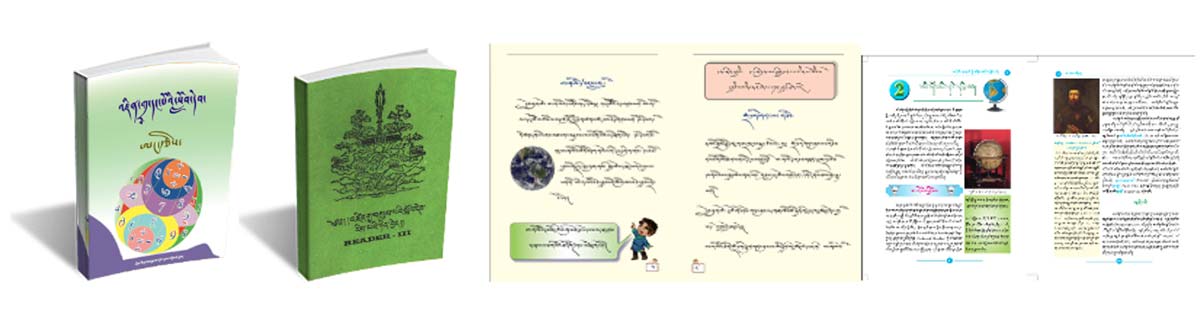
Textbooks in Tibetan on math, science, culture, and social sciences produced for the Tibetan schools in exile.
The policy framed the general purpose of Tibetan education as being to awaken and develop the human qualities of wisdom, loving kindness and compassion, enabling the accomplishment of personal, national and universal goals.
It called for a system of education having traditional Tibetan education as its core and modern education as its essential co-partner. Since the vehicle that conveys the education is equally important, it prioritizes the study in Tibetan language. It mandated that students should have Tibetan as their medium of instruction from the pre-primary stage for the next several years while being proficient in any one foreign language and acquire a working knowledge of reading and writing in a third language. The teaching of second and third languages starts from the fourth grade and sixth grade respectively.
This basic education policy is currently being implemented in the Tibetan schools in India and has been applauded as “rare and unprecedented” and which “can serve as a model for displaced and indigenous peoples” by a US-based educator. In a 2018 article “Tibetan Language at Home in the Diaspora: The Mother Tongue-Based Bilingual Schooling of Tibetans in India” in the peer-reviewed journal “Diaspora, Indigenous, and Minority Education,” Nawang Phuntsog, now Professor Emeritus of Elementary and Bilingual Education of Cal State Fullerton, says “the unique case of mother tongue based bilingual education of Tibetan children in the Diaspora illustrates the language-as-rights policy capacity to allow an autochthonous language of Tibet to blossom on multilingual Indian soil.”
Recommendations
To the Government of the People’s Republic of China:
- Reinstate the legal provision of making Tibetan the major language for education in Tibetan schools, safeguarding its use as a medium of instruction.
- Incorporate the voice of the Tibetan people in the future of the Tibetan language in the drafting of the 15th Five-Year Plan. Chinese state media had reported on Xi “emphasizing the importance of listening to the “voice of the people” “in the plan, the drafting of which will start in 2026.
- Promote Tibetan equally when promoting Mandarin Chinese in all aspects of Tibetan society.
- Ensure that promotion of “nationality unity” does not restrict public debate over issues such as education and the use of the Tibetan language in Tibetan areas.
- Unconditionally release Tibetans who have been prosecuted either for promoting Tibetan language study or for peaceful opposition to state education policies.
- End the suppression of any activities or organizations calling for promotion of Tibetan education.
- Comply with all its international obligations, including UN treaties ensuring that “ethnic minorities” have access to instruction in their mother tongues.
- Learn from the Central Tibetan Administration in exile in formulating an education policy that truly places the interest of the Tibetan people at the center.
To other governments:
- Express serious concern at China’s current Tibetan education policies, which emphasize assimilation over cultural preservation and violate Tibetans’ rights under both domestic and international law.
- Specifically include the protection of Tibetan language and culture in their diplomatic and human rights dialogues with China.
- Call on China to adhere to the conventions it has ratified, such as the UN Convention on the Rights of the Child, which protects the linguistic rights of minority children.
- Reaffirm the established rights of the Tibetan people to mother-tongue instruction in schools.
- Provide support to programs for Tibetan children in exile, such as scholarships for higher education, which empower Tibetan students.
To The United Nations:
- Urge China to provide Tibetan-language instruction to Tibetans in accordance with its obligations under the Convention on the Rights of the Child (UNCRC), which China ratified in 1992. Article 29 says “States Parties agree that the education of the child shall be directed to” the development of “his or her own cultural identity, language and values.” Article 30 says, “In those States in which ethnic, religious or linguistic minorities or persons of indigenous origin exist, a child belonging to such a minority or who is indigenous shall not be denied the right, in community with other members of his or her group, to enjoy his or her own culture, to profess and practice his or her own religion, or to use his or her own language.”
- Urge China to ratify and implement Article 27 of the International Covenant on Civil and Political Rights (ICCPR) which says, “In those States in which ethnic, religious or linguistic minorities exist, persons belonging to such minorities shall not be denied the right, in community with the other members of their group, to enjoy their own culture, to profess and practice their own religion, or to use their own language.”
- To UN Treaty Bodies, monitor the implementation of the right to education in their mother tongue for Tibetans.
Footnotes:
[1] Neither Goat nor Sheep (Tib: Ramalug) is the metaphorical pejorative term Tibetans use in the context of Tibetan language when non-Tibetan words are intermixed with Tibetan in conversations. In a recent social media posting by a Tibetan in Tibet the commentator lamented concluding that the state of Tibetan language today is “beyond even Ramalug.”
“The Central Government has frequently talked about the importance of learning and using the Tibetan language in Tibet. But it has done nothing to ensure its implementation.”
-10th Panchen Lama, TAR delegation session at the National People’s Congress in Beijing, 1987
“How should the death of a language and script be understood?
In gist, initially not even one person remains who is utilizing both the language and script and there is permanent death. Consequently, the entire culture of that nationality gradually disappears. Eventually, even that nationality itself completely transforms into something else, with not even a trace of the past being visible, thus becoming a major cultural disaster.”
-Khenpo Tsultrim Lodrö (Tibetan Buddhist teacher at Larung Gar in Serthar in eastern Tibet). The History of the World’s Eastern and Western, Ancient and Modern Philosophy – the birth and death of world’s languages and scripts, 2013 (ཚུལ་ཁྲིམས་བློ་གྲོས། འཛམ་གླིང་ཤར་ནུབ་ཀྱི་གནའ་དེང་རིག་པའི་རྣམ་གཞག་དང་འཛམ་གླིང་གི་སྐད་ཡིག་སྐྱེ་འཆིའི་ལོ་རྒྱུས། ༢༠༡༣ ལོར ཀན་སུའུ་མི་རིགས་དཔེ་སྐྲུན་ཁང་།)
“The autonomous region shall comprehensively promote the popularization of the national common language and characters…”
-Regulations on the Creation of a Model Region of National Unity and Progress in the Tibet Autonomous Region, 2025, Article 12.
The threat was perceived initially at the social level when Tibetans in Tibet noted the increasing insertion of Chinese words in Tibetan conversations. They dubbed this development as Ramalug. Today, there are public discussions even within the restrictive atmosphere in Tibet that show the situation has gone beyond the state of Ramalug and a combination of official policy and social development are posing a clear threat to the very survival of the Tibetan language. The fact that many Tibetans inside Tibet are courageously speaking out publicly despite the risks of reprisals from the Chinese authorities indicate the critical nature of the situation.
An analysis by the International Campaign for Tibet (ICT) shows there are significant shifts and reversals of comparatively favorable language policies in Tibet and that the Chinese authorities are aggressively implementing President Xi Jinping’s political agenda of a new Chinese national identity through direct and indirect imposition of Chinese (Mandarin), leading to an adverse transformation of Tibetan language and identity. This is being done through rule by law, breaching Beijing’s own constitutional and related legal provisions or negating them by passing measures making the Tibetan language less relevant to the Tibetan people themselves. Additionally, Chinese policies are creating an environment in Tibet that is demotivating Tibetans, particularly the younger generation, from utilizing Tibetan in their daily lives.
This report details the nature of this transformation: from the period when Deng Xiaoping and Hu Yaobang made efforts to respect Tibetan culture and institutionalized the promotion of Tibetan language to the period of Xi Jinping, which is characterized by the Chinese Communist Party’s (CCP) systematic policies to undermine and eventually eliminate the use of the Tibetan language in the education system; forcibly impose Chinese; and create an environment that increasingly encourages Tibetans to adopt Chinese as the medium of communication in their lives. The report shows how Beijing is amending existing legislation that was designed to protect the Tibetan language or passing new laws that actively undermine its use. The development is happening in such a way as to provide no choice to the Tibetan people while superficially allowing the Chinese authorities to continue to claim that they are promoting use of the Tibetan language even while they consistently undercut and marginalize it.
Despite Tibet being under Chinese occupation for many decades, China still feels the need to seek international legitimacy and validation by attempting to project its policies on Tibet and Tibetans as a success story, particularly more so during this 60th year of the establishment of the so-called Tibet Autonomous Region (TAR). The TAR comprises around half of the area of traditional Tibet, the rest being incorporated in Sichuan, Yunnan, Qinghai and Gansu provinces. Throughout these Tibetan areas, the Chinese propaganda approach continues to compare the Tibetan people’s economic and social situation in 2025 to life in Tibet before the Dalai Lama fled to make the case that independent Tibet was worse. Even if we acknowledge this unequal comparison, the legality of political occupation of a territory is not founded on how the inhabitants were governing it before foreigners took it upon themselves to “liberate” them.
China is creating a new normal in Tibet that poses an existential threat to the Tibetan people: the very survival of Tibetan identity. This is a change from an initial policy of physical destruction (during the period of Mao Zedong) when CCP authorities did not aggressively target the Tibetan language. That policy was subsequently changed to one of control, which is transforming the fundamental nature of Tibetan identity to fit the reshaped Chinese national identity under President Xi Jinping. This is most visible in the field of Tibetan language education and usage. Through a combination of initiatives, the CCP is altering the role of the Tibetan language in the people’s daily lives, even while forcing the use of Chinese (Mandarin) upon Tibetans. This engenders in the Tibetan people a feeling of disconnection from their own linguistic identity, which could lead to the language’s gradual erasure.
Tibet has a unique and diverse linguistic heritage composed of dozens of dialects and additional “minoritized” languages spoken in particular communities. From this rich foundation, it is clear that the CCP’s vision of Tibet is one in which these languages are slowly and steadily replaced by Chinese.
Tibetan Language as Cultural Heritage
There is a saying in Tibetan highlighting the important role of language for the Tibetan people: “Pure father tongue is one’s life and soul” (ཕ་སྐད་གཙང་མ་རང་གི་བླ་སྲོག་ཡིན།).
In a substantive 2020 report, “China’s ’Bilingual Education’ Policy in Tibet: Tibetan-Medium Schooling Under Threat,” Human Rights Watch says that international human rights law obligates China to provide Tibetan-language instruction to Tibetans. The United Nations Convention on the Rights of the Child (UNCRC), which China ratified in 1992, states that “a child belonging to a … minority … shall not be denied the right … to use his or her own language.” The International Covenant on Civil and Political Rights (ICCPR), which China has signed but not ratified, contains similar language.
In its message for the 2025 International Mother Tongue Day, the UN categorically highlighted “the importance of language preservation in safeguarding cultural heritage, improving education, and fostering more peaceful societies.” According to UNESCO, while the practice and transmission of living heritage contribute to the vitality, strength and well-being of indigenous communities, language is the principal vehicle through which such living heritage is kept alive.
This is also supported by several UN measures, including the Convention for the Safeguarding of the Intangible Cultural Heritage, which was ratified by China in 2004 and refers to “oral traditions and expressions, including language as a vehicle of the intangible cultural heritage.”
Tibetan language is not just a medium of communication but is the most important attribute of the Tibetan people’s identity. The Dalai Lama has said that this is “not a matter of attachment to one’s own nationality.” Rather, he says, the Tibetan language is the one that has best preserved the entirety of the Buddha’s teachings. Through centuries Tibetan language literary works in history, medicine, and philosophy have shaped Tibetan civilization.
Given this significance, the preservation of the Tibetan language is among the utmost priorities of the Dalai Lama. In addition to him publicly highlighting the importance of Tibetan language, the Tibetan side also raised its importance during the dialogue process with the Chinese government between 2002 and 2010, saying, “The protection, use, and development of the Tibetan language are one of the crucial issues for the exercise of genuine autonomy by Tibetans.”
Evolution of China’s Tibetan language policy
Constitutional basis and early assaults in the 1950s and 60s
China spares no efforts in claiming that it is protecting and promoting the Tibetan language. In 1959, soon after the Tibetan uprising demanding China respect Tibetan rights, the official New China News Agency (the then name of Xinhua), reported, “Most of the documents of the Preparatory Committee were written in the Tibetan language” and referred to this as evidence of respect China had “for the right of the people of Tibet.” As recently as February 2023, the State Commission of Nationalities Affairs-run GONGO (“Government Organized Non-Governmental Organization”), China Ethnic Minorities’ Association for External Exchanges, claimed in a document submitted to the UN Human Rights Council that “The study, use and development of Tibetan language and characters are protected by law.”
The two main legal documents that the Chinese cite are the Constitution of the People’s Republic of China and the Law on Regional National Autonomy, the legislative document that promises special considerations for people like the Tibetans. Article IV of the Constitution does recognize all “ethnic groups” as being equal and that “all ethnic groups shall have the freedom to use and develop their own spoken and written languages and to preserve or reform their own traditions and customs.” Even in the 17-Point Agreement with Tibet in 1951, China did say that “The spoken and written language and school education of the Tibetan nationality will be developed step by step in accordance with the actual conditions in Tibet” (Article 9).
Following its takeover of Tibet, however, the Chinese authorities did not take any proactive measures to promote Tibetan language. On the contrary, as the 10th Panchen Lama mentions in his 70,000 character petition of 1962 to the Chinese Premier, “The Tibetan language, dress and personal adornment, good customs and habits and other such important national characteristics which should have been respected were also included in the “Three Greats” revolutionary work of “great destruction, great exposure, great construction.” In short, Tibetan language was projected as being inferior.
Nevertheless, on account of the absence of any economic development support in the initial decades of occupation, the Chinese authorities had to rely on the Tibetan language as a vehicle to control the Tibetan people.
Limited protection in the late 70s and 80s
Beginning in the late 1970s, during the period of comparatively liberal policies, there were efforts to promote Tibetan language and Tibetan education in general, including inviting Tibetans in exile to play a role in the process. The Dalai Lama mentioned these efforts in his communication to the Chinese leadership after establishment of his contact with China’s paramount leader Deng Xiaoping in 1979. The communications were made public subsequently, and among the first understandings they had was that the Dalai Lama would send 50 Tibetans educated in exile to help teach in Tibet.
Following the resumption of contact with the Dalai Lama, Deng invited fact-finding delegations from the Dalai Lama’s side to study the situation in Tibet. The third such delegation, led by then president of the Tibetan Children’s Villages, Jetsun Pema, traveled extensively across Tibet in 1980 and focused on the status of Tibetan education. Participating in an event in Washington, DC, she said the delegation toured 59 Tibetan villages and towns in 105 days and returned confirming that the standard of education in Tibet was deplorably low.
Simultaneously, Deng set up a four-member working group, headed by liberal leader Hu Yaobang who had by then become CCP General Secretary, “to assess the situation and formulate correct policies for Tibet.” The other members were vice premier Wan Li, Ngapo Ngawang Jigme (who was then a vice-chairman of the National People’s Congress), and Yang Jingren, head of the State Commission of Nationalities Affairs.
Hu in turn convened the first-ever Tibet Work Forum meeting, from March 14 to 15, 1980, which produced a series of recommendations in the form of “Minutes of the Tibet Work Forum.” In order to establish the importance of the minutes, the CCP Central Committee formally approved and circulated them to the Party, Government and Military leadership of all provinces. A key directive of this Forum was to “attach importance to the use of Tibetan and Tibetan languages” and that students, “must learn Tibetan.” The Forum also said, “Tibetan textbooks should be compiled and published to improve teaching quality.” Highlighting the need to put Tibetan language into daily use by the authorities, the Forum said, “Documents issued by party and government organs in the autonomous region must be written in both Tibetan and Chinese. We should train translators and establish translation and printing institutions.”
Thereafter, Hu led the working group delegation, the first-ever CCP delegation of this kind, on an inspection trip to Lhasa from May 22 to 31, 1980 during which he publicly reprimanded the officials for neglecting the welfare of the Tibetan people. Amongst other findings, Hu believed that “Education has not progressed well in Tibet” and confirmed the need for “more extensive use of Tibetan language.”
Hu Yaobang, seen here with Ngapo Ngawang Jigme, during his visit to Lhasa in May 1980.
The visit resulted in a six-point reform policy initiative on Tibet known as “Six Major Issues” in which the importance of the Tibetan language was highlighted, specifically making the learning of it mandatory for Chinese cadres in Tibet. It said, “…otherwise they will be divorced from the masses. Cherishing the people of minority nationalities is not empty talk. The Tibetan people’s habits, customs, history and culture must be respected.”
Legislation institutionalizing promotion of the Tibetan language during the late 80s and 90s
Subsequently, there was the enactment of legislation, both in Beijing and in the Tibetan capital Lhasa, which promised to protect and promote the Tibetan language. In 1984, the national-level Law on Regional National Autonomy was passed, which guaranteed rights to communities like the Tibetans, including the freedom “to use and develop their own spoken and written languages” (Article 10) and mandated this in the education system by having Tibetans “use textbooks in their own languages and use their languages as the medium of instruction” (Article 37) (emphasis added).
Specifically, in 1987, the Tibet Autonomous Region saw the adoption of “Several Provisions of the Tibet Autonomous Region on the Study, Use and Development of the Tibetan Language” that institutionalized the promotion of Tibetan language, at least on paper. Its Article 2 clearly said, “State organs at all levels shall implement the policy of using Tibetan as the main language and Tibetan and Chinese languages in conjunction with all activities of performing their duties.” In the schools, Article 3 said, “Tibetan students in schools of all levels and types in the autonomous region must list Tibetan language as a primary subject, and other courses must, in principle, be taught primarily in Tibetan.” (emphasis added). It further said, “All Tibetan primary school students will be taught in the Tibetan language. Chinese language courses will be added starting from the upper grades without affecting Tibetan language instruction.” In the judicial field, Article 12 mandated that courts in TAR “must guarantee the right of Tibetan citizens to use their own spoken and written language in litigation.”
This was the period when the 10th Panchen Lama had been rehabilitated and began actively addressing the concerns of the Tibetan people. In his public remarks in the 1980s until his death in 1989, he was critical of Chinese policies in Tibet, including on the Tibetan language. Therefore, he would certainly have had a hand in the developments, particularly relating to Tibet.
Similarly, in 1993, in north-eastern Tibet, the Malho (Huangnan) Tibetan Autonomous Prefecture in Qinghai Province enacted its Regulations on Tibetan Language Work in Malho Tibetan Autonomous Prefecture, which legalized the promotion of Tibetan language. Its Article 4 said, “The autonomous prefecture adheres to the principle of combining popularization with improvement in Tibetan language work, inherits and promotes the excellent historical and cultural heritage of the Tibetan people, promotes the development of the Tibetan language, and enhances its role in the reform, opening up, and economic construction of the autonomous prefecture.”
In 1994, the Measures for the Implementation of the Compulsory Education Law of the People’s Republic of China in the Tibet Autonomous Region was passed. Its Article 20 mandated “Tibetan language as the primary language” in the schools and that “Schools should ensure that minority students first master the local ethnic language and writing system, and then master Chinese.” It also said that TAR should “gradually improve the Tibetan and Chinese language teaching system.”
This and other developments in the 1980s offered a hopeful future for the Tibetan language.
Five Provinces and Autonomous Regions establish Tibetan Education Collaboration Leading Group
The Chinese authorities’ establishment of a Leading Group in the 1980s focused on the Tibetan language demonstrated the seriousness with which Beijing took its promotion and preservation during that period. In the Chinese system, Leading Groups are interagency coordinating bodies that address important policy areas, cutting across the government, party, and military leadership. Taking into consideration the reality of the situation that the Tibetan people inhabit not just their own demarcated Tibet Autonomous Region, but also areas incorporated into the four provinces of Sichuan, Yunnan, Qinghai and Gansu, the Leading Group set out to promote and standardize Tibetan language education throughout the Tibetan regions.
Therefore, in 1982, “The Five Provinces Tibetan Textbook Collaboration Group” was established to coordinate the compilation of Tibetan-language syllabi, textbooks, and reference books for various subjects in primary and secondary schools, and to promote the development of basic education in all Tibetan areas. This was an important development as until then the five Tibetan areas were individually compiling and producing textbooks in Tibetan for their students.
The absence of a coordinated approach resulted in an imbalanced output from the students. As an indication of the importance of the issue, the scope of the group was expanded in 1988, and the authority upgraded to that of a leading group, named the Five Provinces and Autonomous Regions Tibetan Education Collaboration Leading Group (成立五省区藏族教育协作领导小组 Chénglì wǔ shěng qū zàngzú jiàoyù xiézuò lǐngdǎo xiǎozǔ). According to Chinese state media, the group’s members included vice governors and vice chairmen in charge of education in the five provinces and autonomous region; vice directors in charge of ethnic education in the education commissions and education departments; and relevant officials from the State Education Commission and the State Ethnic Affairs Commission.
The Leading group met regularly in the different areas and came out with initiatives to improve education in the Tibetan language.
The Chinese government-run China Education and Research Network wrote positively about the Leading Group. Quoting Sun Youlin, an official of the then Qinghai Provincial Ethnic Textbook Compilation Office, the Network said, “The establishment of the five-province Tibetan Textbook Collaboration Leading Group has built a bridge for communication and exchange in Tibetan education, ushering in a new era for the development of Tibetan textbooks, moving from a fragmented and isolated approach to collaborative development.” It continued that the group had completed the compilation of two sets of textbooks in just seven years, “1,353 Tibetan textbooks covering nine categories and 26 subjects for use in all levels of schools, from elementary school, junior high school, and high school to secondary normal school.”
A meeting of the Five Provinces and Autonomous Regions Tibetan Education Collaboration Leading Group in Pari (Tianzhu) in Kanlho (Gannan) Tibetan Autonomous Prefecture, Gansu, in July 2006.
These developments led to flourishing Tibetan studies and literature in general. There was an increase in the number of Tibetan language writers with people even crediting the 1980s as the time when the history of modern Tibetan literature began.
Bilingual education with Tibetan as the medium of instruction codified in the 90s
When the Chinese authorities introduced bilingual education formally in the Tibetan schools, the Model 1 was implemented and this version prioritized Tibetan as the medium of instruction and Chinese as an additional language. (The Model 2 version prioritized Chinese as the medium of instruction with Tibetan as an additional language and is now being implemented.) This was reflected in the compulsory education law of 1994 referenced above. On paper, several measures were passed guaranteeing the right of Tibetans to use their own language as the medium of instruction in schools.
At the national level, the Chinese Ministry of Education, while issuing a general notice in June 2000 on the preparation of Chinese language textbooks to be used in schools for Tibetans, explained that, “the Chinese textbooks for Tibetan primary and secondary schools are primarily intended for Tibetan students in a model where instruction is primarily in Tibetan, with additional Chinese instruction in selected subjects.” (emphasis added). China’s White Papers on Tibet, including those in 2004 and 2013 also boasted that “Bilingual education, with Tibetan as the principal language, is widespread in Tibet.” The 2004 White Paper even claimed that China has put the “work of using and promoting Tibetan spoken and written language on a legal basis.” It further said, “Both Tibetan and Chinese languages are used in all schools in Tibet, with the Tibetan as the major one, and the textbooks and teaching reference books from primary to high school have been edited, translated into and published in Tibetan language.” (emphasis added)
Even in the “Outline of the National Plan for Medium- and Long-Term Education Reform and Development” for 2010-2020, Chinese authorities categorically committed to, “Respect and guarantee the right of ethnic minorities to receive education in their own spoken and written languages”. It further affirms that “State support shall be given to bilingual faculty training, teaching research, and textbook compilation and publication.”
In 2021, China’s Ministry of Education amended the Education Law, which mentioned that schools and institutions in ethnic autonomous regions and ethnic minorities should use indigenous languages to implement bilingual education while the government provides additional support for minority learners.
Also, as good as these were on paper, in practice the Chinese authorities were gradually marginalizing the study of the Tibetan language. In fact, in 1987, the 10th Panchen Lama presciently said, “The Central Government has frequently talked about the importance of learning and using the Tibetan language in Tibet. But it has done nothing to ensure its implementation.”
Legal imposition of Chinese as medium of instruction in the 2000s
Beginning in the 2000s an aggressive push began to impose Chinese on the Tibetan people. This was accompanied by direct and indirect measures that are now leading to a situation where the Tibetan language is facing a crisis of survival in its own homeland.
In the process, Chinese authorities are amending existing laws and enacting new legislation in order to fulfill the objective of making Tibetans embrace Chinese.
In January 2001, the Law on the National Standard and Spoken Language that came into effect mandated local governments at various levels and the relevant departments under them to take measures to popularize Chinese.
In 2002, the Regulations of the Tibet Autonomous Region on the Study, Use and Development of the Tibetan Language of 1987 was amended to do away with the mandatory requirement making Tibetan the medium of instruction. The amended Article 2 “the principle of equality of all ethnic groups’ languages and scripts” must be adhered to. Similarly, Article 3 mandated that Chinese will have an equal role with Tibetan saying, “When state organs at all levels in the autonomous region perform their duties, the Tibetan language and the national standard spoken and written language have equal validity.”
In 2008, the TAR repealed the 1994 Compulsory Education Law replacing it with a revised version that no longer mandated Tibetan as the medium of instruction while making the promotion of Chinese mandatory. Its Article 32 said, “Article 32 During the compulsory education stage, the Tibetan language and the national standard language shall be used as the basic educational and teaching terms and characters, and Mandarin teaching shall be promoted.”
In the volatile Ngaba (Aba) region in Amdo, even while attempts were made to promote Tibetan, it was now placed in the same level as Mandarin Chinese when it came to the medium of instruction. The Regulations on the Tibetan Language and Writing System in Ngaba Tibetan and Qiang Autonomous Prefecture adopted by the Sichuan People’s Congress in June 2018, Article 8 said, “Preschool education may use the national common language and the Tibetan language for bilingual education in language, art, health, social studies, and science. Primary and secondary schools in Tibetan-populated areas shall use the national common language and Tibetan as the basic medium of instruction.”
Then in 2020, when schools reopened in Ngaba for the academic session that year in the wake of the coronavirus outbreak, Radio Free Asia reported that the parents learned, through announcements during meetings, that Tibetan will no longer be the medium of instruction for primary and middle schools in Ngaba.
In Tibetan areas in Qinghai, the “Outline of the Medium- and Long-Term Education Reform and Development Plan of Qinghai Province (2010-2020)” clearly said, “Use the national standard language as the medium of instruction.” It further stated, “By 2015, primary schools will implement “bilingual” instruction, with the national standard language as the primary medium and the ethnic minority language as the supplementary medium.”
Systematic Dismantling of Tibetan Language Schooling in the 2010s and 20s
In a notable 2015 incident, authorities in Yushul (Ch: Yushu), historically part of the Tibetan province of Kham, forced the closure of a monk-operated private kindergarten teaching the Tibetan language. Chinese officials extended this prohibition to other monasteries and private educational schools and institutions in the region.
Since 2021, authorities have forcibly closed numerous private schools and primary schools in monasteries that specialized in Tibetan language education. On July 12, 2024, the Chinese government ordered the forcible closure of the award-winning Jigme Gyaltsen Nationalities Vocational High School in Golog, Amdo. Previously in June, the Taktsang Lhamo Kirti Monastery school, which had about 500 students, faced increasingly strict restrictions until it was forced to close. On October 31, 2021, not only was the Drakgo Monastery’s Gedhen Nangten (Eng: Buddhist) School closed, but the classrooms, dormitories and other facilities were demolished. Others affected were the Sengdruk Taktse School in Darlag County of Golog Prefecture, followed by the closure of Machen County’s Cherished Children School.
The crackdown intensified in 2022, when three additional schools were forced to cease operations across Kardze prefecture: The Phende Care School in Dzakhog County, the Private Primary School in Chaktsang Center, and the Gyalten Foundation School in the Trehor Dargye Rongpatsa area. Speaking to Radio Free Asia under condition of anonymity, a Tibetan teacher revealed that these institutions were targeted specifically because they offered specialized Tibetan language education programs. This occurred despite the schools having previously secured all necessary governmental approvals and permits for their operations.
According to information released by the Ngaba Prefecture’s Nationality and Religious Affairs Committee in July 2024, before the closure of the Taktsang Lhamo Kirti Monastery school, 69 primary schools throughout Ngaba Prefecture had been completely closed, 8 schools were merged with other schools, and 33 primary schools had their educational systems changed in accordance with the 14th Five-Year Plan of Ngaba Prefecture. Following these events, the PRC government has further intensified its crackdown on Tibetan language schools in monasteries.
Tibetan no longer core college entry subject as of 2026
Chinese officials justify the new education policy in Tibet that reduces the emphasis on core Tibetan language education (while promoting the study of Chinese language) by arguing that this will “provide more opportunities for students to become talents, and provide more choices for students to enter higher education institutions.” For example, the head of the TAR Government, Karma Tseten, cited this as a reason for eliminating Tibetan as one of the core subjects for the critical college entrance examinations from 2026 onwards. While announcing this at a press conference in Beijing on August 5, 2025, Tseten also confirmed the political agenda of undermining the distinct Tibetan identity by saying that “this will help students of all ethnic groups enjoy more equitable high-quality education.”
Since at least 2021, the TAR had been dividing the college entrance examination candidates into two categories, A and B. For candidates who follow the A-type curriculum plan, the unified college entrance examination subjects are Chinese, Tibetan, mathematics, and foreign languages. Chinese and Tibetan each account for 50% of the total score, and the score will be presented in the Chinese subject. For students taking the B-type curriculum plan, the unified college entrance examination subjects are Chinese, mathematics, and a foreign language.
Netizens (their names blurred for security reasons) demanding the Tibetan language to be reinstated as a requirement in college entrance exams, taught in schools, and used in workplaces on a Chinese social media platform, March 31, 2025.
By the time a journalist queried TAR chairman Karma Tseten (Gama Cedain) at a press briefing in Beijing on August 5, 2025 about China’s plans to remove Tibetan from being a core subject in the national college entrance exam, it had already spread among Tibetans in Tibet who came forward to post criticism even on restrictive Chinese social media platforms.
In the beginning of 2025, there were netizens demanding the reinstatement of Tibetan language as a requirement in college entrance exams. “Language and culture are the most precious wealth in the world… Restore Tibetan language in college entrance exams,” one posting said.
“No matter which nationality, as long as there is a language, it needs to be supported by the government and included in textbooks so that children can learn their mother tongue,” wrote another Tibetan.
Boarding schools leading to Tibetan language erosion in recent years
Reacting to this development, three independent UN human rights experts, Fernand de Varennes, Special Rapporteur on minority issues; Farida Shaheed, Special Rapporteur on the right to education, and Alexandra Xanthaki, Special Rapporteur in the field of cultural rights, said in February, “We are alarmed by what appears to be a policy of forced assimilation of the Tibetan identity into the dominant Han-Chinese majority, through a series of oppressive actions against Tibetan educational, religious and linguistic institutions.”
One month later, in March 2023, the United Nations Committee on Economic, Social and Cultural Rights, in its concluding observations on the third periodic report of China demanded that China “abolish immediately the coerced residential (boarding) school system imposed on Tibetan children and allow private Tibetan schools to be established.”
2020 Ethnic Unity Law and marginalization of the Tibetan language
For the first time, the regulations explicitly depart from the principle of preferential treatment for Tibetans, as stipulated in the Regional Ethnic Autonomy Law, which was supposed to guarantee that Tibetans could maintain their culture and way of life under Chinese rule. While Tibetans have faced systematic discrimination even under the preferential treatment policy, the new regulations, along with policies like the residential boarding school system, heighten fears that they will be forced to assimilate into Chinese culture even more rapidly.
The regulations articulate long-held policy goals that seek to reduce ethnic differences in the People’s Republic of China to achieve a stable, Chinese-centric society and consolidate the Communist Party’s grip on Tibet.
The regulations reflect Xi Jinping’s focus on consolidating power in the party and eliminating threats, as well as the ideas of a new generation of ethnic policy thinkers who advocate for the dilution of ethnic differences. These thinkers seek to force the assimilation of Tibetans and therefore further undermine Tibetans’ inherent freedom to preserve their unique culture, language, religion and way of life.
An analysis by ICT of the ethnic unity law in TAR concluded that it violates international human rights standards, such as the Convention on the Elimination of All Forms of Racial Discrimination (CERD), which China ratified in 1981, and in view of provisions regulating education, the Convention on the Rights of the Child, which China ratified in 1992. The regulations also violate the right to freely pursue social and cultural development, pursuant to Article 1 of the Convention on Economic, Social and Cultural Rights, which China ratified in 2001.
In the Two Sessions in 2025, implementation of Xi Jinping’s strategy of a common Chinese identity was voiced by different leaders and included a legislative initiative by the NPC. In his work report to the NPC on March 8, 2025, its Chairman Zhao Leji announced the plan to have a new national “ethnic unity” law saying, “We will formulate a law on promoting ethnic unity and progress to forge a strong sense of national identity, reinforcing the Chinese people as one cohesive community.”
A draft of the legislation has now been made public by the Chinese government. The draft further advances Xi’s and the CCP’s goal to forcibly impose Chinese on Tibetans. Article 15 of the draft says, “The state shall comprehensively promote the popularization of the national standard spoken and written Chinese language, encouraging preschoolers to learn Chinese and adolescents who have completed compulsory education to master the national standard spoken and written Chinese language. No organization or individual may hinder citizens from learning and using the national standard spoken and written Chinese language. State organs shall use the national standard spoken and written Chinese language for official business. Where, in accordance with relevant laws, documents need to be issued in minority languages and scripts, versions in the national standard spoken and written Chinese language shall also be provided. Where, in public settings, state organs, social groups, enterprises, institutions, and other social organizations need to use both the national standard spoken and written Chinese language and the minority languages and scripts, they shall give priority to the national standard spoken and written Chinese language and script in terms of placement and order.”
The political significance of this proposed national legislation on ethnic unity and progress can be understood when we look at the fact that in January 2020, “Regulations on the Creation of a Model Region for National Unity and Progress in the Tibet Autonomous Region” was enacted in Lhasa. The regulations, revised in January 2025, are the first such legislative initiative by China and formalizes CCP powers to enforce a Chinese-centric way of life and represents an explicit legal departure from the principle of preferential treatment for people like the Tibetans, as stipulated in the Regional Ethnic Autonomy Law.
Outside of the PRC, enduring support for Tibetan language rights
Similarly, in May 2020, the then High Representative of the European Union for Foreign Affairs and Security Policy/Vice-President of the European Commission Josep Borrell responded to a question by MEP Isabel Santos on the TAR ethnic unity law saying, “The EU has repeatedly raised its strong concerns about restrictions on freedom of religion or belief and on the rights of minorities in Tibet, both in EU-China bilateral meetings and publicly, including in multilateral fora.” MEP Santos’ question was prefaced with, “The International Campaign for Tibet revealed how the ‘ethnic unity’ legislation recently adopted in Tibet will further erode the fundamental liberties of Tibetans and infringe their human rights.”
In 2023, the German government expressed its concern about the increasingly deteriorating human rights situation in Tibet. A representative of the Foreign Office stated during a meeting of the Committee on Human Rights and Humanitarian Aid that the government expressly supports the UN Committee on Economic, Social and Cultural Rights’ demand for an end to forced boarding schools for Tibetan children and the forced resettlement of Tibetan nomads. The representative stressed that the opportunities for schooling in Tibet have been systematically reduced through the closure of schools. As a result, Tibetan children are forced to attend boarding schools in the cities during the week, where they are taught almost exclusively in Mandarin. The goal is clear, according to the government representative: to suppress Tibetan language and culture.
Erosion of Tibetan Sign Language
The introduction of the TibSL (a project which has been running since 2000) has been a boon to those Tibetans who were otherwise devoid of a common vehicle of communication on account of their disability. According to the Lhasa-based Tibetan Deaf Association, the TibSL compiled several volumes of TibSL dictionaries. It said signs are collected according to the cultural background of deaf Tibetans to make it more practical. TibSL’s creation was a bottom-up approach initiated by a group of deaf and hard-of-hearing Tibetans. They collected sign languages among Tibetan deaf-mutes, turned the signs into images with Tibetan explanations and unified a standardized sign language after prolonged, repeated trial use.
Front cover of the Standard Tibetan Sign Language Dictionary and a sample from a textbook.
In 2004, China appears to not only recognize the introduction of Tibetan Sign Language when Chinese state media reported, “This is the first sign language system designed for deaf-mutes of a minority ethnicity in China,” but more importantly acknowledged its uniqueness in comparison to CSL saying, “This dactylology system differs from the one being used nationwide as the latter is basically a kind of Chinese characters conversion whereas many Tibetans can neither read nor write the Chinese characters.”
Sample of TibSL SAKOR DI ‘this week’ (upper left), DAWA DI ‘this month’ (upper right) and LO DI ‘this year’ (lower left).
(TDA 2011: 433, 436, 424)
Chinese authorities highlighted the impact of TibSL saying in 2007, “The development of standardized Tibetan sign language has effectively promoted the education and social integration of the deaf and mute people and reduced communication barriers.”
However, now even TibSL is facing the challenge of survival with Chinese authorities now promoting Chinese Sign Language (CSL) as the nominal “national language”. The problem here, according to sign language experts, is that CSL follows spoken Chinese and contains many signs related to Chinese pictograms. In short it is incompatible with the Tibetan language. Nevertheless, CSL enjoys a dominant position as the medium of education in Tibetan schools for the deaf. A researcher on Tibetan sign language says this “exerts pressure on the growth and use of TibSL in that Tibetan deaf graduates from the Lhasa school sign more CSL than TibSL and have in recent years apparently connected little with the wider TibSL community after leaving school.”
While deaf activists in China are able to defend regional sign varieties and dialects of CSL, deaf Tibetan advocates are facing an increasingly difficult work environment. In a highly charged and repressive political environment, they often fear repercussions if officials interpret their activities as “politically sensitive,” that is, if they are construed as contested aspects of the Tibetan identity and language nexus.
The TibSL researcher concludes, “Deaf Tibetans in Lhasa find themselves in a complex and dynamic linguistic and socio-political situation. Linguist Gerald Roche has also rightly observed that minority language speakers in the Chinese Tibetosphere tend to be “minorities twice over”, that is, they are classified as part of a minzu (an ethnic minority, or ‘minority nationality’) within the Han-dominated PRC state, as well as a linguistic minority within the Tibetan minzu (2014: 21).” Roche suggests that, as a result, some of the TibSL signers are “minorities thrice over.” In addition to being members of the two minorities mentioned by Roche, they also belong to a minority sign community within a vast state-sponsored CSL and Chinese domains which exert dominance in whatever little exists of deaf activism and sign language-based deaf education within the PRC.
Smaller languages and dialects of Tibet suppressed altogether by State policy
A Tibetan student who comes from a household that speaks standard Amdo Tibetan may, therefore, see Amdo Tibetan spoken on television and receive a minimal amount of classroom hours on Amdo Tibetan instruction. While this is clearly insufficient and falls within the broader CCP plan to undermine and eliminate the use of Tibetan, a Tibetan student who speaks a minoritized language will never hear their language in news programs nor receive any education in it at school. As far as the state is concerned it does not exist, resulting in an even greater breach of China’s responsibilities under international law and the PRC constitution.
Scholars such as Gerald Roche have dedicated considerable time and effort to mapping these languages and documenting how they have been essentially marked for immediate destruction by Chinese policy.
Impact of Chinese policy on Tibetan language
Similarly, Prof. David Germano of the University of Virginia testified that “in two or three decades, we are looking at the possible disappearance of Tibetan where reading and writing becomes the province of a few isolated monasteries. When urban Tibetans rarely speak Tibetan, and even in rural Tibet, spoken Tibetan comes under increasing pressure.”
Prof. Germano further contends that the loss of the Tibetan language would create “a traumatic discontinuity with the 1,300-year history of their own literary culture, with different intellectual disciplines, professional environments, ways of life.”
In a study published in 2019 two researchers, Lubei Zhang and Linda T. H. Tsung, who examined Tibetan bilingual education policy and family language practice in Qinghai between 2013 and 2016 found “that conflicts exist between the top-down government language policies and bottom-up family language practice.”
In its concluding observations in March 2023 on the third periodic report of China, the UN Committee on Economic, Social and Cultural rights expressed concerns about “reports of the large-scale campaign to eradicate Tibetan culture and language, as well as the general undermining of the linguistic identity of ethnic minorities by the assimilation policy of the State party, known as Sinicization, including the coercive residential (boarding) school system imposed on Tibetan children.” Up to 1 million Tibetan children are systematically alienated from their language and culture in compulsory boarding schools.
Language advocacy inside Tibet
In 2010, Tibetan students in Amdo region in present-day Qinghai as well as at the Minzu (Chinese: Nationality) University of China in Beijing took to the streets to protest over plans to restrict the use of Tibetan language. The demonstrations in Amdo were to express opposition to new measures under discussion there about further downgrading Tibetan as a medium of instruction in schools.
Students in Amdo protesting downgrading of Tibetan language education in October 2010.
Demonstrators carried placards in both Tibetan and Chinese, that urged “Equality Among Nationalities” and “Expand the Use of the Tibetan Language.”
More than 300 Tibetan teachers and students in Qinghai signed a petition to the Chinese authorities setting out the reasons why the teaching medium should remain Tibetan rather than Chinese, following proposed education reforms that sparked protests by Tibetans in Amdo.
Similarly, Tashi Wangchuk, a Tibetan from the Kham region of Yulshul (Yushu) in present-day Qinghai launched a petition campaign for the protection of Tibetan language. This was subsequently documented by the New York Times in November 2015. In the video that accompanied the report, Tashi Wangchuk spoke about his anxiety over the survival of Tibetan culture, linked to the erosion of the language. As a result, he was given a five-year prison term from 2016 to 2021 on charges of “inciting separatism.” Even after his release upon the completion of his sentence, he continues to face persecution from the Chinese authorities.
In 2018, a teacher in a school in a small town in Tibet wrote about how the quality of education in Tibetan language has deteriorated since his days as a student, around the late 1990s. At that time there was emphasis on the study of Tibetan language among students. He now sees students conversing with each other in “another language”. He realizes that this situation has been created because the students learn their subjects, other than Tibetan language, in “another language”.
In the first quarter of 2020, Voice of America noted there were at least 40 posts on social media by Tibetans arguing for the continuation of Tibetan as a language of instruction pointing to the provisions in China’s laws; the Tibetan language’s place as the bedrock of Tibetan identity, religion, and culture; Tibetan children facing a disadvantage for higher education if taught in Chinese; and the need for effective education in one’s native language.
In May 2024, Chinese authorities detained Khenpo Tenpa Dhargye, a Tibetan educator, along with 20 other villagers from Amdo, for their connection to the “Language Protection Association,” an initiative led by Khenpo Dhargye to preserve the Tibetan language. One of the Tibetans, Gonpo Namgyal, a village leader from Ponkor village, succumbed to injuries sustained during his seven months in custody on December 18, 2024, just three days after his release.
In recent times, individual Tibetans have been taking to Chinese social media to spread awareness about the importance of Tibetan language. Some postings include footage of young Tibetans reciting poems or making statements in Tibetan as a way to inspire more people to speak in Tibetan. Many other postings voice their concern over the erosion of the Tibetan language in Tibet. They blame the environment in present-day Tibet whereby Tibetans are opting to use Chinese rather than their own mother tongue.
However, even while utilizing the available space on Chinese social media, Tibetan netizens have been facing challenges while opting to use the Tibetan language in today’s social media dominated society. Online platforms and service providers have not been providing full access to the Tibetan language thereby reducing the opportunity for Tibetans, particularly for getting critical online medical services or to avail themselves of the online sales targeting Tibetans. Livestreaming has become the most popular online retail sales avenue in the People’s Republic of China, but Tibetans are facing discrimination from platforms which, like Douyin, restrict the usage of Tibetan. The list of these platforms includes major Chinese sites such as Kuaishou, Bilibili, and Talkmate.
In 2024, one Tibetan medical practitioner expressed frustration at not being able to use Tibetan in online consultations and was forced to shut down his online medical practice. The doctor is quoted by the Dharamsala-based Tibetan Centre for Human Rights and Democracy as saying, “I may be a small-time Tibetan doctor, but my medical expertise has never been in question. I encounter numerous patients who self-medicate for headaches and other illnesses with painkillers without seeking medical advice. Many seriously ill individuals and those with health issues seek my guidance. With the prohibition on using the Tibetan language, I am forced to use Chinese, and since my patients are Tibetan, especially the elderly and illiterate youth, including farmers and nomads, they struggle to understand me when I speak in Chinese. What purpose does speaking Chinese serve if they cannot comprehend it? As a result, I have stopped my online broadcasts.”
Although Tibetan netizens have been vocal about the restrictions they face for more than a year on Chinese social media, the usually alert Chinese authorities have not been moving to make the platforms accessible to netizens using the Tibetan language without any obstacles. In June-July 2025, a popular Tibetan singing competition ཁྱེད་རང་གླུ་པ་རེད། “You are the Singer” was livestreamed on the Douyin platform, which is the Chinese version of TikTok. Although the competition was targeted to a Tibetan-speaking audience, the host and the judges of the competition were speaking in Tibetan only intermittently while also using Chinese. On a few occasions in the course of the month-long competition, the host explained this by saying that if they only spoke in Tibetan Douyin was shutting down the livestream. Douyin merely seems to be following “advice” issued by the Chinese Ministry of Commerce in 2021 for using Chinese in livestreams.
The judges of the competition “You are the Singer” performing a piece. Douyin had been forcing them to use Chinese even for the Tibetan audience.
In contrast, education policy of Tibetans in exile prioritizes well-rounded Tibetan education
The cover of the Basic Education Policy for Tibetans in Exile.
After coming into exile in 1959, the Dalai Lama prioritized education of Tibetan children and established the Tibetan Department of Education in 1960. As India generously supported Tibetan education, the Dalai Lama requested the establishment of separate schools for Tibetan refugee children so that they can be provided with quality modern education and traditional Tibetan education, including in Tibetan language and culture.In the initial period, there was no alternative but to model an education system for Tibetans on the structure that exists in India even though study of Tibetan language and other traditional subjects did not exist within that curriculum. New textbooks in Tibetan were compiled and teachers trained to teach them. As years passed, the need to work out a sound system of education suitable for the temporary and long-term goals and needs of the Tibetan people, incorporating both traditional Tibetan and modern education, became ever more pressing.These twin objectives of the Tibetan schools in exile since the 1960s became the core of the Basic Education Policy for Tibetans in Exile of 2004. Highlighting the importance placed on Tibetan education, this policy was drafted by educators, discussed thoroughly by Tibetan policy makers, and eventually passed by the Tibetan Parliament in Exile.
Textbooks in Tibetan on math, science, culture, and social sciences produced for the Tibetan schools in exile.
The policy framed the general purpose of Tibetan education as being to awaken and develop the human qualities of wisdom, loving kindness and compassion, enabling the accomplishment of personal, national and universal goals.
It called for a system of education having traditional Tibetan education as its core and modern education as its essential co-partner. Since the vehicle that conveys the education is equally important, it prioritizes the study in Tibetan language. It mandated that students should have Tibetan as their medium of instruction from the pre-primary stage for the next several years while being proficient in any one foreign language and acquire a working knowledge of reading and writing in a third language. The teaching of second and third languages starts from the fourth grade and sixth grade respectively.
This basic education policy is currently being implemented in the Tibetan schools in India and has been applauded as “rare and unprecedented” and which “can serve as a model for displaced and indigenous peoples” by a US-based educator. In a 2018 article “Tibetan Language at Home in the Diaspora: The Mother Tongue-Based Bilingual Schooling of Tibetans in India” in the peer-reviewed journal “Diaspora, Indigenous, and Minority Education,” Nawang Phuntsog, now Professor Emeritus of Elementary and Bilingual Education of Cal State Fullerton, says “the unique case of mother tongue based bilingual education of Tibetan children in the Diaspora illustrates the language-as-rights policy capacity to allow an autochthonous language of Tibet to blossom on multilingual Indian soil.”
Recommendations
To the Government of the People’s Republic of China:
- Reinstate the legal provision of making Tibetan the major language for education in Tibetan schools, safeguarding its use as a medium of instruction.
- Incorporate the voice of the Tibetan people in the future of the Tibetan language in the drafting of the 15th Five-Year Plan. Chinese state media had reported on Xi “emphasizing the importance of listening to the “voice of the people” “in the plan, the drafting of which will start in 2026.
- Promote Tibetan equally when promoting Mandarin Chinese in all aspects of Tibetan society.
- Ensure that promotion of “nationality unity” does not restrict public debate over issues such as education and the use of the Tibetan language in Tibetan areas.
- Unconditionally release Tibetans who have been prosecuted either for promoting Tibetan language study or for peaceful opposition to state education policies.
- End the suppression of any activities or organizations calling for promotion of Tibetan education.
- Comply with all its international obligations, including UN treaties ensuring that “ethnic minorities” have access to instruction in their mother tongues.
- Learn from the Central Tibetan Administration in exile in formulating an education policy that truly places the interest of the Tibetan people at the center.
To other governments:
- Express serious concern at China’s current Tibetan education policies, which emphasize assimilation over cultural preservation and violate Tibetans’ rights under both domestic and international law.
- Specifically include the protection of Tibetan language and culture in their diplomatic and human rights dialogues with China.
- Call on China to adhere to the conventions it has ratified, such as the UN Convention on the Rights of the Child, which protects the linguistic rights of minority children.
- Reaffirm the established rights of the Tibetan people to mother-tongue instruction in schools.
- Provide support to programs for Tibetan children in exile, such as scholarships for higher education, which empower Tibetan students.
To The United Nations:
- Urge China to provide Tibetan-language instruction to Tibetans in accordance with its obligations under the Convention on the Rights of the Child (UNCRC), which China ratified in 1992. Article 29 says “States Parties agree that the education of the child shall be directed to” the development of “his or her own cultural identity, language and values.” Article 30 says, “In those States in which ethnic, religious or linguistic minorities or persons of indigenous origin exist, a child belonging to such a minority or who is indigenous shall not be denied the right, in community with other members of his or her group, to enjoy his or her own culture, to profess and practice his or her own religion, or to use his or her own language.”
- Urge China to ratify and implement Article 27 of the International Covenant on Civil and Political Rights (ICCPR) which says, “In those States in which ethnic, religious or linguistic minorities exist, persons belonging to such minorities shall not be denied the right, in community with the other members of their group, to enjoy their own culture, to profess and practice their own religion, or to use their own language.”
- To UN Treaty Bodies, monitor the implementation of the right to education in their mother tongue for Tibetans.
Footnotes:
[1] Neither Goat nor Sheep (Tib: Ramalug) is the metaphorical pejorative term Tibetans use in the context of Tibetan language when non-Tibetan words are intermixed with Tibetan in conversations. In a recent social media posting by a Tibetan in Tibet the commentator lamented concluding that the state of Tibetan language today is “beyond even Ramalug.”