Tibetan Culture
Non-violence
Guided by the Dalai Lama and Buddhist principles, Tibetans remain committed to nonviolence despite decades of repression.
What you need to know
For more than six decades, His Holiness the Dalai Lama has steadfastly championed nonviolence, compassion, and dialogue in the face of severe Chinese government repression in Tibet. Far from passive, this peaceful resistance demands extraordinary discipline, courage, and restraint. Rooted in Buddhist principles, nonviolence has become a defining principle of the Tibetan movement.

AN EXAMPLE FOR THE WORLD
Following a tradition of nonviolent resistance associated with figures such as Mahatma Gandhi and Martin Luther King Jr., His Holiness the Dalai Lama has championed peaceful dialogue and nonviolence for decades. In 1989, he received the Nobel Peace Prize for advocating peaceful solutions based on tolerance and mutual respect.
PUNISHED FOR PEACEFUL PROTESTING
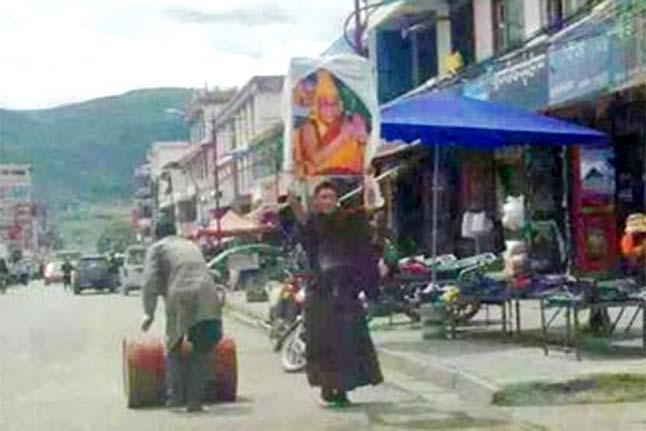
Tibetans have continued to peacefully protest, organize, and express their religious and cultural identity despite severe consequences. Monks, students, writers, activists, and ordinary Tibetans have been detained for peaceful expression and protest, with UN bodies documenting cases involving arbitrary detention, disappearance, alleged torture, and other mistreatment.
“Ours has been a long struggle. We know our cause is just. Because violence can only breed more violence and suffering, our struggle must remain nonviolent and free of hatred. We are trying to end the suffering of our people, not to inflict suffering upon others.”
— His Holiness the 14th Dalai Lama, Nobel Peace Prize acceptance speech, 1989
Nonviolence in the face of repression
Tibetans have maintained a tradition of peaceful resistance despite decades of severe repression. The Central Tibetan Administration estimates that over 1.2 million Tibetans have died as a direct result of the Chinese invasion and occupation of Tibet. Freedom House ranks Tibet 0 out of 100 for political rights and civil liberties — its lowest possible freedom score. Tibetans are denied basic human rights in Tibet, with sweeping restrictions on dissent, religion, expression, and cultural identity.
67 yrs
Of nonviolent resistance by Tibetans against Chinese occupation and rule
1989
The year that His Holiness the Dalai Lama received the Nobel Peace Prize
159
Tibetans have self-immolated inside Tibet and China since 2009
“To struggle nonviolently is the most difficult struggle… Every moment, it is a new dedication that we have to make.”
ICT’s late executive chairman Lodi Gyari spoke these words to the Senate Foreign Relations Committee about the situation in Tibet. Lodi Gyari was a prominent Tibetan activist and special envoy for the Dalai Lama who championed nonviolence throughout his life of advocacy.
Non-violence in action
GUIDED BY THE DALAI LAMA
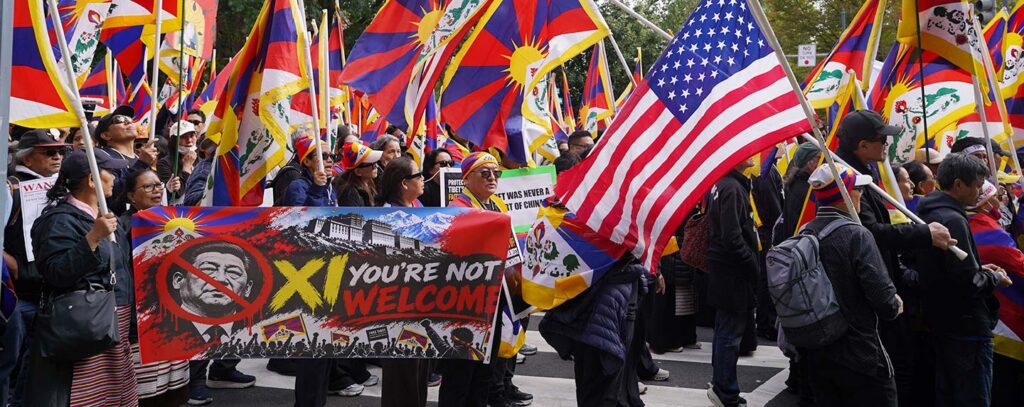
For Tibetans, nonviolence is more than an ideal. Under the leadership of His Holiness the Dalai Lama, it has shaped decades of efforts to protect Tibetan identity, defend fundamental rights, and seek a peaceful resolution to the Tibet-China conflict.
THE MIDDLE WAY APPROACH
His Holiness has long advocated the Middle Way Approach, which seeks genuine autonomy for Tibetans within the People’s Republic of China rather than independence. It calls for resolving the conflict through dialogue and negotiation without violence.
DIALOGUE OVER VIOLENCE
The Tibetan leadership has consistently pursued dialogue as the path to resolving the conflict. Representatives of the Dalai Lama held multiple rounds of talks with Chinese officials between 2002 and 2010, but formal dialogue has stalled since then.
OUR Impact
- 2002: ICT advocacy helped advance the Tibetan Policy Act, which established support for Tibet in U.S. law, created the Special Coordinator for Tibetan Issues, and directed U.S. officials to encourage substantive negotiations between Beijing and the Dalai Lama or his representatives.
- 2024: ICT played a major advocacy role in passage of the bipartisan Resolve Tibet Act, which states that the Tibet-China dispute should be resolved peacefully through substantive dialogue without preconditions and strengthens U.S. efforts to promote a negotiated agreement.
- 2009 onwards: ICT organized the first Tibet Lobby Day in Washington, D.C., in 2009, bringing Tibetan Americans and Tibet supporters to Capitol Hill to advocate peacefully with their elected representatives. It has since become an annual platform for advancing Tibet legislation, human rights, religious freedom, and a negotiated resolution to the Tibet-China conflict.
- Pressing for the resumption of Tibet-China dialogue. ICT continues urging U.S. leaders and global governments to press Beijing to resume substantive dialogue without preconditions with His Holiness the Dalai Lama, his representatives, or democratically elected Tibetan leaders — keeping peaceful negotiation at the center of international policy on Tibet.
Common Questions
Does nonviolence work against systemic oppression?
Yes, historical and sociological data shows that nonviolent resistance can be highly effective against systemic oppression, though its success is never guaranteed.
A foundational 2011 study by political scientists Erica Chenoweth and Maria J. Stephan, which analyzed over 300 struggles for regime change and self-determination between 1900 and 2006, found that nonviolent campaigns were more than twice as likely to succeed as violent ones. Their research identified broad public participation as a major advantage of nonviolent movements: peaceful resistance can involve far more people than armed struggle and can increase pressure on the institutions and individuals that sustain a government.
How are self-immolations viewed within a nonviolent movement?
Tibetan self-immolations present a profound and painful question about the boundaries of nonviolence. Unlike violence directed against another person, self-immolation directs physical harm entirely toward the protester. The acts have consequently been interpreted through different political, ethical, and Buddhist perspectives, rather than having one universally accepted meaning.
His Holiness the Dalai Lama has expressed deep sadness over the self-immolations and has emphasized the importance of motivation in Buddhist understandings of violence and nonviolence. More broadly, the deaths have generated difficult debate over self-sacrifice, suffering, political protest, and the limits of nonviolent resistance.
Have there ever been violent Tibetan uprisings or protests?
Yes. Tibet’s modern history includes armed resistance to Chinese rule during the 1950s and 1960s, including guerrilla forces associated with the Tibetan resistance. Declassified U.S. government records confirm that the CIA covertly trained and supported Tibetan fighters during the Cold War.
His Holiness the Dalai Lama subsequently established nonviolence as the guiding principle of the Tibetan movement. He has repeatedly rejected armed struggle in favor of dialogue, reconciliation, and a negotiated resolution, declaring that for Tibetans “the path of non-violence is a matter of principle.”
How do Tibetans resist when open protest is restricted?
Tibetans have developed remarkably creative forms of quiet and coded resistance when open protest is too dangerous. On the Dalai Lama’s 88th birthday in 2023, an image circulated inside Tibet showing only his distinctive ceremonial hat and the Tibetan numerals ༨༨ — allowing Tibetans to honor him without depicting his face directly.
Resistance can also be embedded in everyday religious and cultural life. Tibetans have marked the Dalai Lama’s birthday by burning incense, raising prayer flags, holding prayers and picnics, making offerings, closing shops, sharing poems and songs, and displaying his photograph discreetly in homes and monasteries. These seemingly ordinary acts can become powerful assertions of religious devotion and Tibetan identity when the expressions they represent are restricted.