


The European Parliament adopted a new report on EU-China political relations this week calling for a more coordinated and human rights-centered European policy towards China and reiterating concern over China’s assimilation policies in Tibet. While the report contains many welcome statements on Tibet, including a call on China not to interfere in the selection of the next Dalai Lama, ICT hopes to see these commitments translated into practical EU policy measures that make a meaningful difference to the Tibetan people.
The report adopted at the European Parliament plenary session in Strasbourg on October 7, addresses a wide range of challenges in EU-China relations, from economic and security concerns to China’s support for Russia’s war against Ukraine and tensions in the Taiwan Strait. While stressing the importance of continued dialogue with Beijing, it reaffirms that the EU is required to pursue a “principled, coherent, and human rights-centered China policy” and urges the EU to “keep the pressure firmly on China with regard to the defense of human rights and to not ignore human rights in EU-China relations.”
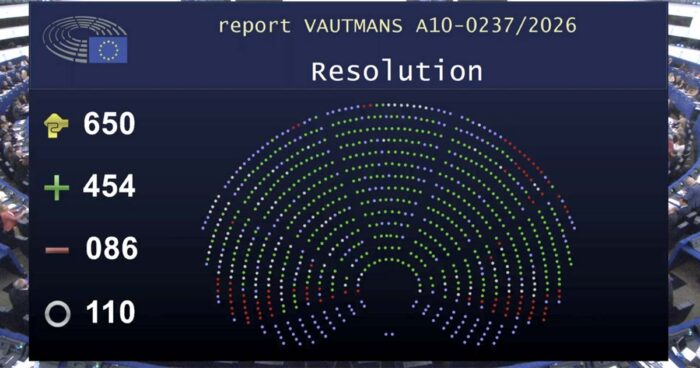
Screenshot from the European Parliament’s Plenary recording showing the result of the vote on the report on EU-China political relations on October 7, 2026. (Source: European Parliament webcast)
Regarding Tibet specifically, the report expresses “deep concern” over China’s systemic repression and forced assimilation policies in Tibet,” including “attempts at forced Sinicization and destruction of cultural heritage.” It reiterates the Parliament’s previous calls for the abolition of the boarding-school system for Tibetan children and for China to refrain from interfering in the selection of Tibetan Buddhist spiritual leaders – describing such interference as a “politically calculated move” to undermine Tibetan spiritual authority, culture and identity. It also calls for information on the whereabouts of the Panchen Lama and demands the unconditional release of political prisoners, while urging that these concerns be raised during diplomatic meetings with Chinese counterparts. On the new Chinese “ethnic unity” law, the report raises concerns about its potential to further “undermine the linguistic, cultural and religious rights of ethnic minorities,” and calls for the repeal of Article 63, which allows China to exercise jurisdiction over individuals residing in third countries.
The report also addresses the August floods along the Nepal-Tibet border, calling on Chinese authorities to provide full and verifiable casualty data and to allow independent observers, journalists and humanitarian organizations access to the affected Tibetan areas. ICT had previously reported on the lack of independent access, restrictions on information and the need for greater transparency and accountability following the disaster.
“With this report, the European Parliament has sent a clear message that China’s human rights violations in Tibet and elsewhere cannot be treated as a peripheral issue in EU-China relations,” said Tencho Gyatso, President of the International Campaign for Tibet. “This clear stand against China’s assimilation policies in Tibet is particularly timely as the new Chinese law on “ethnic unity,” which entered into force on July 1, 2026, institutionalizes these policies and further undermines Tibetans’ human rights, language, culture, and identity.”
Report stresses that human rights must be at the heart of EU-China engagement
During the debate ahead of the vote on the report, several MEPs stressed that closer engagement with China cannot come at the expense of human rights. “Partnership cannot mean silence. Not on the Uyghurs, not on Tibet, not on Hong Kong,” said the Rapporteur for the report, Parliamentarian Hilde Vautmans. The European Commission, represented by EU Commissioner for Democracy, Justice, the Rule of Law and Consumer Protection Michael McGrath, similarly stressed the need to raise concerns over “systemic human rights violations in Xinjiang, Tibet and Hong Kong” in the EU’s engagement with Beijing.
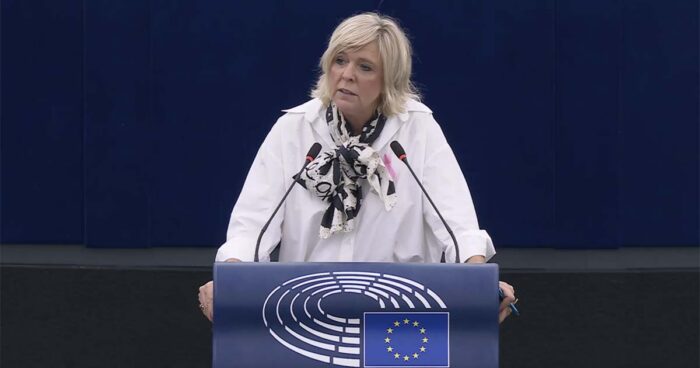
Member of the European Parliament Hilde Vautmans, Rapporteur for the report on EU-China political relations, presents her report during the parliamentary debate on 6 October 2026. (Source: European Parliament webcast)
The European Parliament’s position on Tibet has been consistent in recent years, with repeated calls for an end to policies that undermine Tibetan cultural and religious identity. In December 2023, Parliament notably called for the immediate abolition of China’s state-run residential boarding-school system for Tibetan children. In May 2025, it opposed Chinese government interference in the selection of Tibetan Buddhist spiritual leaders, including the Dalai Lama. In April 2026, the European Parliament also adopted a resolution raising concerns about the ramifications of China’s new “Ethnic Unity and Progress Law” for the languages, cultures and religious practices of Tibetans and other non-Chinese people, as well as its potential reach beyond China – concerns that were also set out in an ICT analysis of the law shared with Members of the European Parliament ahead of the resolution’s adoption.
The new EU-China report now places these concerns within the broader framework of the EU’s relations with Beijing, signaling that human rights concerns over Tibet should remain central to the EU’s wider political engagement with China, rather than being addressed only in discussions specifically focused on human rights. In this context, the EU should also consider appointing an EU Special Coordinator for Tibet to improve coordination and coherence in EU policy on Tibet and ensure that Tibet remains effectively addressed across the EU’s engagement with China.
The report also calls on the EU “to engage with China to reinforce and make more effective the EU-China Human Rights Dialogue in order to keep the pressure firmly on China” and stresses that human rights concerns should be raised “at every political meeting with Chinese counterparts.” This reflects longstanding concerns among civil society organizations, including the International Campaign for Tibet, about the limited impact of the Dialogue in addressing China’s deteriorating human rights record.
In recent years, NGOs have called for the Dialogue to be substantially reformed, arguing that human rights should not be confined to a dedicated dialogue that has not delivered any concrete results, but should be systematically raised across the full range of EU-China political engagement. At this stage, no date has been confirmed for the next EU-China Human Rights Dialogue or for the next EU-China Summit.