


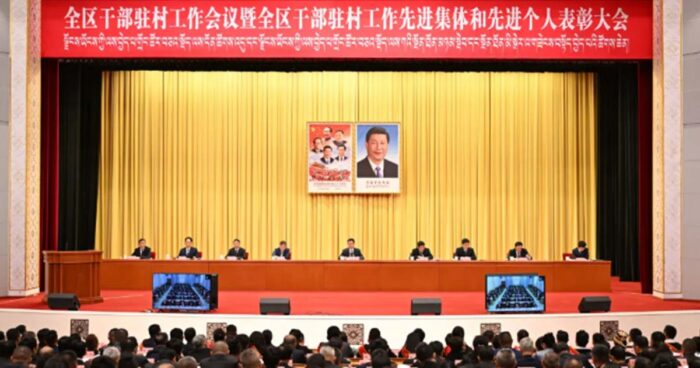
Cadres meeting in progress on May 18 (Photo: State media/propaganda handout)
The International Campaign for Tibet (ICT) has learned that, in 2026, Chinese authorities are continuing one of the most intensive rural governance programs in the Tibet Autonomous Region (TAR), stationing over 22,000 cadres across nearly every village. These actions are part of the Chinese Communist Party (CCP)’s long-running strategy to strengthen political control and accelerate forced assimilation policies across the TAR. At a high-level conference held on May 18 in Lhasa, Party Secretary Wang Junzheng praised the achievements of village-stationed work teams and outlined priorities for the newly deployed 15th batch of cadres. The meeting combined awards for outstanding performers with directives to deepen ideological education, maintain stability and promote rural revitalization.
State-embedded presence
Under the program, which began in 2011, teams of cadres are required to live, eat and work full-time in villages for one-year rotations. With approximately 22,500 cadres active at any time, the CCP maintains an average of four cadres per village within the TAR, making it one of the highest densities of state-embedded personnel, relative to any place under the CCP’s rule. Since the program’s launch, China has carried out more than 297,000 cadre deployments across 15 batches. The latest rotation in May 2026 continues a pattern of annual deployments that has become highly institutionalized, with the goal of surveilling, intimidating and exerting pressure on Tibetan communities.
In Tibetan autonomous prefectures outside the TAR including parts of Qinghai, Sichuan, Gansu and Yunnan, cadre deployments are considerably smaller than in the TAR. For example, Qinghai province dispatched 5,221 village work team members in 2021, the majority of them in Tibetan areas. In Sichuan’s Kardze (Ganzi) and Ngaba (Aba) Tibetan prefectures, as well as in Gansu’s Tibetan areas, ICT believes the CCP deployed several hundred cadres per county in some cases, suggesting total numbers in the low thousands across all non-TAR Tibetan regions. Overall, these deployments remain significantly lighter than the concentrated deployment inside the TAR, underscoring Beijing’s view of the TAR as a strategic priority requiring deeper grassroots penetration.
“Carrying out the work of stationing cadres in villages is a major decision and deployment made by the Party Committee of the Tibet Autonomous Region in accordance with the requirements of the Party Central Committee,” Wang Junzheng said in his speech, according to official reports. The program’s five key focus areas were defined as forging a strong sense of community for the Chinese nation, carrying out anti-separatism work, defending border areas, boosting rural incomes and maintaining social stability.
For this year’s village-stationing work, Wang Junzheng emphasized focusing on five continuing priorities to strengthen ideological and political work, strengthen grassroots governance, forge a strong sense of Chinese national community and revitalize rural and grassroots party building.
“Befriending” and surveillance
In clear instructions, Wang told the cadres to “adhere to the clear orientation of focusing on grassroots work, strengthen grassroots Party organizations, follow the Party’s mass line in the new era, and carry out the activities of ‘Party members and cadres going into villages and households to form pairs and make friends’ and the ‘100-day large-scale survey of villages and households’ to further strengthen the relationship between the Party and the masses and continuously enhance the people’s centripetal force and cohesion towards the Party and the government.”
“Form pairs and make friends” is a common united front mass work tactic used in Tibet where tens of thousands of cadres have been paired with Tibetan households in an organized “befriending” program where officials are assigned specific families to regularly visit and sometimes stay with overnight. The cadres carry out political indoctrination and propaganda by explaining party policies, Xi Jinping Thought, and promoting “ethnic unity.”
CCP cadres also gather information and report on family situations, ideological positions or potential risks. The cadres promote the use of the Chinese language and the commemoration of Chinese national holidays in rural Tibet. For instance, in the Menling (Milin) border county, the Daling village work team coordinated prosecutors to go into the village to deliver over 800 copies of bilingual legal materials to the people after the announcement of construction of the Medog hydropower project in July 2025. Feng Chun, a team leader stationed in Yusong village relocated 63 households with 223 people to “new homes” within seven days due to the hydropower project. Feng claimed that the work team “visited a total of 10,000 people, facilitated the signing of agreements by 605 households with 2,587 people, and completed the resettlement tasks in nine resettlement villages” this year.
In practice, the “befriending” program which has been running for a decade turns officials into embedded “relatives” who monitor and steer Tibetans towards party policies to ensure tight grassroots control in Tibet. Between 2011-2024, the party-state spent more than 20 billion yuan (approximately $2.8 billion USD) to enhance the party’s control in the TAR’s 5,594 villages, according to the TAR People’s Government Press Office.
Strategic evolution and border security
Originally expanded during China’s national poverty alleviation campaign, the village-stationing program has evolved into a permanent tool of state control. Since claiming victory over absolute poverty, the focus has shifted toward ideological work, China’s national identity building and border security.
In Tibet’s border villages near India, Nepal and Bhutan, cadres play a dual role in promoting economic development while supporting “xiaokang” (well-off villages) border settlements and joint defense mechanisms. The program creates a direct channel for central and regional authorities to monitor local sentiment and ensure implementation of central policies. Successful cadres often receive promotion advantages, turning village service into a steppingstone for political careers.
Future outlook
With the 15th cadre deployment underway, there are no signs of the program being scaled back. Wang Junzheng emphasized making the work “deeper and more solid,” suggesting continued high investment in personnel, training, and evaluation systems. ICT assesses that the May 2026 conference reinforces the centrality of village-stationing program as a cornerstone of China’s Tibet policy under Xi Jinping, blending development projects with political and security objectives. As Beijing continues to prioritize “forging a shared Chinese national identity” across Tibetan areas, the village-stationed cadres program is expected to remain central to governance in Tibetan areas for years to come.
As cadres implement the existing party-state policies, concrete short- to medium-term directions and strategies are expected to emerge during the impending 11th TAR Party Congress later this year, as well as the 8th Central Tibet Work Forum, which is due following its five-year interval. The last Tibet Work Forum was held in August 2020.