


CHINA’S “STABILITY” NORM ENTREPRENEURSHIP
Taking Tibet repression globally
CHINA’S “STABILITY” NORM ENTREPRENEURSHIP
Taking Tibet repression globally
Executive summary
Findings from multiple think tanks, academics, and the International Campaign for Tibet (ICT) demonstrate that China is now actively packaging and exporting its authoritarian and security-based governance model on a global scale by training foreign security forces. This spread is facilitated through China’s Ministry of Public Security (MPS) and the framework of Xi Jinping’s Global Security Initiative (GSI). Consequently, Beijing plays an unprecedented role in shaping public security practices, internal security organs, and technological norms within nations across Asia, Africa, Latin America, and the Pacific.
This Tibet-derived model is steadily emerging as a de facto global template for authoritarian security governance. By prioritizing regime protection over human rights, this framework presents a fundamental challenge to democratic international order. As the Tibet model becomes a template for others, it normalizes authoritarian control on an international scale. “Stability maintenance” (weiwen), which has been the Chinese Communist Party’s (CCP) core objective in Tibet for decades, is being established as a new global norm that seeks to displace existing global norms predicated upon the protection of human rights enshrined in international law.
The proliferation of China’s GSI and the export of the Tibet-refined model represent a paradigm shift in international security governance. When countries adopt Chinese-style preemptive policing and “stability maintenance,” they import the assumption that dissent is a security threat. This false equivalence undermines the international human rights framework and accelerates global democratic backsliding.
Recommendations for the international community:
- Ensure that China’s Tibet-refined “stability maintenance” model does not become a template for the normalization of authoritarian control on a global scale.
- Shine a light on and promote accountability for the CCP’s repression in Tibet. The Party’s strategy for Tibet has global implications. China’s repressive treatment of Tibetans is being adopted by governments in many other parts of the world.
- Sanction and expand entity lists to include all Chinese entities exporting “stability maintenance” mechanisms to promote authoritarianism via security trainings and related coordination in other countries.
- Democracies should actively counter the export of Chinese governance models worldwide. This requires reinforcing security assistance programs in partner countries, offering viable, human security-focused alternatives to Chinese models of authoritarianism and social control.
- Enforce strict due diligence requirements for local companies supplying components for Chinese surveillance technology, which could be used in human rights violations.
- Condition engagement with China on human rights audits and push the United Nations to investigate the role of Chinese police training in facilitating authoritarianism abroad.
Historical foundations: Tibet as the original laboratory
Under Party Secretary Chen Quanguo, who was appointed to the Tibet Autonomous Region (TAR) in 2011 before taking his methods to Xinjiang, Tibet became the advanced testing ground for “social management with Chinese characteristics,” which continued into the Xi era, reframed as “social governance.” Many of these innovations were later repeated and amplified in Xinjiang.
China has utilized the Tibetan plateau as a foundational laboratory for refining its “stability maintenance” apparatus. As documented by Human Rights Watch as early as 2016, this framework underwent a strategic evolution from reactive crackdowns to a comprehensive and pre-emptive model of control.[1]
The reach of the authorities permeated beyond urban centers into the most remote rural villages and monasteries. This intensified presence has been facilitated by thousands of cadre teams and the strategic placement of “convenience police posts,” ensuring that daily routines and religious activities are under constant scrutiny. Under this regime, a wide spectrum of peaceful behavior, such as advocating for Tibetan language rights or resisting “patriotic education”, has been effectively criminalized.
Tibet has served as a critical testing ground for sophisticated social engineering techniques. Key Chinese security innovations scaled and refined in Tibet include:
- Grid management: Communities are divided into local monitored units with embedded informants, comprehensive CCTV surveillance, and rapid-response teams.
- Convenience police stations: Hundreds of neighborhood police stations built every 200–300 meters in urban areas, staffed 24/7 for instant intervention.
- Double-linked household system: Neighbors are required to monitor and report on each other, compromising community trust.
- Mass biometric collection: DNA and iris scan collection under the guise of “free medical checkups” created one of the world’s largest ethnic-specific biometric databases.
All these practices were gradually rolled out and heavily intensified after the spring 2008 protests, with refinement of the “stability maintenance” framework to eliminate dissent before it manifests. Chinese authorities justify and legitimize their intensive security controls in Tibet to the international community within a counterterrorism and anti-extremism framework, even though there is no evidence of organized terrorism or violence within Tibetan communities both inside Tibet and in exile.
Broadly, Chinese authorities consistently attempt to link Tibet-related issues to the broader narrative of combating the “three evils” of terrorism, separatism (“splittism”), and religious extremism. This framing is reflected in official documents, such as Chinese white papers on Tibet’s governance, national security policies, including the 2015 National Security Law and 2016 Counter-Terrorism Law, which conflate separatism, extremism, and terrorism without clear distinctions, statements portraying exile Tibetan groups as promoting or inciting terrorism, or labeling Tibetan self-immolators as extremists.
This broad labeling enables repression of peaceful dissent, religious practice, and cultural identity under the guise of security measures by expanding militarization, surveillance, and detentions without evidence of terrorism or extremism.
Security drills in Tibet
- In July 2024, the Tibet Corps of the People’s Armed Police conducted a counterterrorism drill focused on “mountain capture-annihilation combat” and “anti-hijacking operations in low-rise buildings.” The exercise simulated a scenario in which five terrorists were hiding in “Mountain No. 2” and planning to carry out terrorist activities targeting major cities.[2]
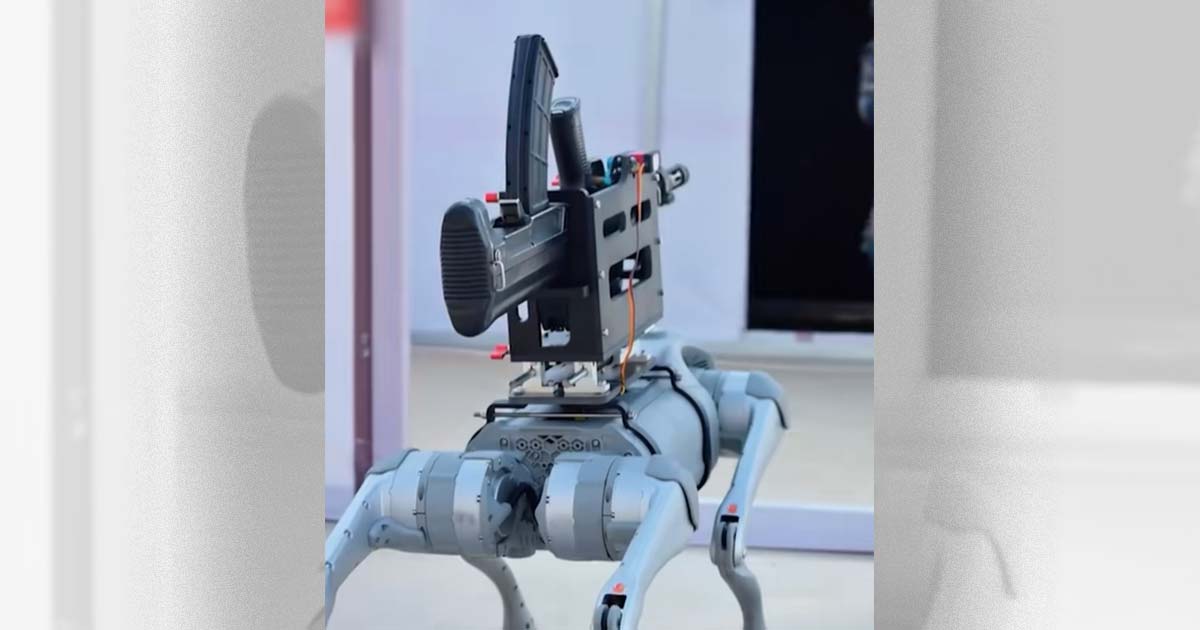
Chinese armed police showcase an armed robot dog in an urban combat drill in eastern Tibet, CGTN, May 2025.[3]
- In the lead-up to the 20th National Congress of the Communist Party of China, the Malho (Huangnan) Prefecture Public Security Bureau in Qinghai Province conducted prefecture-wide unified “anti-terrorist” drills beginning on September 28, 2022. Party Secretary Zhu Zhanmin instructed security forces to maintain “combat readiness … to deter extremist terrorist forces … and welcome the Party’s 20th National Congress.” The 580-member team initiated the drills in Rebkong (Tongren) County, a Tibetan-majority area renowned for its language activism.[4]
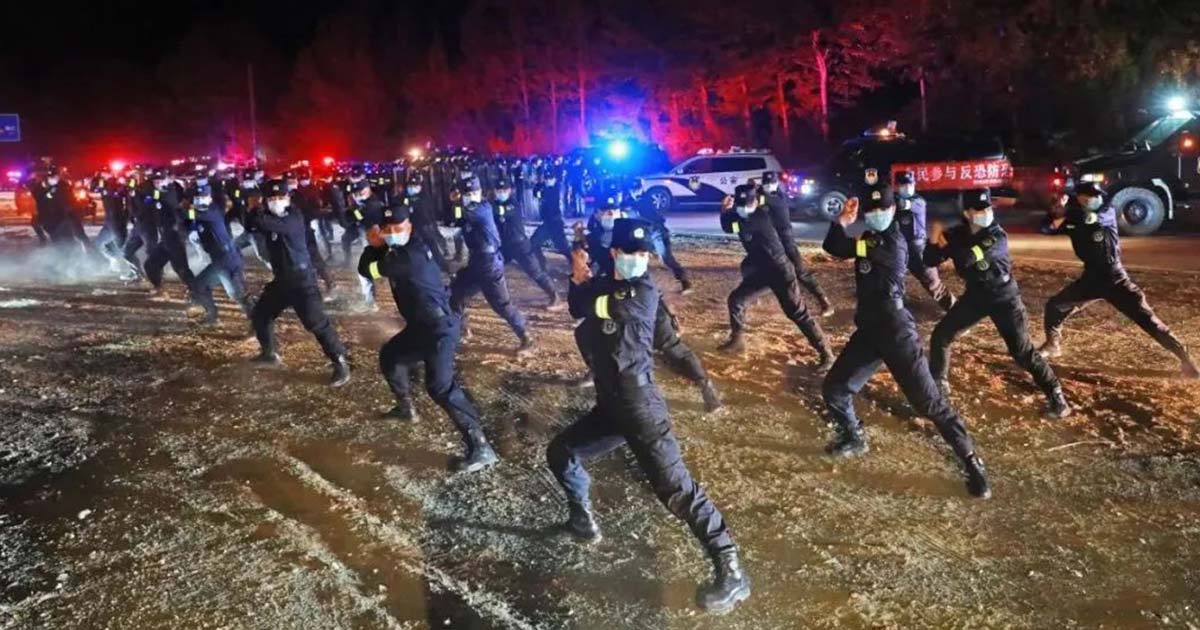
“Plateau Sharpening the Sword”: An armed mobilization and counterterrorism exercise held in Malho Prefecture on September 28, 2022, in preparation for the 20th Party Congress.
- In the lead-up to the politically sensitive anniversary of Tibetan Uprising Day on 10 March 2022, the Shigatse Military Division conducted a combat-readiness drill near Tibet’s sensitive border with India.[5]
- On March 6, 2020, as Tibetans approached the 61st anniversary of the Tibetan Uprising, the Chinese government demonstrated its power through a massive show of military force. A joint military drill in central Lhasa, the capital of Tibet, deployed “combat-ready” troops from the People’s Liberation Army, along with firefighters and officers from the People’s Armed Police.[6]
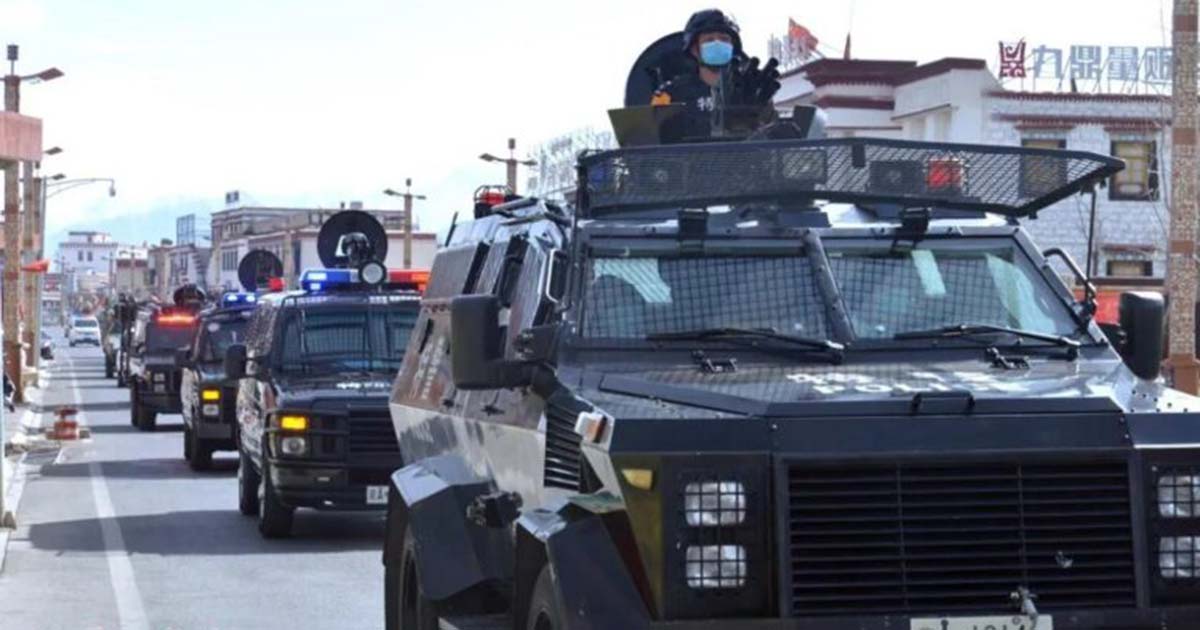
A massive show of force with a joint security drill in central Lhasa on March 6, 2020, just days before the March 10 anniversaries of the 1959 uprising and the 2008 protests.
- On March 2, 2018, coinciding with a major prayer festival in Tibet, Chinese authorities conducted a large-scale military drill in Lhasa, described as a “wall of steel,” in the lead-up to the anniversary of the 1959 Tibetan Uprising on March 10. The joint drill involved a massive display of “combat-ready” troops from the People’s Liberation Army (PLA) and the People’s Armed Police (PAP). Chinese state media reported that the drills were intended to demonstrate the authorities’ resolve to maintain “social stability,” referring to the suppression of dissent and the enforcement of loyalty to the CCP.[7]
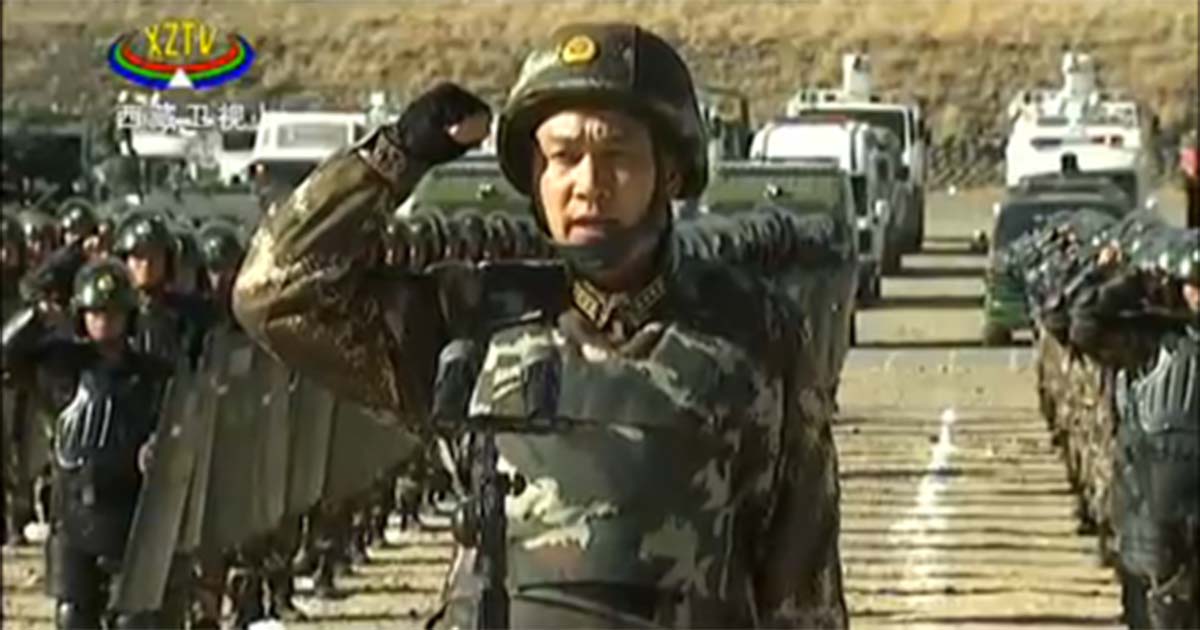
A Chinese state media television clip documenting military drills in Lhasa, March 2, 2018.
- Two major military drills were conducted in May and June 2014, in Ngari and Kardze in Tibet. In Ngari, the exercise focused on combating “self-immolation, vehicle collisions, arson attacks, and mobs.” In Kardze, the drill was described as an “anti-terrorism and stability maintenance combat exercise” and included tactics for suppressing “thugs.” As in Ngari, the Kardze “counterterrorism” training depicted police responding to individuals simulating self-immolation.[8]
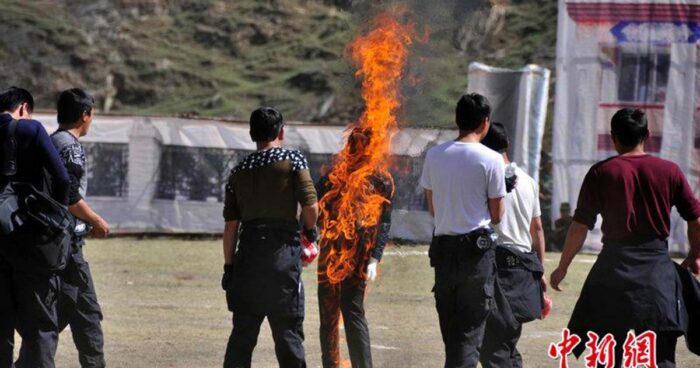
Simulation of self-immolation, May 26, 2014, during a joint counterterrorism and stability maintenance drill in Kardze Tibetan Autonomous Prefecture, Sichuan.[9]
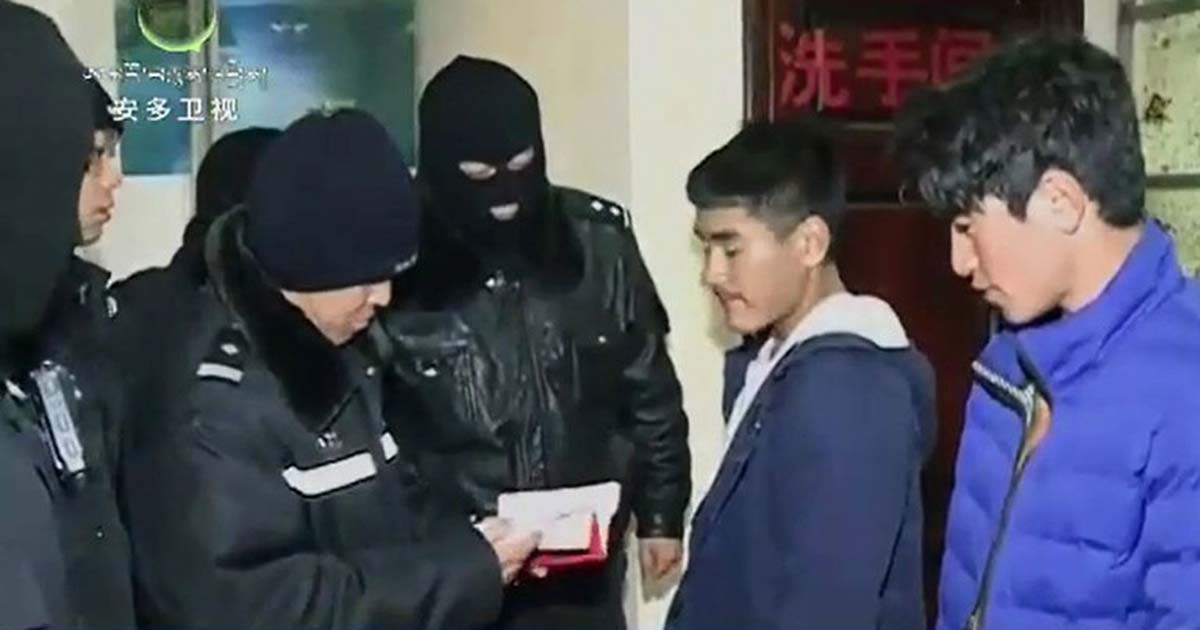
Qinghai TV footage from December 16, 2015, shows paramilitary forces conducting armed raids on internet cafes and Tibetan hotels in Dzoege (Ruo’ergai), Ngaba (Aba), Sichuan.[10]
- On March 9 and 13, 2014, large-scale “military drills” and “emergency stability maintenance” drills were conducted in Lhasa to test “comprehensive combat capability.” The commander-in-chief of the stability maintenance headquarters declared: “This stability maintenance response simulation exercise is our new starting point. We must closely monitor all important and sensitive locations… It is most important to prevent individual extreme events such as self-immolations, violent terrorist incidents, and illegal gatherings […]. We must strike hard as soon as any enemies dare to jump out and incite.”[11]
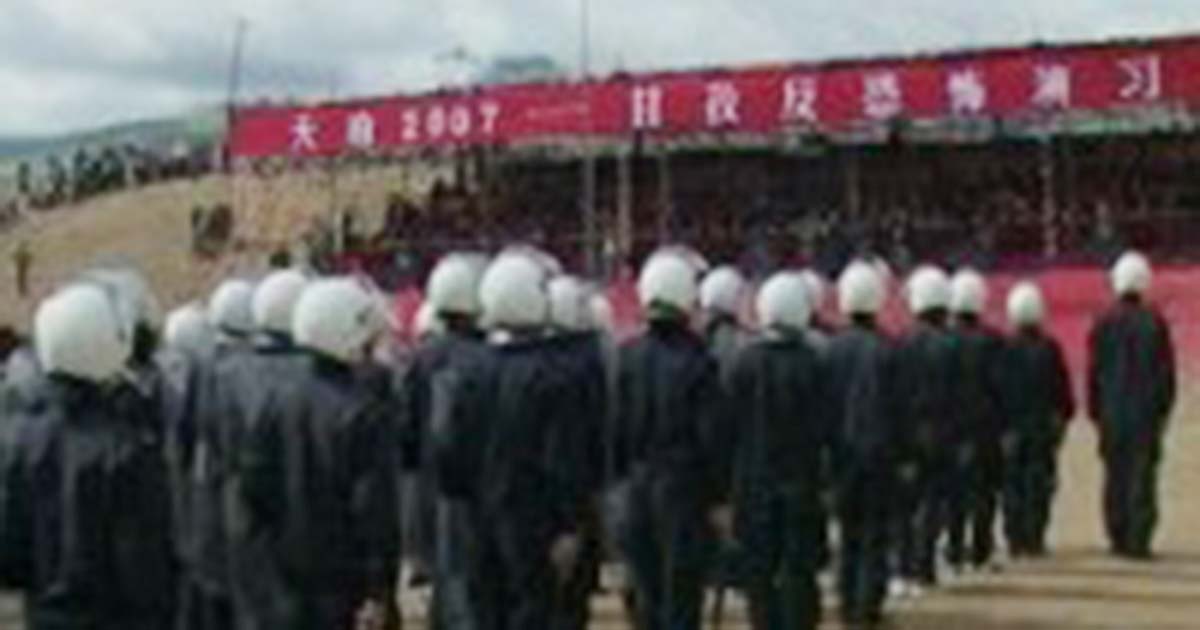
A counterterrorism and stability maintenance exercise held in Pari (Tianzhu) Tibetan Autonomous County, Gansu Province. The red banner in Chinese reads: Tianzhu 2007 Counterterrorism and Stability Maintenance Exercise.[12]
Establishing the Chinese norm: Exporting “stability maintenance”
This model originated in the early 1960s in Fengqiao Township, Zhejiang Province, during Mao Zedong’s Socialist Education Movement. Local cadres and residents were mobilized to identify, monitor, and “reform” so-called class enemies and social contradictions at the grassroots level, rather than escalating issues to higher authorities. Mao praised the approach for achieving social control with fewer formal arrests.
A significant example of this global outreach was the September 2025 pilot program in the Solomon Islands, which involved household mapping and biometric data collection—techniques mirrored from the Tibetan context.
By framing these exports as mutually beneficial tools for development and crime prevention, China seeks to legitimize and universalize its authoritarian approach to social order. This “stability maintenance with Chinese characteristics” presents a direct challenge to existing norms regarding individual rights. As Beijing positions itself as a provider of alternative governance solutions, there is a significant risk that these surveillance-heavy models may become a norm worldwide, ultimately eroding human rights standards that have been enshrined in international law.
The Global Security Initiative: Promoting a new authoritarian norm
The Global Security Initiative (GSI), announced by Xi Jinping in April 2022, serves as the overarching policy framework for exporting China’s internal security model.[13] Announced by Xi during the Central National Security Commission meeting in April 2014, the Comprehensive National Security Concept (CNSC) was later enshrined in the Chinese Communist Party (CCP) constitution at the 19th Party Congress in 2017.[14]
Under GSI’s overarching framework, China promotes its CNSC, which is “an important component of Xi Jinping Thought on Socialism with Chinese Characteristics for a New Era and represents a major theoretical contribution from contemporary China to the global community”, according to China’s National Security White Paper released in May 2025.[15]
Beijing is calling for a holistic, preventive, and integrated approach that treats security as interconnected across all domains of governance, rather than limited to traditional military domains. Through the GSI, China acts as a norm entrepreneur, aiming to transform the existing security norms to further its authoritarian agenda. In contrast to existing norms centered on human security, GSI emphasizes “indivisible security” and state sovereignty, reframing dissent as “instability”. China leverages the GSI to embed these security norms within multilateral organizations like the United Nations, ASEAN, and the Shanghai Cooperation Organisation (SCO).
Foreign police training in Nepal
Nepal, as an immediate underdeveloped neighbor of Tibet, might have been among the first countries to be influenced by China’s exported security initiatives. With around 10,000 – 20,000 Tibetans permanently living in Nepal since the occupation of Tibet in 1959, China has targeted Nepal to export its “stability maintenance” model to curb the exodus and movement of Tibetans in Nepal, long before the international community began to learn about China’s export of security training around the world. China’s assistance to Nepal focuses heavily on border security, crowd control, and preventing activities by Tibetan refugees. Nepal stopped granting refugee status to new Tibetan arrivals after 1989, and ceased issuing or renewing Refugee Identity Cards to long-staying Tibetans starting around 1994.[16]
China has conducted specific training programs for Nepali police and intelligence officials aimed at monitoring and controlling anti-Beijing activities, particularly protests by Tibetan refugees in Nepal. Reports from over the years show Chinese trainers instructing Nepali forces on how to prevent and disperse demonstrations related to Tibet.[17]
In 2017, China built and handed over the National Armed Police Force Academy in Chandragiri, Kathmandu. The academy is Nepal’s “first of its kind” dedicated armed police training institution, funded by a 200 million Chinese yuan grant, and serves as a key training hub for Nepal’s Armed Police Force (APF), which handles internal security, riot control, and border management. Nepali officers receive training at the Academy and in China on public order maintenance, counter-protest tactics, and stability-related operations.
China provides regular training, equipment, and joint exercises to Nepal’s security forces (Nepal Police and Armed Police Force) along the Tibet-Nepal border.[18] The focus is on preventing “instability” crossing the border, including Tibetan refugees, activists, and any perceived separatist activities. This includes training in surveillance, intelligence sharing, and crowd control techniques.
China has supplied riot gear, vehicles, and surveillance technology, according to the procurement documents from the Armed Police Force Headquarters, and training on “large-scale event security” and “maintaining social order.”[19] These programs often blend standard policing with elements of China’s stability maintenance approach, such as stopping the celebration of the Dalai Lama’s birthday or the commemoration of the March 10 Tibetan Uprising Day.[20]
Foreign police training findings by the Carnegie Endowment for International Peace
The Carnegie Endowment’s 2025 dataset provides the most comprehensive quantitative baseline for how China’s internal security training shapes the global landscape. Between 2000 and 2025, 863 training events were conducted involving internal security forces from 138 countries.[21] Though Tibet is not directly referenced in the study, the International Campaign for Tibet (ICT) has reported for decades on how China’s security forces use “stability maintenance” to clamp down on dissent within Tibetan communities and violate Tibetans’ human rights.
Although these trainings were initially concentrated on China’s periphery, they now span the globe, according to findings from the Carnegie Endowment study.
- Africa (25.4% of total): Focuses heavily on regime stability, presidential guard training, and anti-fraud operations with the Shandong Police College as the primary hub.
- Southeast Asia (25.2%): Concentrates on border control, counternarcotics, and joint patrols with the Yunnan Police College, leading this effort.
- Central Asia (11.7%): Focused on counterterrorism (targeting the “three evils” of terrorism, separatism, and extremism) and internet censorship. The Xinjiang Police College provides specialized “frontier expertise.”
Training courses typically involve multi-week, lecture-based instruction in China. While some modules cover capacity building, a significant portion focuses on stability maintenance; instruction on crowd control and the suppression of protest using tactics familiar to China’s repressive security apparatus in Tibet.
There is significant evidence that China deliberately downplays or conceals aspects of its foreign police training to avoid international criticism. Internal documents warn that “sensitive topics” in training are “prone to be hyped by anti-China forces” and suggest imposing confidentiality requirements on participants.
Exporting the “Fengqiao Experience:” The Solomon Islands Case Study
In the Tibet Autonomous Region, comprehensive governance centers have been established at 7 prefectural-level, 77 county-level, 691 township (street), and 5,519 villages (community) to implement the Party’s leadership at the grassroots level, making the Party organization the leading force in grassroots social governance.[22] The Fengqiao model has been actively implemented and adapted in Tibet in recent years. This model originated in the early 1960s in Fengqiao Township, Zhejiang Province, during Mao Zedong’s Socialist Education Movement. Local cadres and residents were mobilized to identify, monitor, and “reform” so-called class enemies at the grassroots level, rather than escalating to higher authorities. Mao praised the approach for achieving social control with fewer formal arrests.
Throughout Tibet, security authorities have established “Fengqiao-style” police stations, convenience police posts, and grid-based management. In Tibetan areas, it involves heavy reliance on village-level Party cadres, resident informants, household visits, and digital surveillance to monitor daily activities, religious practices, and expressions of discontent. These tactics were intensified in Tibet after the 2008 protests and later influenced similar approaches in Xinjiang. Mechanisms such as “double-linked household”, where families monitor each other, and widespread biometric registration have been used to strengthen control in Tibetan communities.
In September 2025, the Solomon Islands became the first foreign country known to pilot the adoption of China’s “Fengqiao Experience”. A leaked draft of the security agreement stated that the “Solomon Islands may, according to its own needs, request China to send police, armed police, military personnel and other law enforcement and armed forces to Solomon Islands to assist in maintaining social order.”[23]
Chinese police are working with local Solomon Islands counterparts to collect fingerprints, palm prints, and household registration information from residents in communities near Honiara. This directly mirrors Tibet. Although there is no confirmed widespread use of facial recognition, DNA or iris scans yet in public reports, the current fingerprint and palm print collection may prove to be a foundational step toward building a more sophisticated system like that in Tibet. China has supplied CCTV cameras and surveillance equipment to the Solomon Islands, which could eventually integrate with biometric databases.[24]
“Surveillance Capitalism” in Africa
Partner nations are trading their citizens’ biometric data for Chinese infrastructure. In 2018, the government of Zimbabwe signed a contract with CloudWalk Technology to build a national facial recognition database. The agreement required Zimbabwe to send biometric images to China so the firm could improve its algorithm’s ability to recognize dark-skinned faces. This allows Chinese firms to refine and customize technology for global export while helping illiberal regimes cement their domestic power.
The financing of these projects through soft loans from the Chinese Exim Bank creates a “technological lock-in”. Once a national digital ecosystem is built on Chinese standards and maintained by Chinese technicians embedded in local security agencies, switching to alternative providers becomes prohibitively expensive. This ensures long-term dependency on Chinese security norms and operational practices, according to the Carnegie Endowment for International Peace.
Findings by the Center for American Progress
Based on information from worldwide PRC embassy websites tracking MPS’s bilateral foreign engagements from 1995 to 2021, the Center for American Progress (CAP, 2022) documented MPS foreign police training and exchanges, explicitly noting programs on “stability maintenance”.[25] China’s MPS signed 51 agreements with 31 different foreign governments. China trained officers from at least 10 countries (e.g., Argentina and Tunisia on “maintaining and securing stability”; Fiji and Liberia on riot control; Uzbekistan/Kazakhstan on facial recognition for “order maintenance”; Myanmar, Panama, Papua New Guinea on large-scale event security).
CAP identified around 77 MPS training sessions, mostly post-2010, aligning with the Xi Jinping era, with a heavy focus on Asia and Africa. The study finds that China is exporting its coercive domestic model, including surveillance, cyber tools, and legal systems prioritizing regime stability. Xi’s 2017 pledge to train 20,000 developing-country officers is referenced as achieved.
Findings by the Africa Center for Strategic Studies
The Africa Center for Strategic Studies in 2025 studies find that China’s security assistance (including police training) in Africa prioritizes “stability maintenance”, where regime protection is considered national security.[26] Roughly 2,000 African law enforcement officers were trained in China (2018–2021) via institutions like the People’s Public Security University. Specific programs (e.g., Kenya training 400 officers/year since 2021, including presidential guards) emphasize CCP-style order maintenance. Surveillance tech has been adopted in at least 22 African countries, advancing Chinese governance norms in countries where security forces already prioritize regime stability.[27]
Findings on “Chinese Governance Export in Central Asia”
Drawing from a dataset of 59 in-China training programs for Central Asian officials (2007–2020), of which 24 focused on security (including counterterrorism, cybersecurity, and transport policing), Niva Yau shows that these programs explicitly export surveillance-led “stability maintenance” practices.[28] These include ideology sessions on CCP achievements, combat simulations, and technology transfers such as Huawei/ZTE cameras, facial recognition systems, and “Smart City” platforms. Central Asian states like Kazakhstan and Uzbekistan have adopted these practices for social control, resulting in expanded surveillance, preventive detentions, and heightened human rights concerns.
Conclusion
By promoting preemptive policing, mass surveillance and the criminalization of dissent, this Tibet-derived model challenges the foundations of the democratic international order. As more countries adopt Chinese-style “stability maintenance,” they normalize the idea that political dissent is a security threat. This quiet but profound gradual shift accelerates global democratic backsliding and erodes long-standing human rights norms recognized in international law.
The international community still possesses the tools to counter this expansion through diplomatic pressure, targeted sanctions, technology safeguards, and principled alliances. Tibetans have endured seven decades of occupation with extraordinary resilience, refusing to surrender their identity and dignity.
The rise of China’s authoritarian model and its police-state practices pose a growing threat to freedom worldwide. The international community must recognize that China’s model of repression, developed, scaled, and refined in Tibet over decades, is now being exported worldwide. Exposing this laboratory of control and halting the global spread of its methods is essential to protecting fundamental freedoms and preserving international human rights norms.
Footnotes:
[1] Human Rights Watch, Relentless: Detention and Prosecution of Tibetans under China’s “Stability Maintenance” Campaign (New York: Human Rights Watch, May 2016), https://www.hrw.org/sites/default/files/report_pdf/tibet0516web_0.pdf.
[2] International Campaign for Tibet, “People’s Armed Police Counter-Terrorism Drill in Tibet Projects Tibetan Dissent as Terrorism,” in ICT’s Tibet Roundup—2024 Issue 13 (July 16–August 15) (Washington, DC: International Campaign for Tibet, 2024), https://savetibet.org/news/tibet-roundup-2024-issue-13/#ch2.
[3] CGTN Europe (@cgtneurope), “Chinese armed police show case robot dog in Tibet drill,” TikTok, May 2025, https://www.tiktok.com/@cgtneurope/video/7500210401095847201.
[4] Huangnan Prefecture Public Security Bureau, “Huangnan Prefecture organized and carried out armed mobilization drills for counter-terrorism emergency response,” Huangnan News Network, September 30, 2022, https://www.qhhnnews.com/hnyw/bmdt/2022-09-30/26664.html
[5] Shigatse Military Division, “Actual Combat Readiness Pulling Drill in the Hinterland of the Tibetan Plateau at an Altitude of 4,300 Meters,” March 2022, Weibo video, https://weibo.com/tv/show/1034:4744847781986394.
[6] International Campaign for Tibet, “Massive Show of Military Force Close to Tibetan Uprising Day,” March 12, 2020, https://savetibet.org/massive-show-of-military-force-close-to-tibetan-uprising-day/.
[7] International Campaign for Tibet, “‘Wall of Steel’ in Tibet with Major Military Drill in Buildup to March 10 Anniversary,” March 5, 2018, https://savetibet.org/wall-of-steel-in-tibet-with-major-military-drill-in-buildup-to-march-10-anniversary/
[8] International Campaign for Tibet, “New Aggressive ‘Counterterrorism’ Campaign Expands from Xinjiang to Tibet with Increased Militarization of the Plateau,” October 15, 2014, https://savetibet.org/new-aggressive-counter-terrorism-campaign-expands-from-xinjiang-to-tibet-with-increased-militarization-of-the-plateau/.
[9] Sichuan Ganzi anti-terrorism drill: “Terrorists” confront armed police, China News Service, May 27, 2014, https://www.chinanews.com.cn/tp/hd2011/2014/05-27/353321.shtml.
[10] “Tightening of an Invisible Net: New Security Measures in Eastern Tibet Heighten Surveillance, Control,” International Campaign for Tibet, February 2, 2015, https://savetibet.org/tightening-of-an-invisible-net-new-security-measures-in-eastern-tibet-heighten-surveillance-control/. https://www.youtube.com/watch?v=6XiAL0EShzA
[11] International Campaign for Tibet, “The Crackdown in Tibet under Xi: The March Anniversaries and Tibetan New Year as Xi Jinping Marks a Year in Power,” March 18, 2014, https://savetibet.org/the-crackdown-in-tibet-under-xi-the-march-anniversaries-and-tibetan-new-year-as-xi-jinping-marks-a-year-in-power/.
[12] “China’s First Counter-Terror Law and Its Implications for Tibet,” International Campaign for Tibet, January 7, 2016, https://savetibet.org/chinas-first-counter-terror-law-and-its-implications-for-tibet/.
[13] “Global Security Initiative: A Solution to Global Security Challenges,” Ministry of Foreign Affairs of the People’s Republic of China, May 5, 2022, https://www.fmprc.gov.cn/eng/wjb/zzjg_663340/zcyjs_663346/xgxw_663348/202205/t20220505_10681820.html.
[14] Katja Drinhausen and Helena Legarda, “Comprehensive National Security Unleashed: How Xi’s Approach Shapes China’s Policies at Home and Abroad,” MERICS, November 2, 2022, https://merics.org/en/report/comprehensive-national-security-unleashed-how-xis-approach-shapes-chinas-policies-home-and.
[15] State Council Information Office of the People’s Republic of China, “China Releases White Paper on National Security,” Xinhua, May 12, 2025, http://english.scio.gov.cn/whitepapers/2025-05/12/content_117870467.html.
[16] Tibet Justice Center, “Tibet’s Stateless Nationals: Tibetan Refugees in Nepal” (Berkeley, CA: Tibet Justice Center, June 2002), PDF, https://law.yale.edu/sites/default/files/area/center/schell/tibet_justice_center.pdf.
[17] “A Fragile Welcome: China’s Influence on Nepal and Its Impact on Tibetans,” International Campaign for Tibet, May 16, 2013, https://savetibet.org/a-fragile-welcome-chinas-influence-on-nepal-and-its-impact-on-tibetans/
[18] “Nepal in Joint Tibet-Border Security Patrol with the Chinese,” Tibetan Review, December 20, 2025, https://www.tibetanreview.net/nepal-in-joint-tibet-border-security-patrol-with-the-chinese/.
[19] Armed Police Force Nepal Headquarters, Procurement Division, Kathmandu, Nepal, “Letter of Intent,” PDF, date of publication November 12, 2025, https://api.apf.gov.np:8443/storage/uploads/news/pdf/WhatsApp_Image_2025-11-12_at_16.11.56_1762943513.pdf
[20] Nepal stops Dalai Lama birthday celebrations in Kathmandu [Updated July 11],” International Campaign for Tibet, July 11, 2019, https://savetibet.org/nepal-stops-dalai-lama-birthday-celebrations-in-kathmandu-updated-july-11/. “Tibetans in Nepal Urged Not to Observe March 10 Uprising Anniversary,” Central Tibetan Administration, March 7, 2019, https://tibet.net/tibetans-in-nepal-urged-not-to-observe-march-10-uprising-anniversary/.
[21] Sheena Chestnut Greitens, Isaac Kardon, and Cameron Waltz, “China’s Foreign Police Training: A Global Footprint,” Carnegie Endowment for International Peace, November 2025, https://assets.carnegieendowment.org/static/files/Greitens%20et%20al._China%20Police-2.pdf.
[22] The Magnificent Scenery of Tibet, Especially the Maple Leaves, Is a Testament to the ‘Fengqiao Experience’ in the New Era,” Tibet Daily, November 6, 2023, http://mw.xizang.gov.cn/xwzx/xzxw/202311/t20231106_384311.html.
[23] Sean Kelly, “The China–Solomon Islands Security Agreement: Clear and Present Danger?” The China Story (Australian Centre on China in the World), June 6, 2022, https://www.thechinastory.org/the-china-solomon-islands-security-agreement-clear-and-present-danger/.
[24] Emile Dirks, “Mass DNA Collection in the Tibet Autonomous Region from 2016–2022,” Citizen Lab, September 13, 2022, https://munkschool.utoronto.ca/research/mass-dna-collection-tibet-autonomous-region-2016-2022. Emile Dirks, “Mass Iris Scan Collection in Qinghai,” Citizen Lab, December 14, 2022, https://citizenlab.ca/research/mass-iris-scan-collection-in-qinghai/.
[25] Jordan Link, “The Expanding International Reach of China’s Ministry of Public Security,” Center for American Progress, October, 2022, https://www.americanprogress.org/wp-content/uploads/sites/2/2022/10/ChinaMinistryPublicSecurity-report.pdf.
[26] Paul Nantulya, “China Widening Its Influence in Africa through Expanded Security Engagements,” Africa Center for Strategic Studies, June 10, 2025, https://africacenter.org/spotlight/china-influence-africa-security-engagements/.
[27] Paul Nantulya, “China’s Policing Models Make Inroads in Africa,” Africa Center for Strategic Studies, May 22, 2023, https://africacenter.org/spotlight/chinas-policing-models-make-inroads-in-africa/.
[28] Niva Yau, “Chinese Governance Export in Central Asia,” Security and Human Rights (Brill Nijhoff) (2022): 1–13, https://www.shrmonitor.org/assets/uploads/2022/03/18750230-Security-and-Human-Rights-Chinese-Governance-Export-in-Central-Asia.pdf.
Executive summary
Findings from multiple think tanks, academics, and the International Campaign for Tibet (ICT) demonstrate that China is now actively packaging and exporting its authoritarian and security-based governance model on a global scale by training foreign security forces. This spread is facilitated through China’s Ministry of Public Security (MPS) and the framework of Xi Jinping’s Global Security Initiative (GSI). Consequently, Beijing plays an unprecedented role in shaping public security practices, internal security organs, and technological norms within nations across Asia, Africa, Latin America, and the Pacific.
This Tibet-derived model is steadily emerging as a de facto global template for authoritarian security governance. By prioritizing regime protection over human rights, this framework presents a fundamental challenge to democratic international order. As the Tibet model becomes a template for others, it normalizes authoritarian control on an international scale. “Stability maintenance” (weiwen), which has been the Chinese Communist Party’s (CCP) core objective in Tibet for decades, is being established as a new global norm that seeks to displace existing global norms predicated upon the protection of human rights enshrined in international law.
The proliferation of China’s GSI and the export of the Tibet-refined model represent a paradigm shift in international security governance. When countries adopt Chinese-style preemptive policing and “stability maintenance,” they import the assumption that dissent is a security threat. This false equivalence undermines the international human rights framework and accelerates global democratic backsliding.
Recommendations for the international community:
- Ensure that China’s Tibet-refined “stability maintenance” model does not become a template for the normalization of authoritarian control on a global scale.
- Shine a light on and promote accountability for the CCP’s repression in Tibet. The Party’s strategy for Tibet has global implications. China’s repressive treatment of Tibetans is being adopted by governments in many other parts of the world.
- Sanction and expand entity lists to include all Chinese entities exporting “stability maintenance” mechanisms to promote authoritarianism via security trainings and related coordination in other countries.
- Democracies should actively counter the export of Chinese governance models worldwide. This requires reinforcing security assistance programs in partner countries, offering viable, human security-focused alternatives to Chinese models of authoritarianism and social control.
- Enforce strict due diligence requirements for local companies supplying components for Chinese surveillance technology, which could be used in human rights violations.
- Condition engagement with China on human rights audits and push the United Nations to investigate the role of Chinese police training in facilitating authoritarianism abroad.
Historical foundations: Tibet as the original laboratory
Under Party Secretary Chen Quanguo, who was appointed to the Tibet Autonomous Region (TAR) in 2011 before taking his methods to Xinjiang, Tibet became the advanced testing ground for “social management with Chinese characteristics,” which continued into the Xi era, reframed as “social governance.” Many of these innovations were later repeated and amplified in Xinjiang.
China has utilized the Tibetan plateau as a foundational laboratory for refining its “stability maintenance” apparatus. As documented by Human Rights Watch as early as 2016, this framework underwent a strategic evolution from reactive crackdowns to a comprehensive and pre-emptive model of control.[1]
The reach of the authorities permeated beyond urban centers into the most remote rural villages and monasteries. This intensified presence has been facilitated by thousands of cadre teams and the strategic placement of “convenience police posts,” ensuring that daily routines and religious activities are under constant scrutiny. Under this regime, a wide spectrum of peaceful behavior, such as advocating for Tibetan language rights or resisting “patriotic education”, has been effectively criminalized.
Tibet has served as a critical testing ground for sophisticated social engineering techniques. Key Chinese security innovations scaled and refined in Tibet include:
- Grid management: Communities are divided into local monitored units with embedded informants, comprehensive CCTV surveillance, and rapid-response teams.
- Convenience police stations: Hundreds of neighborhood police stations built every 200–300 meters in urban areas, staffed 24/7 for instant intervention.
- Double-linked household system: Neighbors are required to monitor and report on each other, compromising community trust.
- Mass biometric collection: DNA and iris scan collection under the guise of “free medical checkups” created one of the world’s largest ethnic-specific biometric databases.
All these practices were gradually rolled out and heavily intensified after the spring 2008 protests, with refinement of the “stability maintenance” framework to eliminate dissent before it manifests. Chinese authorities justify and legitimize their intensive security controls in Tibet to the international community within a counterterrorism and anti-extremism framework, even though there is no evidence of organized terrorism or violence within Tibetan communities both inside Tibet and in exile.
Broadly, Chinese authorities consistently attempt to link Tibet-related issues to the broader narrative of combating the “three evils” of terrorism, separatism (“splittism”), and religious extremism. This framing is reflected in official documents, such as Chinese white papers on Tibet’s governance, national security policies, including the 2015 National Security Law and 2016 Counter-Terrorism Law, which conflate separatism, extremism, and terrorism without clear distinctions, statements portraying exile Tibetan groups as promoting or inciting terrorism, or labeling Tibetan self-immolators as extremists.
This broad labeling enables repression of peaceful dissent, religious practice, and cultural identity under the guise of security measures by expanding militarization, surveillance, and detentions without evidence of terrorism or extremism.
Security drills in Tibet
- In July 2024, the Tibet Corps of the People’s Armed Police conducted a counterterrorism drill focused on “mountain capture-annihilation combat” and “anti-hijacking operations in low-rise buildings.” The exercise simulated a scenario in which five terrorists were hiding in “Mountain No. 2” and planning to carry out terrorist activities targeting major cities.[2]
Chinese armed police showcase an armed robot dog in an urban combat drill in eastern Tibet, CGTN, May 2025.[3]
- In the lead-up to the 20th National Congress of the Communist Party of China, the Malho (Huangnan) Prefecture Public Security Bureau in Qinghai Province conducted prefecture-wide unified “anti-terrorist” drills beginning on September 28, 2022. Party Secretary Zhu Zhanmin instructed security forces to maintain “combat readiness … to deter extremist terrorist forces … and welcome the Party’s 20th National Congress.” The 580-member team initiated the drills in Rebkong (Tongren) County, a Tibetan-majority area renowned for its language activism.[4]
“Plateau Sharpening the Sword”: An armed mobilization and counterterrorism exercise held in Malho Prefecture on September 28, 2022, in preparation for the 20th Party Congress.
- In the lead-up to the politically sensitive anniversary of Tibetan Uprising Day on 10 March 2022, the Shigatse Military Division conducted a combat-readiness drill near Tibet’s sensitive border with India.[5]
- On March 6, 2020, as Tibetans approached the 61st anniversary of the Tibetan Uprising, the Chinese government demonstrated its power through a massive show of military force. A joint military drill in central Lhasa, the capital of Tibet, deployed “combat-ready” troops from the People’s Liberation Army, along with firefighters and officers from the People’s Armed Police.[6]
A massive show of force with a joint security drill in central Lhasa on March 6, 2020, just days before the March 10 anniversaries of the 1959 uprising and the 2008 protests.
- On March 2, 2018, coinciding with a major prayer festival in Tibet, Chinese authorities conducted a large-scale military drill in Lhasa, described as a “wall of steel,” in the lead-up to the anniversary of the 1959 Tibetan Uprising on March 10. The joint drill involved a massive display of “combat-ready” troops from the People’s Liberation Army (PLA) and the People’s Armed Police (PAP). Chinese state media reported that the drills were intended to demonstrate the authorities’ resolve to maintain “social stability,” referring to the suppression of dissent and the enforcement of loyalty to the CCP.[7]
A Chinese state media television clip documenting military drills in Lhasa, March 2, 2018.
- Two major military drills were conducted in May and June 2014, in Ngari and Kardze in Tibet. In Ngari, the exercise focused on combating “self-immolation, vehicle collisions, arson attacks, and mobs.” In Kardze, the drill was described as an “anti-terrorism and stability maintenance combat exercise” and included tactics for suppressing “thugs.” As in Ngari, the Kardze “counterterrorism” training depicted police responding to individuals simulating self-immolation.[8]
Simulation of self-immolation, May 26, 2014, during a joint counterterrorism and stability maintenance drill in Kardze Tibetan Autonomous Prefecture, Sichuan.[9]
Qinghai TV footage from December 16, 2015, shows paramilitary forces conducting armed raids on internet cafes and Tibetan hotels in Dzoege (Ruo’ergai), Ngaba (Aba), Sichuan.[10]
- On March 9 and 13, 2014, large-scale “military drills” and “emergency stability maintenance” drills were conducted in Lhasa to test “comprehensive combat capability.” The commander-in-chief of the stability maintenance headquarters declared: “This stability maintenance response simulation exercise is our new starting point. We must closely monitor all important and sensitive locations… It is most important to prevent individual extreme events such as self-immolations, violent terrorist incidents, and illegal gatherings […]. We must strike hard as soon as any enemies dare to jump out and incite.”[11]
A counterterrorism and stability maintenance exercise held in Pari (Tianzhu) Tibetan Autonomous County, Gansu Province. The red banner in Chinese reads: Tianzhu 2007 Counterterrorism and Stability Maintenance Exercise.[12]
Establishing the Chinese norm: Exporting “stability maintenance”
This model originated in the early 1960s in Fengqiao Township, Zhejiang Province, during Mao Zedong’s Socialist Education Movement. Local cadres and residents were mobilized to identify, monitor, and “reform” so-called class enemies and social contradictions at the grassroots level, rather than escalating issues to higher authorities. Mao praised the approach for achieving social control with fewer formal arrests.
A significant example of this global outreach was the September 2025 pilot program in the Solomon Islands, which involved household mapping and biometric data collection—techniques mirrored from the Tibetan context.
By framing these exports as mutually beneficial tools for development and crime prevention, China seeks to legitimize and universalize its authoritarian approach to social order. This “stability maintenance with Chinese characteristics” presents a direct challenge to existing norms regarding individual rights. As Beijing positions itself as a provider of alternative governance solutions, there is a significant risk that these surveillance-heavy models may become a norm worldwide, ultimately eroding human rights standards that have been enshrined in international law.
The Global Security Initiative: Promoting a new authoritarian norm
The Global Security Initiative (GSI), announced by Xi Jinping in April 2022, serves as the overarching policy framework for exporting China’s internal security model.[13] Announced by Xi during the Central National Security Commission meeting in April 2014, the Comprehensive National Security Concept (CNSC) was later enshrined in the Chinese Communist Party (CCP) constitution at the 19th Party Congress in 2017.[14]
Under GSI’s overarching framework, China promotes its CNSC, which is “an important component of Xi Jinping Thought on Socialism with Chinese Characteristics for a New Era and represents a major theoretical contribution from contemporary China to the global community”, according to China’s National Security White Paper released in May 2025.[15]
Beijing is calling for a holistic, preventive, and integrated approach that treats security as interconnected across all domains of governance, rather than limited to traditional military domains. Through the GSI, China acts as a norm entrepreneur, aiming to transform the existing security norms to further its authoritarian agenda. In contrast to existing norms centered on human security, GSI emphasizes “indivisible security” and state sovereignty, reframing dissent as “instability”. China leverages the GSI to embed these security norms within multilateral organizations like the United Nations, ASEAN, and the Shanghai Cooperation Organisation (SCO).
Foreign police training in Nepal
Nepal, as an immediate underdeveloped neighbor of Tibet, might have been among the first countries to be influenced by China’s exported security initiatives. With around 10,000 – 20,000 Tibetans permanently living in Nepal since the occupation of Tibet in 1959, China has targeted Nepal to export its “stability maintenance” model to curb the exodus and movement of Tibetans in Nepal, long before the international community began to learn about China’s export of security training around the world. China’s assistance to Nepal focuses heavily on border security, crowd control, and preventing activities by Tibetan refugees. Nepal stopped granting refugee status to new Tibetan arrivals after 1989, and ceased issuing or renewing Refugee Identity Cards to long-staying Tibetans starting around 1994.[16]
China has conducted specific training programs for Nepali police and intelligence officials aimed at monitoring and controlling anti-Beijing activities, particularly protests by Tibetan refugees in Nepal. Reports from over the years show Chinese trainers instructing Nepali forces on how to prevent and disperse demonstrations related to Tibet.[17]
In 2017, China built and handed over the National Armed Police Force Academy in Chandragiri, Kathmandu. The academy is Nepal’s “first of its kind” dedicated armed police training institution, funded by a 200 million Chinese yuan grant, and serves as a key training hub for Nepal’s Armed Police Force (APF), which handles internal security, riot control, and border management. Nepali officers receive training at the Academy and in China on public order maintenance, counter-protest tactics, and stability-related operations.
China provides regular training, equipment, and joint exercises to Nepal’s security forces (Nepal Police and Armed Police Force) along the Tibet-Nepal border.[18] The focus is on preventing “instability” crossing the border, including Tibetan refugees, activists, and any perceived separatist activities. This includes training in surveillance, intelligence sharing, and crowd control techniques.
China has supplied riot gear, vehicles, and surveillance technology, according to the procurement documents from the Armed Police Force Headquarters, and training on “large-scale event security” and “maintaining social order.”[19] These programs often blend standard policing with elements of China’s stability maintenance approach, such as stopping the celebration of the Dalai Lama’s birthday or the commemoration of the March 10 Tibetan Uprising Day.[20]
Foreign police training findings by the Carnegie Endowment for International Peace
The Carnegie Endowment’s 2025 dataset provides the most comprehensive quantitative baseline for how China’s internal security training shapes the global landscape. Between 2000 and 2025, 863 training events were conducted involving internal security forces from 138 countries.[21] Though Tibet is not directly referenced in the study, the International Campaign for Tibet (ICT) has reported for decades on how China’s security forces use “stability maintenance” to clamp down on dissent within Tibetan communities and violate Tibetans’ human rights.
Although these trainings were initially concentrated on China’s periphery, they now span the globe, according to findings from the Carnegie Endowment study.
- Africa (25.4% of total): Focuses heavily on regime stability, presidential guard training, and anti-fraud operations with the Shandong Police College as the primary hub.
- Southeast Asia (25.2%): Concentrates on border control, counternarcotics, and joint patrols with the Yunnan Police College, leading this effort.
- Central Asia (11.7%): Focused on counterterrorism (targeting the “three evils” of terrorism, separatism, and extremism) and internet censorship. The Xinjiang Police College provides specialized “frontier expertise.”
Training courses typically involve multi-week, lecture-based instruction in China. While some modules cover capacity building, a significant portion focuses on stability maintenance; instruction on crowd control and the suppression of protest using tactics familiar to China’s repressive security apparatus in Tibet.
There is significant evidence that China deliberately downplays or conceals aspects of its foreign police training to avoid international criticism. Internal documents warn that “sensitive topics” in training are “prone to be hyped by anti-China forces” and suggest imposing confidentiality requirements on participants.
Exporting the “Fengqiao Experience:” The Solomon Islands Case Study
In the Tibet Autonomous Region, comprehensive governance centers have been established at 7 prefectural-level, 77 county-level, 691 township (street), and 5,519 villages (community) to implement the Party’s leadership at the grassroots level, making the Party organization the leading force in grassroots social governance.[22] The Fengqiao model has been actively implemented and adapted in Tibet in recent years. This model originated in the early 1960s in Fengqiao Township, Zhejiang Province, during Mao Zedong’s Socialist Education Movement. Local cadres and residents were mobilized to identify, monitor, and “reform” so-called class enemies at the grassroots level, rather than escalating to higher authorities. Mao praised the approach for achieving social control with fewer formal arrests.
Throughout Tibet, security authorities have established “Fengqiao-style” police stations, convenience police posts, and grid-based management. In Tibetan areas, it involves heavy reliance on village-level Party cadres, resident informants, household visits, and digital surveillance to monitor daily activities, religious practices, and expressions of discontent. These tactics were intensified in Tibet after the 2008 protests and later influenced similar approaches in Xinjiang. Mechanisms such as “double-linked household”, where families monitor each other, and widespread biometric registration have been used to strengthen control in Tibetan communities.
In September 2025, the Solomon Islands became the first foreign country known to pilot the adoption of China’s “Fengqiao Experience”. A leaked draft of the security agreement stated that the “Solomon Islands may, according to its own needs, request China to send police, armed police, military personnel and other law enforcement and armed forces to Solomon Islands to assist in maintaining social order.”[23]
Chinese police are working with local Solomon Islands counterparts to collect fingerprints, palm prints, and household registration information from residents in communities near Honiara. This directly mirrors Tibet. Although there is no confirmed widespread use of facial recognition, DNA or iris scans yet in public reports, the current fingerprint and palm print collection may prove to be a foundational step toward building a more sophisticated system like that in Tibet. China has supplied CCTV cameras and surveillance equipment to the Solomon Islands, which could eventually integrate with biometric databases.[24]
“Surveillance Capitalism” in Africa
Partner nations are trading their citizens’ biometric data for Chinese infrastructure. In 2018, the government of Zimbabwe signed a contract with CloudWalk Technology to build a national facial recognition database. The agreement required Zimbabwe to send biometric images to China so the firm could improve its algorithm’s ability to recognize dark-skinned faces. This allows Chinese firms to refine and customize technology for global export while helping illiberal regimes cement their domestic power.
The financing of these projects through soft loans from the Chinese Exim Bank creates a “technological lock-in”. Once a national digital ecosystem is built on Chinese standards and maintained by Chinese technicians embedded in local security agencies, switching to alternative providers becomes prohibitively expensive. This ensures long-term dependency on Chinese security norms and operational practices, according to the Carnegie Endowment for International Peace.
Findings by the Center for American Progress
Based on information from worldwide PRC embassy websites tracking MPS’s bilateral foreign engagements from 1995 to 2021, the Center for American Progress (CAP, 2022) documented MPS foreign police training and exchanges, explicitly noting programs on “stability maintenance”.[25] China’s MPS signed 51 agreements with 31 different foreign governments. China trained officers from at least 10 countries (e.g., Argentina and Tunisia on “maintaining and securing stability”; Fiji and Liberia on riot control; Uzbekistan/Kazakhstan on facial recognition for “order maintenance”; Myanmar, Panama, Papua New Guinea on large-scale event security).
CAP identified around 77 MPS training sessions, mostly post-2010, aligning with the Xi Jinping era, with a heavy focus on Asia and Africa. The study finds that China is exporting its coercive domestic model, including surveillance, cyber tools, and legal systems prioritizing regime stability. Xi’s 2017 pledge to train 20,000 developing-country officers is referenced as achieved.
Findings by the Africa Center for Strategic Studies
The Africa Center for Strategic Studies in 2025 studies find that China’s security assistance (including police training) in Africa prioritizes “stability maintenance”, where regime protection is considered national security.[26] Roughly 2,000 African law enforcement officers were trained in China (2018–2021) via institutions like the People’s Public Security University. Specific programs (e.g., Kenya training 400 officers/year since 2021, including presidential guards) emphasize CCP-style order maintenance. Surveillance tech has been adopted in at least 22 African countries, advancing Chinese governance norms in countries where security forces already prioritize regime stability.[27]
Findings on “Chinese Governance Export in Central Asia”
Drawing from a dataset of 59 in-China training programs for Central Asian officials (2007–2020), of which 24 focused on security (including counterterrorism, cybersecurity, and transport policing), Niva Yau shows that these programs explicitly export surveillance-led “stability maintenance” practices.[28] These include ideology sessions on CCP achievements, combat simulations, and technology transfers such as Huawei/ZTE cameras, facial recognition systems, and “Smart City” platforms. Central Asian states like Kazakhstan and Uzbekistan have adopted these practices for social control, resulting in expanded surveillance, preventive detentions, and heightened human rights concerns.
Conclusion
By promoting preemptive policing, mass surveillance and the criminalization of dissent, this Tibet-derived model challenges the foundations of the democratic international order. As more countries adopt Chinese-style “stability maintenance,” they normalize the idea that political dissent is a security threat. This quiet but profound gradual shift accelerates global democratic backsliding and erodes long-standing human rights norms recognized in international law.
The international community still possesses the tools to counter this expansion through diplomatic pressure, targeted sanctions, technology safeguards, and principled alliances. Tibetans have endured seven decades of occupation with extraordinary resilience, refusing to surrender their identity and dignity.
The rise of China’s authoritarian model and its police-state practices pose a growing threat to freedom worldwide. The international community must recognize that China’s model of repression, developed, scaled, and refined in Tibet over decades, is now being exported worldwide. Exposing this laboratory of control and halting the global spread of its methods is essential to protecting fundamental freedoms and preserving international human rights norms.
Footnotes:
[1] Human Rights Watch, Relentless: Detention and Prosecution of Tibetans under China’s “Stability Maintenance” Campaign (New York: Human Rights Watch, May 2016), https://www.hrw.org/sites/default/files/report_pdf/tibet0516web_0.pdf.
[2] International Campaign for Tibet, “People’s Armed Police Counter-Terrorism Drill in Tibet Projects Tibetan Dissent as Terrorism,” in ICT’s Tibet Roundup—2024 Issue 13 (July 16–August 15) (Washington, DC: International Campaign for Tibet, 2024), https://savetibet.org/news/tibet-roundup-2024-issue-13/#ch2.
[3] CGTN Europe (@cgtneurope), “Chinese armed police show case robot dog in Tibet drill,” TikTok, May 2025, https://www.tiktok.com/@cgtneurope/video/7500210401095847201.
[4] Huangnan Prefecture Public Security Bureau, “Huangnan Prefecture organized and carried out armed mobilization drills for counter-terrorism emergency response,” Huangnan News Network, September 30, 2022, https://www.qhhnnews.com/hnyw/bmdt/2022-09-30/26664.html
[5] Shigatse Military Division, “Actual Combat Readiness Pulling Drill in the Hinterland of the Tibetan Plateau at an Altitude of 4,300 Meters,” March 2022, Weibo video, https://weibo.com/tv/show/1034:4744847781986394.
[6] International Campaign for Tibet, “Massive Show of Military Force Close to Tibetan Uprising Day,” March 12, 2020, https://savetibet.org/massive-show-of-military-force-close-to-tibetan-uprising-day/.
[7] International Campaign for Tibet, “‘Wall of Steel’ in Tibet with Major Military Drill in Buildup to March 10 Anniversary,” March 5, 2018, https://savetibet.org/wall-of-steel-in-tibet-with-major-military-drill-in-buildup-to-march-10-anniversary/
[8] International Campaign for Tibet, “New Aggressive ‘Counterterrorism’ Campaign Expands from Xinjiang to Tibet with Increased Militarization of the Plateau,” October 15, 2014, https://savetibet.org/new-aggressive-counter-terrorism-campaign-expands-from-xinjiang-to-tibet-with-increased-militarization-of-the-plateau/.
[9] Sichuan Ganzi anti-terrorism drill: “Terrorists” confront armed police, China News Service, May 27, 2014, https://www.chinanews.com.cn/tp/hd2011/2014/05-27/353321.shtml.
[10] “Tightening of an Invisible Net: New Security Measures in Eastern Tibet Heighten Surveillance, Control,” International Campaign for Tibet, February 2, 2015, https://savetibet.org/tightening-of-an-invisible-net-new-security-measures-in-eastern-tibet-heighten-surveillance-control/. https://www.youtube.com/watch?v=6XiAL0EShzA
[11] International Campaign for Tibet, “The Crackdown in Tibet under Xi: The March Anniversaries and Tibetan New Year as Xi Jinping Marks a Year in Power,” March 18, 2014, https://savetibet.org/the-crackdown-in-tibet-under-xi-the-march-anniversaries-and-tibetan-new-year-as-xi-jinping-marks-a-year-in-power/.
[12] “China’s First Counter-Terror Law and Its Implications for Tibet,” International Campaign for Tibet, January 7, 2016, https://savetibet.org/chinas-first-counter-terror-law-and-its-implications-for-tibet/.
[13] “Global Security Initiative: A Solution to Global Security Challenges,” Ministry of Foreign Affairs of the People’s Republic of China, May 5, 2022, https://www.fmprc.gov.cn/eng/wjb/zzjg_663340/zcyjs_663346/xgxw_663348/202205/t20220505_10681820.html.
[14] Katja Drinhausen and Helena Legarda, “Comprehensive National Security Unleashed: How Xi’s Approach Shapes China’s Policies at Home and Abroad,” MERICS, November 2, 2022, https://merics.org/en/report/comprehensive-national-security-unleashed-how-xis-approach-shapes-chinas-policies-home-and.
[15] State Council Information Office of the People’s Republic of China, “China Releases White Paper on National Security,” Xinhua, May 12, 2025, http://english.scio.gov.cn/whitepapers/2025-05/12/content_117870467.html.
[16] Tibet Justice Center, “Tibet’s Stateless Nationals: Tibetan Refugees in Nepal” (Berkeley, CA: Tibet Justice Center, June 2002), PDF, https://law.yale.edu/sites/default/files/area/center/schell/tibet_justice_center.pdf.
[17] “A Fragile Welcome: China’s Influence on Nepal and Its Impact on Tibetans,” International Campaign for Tibet, May 16, 2013, https://savetibet.org/a-fragile-welcome-chinas-influence-on-nepal-and-its-impact-on-tibetans/
[18] “Nepal in Joint Tibet-Border Security Patrol with the Chinese,” Tibetan Review, December 20, 2025, https://www.tibetanreview.net/nepal-in-joint-tibet-border-security-patrol-with-the-chinese/.
[19] Armed Police Force Nepal Headquarters, Procurement Division, Kathmandu, Nepal, “Letter of Intent,” PDF, date of publication November 12, 2025, https://api.apf.gov.np:8443/storage/uploads/news/pdf/WhatsApp_Image_2025-11-12_at_16.11.56_1762943513.pdf
[20] Nepal stops Dalai Lama birthday celebrations in Kathmandu [Updated July 11],” International Campaign for Tibet, July 11, 2019, https://savetibet.org/nepal-stops-dalai-lama-birthday-celebrations-in-kathmandu-updated-july-11/. “Tibetans in Nepal Urged Not to Observe March 10 Uprising Anniversary,” Central Tibetan Administration, March 7, 2019, https://tibet.net/tibetans-in-nepal-urged-not-to-observe-march-10-uprising-anniversary/.
[21] Sheena Chestnut Greitens, Isaac Kardon, and Cameron Waltz, “China’s Foreign Police Training: A Global Footprint,” Carnegie Endowment for International Peace, November 2025, https://assets.carnegieendowment.org/static/files/Greitens%20et%20al._China%20Police-2.pdf.
[22] The Magnificent Scenery of Tibet, Especially the Maple Leaves, Is a Testament to the ‘Fengqiao Experience’ in the New Era,” Tibet Daily, November 6, 2023, http://mw.xizang.gov.cn/xwzx/xzxw/202311/t20231106_384311.html.
[23] Sean Kelly, “The China–Solomon Islands Security Agreement: Clear and Present Danger?” The China Story (Australian Centre on China in the World), June 6, 2022, https://www.thechinastory.org/the-china-solomon-islands-security-agreement-clear-and-present-danger/.
[24] Emile Dirks, “Mass DNA Collection in the Tibet Autonomous Region from 2016–2022,” Citizen Lab, September 13, 2022, https://munkschool.utoronto.ca/research/mass-dna-collection-tibet-autonomous-region-2016-2022. Emile Dirks, “Mass Iris Scan Collection in Qinghai,” Citizen Lab, December 14, 2022, https://citizenlab.ca/research/mass-iris-scan-collection-in-qinghai/.
[25] Jordan Link, “The Expanding International Reach of China’s Ministry of Public Security,” Center for American Progress, October, 2022, https://www.americanprogress.org/wp-content/uploads/sites/2/2022/10/ChinaMinistryPublicSecurity-report.pdf.
[26] Paul Nantulya, “China Widening Its Influence in Africa through Expanded Security Engagements,” Africa Center for Strategic Studies, June 10, 2025, https://africacenter.org/spotlight/china-influence-africa-security-engagements/.
[27] Paul Nantulya, “China’s Policing Models Make Inroads in Africa,” Africa Center for Strategic Studies, May 22, 2023, https://africacenter.org/spotlight/chinas-policing-models-make-inroads-in-africa/.
[28] Niva Yau, “Chinese Governance Export in Central Asia,” Security and Human Rights (Brill Nijhoff) (2022): 1–13, https://www.shrmonitor.org/assets/uploads/2022/03/18750230-Security-and-Human-Rights-Chinese-Governance-Export-in-Central-Asia.pdf.