
Tibetan Democracy and the Central Tibetan Administration in a Changing Global Political Landscape
Tibetan Democracy and the Central Tibetan Administration in a Changing Global Political Landscape
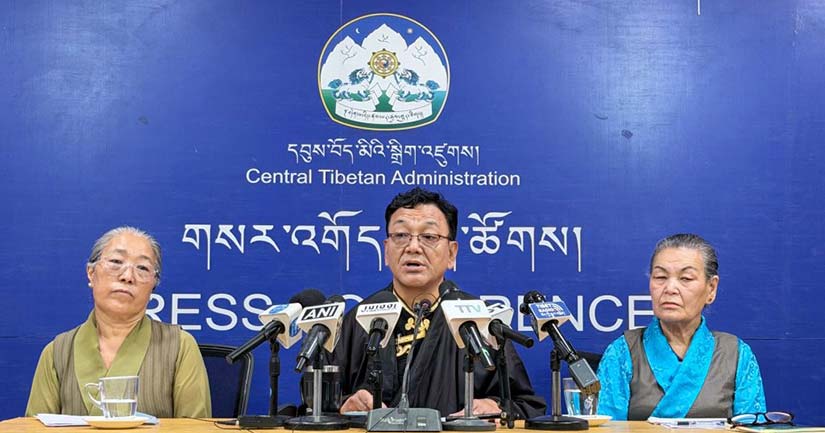
Chief Tibetan Election Commissioner Lobsang Yeshi (center) flanked by commissioners Tsering Youdon (left, in green) and Nangsa Choedon announcing the results on May 13, 2026. (Photo: Tibet.net)
Development of the Central Tibetan Administration
In 1960, the Dalai Lama informed Tibetan society about his plans to reform Tibetan governance, saying, “Changes must come in all spheres. The government structure will also have to undergo far-reaching reforms so that the people are more intimately associated with government policy and the administration of the country. The task and responsibility of establishing improved political and religious institutions lies with all of us.”
He was critical of the governance system in traditional Tibet, saying, “In order to make Tibet a rich, strong and vigorous nation, the special privileges and the large estates enjoyed, whether by monasteries or aristocratic families, will have to go and everyone will have to learn and live with and help the common people.”
He could not implement all of these reforms in Tibet, but being in exile gave him the first real opportunity to do so. Over time, he transformed Tibet’s governance system into a functioning democracy. He later explained this rationale: “One of the aspirations I have cherished since childhood is the reform of Tibet’s political and social structure, and in the few years when I held effective power in Tibet, I managed to make some fundamental changes. Although I was unable to take this further in Tibet, I have made every effort to do so since we came into exile.”
The CTA is organized around three pillars: the judiciary, represented by the Tibetan Supreme Justice Commission; the legislature, represented by the Tibetan Parliament-in-Exile (TPiE); and the executive, represented by the Sikyong and the Kashag. While the three Justice Commissioners are elected by the TPiE, the Sikyong and the 45 members of the TPiE are directly elected by Tibetans living in exile outside Tibet. The institutional framework is set out in the Charter of Tibetans-in-Exile, the Tibetan diaspora’s guiding legal document.
The Dalai Lama took the most consequential step in 2011, when he devolved his political authority to the three pillars of Tibetan democracy. In doing so, he ended more than three centuries of political rule by the Dalai Lamas. Equally important, he made clear that responsibility for sustaining Tibetan democracy would henceforth rest with the Tibetan people themselves.
The CTA’s current governance model closely resembles what German sociologist Max Weber called rational-legal authority. Weber identified three forms of legitimate authority: traditional, charismatic, and rational-legal. The transfer of authority from the Dalai Lama to elected CTA leaders—grounded in the Charter of Tibetans-in-Exile and related rules, rather than in the charisma of a single individual or in customary practice—is a clear example of that model.
This governance system is the outcome of successive reform initiatives promoted by the Dalai Lama since he came into exile from Tibet to India in 1959. Institutionalization of a democratic system of governance has been his long-held vision. When announcing the complete transfer of his political authority to the CTA in 2011, the Dalai Lama said, “So, the many political changes that I have made are based on sound reasons and of immediate and ultimate benefit for all of us. In fact, these changes will make our administration more stable and excel its development.” He further had this message to the Tibetan people: “While I am still healthy and present amidst you all, you should take full responsibility of the Tibetan affairs. And if some problem arises that necessitates my help, then of course, I am still here. I have not given up and neither am I disheartened. The democratic system that we have followed till now can take full responsibility and after considering the many requirements and reasons, I am asking the democratic system to take full responsibility.”
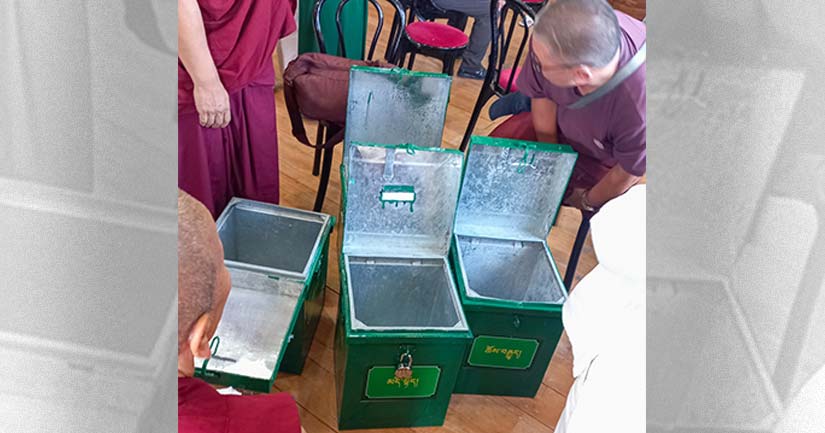
Ballot boxes being checked in preparation for elections in a Tibetan settlement. (Photo: ANFREL)
Results of the 2026 elections
17 New Members of Parliament
According to the Tibetan Election Commission, 41,638 of 91,073 registered voters cast ballots in the April 26, 2026, parliamentary elections, for a turnout of 45.71 percent (compared to 51.14 percent turnout in the February 1 elections). Tibetan democracy uses a two-stage election process: the first stage identifies candidates, and the second elects representatives. The lower turnout in the second round likely reflects reduced public interest once the Sikyong race had already been during the primary elections in February. Vote totals also varied sharply across constituencies because of their different sizes: in one constituency, a winning candidate received just 95 votes, while in another, the winner received 17,776.
All Tibetans aged 18 years or older have the right to vote. Those wishing to be members of the TPiE must be 25 years old and candidates for Sikyong must be 35 years old.
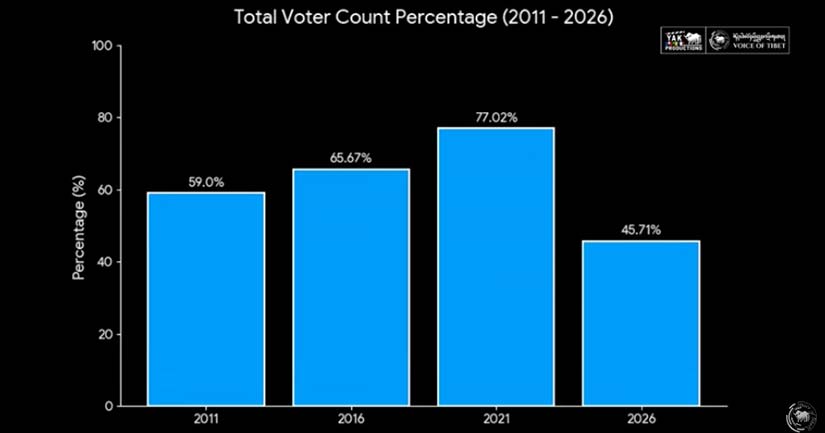
A comparison of the voter turnouts in Tibetan elections since 2011. (Graph: Courtesy of Voice of Tibet)
Of the 17 new members, five were elected from Dhotoe constituencies in the Indian subcontinent, four from Dhomey and three from U-Tsang. The religious constituencies returned one new representative, from the Bon tradition. Tibetans in Europe elected one new member, those in the Americas elected two, and Tibetans in Australasia and Oceania elected a new representative to their single seat.
The new Parliament includes nine women, two fewer than the outgoing body, and 10 monks, also two fewer than before. Its youngest member was born in 1996 (age 30), while its oldest was born in 1953 (age 73). Four members were born in the 1950s, six in the 1960s, 13 in the 1970s, 17 in the 1980s, and five in the 1990s. By generation, eight are Boomers, 21 are Gen X, and 16 are Millennials. Notably, a majority of the members (25) were born in Tibet after 1959 and came into exile after 1980.
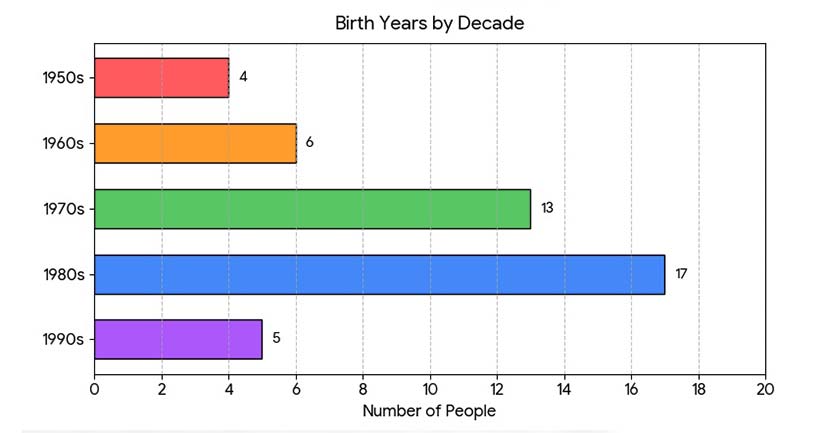
The age range of elected members of the Tibetan Parliament in Exile.
The Asian Network for Free Elections (ANFREL), a civil society network focused on election integrity and monitoring, dispatched an independent International Expert Election Observation Mission (IEEOM) to Tibetan settlements in India to assess the conduct and integrity of the second round of the 2026 elections.Although ANFREL had previously taken part in a 2015 joint solidarity mission during Tibetan elections—organized by the International Campaign for Tibet and the Tibetan Center for Human Rights and Democracy, alongside the Asia Democracy Network and FORUM-ASIA —this was its first independent observation mission focused on the Tibetan voting system.
Through pre-election, Election Day, and post-election observation, along with interviews with election authorities, candidates, monastic leaders, and civil society representatives in several settlements, the mission—conducted in coordination with ICT—assessed the administration, integrity, and legitimacy of the electoral process. ANFREL is expected to release its election observation report by June 2026.
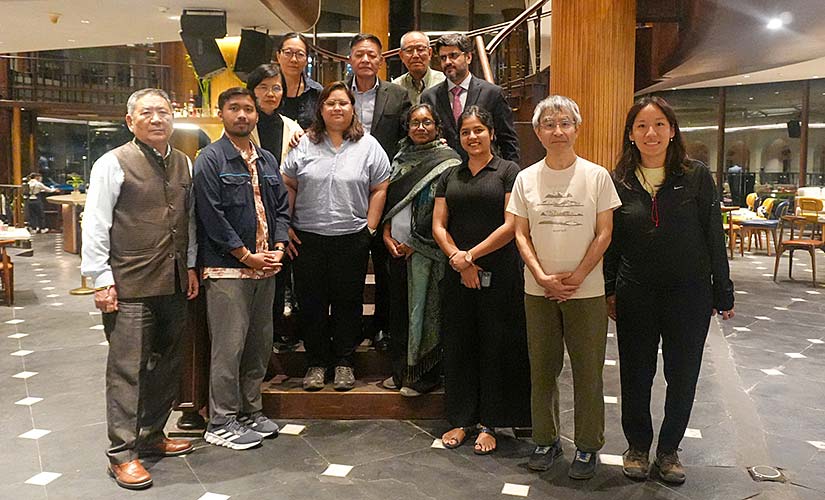
The ANFREL election observation team and ICT staff after a discussion session with Sikyong Penpa Tsering and Representative Jigme Jungney of the Bureau of H.H. the Dalai Lama in New Delhi on April 29, 2026. (Photo: ANFREL)
Empowerment of Tibetans
Under Chinese rule, meanwhile, the Tibetan people are being denied the right to determine their own future, including the right to elect their own leaders. Ever since Communist China’s invasion of Tibet beginning in 1949 and complete occupation in 1959, the Tibetan people have been placed under the rule of non-Tibetans. The Chinese Communist Party rules Tibet without the consent of Tibetans. Equally important, Tibetans in Tibet are denied freedom of speech, freedom of assembly and other democratic freedoms by the CCP.
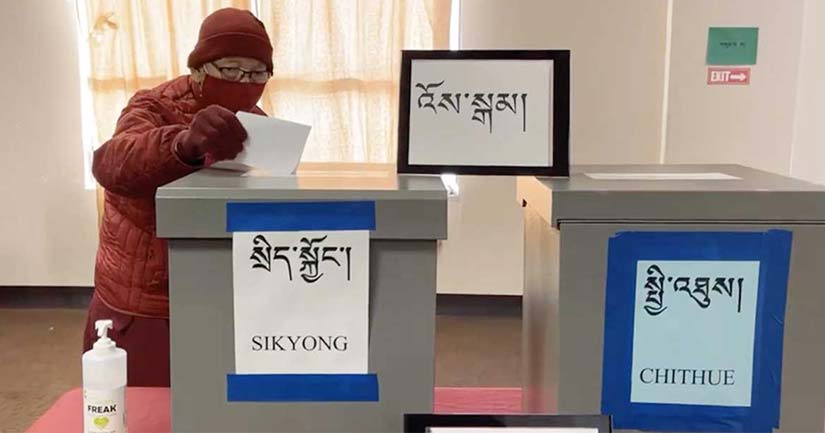
Ven. Gedun Kesang, a Tibetan monk residing in Minnesota, USA, who was then 100 years old, exercising his voting rights in the Tibetan elections on January 3, 2021. The ballot box on the left is for Sikyong (President of the CTA) ballots and the box marked Chithue is for parliamentary ballots. (Photo: TAFM video)
The Dalai Lama saw his democratic initiatives as a vehicle to enable the Tibetan people to be self-sufficient in governance for one day running a democratic Tibet. In his statement on the anniversary of the Tibetan National Uprising Day on March 10, 1961, he asserted, “To the thousands of my countrymen in India, Nepal, Bhutan and Sikkim, I want to say that a heavy responsibility devolves on all of us to prepare ourselves for the day when we can return to our country and build a happier and greater independent Tibet. New Tibet will need thousands of trained and skilled men and women, necessary to bring Tibet in consonance with the spirit of democracy without losing our cultural and religious heritage or our soul.”Three key features of the governance system in exile are: all Tibetans must have a say in their governance through democratization, regular elections and representative government; rule of law is established through the Tibetan Charter-in-Exile; and, a system of elected leaders must be empowered to make decisions by devolving political authority to them. Today, the democratic system in exile provides opportunity to non-aristocratic ordinary individuals to be heads of the CTA’s three pillars of democracy, proving the Tibetan saying, “If mother’s child has education, the throne of Gaden [symbolizing the head of the Gelug lineage, an important Tibetan Buddhist position] has no owner.” (ཨ་མའི་བུ་ལ་ཡོན་ཏན་ཡོད་ན། ། དགའ་ལྡན་ཁྲི་ལ་བདག་པོ་མེད།)
Constraints of governance in exile
These constraints are also visible in the electoral system. Tibetans do not follow a pure one-person, one-vote model in parliamentary elections. Instead, the system combines one-person, one-vote with forms of plural voting to reflect the circumstances of exile. Tibetans living in the Indian subcontinent (India, Nepal, and Bhutan), for example, vote for 10 members—at least two of whom must be women—based on their traditional provincial origin: U-Tsang, Kham, or Amdo. Tibetans living outside South Asia do not vote for provincial seats; those in Europe elect two TPiE members, as do Tibetans in the Americas. Tibetans in Australasia and other Asian countries outside the Indian subcontinent elect one member. Clergy members cast two additional votes to choose representatives from their religious traditions—Sakya, Kagyu, Gelug, Nyingma, or Bon. In total, the TPiE reserves 10 seats for religious representatives.
Operating in exile also creates procedural and jurisdictional complications. On April 23, 2026, just three days before the main elections, the Tibetan Election Commission announced that it would deny voting rights to Tibetans in a district in Nepal because of alleged irregularities in the February 1 primary elections. The decision quickly became controversial within the Tibetan community. After further deliberation, the Commission reversed itself, but voting still did not take place in that district. A representative of the affected community filed a petition before the Tibetan Justice Commission on May 7, with support from the Tibetan Legal Association. As of May 18, the case had been accepted, but no hearings had yet been scheduled. Although the matter remains unresolved, the case nonetheless illustrates the operation of checks and balances within Tibetan democracy.
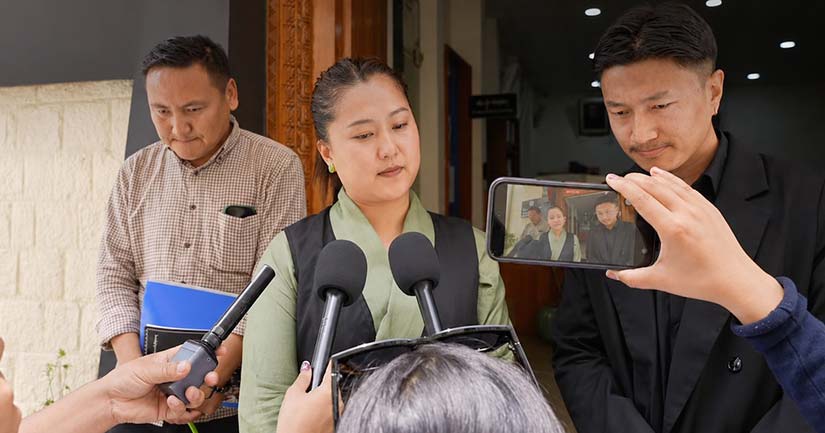
Tibetan Legal Association’s team speaking to media personnel outside the Tibetan Supreme Justice Commission on May 11, 2026, giving an update on the status of the Nepal case. (Photo: Phayul)
Challenges facing the Sikyong in the coming years
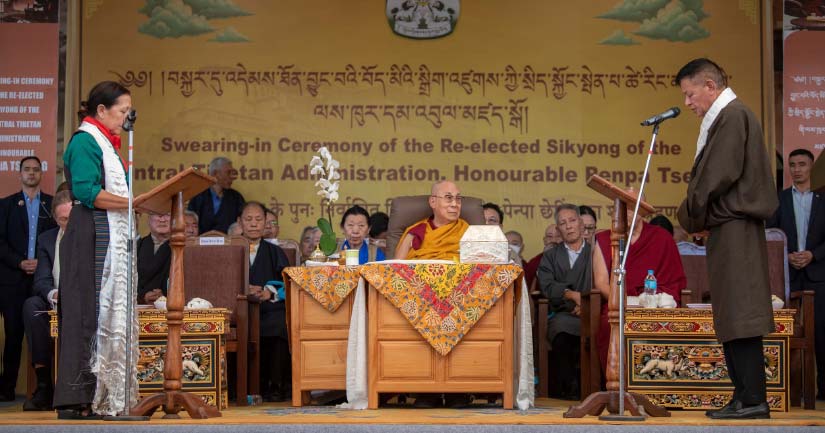
As the Dalai Lama presides, Sikyong Penpa Tsering taking his oath of office from the Tibetan Justice Commissioner Yeshi Wangmo on May 27, 2026. (Photo: Tenzin Jigme Taydeh, CTA)
Providing Tibetan political leadership in a changing geopolitical landscape
In this environment, Western dominance of the global order is fading, multilateralism is declining, and great-power rivalry—particularly between the United States and China—is intensifying. India, which has provided foundational support to Tibetans in exile, is caught in this shifting landscape.
In Tibet, China is pursuing policies that threaten the long-term survival of Tibetan identity. The Tibet-related components of the 15th Five-Year Plan (2026-2030), at both the national and regional levels, indicate that Xi Jinping’s agenda of Sinicization and assimilation remains central to the Chinese Communist Party’s Tibet policy.
This is also a pivotal period in Chinese domestic politics. Preparations are under way for the 21st Party Congress, expected in late 2027, which could bring significant leadership changes under Xi Jinping’s direction. Any reshuffling within the Chinese political system is likely to affect Tibet policy.
Against this backdrop, the Penpa Tsering administration will need to provide political leadership that reinforces Tibetan institutions and creates space for the Tibet issue within a rapidly shifting international environment.
India remains the CTA’s and India-based Tibetan diaspora’s foundational supporter. At the same time, New Delhi is seeking to stabilize its relationship with China. While India has too much at stake to simply abandon Tibet, the CTA must think strategically about how to preserve Indian support over the long term. The United States—the other country that has consistently provided substantial policy and programmatic support to Tibetans—is also undergoing change. A generational shift is under way in Congress among long-standing supporters of Tibet. The US government still has a mandate to support a resolution of the Tibetan issue through substantive dialogue between Tibetan representatives and the Chinese government. However, some recent US policy choices, including reduced programmatic assistance for Tibetans and the failure to mention Tibet in high-level interactions with China, have had adverse effects on Tibetans.
In Europe, both the European Union and individual governments can serve as influential advocates for Tibet, and the European Parliament remains an important venue for debate on Tibet-related issues. Yet Europe, too, is recalibrating its relationships with both China and the United States.
Tibet therefore remains a consequential issue in India-China relations and in the broader Asian security landscape. The CTA’s challenge is to create a strategy capable of preserving international support under changing political conditions.
Dalai Lama and the future of CTA
Although the Dalai Lama remains the central moral and symbolic force in the Tibet movement, his withdrawal from political leadership means that CTA officials do not command the same degree of access to governments or the same personal relationships with international leaders.
More importantly, the institution of the Dalai Lama has linked Tibetans inside Tibet with those in exile and, by extension, with the CTA. Inspired by him, Tibetans in exile built democratic institutions designed to endure beyond any single leader.
With the Dalai Lama now in his nineties and scaling back his diplomatic engagement, the CTA must reassess its policy frameworks on Tibet and prepare for the geopolitical, economic, environmental, and humanitarian challenges of a post-14th Dalai Lama era.
In fact, in his message to the Tibetan Parliament in March 2011 announcing his intention to devolve authority, the Dalai Lama raised the issue of being prepared, saying, “If we have to remain in exile for several more decades, a time will inevitably come when I will no longer be able to provide leadership. Therefore, it is necessary that we establish a sound system of governance while I remain able and healthy, in order that the exile Tibetan administration can become self-reliant rather than being dependent on the Dalai Lama. If we are able to implement such a system from this time onwards, I will still be able to help resolve problems if called upon to do so. But, if the implementation of such a system is delayed and a day comes when my leadership is suddenly unavailable, the consequent uncertainty might present an overwhelming challenge. Therefore, it is the duty of all Tibetans to make every effort to prevent such an eventuality.”
International community and the CTA’s future
In more than six decades of struggle, organized violence was concentrated largely in the early period, when Tibetan groups launched attacks on Chinese forces. Even during the wave of self-immolations between 2009 and 2019, the only violence—if it can be described that way—was self-directed. This commitment to nonviolence has helped keep Tibet from becoming another international flashpoint. If governments want to reduce the risk of a deeper Tibet crisis in the future, they will need to develop more credible and formal ways of engaging with the CTA.
There is a strong strategic case for democratic governments to offer clearer and more sustained support to the CTA. Despite intense repression and systemic human rights violations under Chinese Communist Party rule, Tibetan democracy in Dharamsala has endured as a resilient institution in contrast to rising authoritarianism in China. Greater engagement with the CTA would reinforce its legitimate representative role, strengthen a democratic partner committed to peaceful engagement, and increase pressure on Beijing to pursue meaningful dialogue with the Dalai Lama or his representatives. Such support would also advance the long-term goal of preserving Tibet’s distinctive cultural, linguistic, and religious heritage.
Outlining future Tibetan political direction
Following up on this, the Kashag (Cabinet) provided the Tibetan people with four different policy alternatives: 1) continuing the Middle Way Approach; 2) pressing for Tibetan independence; 3) struggling for Tibetan self-determination under the supervision of the UN; or 4) embracing the concept of Satyagraha, the guiding philosophy of Mahatma Gandhi. Accordingly, a preliminary opinion poll was conducted in which more than 64 percent of responses indicated support for the Middle Way Approach, or for whatever decisions the Dalai Lama would take.
In the post-2011 period, the broader policy framework remained intact, but the two individuals who have served as Sikyong have introduced their own emphases and styles.
In April 2023, during the second year of his first term, Sikyong Penpa Tsering’s administration released a Vision Paper—Securing Tibet’s Future, in which he stated: “We will reach out to truth and justice-loving countries and governments to emphasize the significance of the historical independent status of Tibet to counter PRC’s false narratives.”
In his public message following his re-election in February 2026, Tsering reaffirmed his commitment to seeking a resolution to Tibet’s status through the Middle Way Approach.
The Penpa Tsering administration now faces the challenge of articulating a longer-term political direction that responds to both global shifts and internal community change, rather than focusing only on short-term electoral cycles.
Transforming the framework of the Tibet movement
Recommendations for Governments
General recommendations
- Publicly acknowledge and commend the democratic significance of the February-April 2026 Tibetan elections and the assumption of office by Sikyong Penpa Tsering and the new Tibetan Parliament-in-Exile;
- Engage the CTA at senior levels in capitals and during diplomatic visits to India as a credible democratic partner and representative institution;
- Sustain support for programs serving Tibetans in exile, including initiatives that preserve Tibetan language and culture, through the CTA;
- Support the CTA’s involvement in multilateral dialogues, institutions, and processes where relevant to increase its standing on the global stage; and
- Press China to resume Sino-Tibetan dialogue without preconditions in pursuit of a peaceful resolution.
United States
- For the US Congress – pass the bipartisan “Assuring the Future of Tibet Act,” which provides greater legitimacy to the CTA by recognizing the institution as the democratically elected representative of the Tibetan people; and
- For the State Department – as mandated by bipartisan appropriations legislation, reinstate full funding for humanitarian and other support to Tibetan communities in India and Nepal and for capacity building efforts within the CTA.
European Union
- Appoint a Special Representative for Tibet to improve coordination and coherence in EU policy on Tibet, including consulting with the CTA, similar to the role of the US Special Coordinator for Tibetan Issues.
Chief Tibetan Election Commissioner Lobsang Yeshi (center) flanked by commissioners Tsering Youdon (left, in green) and Nangsa Choedon announcing the results on May 13, 2026. (Photo: Tibet.net)
Development of the Central Tibetan Administration
In 1960, the Dalai Lama informed Tibetan society about his plans to reform Tibetan governance, saying, “Changes must come in all spheres. The government structure will also have to undergo far-reaching reforms so that the people are more intimately associated with government policy and the administration of the country. The task and responsibility of establishing improved political and religious institutions lies with all of us.”
He was critical of the governance system in traditional Tibet, saying, “In order to make Tibet a rich, strong and vigorous nation, the special privileges and the large estates enjoyed, whether by monasteries or aristocratic families, will have to go and everyone will have to learn and live with and help the common people.”
He could not implement all of these reforms in Tibet, but being in exile gave him the first real opportunity to do so. Over time, he transformed Tibet’s governance system into a functioning democracy. He later explained this rationale: “One of the aspirations I have cherished since childhood is the reform of Tibet’s political and social structure, and in the few years when I held effective power in Tibet, I managed to make some fundamental changes. Although I was unable to take this further in Tibet, I have made every effort to do so since we came into exile.”
The CTA is organized around three pillars: the judiciary, represented by the Tibetan Supreme Justice Commission; the legislature, represented by the Tibetan Parliament-in-Exile (TPiE); and the executive, represented by the Sikyong and the Kashag. While the three Justice Commissioners are elected by the TPiE, the Sikyong and the 45 members of the TPiE are directly elected by Tibetans living in exile outside Tibet. The institutional framework is set out in the Charter of Tibetans-in-Exile, the Tibetan diaspora’s guiding legal document.
The Dalai Lama took the most consequential step in 2011, when he devolved his political authority to the three pillars of Tibetan democracy. In doing so, he ended more than three centuries of political rule by the Dalai Lamas. Equally important, he made clear that responsibility for sustaining Tibetan democracy would henceforth rest with the Tibetan people themselves.
The CTA’s current governance model closely resembles what German sociologist Max Weber called rational-legal authority. Weber identified three forms of legitimate authority: traditional, charismatic, and rational-legal. The transfer of authority from the Dalai Lama to elected CTA leaders—grounded in the Charter of Tibetans-in-Exile and related rules, rather than in the charisma of a single individual or in customary practice—is a clear example of that model.
This governance system is the outcome of successive reform initiatives promoted by the Dalai Lama since he came into exile from Tibet to India in 1959. Institutionalization of a democratic system of governance has been his long-held vision. When announcing the complete transfer of his political authority to the CTA in 2011, the Dalai Lama said, “So, the many political changes that I have made are based on sound reasons and of immediate and ultimate benefit for all of us. In fact, these changes will make our administration more stable and excel its development.” He further had this message to the Tibetan people: “While I am still healthy and present amidst you all, you should take full responsibility of the Tibetan affairs. And if some problem arises that necessitates my help, then of course, I am still here. I have not given up and neither am I disheartened. The democratic system that we have followed till now can take full responsibility and after considering the many requirements and reasons, I am asking the democratic system to take full responsibility.”
Ballot boxes being checked in preparation for elections in a Tibetan settlement. (Photo: ANFREL)
Results of the 2026 elections
17 New Members of Parliament
According to the Tibetan Election Commission, 41,638 of 91,073 registered voters cast ballots in the April 26, 2026, parliamentary elections, for a turnout of 45.71 percent (compared to 51.14 percent turnout in the February 1 elections). Tibetan democracy uses a two-stage election process: the first stage identifies candidates, and the second elects representatives. The lower turnout in the second round likely reflects reduced public interest once the Sikyong race had already been during the primary elections in February. Vote totals also varied sharply across constituencies because of their different sizes: in one constituency, a winning candidate received just 95 votes, while in another, the winner received 17,776.
All Tibetans aged 18 years or older have the right to vote. Those wishing to be members of the TPiE must be 25 years old and candidates for Sikyong must be 35 years old.
A comparison of the voter turnouts in Tibetan elections since 2011. (Graph: Courtesy of Voice of Tibet)
Of the 17 new members, five were elected from Dhotoe constituencies in the Indian subcontinent, four from Dhomey and three from U-Tsang. The religious constituencies returned one new representative, from the Bon tradition. Tibetans in Europe elected one new member, those in the Americas elected two, and Tibetans in Australasia and Oceania elected a new representative to their single seat.
The new Parliament includes nine women, two fewer than the outgoing body, and 10 monks, also two fewer than before. Its youngest member was born in 1996 (age 30), while its oldest was born in 1953 (age 73). Four members were born in the 1950s, six in the 1960s, 13 in the 1970s, 17 in the 1980s, and five in the 1990s. By generation, eight are Boomers, 21 are Gen X, and 16 are Millennials. Notably, a majority of the members (25) were born in Tibet after 1959 and came into exile after 1980.
The age range of elected members of the Tibetan Parliament in Exile.
The Asian Network for Free Elections (ANFREL), a civil society network focused on election integrity and monitoring, dispatched an independent International Expert Election Observation Mission (IEEOM) to Tibetan settlements in India to assess the conduct and integrity of the second round of the 2026 elections.Although ANFREL had previously taken part in a 2015 joint solidarity mission during Tibetan elections—organized by the International Campaign for Tibet and the Tibetan Center for Human Rights and Democracy, alongside the Asia Democracy Network and FORUM-ASIA —this was its first independent observation mission focused on the Tibetan voting system.
Through pre-election, Election Day, and post-election observation, along with interviews with election authorities, candidates, monastic leaders, and civil society representatives in several settlements, the mission—conducted in coordination with ICT—assessed the administration, integrity, and legitimacy of the electoral process. ANFREL is expected to release its election observation report by June 2026.
The ANFREL election observation team and ICT staff after a discussion session with Sikyong Penpa Tsering and Representative Jigme Jungney of the Bureau of H.H. the Dalai Lama in New Delhi on April 29, 2026. (Photo: ANFREL)
Empowerment of Tibetans
Under Chinese rule, meanwhile, the Tibetan people are being denied the right to determine their own future, including the right to elect their own leaders. Ever since Communist China’s invasion of Tibet beginning in 1949 and complete occupation in 1959, the Tibetan people have been placed under the rule of non-Tibetans. The Chinese Communist Party rules Tibet without the consent of Tibetans. Equally important, Tibetans in Tibet are denied freedom of speech, freedom of assembly and other democratic freedoms by the CCP.
Ven. Gedun Kesang, a Tibetan monk residing in Minnesota, USA, who was then 100 years old, exercising his voting rights in the Tibetan elections on January 3, 2021. The ballot box on the left is for Sikyong (President of the CTA) ballots and the box marked Chithue is for parliamentary ballots. (Photo: TAFM video)
The Dalai Lama saw his democratic initiatives as a vehicle to enable the Tibetan people to be self-sufficient in governance for one day running a democratic Tibet. In his statement on the anniversary of the Tibetan National Uprising Day on March 10, 1961, he asserted, “To the thousands of my countrymen in India, Nepal, Bhutan and Sikkim, I want to say that a heavy responsibility devolves on all of us to prepare ourselves for the day when we can return to our country and build a happier and greater independent Tibet. New Tibet will need thousands of trained and skilled men and women, necessary to bring Tibet in consonance with the spirit of democracy without losing our cultural and religious heritage or our soul.”Three key features of the governance system in exile are: all Tibetans must have a say in their governance through democratization, regular elections and representative government; rule of law is established through the Tibetan Charter-in-Exile; and, a system of elected leaders must be empowered to make decisions by devolving political authority to them. Today, the democratic system in exile provides opportunity to non-aristocratic ordinary individuals to be heads of the CTA’s three pillars of democracy, proving the Tibetan saying, “If mother’s child has education, the throne of Gaden [symbolizing the head of the Gelug lineage, an important Tibetan Buddhist position] has no owner.” (ཨ་མའི་བུ་ལ་ཡོན་ཏན་ཡོད་ན། ། དགའ་ལྡན་ཁྲི་ལ་བདག་པོ་མེད།)
Constraints of governance in exile
These constraints are also visible in the electoral system. Tibetans do not follow a pure one-person, one-vote model in parliamentary elections. Instead, the system combines one-person, one-vote with forms of plural voting to reflect the circumstances of exile. Tibetans living in the Indian subcontinent (India, Nepal, and Bhutan), for example, vote for 10 members—at least two of whom must be women—based on their traditional provincial origin: U-Tsang, Kham, or Amdo. Tibetans living outside South Asia do not vote for provincial seats; those in Europe elect two TPiE members, as do Tibetans in the Americas. Tibetans in Australasia and other Asian countries outside the Indian subcontinent elect one member. Clergy members cast two additional votes to choose representatives from their religious traditions—Sakya, Kagyu, Gelug, Nyingma, or Bon. In total, the TPiE reserves 10 seats for religious representatives.
Operating in exile also creates procedural and jurisdictional complications. On April 23, 2026, just three days before the main elections, the Tibetan Election Commission announced that it would deny voting rights to Tibetans in a district in Nepal because of alleged irregularities in the February 1 primary elections. The decision quickly became controversial within the Tibetan community. After further deliberation, the Commission reversed itself, but voting still did not take place in that district. A representative of the affected community filed a petition before the Tibetan Justice Commission on May 7, with support from the Tibetan Legal Association. As of May 18, the case had been accepted, but no hearings had yet been scheduled. Although the matter remains unresolved, the case nonetheless illustrates the operation of checks and balances within Tibetan democracy.
Tibetan Legal Association’s team speaking to media personnel outside the Tibetan Supreme Justice Commission on May 11, 2026, giving an update on the status of the Nepal case. (Photo: Phayul)
Challenges facing the Sikyong in the coming years
As the Dalai Lama presides, Sikyong Penpa Tsering taking his oath of office from the Tibetan Justice Commissioner Yeshi Wangmo on May 27, 2026. (Photo: Tenzin Jigme Taydeh, CTA)
Providing Tibetan political leadership in a changing geopolitical landscape
In this environment, Western dominance of the global order is fading, multilateralism is declining, and great-power rivalry—particularly between the United States and China—is intensifying. India, which has provided foundational support to Tibetans in exile, is caught in this shifting landscape.
In Tibet, China is pursuing policies that threaten the long-term survival of Tibetan identity. The Tibet-related components of the 15th Five-Year Plan (2026-2030), at both the national and regional levels, indicate that Xi Jinping’s agenda of Sinicization and assimilation remains central to the Chinese Communist Party’s Tibet policy.
This is also a pivotal period in Chinese domestic politics. Preparations are under way for the 21st Party Congress, expected in late 2027, which could bring significant leadership changes under Xi Jinping’s direction. Any reshuffling within the Chinese political system is likely to affect Tibet policy.
Against this backdrop, the Penpa Tsering administration will need to provide political leadership that reinforces Tibetan institutions and creates space for the Tibet issue within a rapidly shifting international environment.
India remains the CTA’s and India-based Tibetan diaspora’s foundational supporter. At the same time, New Delhi is seeking to stabilize its relationship with China. While India has too much at stake to simply abandon Tibet, the CTA must think strategically about how to preserve Indian support over the long term. The United States—the other country that has consistently provided substantial policy and programmatic support to Tibetans—is also undergoing change. A generational shift is under way in Congress among long-standing supporters of Tibet. The US government still has a mandate to support a resolution of the Tibetan issue through substantive dialogue between Tibetan representatives and the Chinese government. However, some recent US policy choices, including reduced programmatic assistance for Tibetans and the failure to mention Tibet in high-level interactions with China, have had adverse effects on Tibetans.
In Europe, both the European Union and individual governments can serve as influential advocates for Tibet, and the European Parliament remains an important venue for debate on Tibet-related issues. Yet Europe, too, is recalibrating its relationships with both China and the United States.
Tibet therefore remains a consequential issue in India-China relations and in the broader Asian security landscape. The CTA’s challenge is to create a strategy capable of preserving international support under changing political conditions.
Dalai Lama and the future of CTA
Although the Dalai Lama remains the central moral and symbolic force in the Tibet movement, his withdrawal from political leadership means that CTA officials do not command the same degree of access to governments or the same personal relationships with international leaders.
More importantly, the institution of the Dalai Lama has linked Tibetans inside Tibet with those in exile and, by extension, with the CTA. Inspired by him, Tibetans in exile built democratic institutions designed to endure beyond any single leader.
With the Dalai Lama now in his nineties and scaling back his diplomatic engagement, the CTA must reassess its policy frameworks on Tibet and prepare for the geopolitical, economic, environmental, and humanitarian challenges of a post-14th Dalai Lama era.
In fact, in his message to the Tibetan Parliament in March 2011 announcing his intention to devolve authority, the Dalai Lama raised the issue of being prepared, saying, “If we have to remain in exile for several more decades, a time will inevitably come when I will no longer be able to provide leadership. Therefore, it is necessary that we establish a sound system of governance while I remain able and healthy, in order that the exile Tibetan administration can become self-reliant rather than being dependent on the Dalai Lama. If we are able to implement such a system from this time onwards, I will still be able to help resolve problems if called upon to do so. But, if the implementation of such a system is delayed and a day comes when my leadership is suddenly unavailable, the consequent uncertainty might present an overwhelming challenge. Therefore, it is the duty of all Tibetans to make every effort to prevent such an eventuality.”
International community and the CTA’s future
In more than six decades of struggle, organized violence was concentrated largely in the early period, when Tibetan groups launched attacks on Chinese forces. Even during the wave of self-immolations between 2009 and 2019, the only violence—if it can be described that way—was self-directed. This commitment to nonviolence has helped keep Tibet from becoming another international flashpoint. If governments want to reduce the risk of a deeper Tibet crisis in the future, they will need to develop more credible and formal ways of engaging with the CTA.
There is a strong strategic case for democratic governments to offer clearer and more sustained support to the CTA. Despite intense repression and systemic human rights violations under Chinese Communist Party rule, Tibetan democracy in Dharamsala has endured as a resilient institution in contrast to rising authoritarianism in China. Greater engagement with the CTA would reinforce its legitimate representative role, strengthen a democratic partner committed to peaceful engagement, and increase pressure on Beijing to pursue meaningful dialogue with the Dalai Lama or his representatives. Such support would also advance the long-term goal of preserving Tibet’s distinctive cultural, linguistic, and religious heritage.
Outlining future Tibetan political direction
Following up on this, the Kashag (Cabinet) provided the Tibetan people with four different policy alternatives: 1) continuing the Middle Way Approach; 2) pressing for Tibetan independence; 3) struggling for Tibetan self-determination under the supervision of the UN; or 4) embracing the concept of Satyagraha, the guiding philosophy of Mahatma Gandhi. Accordingly, a preliminary opinion poll was conducted in which more than 64 percent of responses indicated support for the Middle Way Approach, or for whatever decisions the Dalai Lama would take.
In the post-2011 period, the broader policy framework remained intact, but the two individuals who have served as Sikyong have introduced their own emphases and styles.
In April 2023, during the second year of his first term, Sikyong Penpa Tsering’s administration released a Vision Paper—Securing Tibet’s Future, in which he stated: “We will reach out to truth and justice-loving countries and governments to emphasize the significance of the historical independent status of Tibet to counter PRC’s false narratives.”
In his public message following his re-election in February 2026, Tsering reaffirmed his commitment to seeking a resolution to Tibet’s status through the Middle Way Approach.
The Penpa Tsering administration now faces the challenge of articulating a longer-term political direction that responds to both global shifts and internal community change, rather than focusing only on short-term electoral cycles.
Transforming the framework of the Tibet movement
Recommendations for Governments
General recommendations
- Publicly acknowledge and commend the democratic significance of the February-April 2026 Tibetan elections and the assumption of office by Sikyong Penpa Tsering and the new Tibetan Parliament-in-Exile;
- Engage the CTA at senior levels in capitals and during diplomatic visits to India as a credible democratic partner and representative institution;
- Sustain support for programs serving Tibetans in exile, including initiatives that preserve Tibetan language and culture, through the CTA;
- Support the CTA’s involvement in multilateral dialogues, institutions, and processes where relevant to increase its standing on the global stage; and
- Press China to resume Sino-Tibetan dialogue without preconditions in pursuit of a peaceful resolution.
United States
- For the US Congress – pass the bipartisan “Assuring the Future of Tibet Act,” which provides greater legitimacy to the CTA by recognizing the institution as the democratically elected representative of the Tibetan people; and
- For the State Department – as mandated by bipartisan appropriations legislation, reinstate full funding for humanitarian and other support to Tibetan communities in India and Nepal and for capacity building efforts within the CTA.
European Union
- Appoint a Special Representative for Tibet to improve coordination and coherence in EU policy on Tibet, including consulting with the CTA, similar to the role of the US Special Coordinator for Tibetan Issues.