


WHY TIBET?
Strategic Imperatives for International Peace and Security
WHY TIBET?
Strategic Imperatives for International Peace and Security
Executive Summary
The International Campaign for Tibet (ICT) urges policymakers in the United States, Europe, Asia and elsewhere to prioritize Tibet amid China’s growing challenge to international norms which have buttressed global peace and security for decades. China’s expanding influence and disregard for international law and human rights threaten not only the freedoms of the Tibetan people but also geopolitical stability and environmental sustainability in the broader South Asia region. China leverages Tibet’s location and exploits its vast economic resources precisely because of Beijing’s systematic repression of the Tibetan people and its denial of their self-determination. Elevating Tibet as a critical issue is both a moral obligation and a strategic imperative to uphold international peace and security.
Tibet is prominently situated at the intersection of three nuclear-armed states: China, India, and Pakistan. This geographic location places Tibet at the crossroads of security dynamics among major powers, with ramifications for international peace and stability, including the United States, Europe and other countries’ strategic role in the region. Developments in Tibet, whether related to military infrastructure, energy and resource extraction, border management, or political stability, have direct implications for the security strategies of countries in the region, the United States, and relevant stakeholders in the global community. This unique positioning makes Tibet central to the broader advancement of international security.
China’s ongoing militarization of Tibet poses a direct threat to regional security. In March 2013, President Xi Jinping declared that “To govern the country well, we must first govern the frontiers well; and to govern the frontiers well, we must first ensure stability in Tibet.”[2] Subsequently, the Tibet Military District was elevated to a sub-theater command under the Western Theater Command in 2016, marking a pivotal change in terms of operational autonomy and integration into the People Liberation Army’s (PLA) modernized command structure and reflecting Tibet’s critical role in China’s security framework and strategic priorities. The Tibet Military District’s elevation to a sub-theater command already has had effects as evidenced by the Droklam (Donglang) standoff (2017),[3] Galwan Valley clash (2020), and infrastructure expansion in Tibet to support military operations in high-altitude areas. In addition to an elevated military presence, there has been a rapid increase in Chinese settlers in strategic frontier rural areas of Tibet. China proactively built over 600 “well-off border villages” (bianjing xiaokang cun) as part of the “Plan for the Construction of Well-off Villages in the Border Areas of the Tibet Autonomous Region” (2017–2020).[4] Additionally, starting in 2017, China has issued 89 standardized place names in the Indian state of Arunachal Pradesh, asserting authority over an area that has never been administered by China.[5]
While Tibet is landlocked, its high-altitude military infrastructure, including airbases, missile sites, and radar systems, serves as a strategic asset for China, enhancing its ability to monitor and influence key maritime regions such as the Arabian Sea, Bay of Bengal, and Indian Ocean. The Indian Ocean is vital for global trade, handling over one-third of bulk cargo and two-thirds of oil shipments, with tens of thousands of vessels carrying billions of tons annually.[6] Approximately 40% of global oil transit passes through chokepoints like the Malacca and Hormuz Straits, critical for China’s energy security.[7] Through a military buildup in Tibet, coupled with Belt and Road Initiative (BRI) connectivity such as the China-Pakistan Economic Corridor to Gwadar Port, China leverages Tibet to project power and safeguard its trade and energy interests in the Indian Ocean.
Additionally, China’s railway network in Tibet, particularly the Gormo-Lhasa line completed in 2006, has long raised concerns about nuclear militarization of the Tibetan Plateau. While China promotes railway infrastructure as an economic driver for Tibetans, renewed activity at Lop Nur test site in East Turkestan (“Xinjiang Uyghur Autonomous Region”), near Gormo in Tibet’s Amdo region, revives fears of strategic militarization and casts doubt on the veracity of China’s development narrative. Non-proliferation experts have raised deep concern that extensive construction at this historic Chinese nuclear test site indicates preparations for full-scale underground nuclear tests.[8]
Tibet, known as the “Roof of the World” and the “Third Pole,” holds a commanding position at an average elevation of over 4,000 meters, and its abundant water and mineral resources are essential to Asia’s economic prosperity and stability. As Asia’s “Water Tower,” Tibet is the source of the region’s major rivers, including the Indus, Brahmaputra, Sutlej, Salween, Mekong, Yellow and Yangtze. These waters sustain 1.8 billion people in South and Southeast Asia, making them central to the region’s environmental health and economic security.[9] For this reason, China’s massive hydropower construction scheme threatens regional water security; exacerbates the risk of floods, mudslides, earthquakes; and stands to drive the displacement of hundreds of thousands of Tibetans. It also enhances Beijing’s strategic control over downstream countries. Thus, China’s plans amplify geopolitical tensions, particularly with India, and necessitate an urgent international call to cease all hydropower dam construction to mitigate environmental and regional instability.[10]
Tibet’s vast reserves of critical minerals present an additional economic and trade dynamic. The recent discovery of rare earth minerals along a 1,000-km (621 miles) belt in the “Tibet Autonomous Region” (TAR) has estimated reserves potentially surpassing Bayan Obo mine in Inner Mongolia, which account for 40% of global rare earth reserves. This stands to reinforce China’s dominance in the critical minerals supply chain.[11] Control of these minerals, essential for high-tech industries such as electric vehicles, defense systems, and electronics, is poised to bolster China’s strategic leverage in global markets, particularly as demand for rare earth elements is projected to grow significantly in the future. However, large-scale mining operations in Tibet’s sensitive ecology risks exacerbating environmental degradation, polluting vital water sources and negatively impacting the Tibetan population, as well as downstream communities in South and Southeast Asia.
Additionally, combined mining and hydropower construction endanger sacred Tibetan Buddhist sites and displace pastoral and non-pastoral communities.[12] Thus, China’s resource extraction policies not only amplify its economic influence but also raise ethical concerns about environmental sustainability, Tibetan cultural preservation, and the exploitation of occupied Tibetan land.
China also has been intensifying displacement of Tibetans from their traditional homes and livelihoods by forcibly or coercively transferring them, often to consolidated, inadequate dwellings with access to only low-skilled, low-wage jobs as part of a broader strategy of cultural erasure. Tibetan communities in the TAR[13] have been coerced into so-called “vocational training” programs. These initiatives, often presented as opportunities for economic advancement, have raised concern among UN human rights experts, who warn that “such programs could lead to situations of forced labor.”[14] In 2024, the total value of imports and exports in the TAR reached $1.74 billion, up 15.4 percent year-over-year, and included trade partnerships with 175 countries and regions and accelerated export growth in new energy vehicles, lithium and photovoltaic products. While China projects Tibet’s foreign trade as development of local industries, its policies disrupt the autonomy it has promised to Tibetans and raise concerns about China’s use of forced labor in global supply chains.
It is important to recognize the relevance of China’s exploitation of the Tibetan plateau for its security, economic, and energy interests within the larger context of its decades-long illegal occupation of Tibet. Current Chinese rule in Tibet amounts to colonialism characterized by a systematic policy to exert control over the Tibetan people and erode central pillars of their identity.[15] Key policies include cultural suppression through state-run boarding schools that separate Tibetan children from their families and immerse them in Mandarin language and Chinese ideological instruction; restrictions on Tibetan religious practices; destruction of religions and other sacred sites; and displacement of communities.[16] These measures not only violate the rights and freedoms of Tibetans but also seek to reconfigure Tibetan identity to conform to the Chinese Communist Party’s ideology, perpetuating colonialism with Chinese characteristics and threatening the preservation of Tibet’s unique civilization and spiritual heritage.
Pragmatically, attainment of a more stable future for the Asia-Pacific depends on the US and the global community formulating a comprehensive response to China’s aggressive policies in Tibet and the broader region. The core of this response must embrace peaceful dialogue to resolve conflict, an approach the Dalai Lama and the Central Tibetan Administration (CTA) have long advocated. Moreover, the US and likeminded nations need to recognize the CTA as a reliable and credible partner that advances stability and security in the region. By championing the Tibetan people’s right to self-determination and exposing China’s human rights abuses and alarming securitization of Tibet, the CTA serves as a powerful bulwark against Beijing’s expansionist agenda and erosion of universal rights. The CTA’s democratic governance, grounded in principles of transparency and representation, stands in stark contrast to the Chinese Communist Party’s authoritarian model and presents a compelling testament to resilience in the face of oppression. Implementation of current US Tibet-related law, such as the 2020 Tibetan Policy and Support Act, and revitalization of Tibetan assistance programs will amplify this influence and effectively advance values of liberty and democracy, while mitigating China’s attempts to expand its strategic leverage over the broader region.
In sum, while the economic, security, and environmental dimensions of China’s policies in Tibet should urgently concern the US and its partners, at its core, Tibet’s occupation reflects an imperative and an opportunity for the international community to counter China’s threats to democracy; its suppression of religious freedom in Tibet, China and globally; and its undermining of the international human rights norms that have underpinned global peace and security since the second World War. Tibet’s rich cultural and religious heritage, epitomized by Tibetan Buddhism and the institution of the Dalai Lama, resonates deeply with universal values of freedom and human rights and offers a compelling alternative to the authoritarian model that China seeks to rapidly advance globally.
Recommendations for the US and Likeminded Governments:
- Promote Tibet as a zone of peace, as articulated in the Dalai Lama’s Five Point Peace Plan, first proposed in 1987 to the US Congressional Human Rights Caucus.[17]
- Enhance cooperation with regional partners, specifically India, to shine a light on Chinese military and infrastructure expansion in Tibet.
- Legally limit their companies’ investments or participation in Chinese infrastructure projects in Tibet that support militarization or exploit Tibet’s natural resources.
- Recognize Chinese rule in Tibet as colonialism with Chinese characteristics that poses an imminent threat to the survival of Tibet’s unique civilization and spiritual heritage.
- Implement existing legislation on Tibet, or introduce new legislation if none exists, that calls for diplomatic efforts on Tibetan religious freedom as a core diplomatic priority by ensuring that the succession process, particularly that of the Dalai Lama’s, remains free from Chinese government interference.
- For US policymakers, implement the 2024 Promoting a Resolution to the Tibet-China Dispute Act by countering China’s disinformation on Tibet, affirming Tibet’s legal status as unresolved, and enhancing direct engagement with the CTA at senior diplomatic levels.
- Allocate additional assistance to the CTA to protect and promote Tibetan language, religion, culture, and environment, helping to sustain Tibetan identity amidst Chinese Sinicization policies. Ensure continued dedicated diplomatic resources focused on Tibetan affairs, including coordination of policy and programs for Tibetan rights, environment, and security.
- Support academic conferences and research that assess Tibet’s strategic role in shaping the future security architecture of the region, with particular attention to international security priorities and engagement in Asia.
Geopolitical Significance of Tibet
China’s annexation and subsequent occupation of Tibet over the past seven decades have altered the region’s balance of power. The militarization of Tibet and increased Chinese presence along the Indo-Tibetan frontiers have intensified pressure on India, which has experienced repeated incursions along the Line of Actual Control (LAC), one of which led to the fatal Galwan valley conflict in June 2020.
Economic and Resource Implications
Tibet occupies a significant position in global economic and security frameworks due to its vast reserves of critical natural resources and its role as the originating point of Asia’s major river systems. Tibet, also called the “Water Tower of Asia,” is the source of multiple transboundary rivers, including the Sengge Khabab (Indus), Yarlung Tsangpo (Brahmaputra), Langchen Khabab (Sutlej), Gyalmo Ngulchu (Salween), Dzachu (Mekong), and Drichu (Yangtze). The healthy flow of these waters sustains the livelihoods of 1.8 billion people across South and Southeast Asia. These rivers are vital for irrigation, drinking water, environmental sustainability, and economic development for downstream countries.
China’s extensive hydropower construction on Tibet’s rivers poses significant risks to regional water security and economic stability. The unilateral control of these water resources allows Beijing to exert strategic leverage over neighboring countries and trigger disruptions to water flow, increased disasters such as floods, mudslides, earthquakes, and attendant loss of life, while driving displacement of hundreds of thousands of people. Downstream nations such as India have been especially alarmed by the world’s largest dam that China is constructing on the Yarlung Tsangpo river. For example, during recently concluded meetings between Indian Minister of External Affairs S. Jaishankar and Chinese Foreign Minister Wang Yi in New Delhi on August 18-19, 2025, the Indian side expressed “concerns” with the mega dam[18] that China is constructing on the Yarlung Tsangpo.[19] The International Campaign for Tibet has comprehensively documented how Chinese hydropower projects not only threaten the environment and climate but also undermine the rights and livelihoods of Tibetans and downstream populations, exacerbating regional instability.[20]
Beyond water resources, Tibet is rich in critical minerals essential for advanced technology and renewable energy.[21] These materials are foundational to the production of batteries, electronics, and defense systems. Recent discovery and future extraction of huge reserves of rare earth elements along a 620-mile belt in the south of Tibet reinforces China’s dominance in the global rare earth supply chain. Tibet ranks among China’s top five regions for reserves and production of over ten strategic minerals, including approximately 80 million tons of copper, significant gold deposits, and 30–40 million tons of lead and zinc, which support industries critical to the PLA, such as electronics and aerospace.[22]
China’s Belt and Road Initiative (BRI) has intensified infrastructure development in Tibet, including the construction of railways, highways, and digital networks that enhance Beijing’s connectivity with South Asia. These projects not only facilitate resource extraction but also serve as tools for consolidating Chinese control and projecting influence across the region and beyond.
Socioeconomic Marginalization and Cultural Erosion
Despite China’s external propaganda projecting economic growth in Tibet, many Tibetans face persistent poverty, limited access to opportunities, and cultural erosion under Chinese rule. State-driven development policies prioritize “integration” of Tibet per Beijing’s forced “Sinicization” campaign and resource extraction over the well-being and rights of local communities.[23] Linguistic and cultural policies, including the promotion of Mandarin over Tibetan, further marginalize Tibetans and threaten the preservation of the Tibetan civilization.[24]
Tibet’s economic and strategic assets are significant to regional stability and the integrity of global supply chains. International engagement—rooted in support for Tibetans’ rights and their inclusion in economic development initiatives—will help ensure that Tibet’s resources contribute to shared prosperity and security, rather than becoming instruments of coercion or sources of conflict.
China’s Militarization of Tibet
China has transformed Tibet into a militarized zone, constructing a dense network of military bases, airfields, missile launch sites, and radar stations across the plateau. Key facilities such as the Ngari (Ali) Gunsa and Shigatse (Rikaze) air bases are equipped to host combat jets, bombers, and transport aircraft, providing Beijing with rapid-response capabilities along the India-China frontier and beyond. The deployment of advance missile systems, long-range artillery, and electronic warfare systems further enhances China’s ability to militarily dominate Tibet and the broader region.
Infrastructure Expansion for Integration and Control
Since the annexation of Tibet, China has consistently prioritized the development of transportation infrastructure for its long-term goals. While China’s external propaganda presents infrastructure development in Tibet as essential for Tibetan economic development and “modernization,” the underlying intent extends far beyond an economic rationale.
The scale and pace of infrastructure expansion accelerated markedly in the 1990s with the launch of the Western Development Program (WDP) as noted in the most recent Center for Strategic and International Studies (CSIS) report on Tibet, China’s Gray-Zone Infrastructure Strategy on the Tibetan Plateau: Roads, Dams, and Digital Domination.[26] Beijing framed the program as stimulating growth in China’s western provinces. In Tibet, it has installed infrastructure for a dramatic connectivity transformation. The road network in Tibet expanded from just 4,536 miles in the early years of China’s rule to over 73,000 miles by the 2020s, according to CSIS. Railways, once non-existent, now link Lhasa, the Tibetan capital, to major Chinese cities and extend southward toward contested frontier regions along the Tibet-India border. Beijing framed the program as stimulating growth in China’s western provinces.
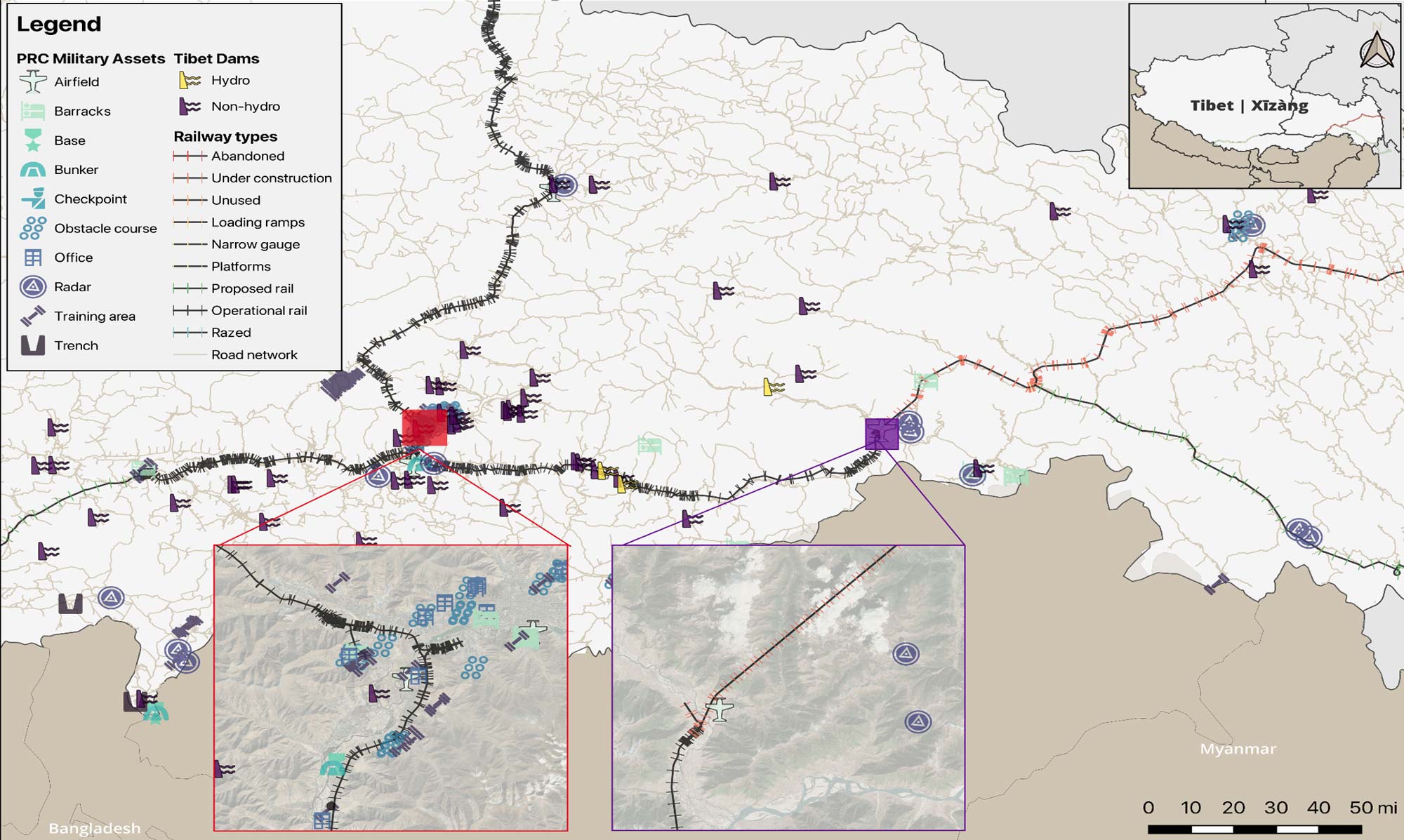
Dual-purpose transportation facilities aiding the PLA in Tibet (Image via Center for Strategic and International Studies, June 2025)
This transportation system has facilitated an influx of Chinese migrants and settlers into Tibet, significantly altering the demographic composition of urban areas, such as the capital city Lhasa, and strategic rural areas in the militarized border prefectures of Nyingtri (Linzhi), Ngari (Ali), and Lhoka (Shannan) along the frontier with India.[27] At the same time, Tibetan populations have been dislocated, ostensibly to improve livelihoods, but China’s aim is to weaken traditional social structures and erode Tibetan cultural identity.[28] The infrastructure boom has thus become a tool for China to subjugate Tibet ever more tightly and diminish the prospects for meaningful autonomy or cultural preservation.
Strategic and Military Utility
Beijing designed Tibet’s transportation infrastructure to be explicitly dual use and meet both civilian and military objectives. The Lhasa-Gormo (Lasa-Ge’ermu) Railway has been operational since 2006, and the Lhasa-Nyingtri Railway, inaugurated in 2021, exemplifies this civilian-military fusion. While it facilitates the movement of goods and people, it also enables rapid mobilization of the People’s Liberation Army (PLA). The railway’s alignment, capacity, and proximity to the frontier areas make it a strategic asset for projecting Chinese power in South Asia and beyond. With expanding Chinese infrastructure, the PLA can effectively deploy advanced weapons across ever broader swaths of the Tibetan plateau.
The PLA has actively leveraged these networks for military exercises and troop deployments. Railways and highways enable the swift movement of heavy equipment, armored vehicles, and personnel to Tibet. This capability is particularly significant given the challenging terrain and high altitude of the Tibetan Plateau, which historically limited the speed and scale of military operations. Strengthened infrastructure has transformed the PLA’s logistical posture, allowing for rapid reinforcement and sustained operations near the Line of Actual Control, the disputed frontier with India.
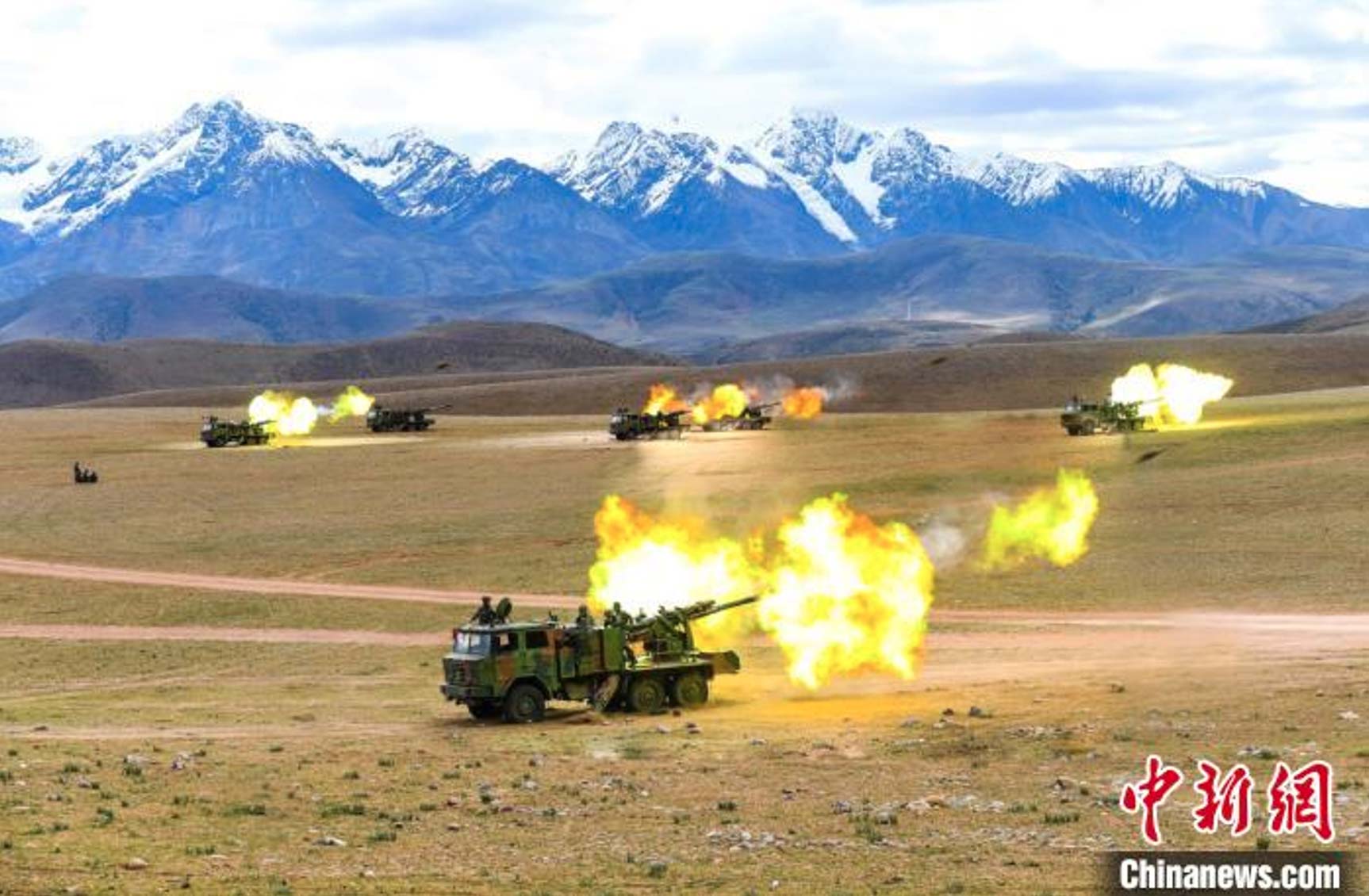
PLA Tibet Military Command conducting military drills in June 2020.[29]
Chinese Air Power in Tibet
After several border confrontations with India, China built or upgraded 37 airports and heliports from 2017-2022. Out of these, at least 22 are used for military purposes or can serve both military and civilian needs, according to CSIS in its October 2022 report on China’s expansion of infrastructure in Tibet.[30]
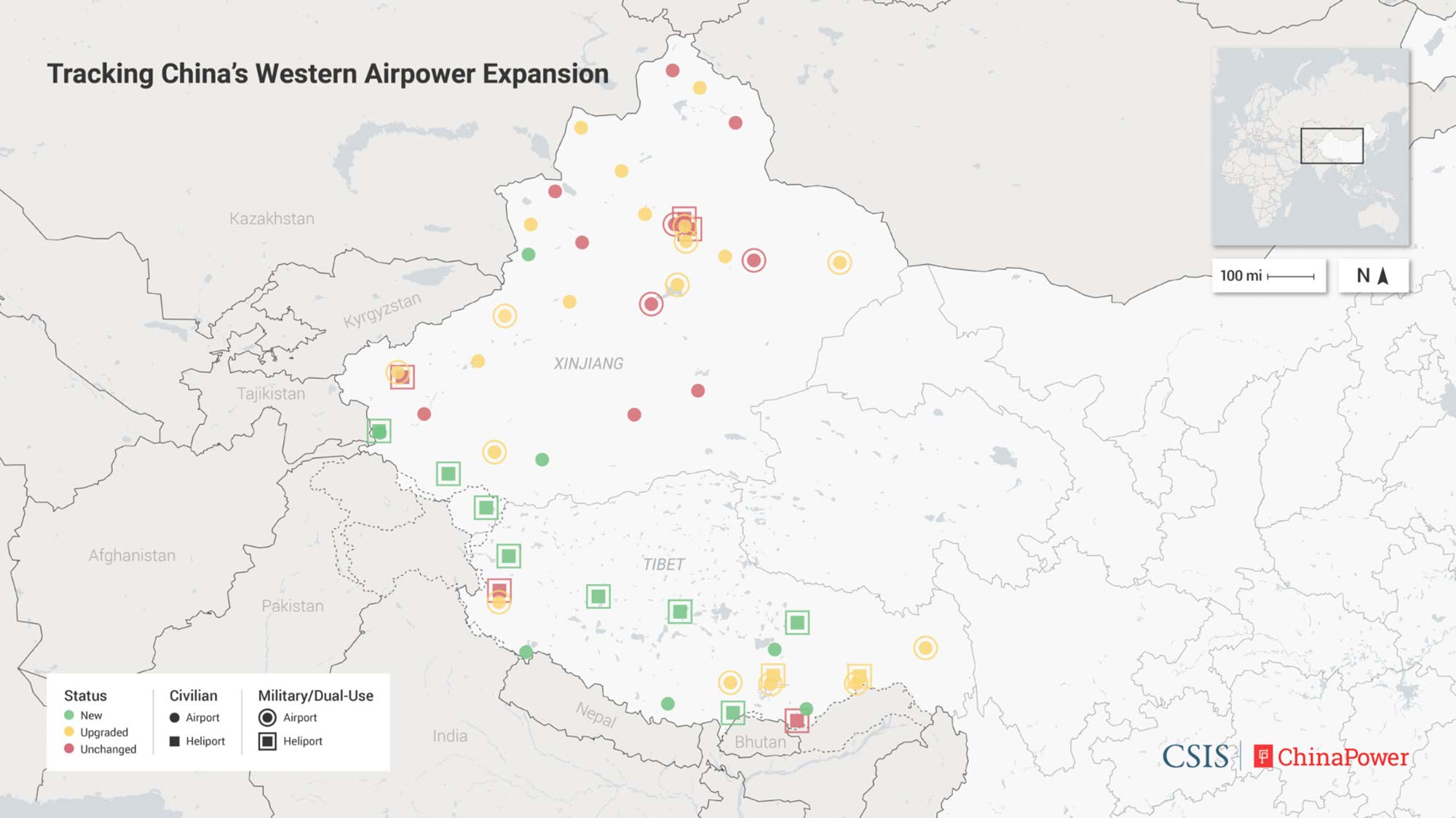
China’s expansion of airpower in Tibet and East Turkestan (Image via CSIS, 2022)
These projects include new runways, aircraft hangars, and surface-to-air missile systems. In Tibet, the Chinese military has erected a series of heliports, operated by the PLA Army Aviation, stretching from Rutog county to Nyingtri city. These heliports facilitate faster troop and equipment movement within Tibet’s challenging mountain terrain.
China is already planning greater expansion. In December 2022, the Development and Reform Commission of the TAR unveiled the “Tibet Autonomous Region General Aviation Development Plan (2021–2035)”[31], aiming to ensure that each county in the TAR is served by at least one general aviation airport by 2035. The plan envisions a comprehensive aviation network covering over 95% of the region’s population, with supporting infrastructure such as security facilities to enable robust air connectivity across the Tibetan plateau.
The Chinese party-state grasped the Dingri earthquake early this year as a justification for accelerating its aerial infrastructure agenda in Tibet’s border regions.[32] In the aftermath of the disaster, authorities asserted that the existing aviation facilities are essential for emergency response and disaster relief. This narrative provides leverage to fast-track construction projects that also serve broader strategic objectives, including the consolidation of state control, enhancement of rapid military deployment capabilities, and support for other large-scale development initiatives such as hydropower projects.
On the day of the 7.1 Dingri earthquake, China landed its Y-20, a top tier strategic transport aircraft essential for airlifting troops, equipment (up to 66 tons), and supplies, in Dingri on January 7, 2025.[33] This is a significant development regarding China’s power projection in Tibet. The successful landing of an advanced aircraft in Tibet effectively dispelled past skepticism regarding the feasibility and efficiency of Chinese aerial infrastructure projects in Tibet stemming from concerns about Tibet’s extreme altitude and harsh climatic conditions. Landing of the Y-20 in Shigatse, which is over 12,500 feet above sea level, also demonstrates that technological advancements and strategic investments have enabled China to overcome significant geographical constraints to provide logistics support, thereby validating the operational viability of its expanding aviation network in Tibet. The Y-20’s landing in Tibet demonstrates China’s military readiness, logistical capabilities, and signals both operational capability and strategic intent, while showcasing China’s technological progress.
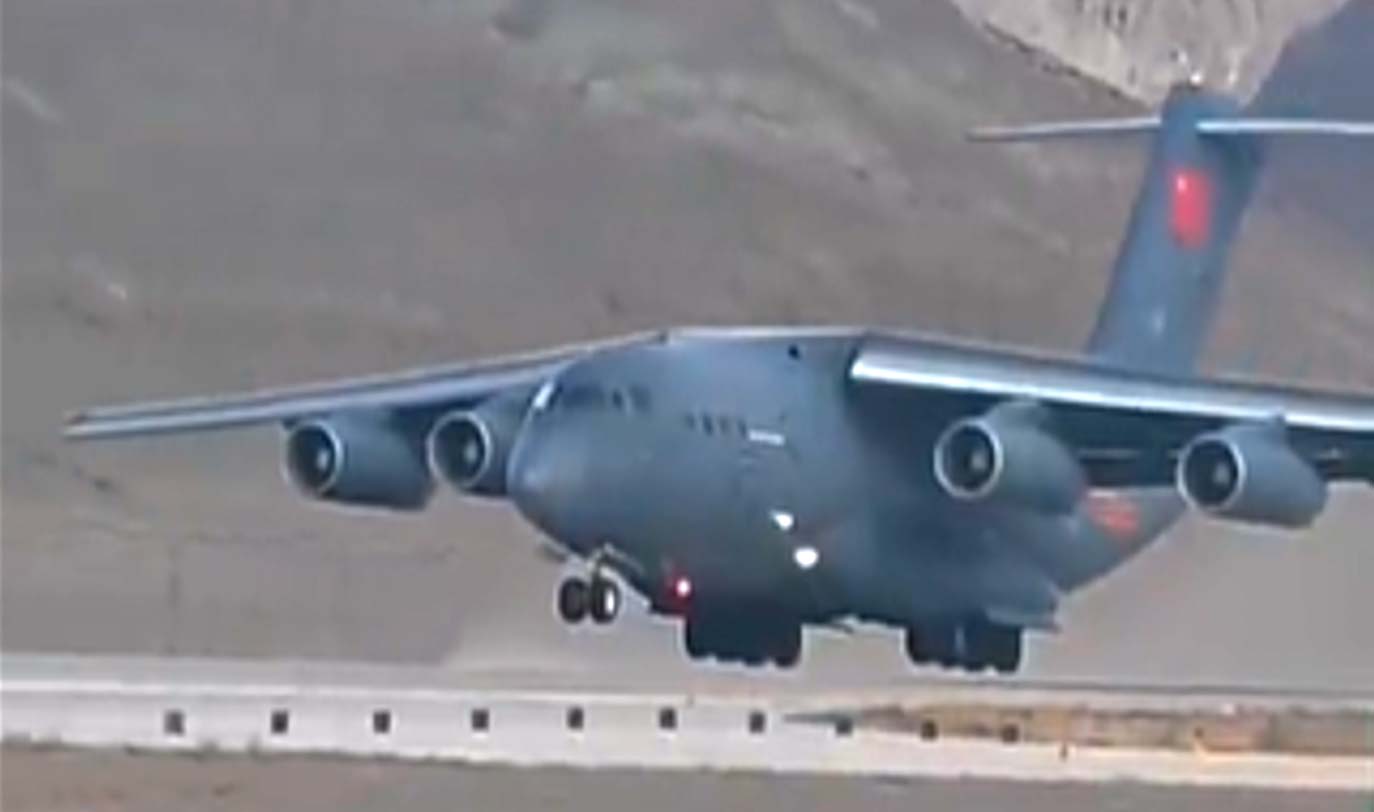
China’s Y-20 landing in Dingri, Tibet, on January 7, 2025.
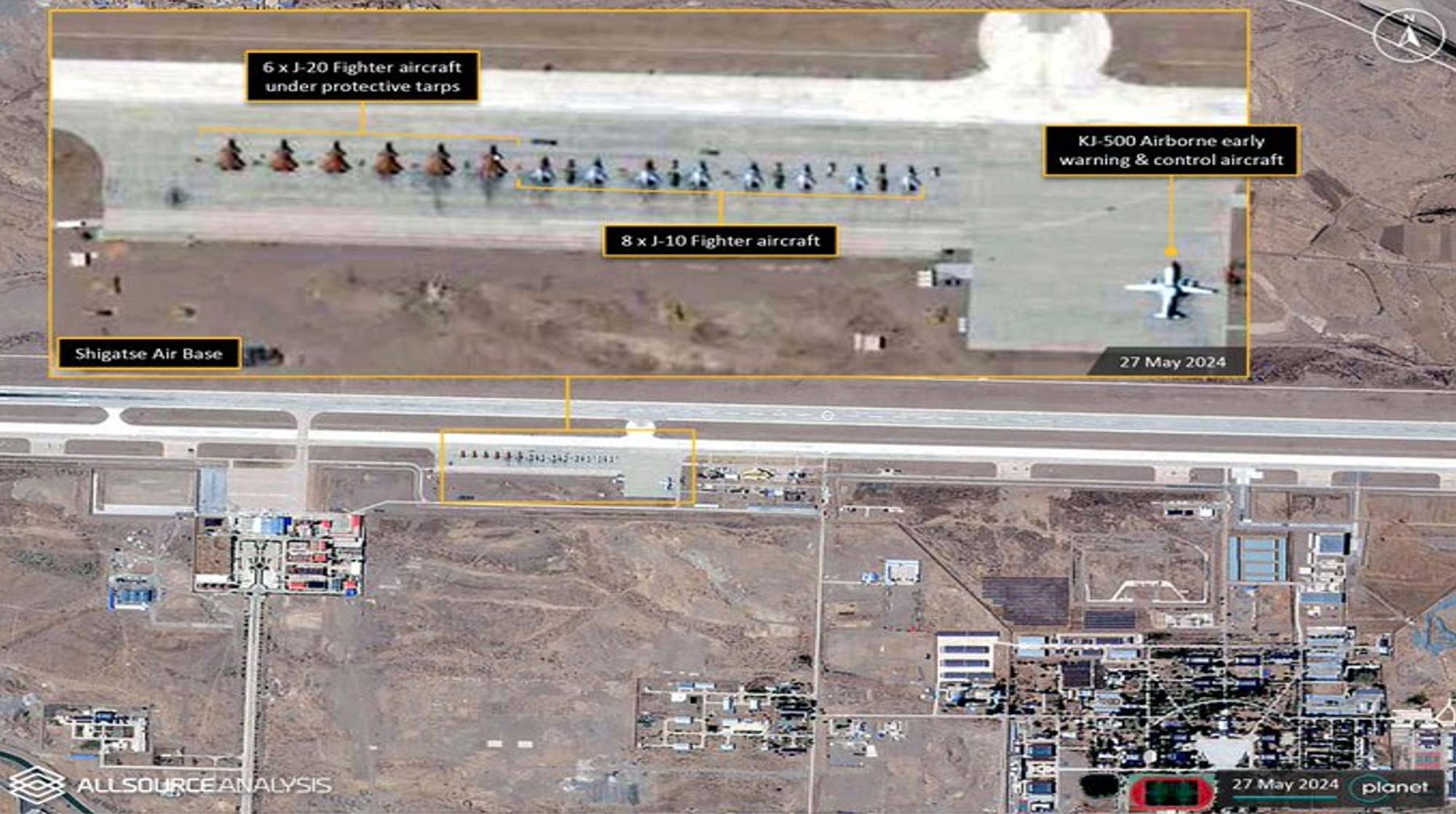
A squadron of J-20 and J-10 fighters at Shigatse Air Base, May 27, 2024. (Image via AllSource Analysis)[35]
Potential Resumption of Nuclear Testing
China’s railway infrastructure in Tibet also has been the source of concern for possible nuclear militarization of Tibet for several decades. The International Campaign for Tibet, in its 2003 report Crossing the Line: China’s railway to Lhasa, Tibet, forecasted that the nascent Gormo-Lhasa railway could be utilized for militarization.[36] Since its completion, China’s external propaganda has projected the railway as development in Tibet benefitting the Tibetans economically. However, China’s activities in recent years at Lop Nur, a nuclear test site bordering Tibet in East Turkestan (“Xinjiang Uyghur Autonomous Region”), reignites concerns.
Between 2020 and 2024, China has significantly expanded its nuclear test site at Lop Nur. This remote desert site, historically used for nuclear testing, has seen a surge in activity, raising concerns about China’s intentions regarding its nuclear arsenal. The nearest major transportation hub to Lop Nur is the Gormo train station, part of the Qinghai-Tibet Railway, which connects Xining in Qinghai Province to Lhasa in Tibet. Operational since July 2006, this railway has been critical for logistical support to the Lop Nur site. As early as 1995, analyst Vipin Gupta identified Gormo as the primary logistical base for Lop Nur, citing its robust rail connectivity, relatively developed infrastructure, and status as the closest city of significant size, making it a key node for transporting materials and personnel to the test site.[37]
Recent developments at Lop Nur indicate a substantial escalation in activity, consistent with preparations for underground nuclear testing. Satellite imagery and expert analysis reveal the construction of new underground facilities, including deep tunnels excavated into the granite formations of the surrounding mountains, designed to contain nuclear explosions. New access roads have been built, improving connectivity within the site, while the electrical infrastructure has been significantly upgraded, likely to support advanced testing equipment and operations. Additionally, the installation of drill rigs suggests active exploration or preparation for test shafts, a hallmark of nuclear test site activity. These developments mark a significant departure from the site’s relative dormancy since China’s last known nuclear test in 1996, the year it signed the Comprehensive Nuclear-Test-Ban Treaty (CTBT). To date, China has not ratified the CTBT and the international community should not rule out the probability of China contravening the treaty to resume nuclear testing, considering the evidence.
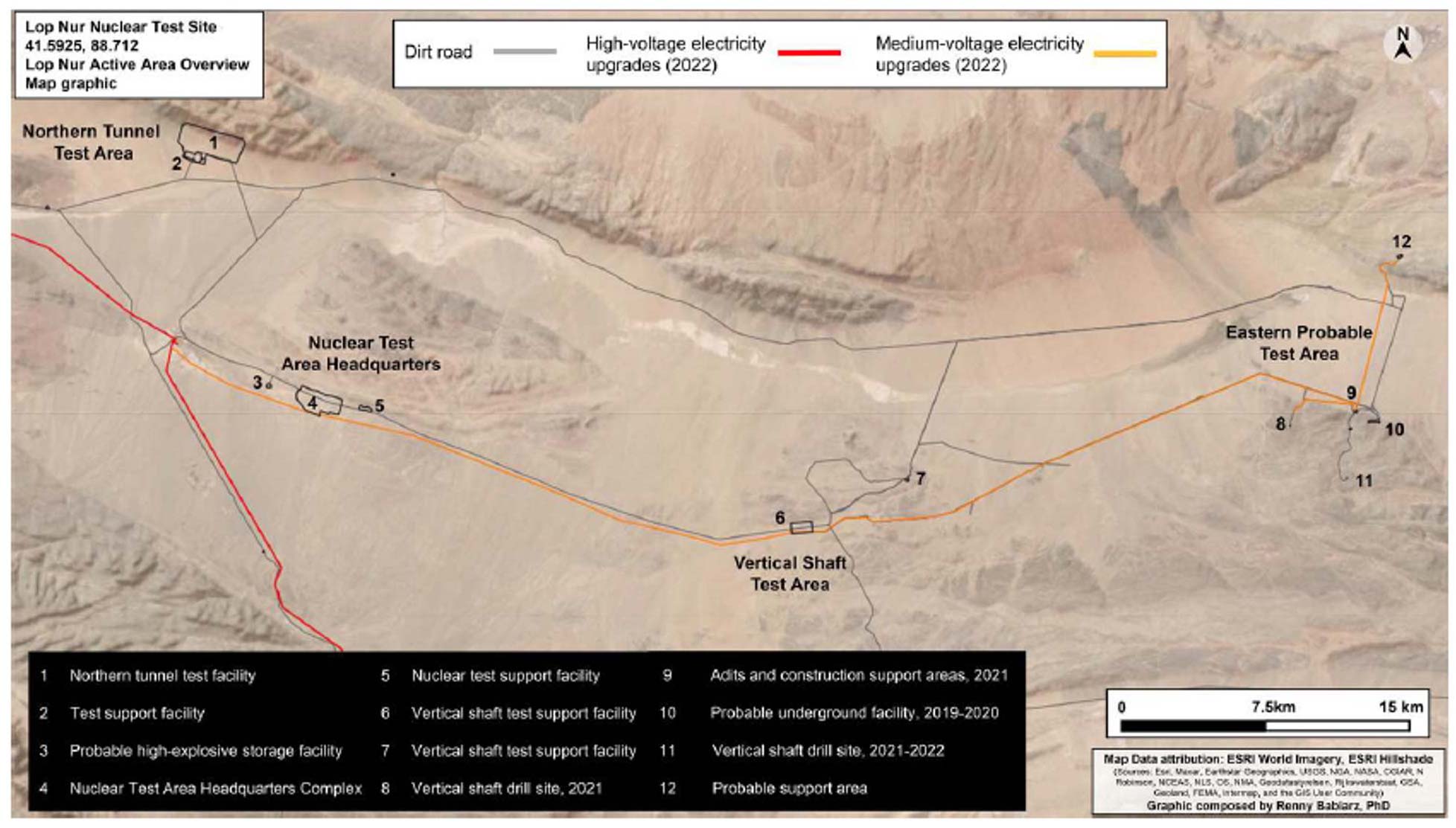
Image reproduced from Renny Babiarz and Jason Wang, “Nuclear-Test Preparation at the Lop Nur Nuclear Test Site, 2020–24,” The Nonproliferation Review, June 11, 2025.
Analysts Renny Babiarz and Jason Wang, who have closely studied these developments, argue that the scale and nature of the construction strongly suggest preparations for full-scale underground nuclear tests.[38] While some might propose alternative explanations, such as conventional explosive testing or subcritical nuclear experiments, the evidence leans heavily toward nuclear test preparations. The site’s historical designation as China’s primary nuclear testing ground, the extensive infrastructure upgrades, and the specific patterns of activity, such as tunnel excavation and drill rig deployment, point to probable nuclear testing – “for nuclear-weapons modernization or expansion efforts or both” – rather than less intensive activities.
China’s lack of transparency regarding its activities at Lop Nur combined with its broader efforts to modernize its nuclear arsenal, including the development of new warheads and delivery systems, undermines the credibility of non-nuclear explanations. This concern is exacerbated by multiple sources, notably the Stockholm International Peace Research Institute, Federation of American Scientists, and Arms Control Association, concluding that China is expanding its nuclear stockpile with estimates suggesting that China’s nuclear warhead count has grown from around 350 in 2020 to approximately 500-600 by 2025, with projections to reach 1,000 by 2030.[39]
A resumption of nuclear testing at Lop Nur would mark the first such test by China in nearly three decades, potentially signaling a shift in its nuclear posture and escalating global tensions. It could also undermine the global non-proliferation regime, particularly if other nuclear powers interpret China’s actions as a justification to resume their own testing.
Continuing Infrastructure Expansion
Chinese leadership, under CCP General Secretary Xi Jinping, has made clear that investment in Tibet’s infrastructure remains a top priority. In 2020, Xi publicly called for the acceleration of major transportation and public service projects, framing them as essential for China’s unity and the economic prosperity of the Tibetan people.
In 2020, China had planned to inject 1 trillion yuan ($145 billion in 2020 dollars) to accelerate infrastructure projects in Tibet.[40] Presenting a work report during the 12th People’s Congress of the TAR in 2024, then chairman of the TAR government, Yan Jinhai, stated that the expected 80 billion yuan ($11 billion) from the Chinese government for the year will be directed toward infrastructure projects such as railways, highways and airports.[41] Planning for China’s 15th five-year plan (2026-2030) is underway, and infrastructure development is expected to be the key component of the plan.
The strategic calculus behind these investments is clear. By building transportation infrastructure, Beijing is simultaneously enhancing its ability to project power and respond to contingencies along the Tibetan frontier and beyond while using an inaccurate development justification to obscure this goal.
The construction of new and planned railways, some of which run perilously close to the Indian border, has heightened security concerns in New Delhi. These lines provide the People’s Liberation Army with additional routes for the rapid deployment of troops and equipment. The dual-use nature of these projects makes it difficult for outside observers to distinguish between civilian and military intentions, complicating diplomatic efforts to manage tensions and build confidence.
The PRC’s approach to infrastructure in Tibet is thus characterized by a deliberate ambiguity, blending narratives of development and integration with very clear signals of military preparedness. This strategy enables China to pursue its regional ambitions while maintaining plausible deniability about the true purpose of its infrastructure.
Implications for Regional Security
The expansion of civilian-military dual-use infrastructure in Tibet has profound implications for regional security and the strategic balance in Asia. By systematically enhancing its ability to mobilize and sustain military operations along the LAC, China is positioning itself for future border conflicts with India. The improved transportation network reduces the logistical challenges that once constrained the PLA, enabling speedier, larger, and more sustained deployments to contested areas. For India, these developments represent a direct challenge to its security and territorial integrity. The enhanced Chinese military presence along the frontier increases the risk of miscalculation and escalation, particularly in the context of ongoing disputes over territory in the eastern and western sectors.
China’s use of infrastructure as a tool of military and political coercion sets a troubling precedent for the region. It signals a willingness to leverage economic development for strategic gain through coercive statecraft. For the international community, these trends underscore the need for a coordinated response that addresses the security, development, and human rights implications of China’s activities in Tibet.
Conclusion
Since Xi Jinping’s 2013 statement tying China’s governance to stability in Tibet, significant changes have occurred over the past decade and continue to shape the region. The elevation of the Tibet Military District to a sub-theater command in 2016 has granted the Chinese military greater operational autonomy, enabling proactive efforts to alter the status quo along the frontier with India. This is evidenced by the Doklam standoff (2017), the Galwan Valley clash (2020), infrastructure expansion in Tibet to support high-altitude operations and nuclear militarization, the construction of over 600 “well-off border villages” in the Tibet Autonomous Region’s border areas (2017–2020), increased Chinese migration to strategic frontier areas, and the issuance of standardized place names for India’s Arunachal Pradesh. These developments not only heighten the risk of conflict but also have significant implications for regional and international security, given Tibet’s strategic position overlooking key maritime regions from its high-altitude vantage point.
China’s strategic control over Tibet’s water resources also gives China significant leverage over its neighbors, many of whom depend on rivers originating in Tibet for their water supply, which is especially critical during the dry seasons. Equally critical to the global supply chain are the recently discovered large deposits of rare earth elements in Tibet. While China is undoubtedly poised to exploit these deposits in the future to solidify its dominance in the global rare earth supply chain, such extractions risk not only environmental degradation but also heightened conflict with India, as the deposits are located on the southern border of Tibet along the Line of Actual Control with India.
Culturally and politically, Tibet stands as a powerful symbol in the contest between authoritarianism and democratic values. The global resonance of the Dalai Lama and Tibetan culture align directly with universal values and the national security imperatives of the United States and likeminded partners. To counter China’s strategic designs, it is imperative to provide consistent economic support to the Central Tibetan Administration and related programs that serve as a bulwark against China’s authoritarian expansion. Nations worldwide should adopt this model of intervention. Failure to do so risks enabling China to extend its influence and authoritarian model globally and threaten the sovereignty of nations beyond South Asia. Thus, the international community must unite to demonstrate that dialogue, democracy, and the rule of law offer a superior path to global stability and peace in an era of conflict. The prioritization of Tibet in the foreign policies of the United States, likeminded partners, and countries in the region is therefore fundamental to promoting international peace and security.
Footnotes:
[1] NOTE ON GEOGRAPHICAL TERMS: Tibet traditionally comprised three main areas: Amdo (northeastern Tibet), Kham (eastern Tibet) and U-Tsang (central and western Tibet). The Tibet Autonomous Region was set up by the Chinese government in 1965 and covers the area of Tibet west of the Drichu or Yangtze River, including part of Kham. The rest of Amdo and Kham have been incorporated into Chinese provinces, and where Tibetan communities were said to have “compact inhabitancy” in these provinces, they were designated Tibetan autonomous prefectures and counties. As a result most of Qinghai and parts of Gansu, Sichuan and Yunnan provinces are acknowledged by the Chinese government to be “Tibetan.” ICT uses the term “Tibet” to refer to all Tibetan areas currently under the jurisdiction of the People’s Republic of China.
[2] “Steadfastly Following the Chinese Path of Promoting Human Rights and Fully Advancing the Cause of Human Rights in Tibet.” Qiushi Journal (English Edition), July 11, 2023. https://en.qstheory.cn/2023-07/11/c_900758.htm.
[3] International Campaign for Tibet. “Inside Tibet: Major Live Fire Drill Testing New Tanks in Tibet Highlights Political Imperatives, Military Capacity on Plateau.” July 21, 2017. https://savetibet.org/ict-inside-tibet-major-live-fire-drill-testing-new-tanks-in-tibet-highlights-political-imperatives-military-capacity-on-plateau/.
[4] International Campaign for Tibet. “New ‘Defense’ Villages and Infrastructure Being Built on Tibet’s Border.” December 23, 2019. https://savetibet.org/new-defense-villages-and-infrastructure-being-built-on-tibets-border/.
[5] International Campaign for Tibet. “China Foists Standardized Place Names on ‘Southern Tibet’ to Challenge India.” May 13, 2025. https://savetibet.org/china-foists-standardized-place-names-on-southern-tibet-to-challenge-india/.
[6] United Nations Conference on Trade and Development. Review of Maritime Transport 2023. Geneva: United Nations, 2023. https://unctad.org/system/files/official-document/rmt2023_en.pdf.
[7] US Energy Information Administration. “World Oil Transit Chokepoints.” Last updated: June 25, 2024. https://www.eia.gov/international/analysis/special-topics/World_Oil_Transit_Chokepoints
[8] Babiarz, R., & Wang, J. (2025). Nuclear-test preparation at the Lop Nur nuclear test site, 2020–24. The Nonproliferation Review, 1–21. https://www.tandfonline.com/doi/epdf/10.1080/10736700.2025.2497201?needAccess=true
[9] United Nations Environment Programme. Himalayan Ecosystems. Nairobi: United Nations Environment Programme, 2023. https://www.unep.org/resources/report/himalayan-ecosystems.
[10] International Campaign for Tibet. Chinese Hydropower: Damning Tibet’s Culture, Community, and Environment. Washington, DC: International Campaign for Tibet, December 2024. https://savetibet.org/wp-content/uploads/2024/11/FINAL_2024_dam-report_letter_web.pdf
[11] US Geological Survey. Mineral Commodity Summaries 2024: Rare Earths. Reston, VA: U.S. Geological Survey, January 2024. https://pubs.usgs.gov/periodicals/mcs2024/mcs2024-rare-earths.pdf. Rare Earth Exchanges. “Bayan Obo Mine: The Unseen Power Behind Global Technology—and Its Heavy Cost.” Rare Earth Exchanges, April 27, 2025. https://rareearthexchanges.com/news/bayan-obo-mine-the-unseen-power-behind-global-technology-and-its-heavy-cost/. “A 1,000-Kilometer Rare Earth Mineral Belt Has Been Discovered in the Himalayas! My Country Has Developed AI to Locate Deposits with 96% Accuracy! Is India Planning to Grab the Prize?” WeChat, June 30, 2023. https://mp.weixin.qq.com/s/VgqEfI9DiVPqq3h255jMOw.
[12] Human Rights Watch, “Educate the Masses to Change Their Minds”: China’s Forced Relocation of Rural Tibetans (New York: Human Rights Watch, 2024), https://www.hrw.org/report/2024/05/22/educate-masses-change-their-minds/chinas-forced-relocation-rural-tibetans.
[13] Zenz, Adrian. “Xinjiang’s System of Militarized Vocational Training Comes to Tibet.” China Brief 20, no. 17. Jamestown Foundation. Accessed August 18, 2025. https://jamestown.org/program/jamestown-early-warning-brief-xinjiangs-system-of-militarized-vocational-training-comes-to-tibet/.
[14] United Nations Human Rights Office of the High Commissioner. “China: ‘Vocational Training’ Programmes Threaten Tibetan Identity, Carry Risk of Forced Labour, Say UN Experts.” April 27, 2023. https://www.ohchr.org/en/press-releases/2023/04/china-vocational-training-programmes-threaten-tibetan-identity-carry-risk
[15] Barnett, Robert. “Essay on Tibet.” In The Tibetans: A Struggle to Survive, by Steve Lehman, New York: Umbrage Editions, 2002. See also Anand, Dibyesh. “Colonization with Chinese Characteristics: Politics of (In)Security in Xinjiang and Tibet.” Central Asian Survey 38, no. 1 (2019): 129–47.
[16] Tibet Action Institute. Separated from Their Families, Hidden from the World: China’s Vast System of Colonial Boarding Schools Inside Tibet. Boston: Tibet Action Institute, May 13, 2025. 2021_TAI_ColonialBoardingSchoolReport_Digital-StudentsEdited.pdf
[17] Dalai Lama. “Five Point Peace Plan.” Address to the U.S. Congressional Human Rights Caucus, Washington, DC, September 21, 1987. https://www.dalailama.com/messages/tibet/five-point-peace-plan.
[18] McCartney, Micah. “Satellite Photos Show Where China Is Building World’s Biggest Hydro Dam.” Newsweek, July 23, 2025. https://www.newsweek.com/satellite-photos-china-building-worlds-biggest-medog-hydropower-dam-2102179.
[19] Visit of Foreign Minister of China to India (August 18-19, 2025), Indian Ministry of External Affairs, New Delhi, August 19, 2025, https://www.mea.gov.in/press-releases.htm?dtl/40014/Visit_of_Foreign_Minister_of_China_to_India__August_1819_2025
[20] International Campaign for Tibet, Chinese Hydropower, 10.
[21] Pengyu Ren et al., “The Sustainable Supply of Lithium Resources from the Qinghai-Tibet Plateau Salt Lakes Group: The Selection of Extraction Methods and the Assessment of Adsorbent Application Prospects,” Desalination 583 (August 19, 2024): 117659, https://doi.org/10.1016/j.desal.2024.117659. See also Free Tibet, BYD in Tibet: The Costs of Lithium Extraction (London: Free Tibet, 2022), https://freetibet.org/wp-content/uploads/2022/02/BYD-in-Tibet-the-costs-of-lithium-extraction.pdf.
[22] Xinhua. “Huge Mineral Resources Found on Qinghai-Tibet Plateau.” China Daily, February 13, 2007. https://www.chinadaily.com.cn/bizchina/2007-02/13/content_833286.htm. See also Pathak, Sriparna. “China’s Rapacity for Mining in Tibet: An Indian Perspective.” Issue Brief, Institute for Security and Development Policy, April 22, 2025. https://www.isdp.eu/wp-content/uploads/2025/04/Brief-Sriparna-Apr-22-2025.pdf.
[23] Tashi Tsering, “A Tibetan Perspective on Development and Globalization,” HIMALAYA 24, no. 1 (2004), https://digitalcommons.macalester.edu/himalaya/vol24/iss1/13.
[24] Human Rights Watch, “China’s ‘Bilingual Education’ Policy in Tibet: Tibetan-Medium Schooling Under Threat,” March 5, 2020, https://www.hrw.org/report/2020/03/05/chinas-bilingual-education-policy-tibet/tibetan-medium-schooling-under-threat.
[25] Throughout its history, China has engaged in violent armed conflicts ranging between a conservative estimate of 500-1000 to a plausible 3790 between 1100 BC to 1911 according to estimates using different methodologies. See Li Xiaobing, China at War (Bloomsbury Publishing, 2012), https://www.bloomsbury.com/us/china-at-war-9781598844153/. See also Michael D. Swaine and Ashely J. Tellis, Interpreting China’s Grand Strategy: Past, Present, and Future (Santa Monica: RAND Corporation, 2000), 46, http://www.rand.org/pubs/monograph_reports/MR1121.
[26] Thomas Hader et al., “China’s Gray-Zone Infrastructure Strategy on the Tibetan Plateau: Roads, Dams, and Digital Domination” (Center for Strategic and International Studies (CSIS), June 4, 2025), https://www.csis.org/analysis/chinas-gray-zone-infrastructure-strategy-tibetan-plateau-roads-dams-and-digital-domination.
[27] Fischer, Andrew M. “How Much Does Beijing Control the Ethnic Makeup of Tibet?” ChinaFile, September 2, 2021. https://www.chinafile.com/reporting-opinion/viewpoint/how-much-does-beijing-control-ethnic-makeup-of-tibet.
[28] “‘Educate the Masses to Change Their Minds’ China’s Forced Relocation of Rural Tibetans” (Human Rights Watch, May 21, 2024), https://www.hrw.org/report/2024/05/22/educate-masses-change-their-minds/chinas-forced-relocation-rural-tibetans.
[29] “China Increases Military Drills in Tibet amid Tensions with India” (International Campaign for Tibet, June 25, 2020), https://savetibet.org/china-increases-military-drills-in-tibet-amid-tensions-with-india/.
[30] Brian Hart, “How Is China Expanding Its Infrastructure to Project Power Along Its Western Borders?” (Center for Strategic and International Studies (CSIS), March 16, 2022), https://chinapower.csis.org/china-tibet-xinjiang-border-india-military-airport-heliport/.
[31] “西藏自治区通用航空发展规划(2021—2035 年)[Tibet Autonomous Region General Aviation Development Plan (2021–2035)]” (西藏自治区发展和改革委员会 [Tibet Autonomous Region Development and Reform Commission], December 2022), https://web.archive.org/web/20230209063939/https:/file.veryzhun.com/buckets/carnoc/keys/06b6853e0052d89e2a6c554f7e86f9dd.pdf.
[32] “Tibet Earthquake: Tibetan Resilience and Future Risks – International Campaign for Tibet” (International Campaign for Tibet), January 24, 2025, https://savetibet.org/tibet-earthquake-tibetan-resilience-and-future-risks/.
[33] China sent the Y-20 transport aircraft for the earthquake rescue command to Xizang’s Xigaze,” X (formerly Twitter), January 8, 2025, https://x.com/XH_Lee23/status/1876948347682275730.
[34] Rajat Pandit, “China Deploys J-20 Stealth Fighters at Tibet Airfield | India News – The Times of India,” May 31, 2024, https://timesofindia.indiatimes.com/india/china-deploys-j-20-stealth-fighters-at-tibet-airfield/articleshow/110574443.cms.
[35] AllSource Analysis, “Analysis of imagery collected over Shigatse Air Base in China shows the deployment of six likely J-20 stealth fighter aircraft near the Indian border,” X (formerly Twitter), May 29, 2024, https://x.com/AllSourceA/status/1795869359736238366.
[36]“Crossing the Line: China’s Railway to Lhasa, Tibet” (International Campaign for Tibet, 2003), https://www.savetibet.org/wp-content/uploads/2013/01/2003RailwayReport.pdf.
[37] Vipin Gupta, “Monitoring Underground Nuclear Explosions in China: A Review of the Lop Nor Test Site,” Science & Global Security, Volume 5, Issue 2, 1995, pages 217-286.
[38] Babiarz and Wang, “Nuclear-test Preparation,” 68
[39] Stockholm International Peace Research Institute (SIPRI)’s 2025 report estimates China’s nuclear arsenal at 600 warheads as of mid-2025, with an increase of about 100 warheads annually since 2023. It projects China could reach 1,500 warheads by 2035, implying a trajectory toward 1,000 by 2030. https://www.sipri.org/media/press-release/2025/nuclear-risks-grow-new-arms-race-looms-new-sipri-yearbook-out-now Federation of American Scientists (FAS)’s 2025 Nuclear Notebook estimates China’s stockpile at approximately 600 warheads, up from 410 in 2023. It notes projections of over 1,000 warheads by 2030. https://fas.org/publication/nuclear-notebook-china-2025/ US Department of Defense (DoD)’s 2024 China Military Power Report states China’s stockpile surpassed 600 operational warheads by mid-2024, up from over 500 in 2023, 400 in 2022. It projects over 1,000 warheads by 2030. https://www.armscontrol.org/act/2025-01/news/pentagon-says-chinese-nuclear-arsenal-still-growing
[40] “China Planning Building Spree in Tibet as India Tensions Rise, Sources Say | Reuters,” September 4, 2020, https://www.reuters.com/article/world/china-planning-building-spree-in-tibet-as-india-tensions-rise-sources-say-idUSKBN25V1N9/.
[41] “China to Invest Heavily on New Infrastructure in Tibet This Year” (Tibetan Review, January 7, 2024), https://www.tibetanreview.net/china-to-invest-heavily-on-new-infrastructure-in-tibet-this-year/.
Executive Summary
The International Campaign for Tibet (ICT) urges policymakers in the United States, Europe, Asia and elsewhere to prioritize Tibet amid China’s growing challenge to international norms which have buttressed global peace and security for decades. China’s expanding influence and disregard for international law and human rights threaten not only the freedoms of the Tibetan people but also geopolitical stability and environmental sustainability in the broader South Asia region. China leverages Tibet’s location and exploits its vast economic resources precisely because of Beijing’s systematic repression of the Tibetan people and its denial of their self-determination. Elevating Tibet as a critical issue is both a moral obligation and a strategic imperative to uphold international peace and security.
Tibet is prominently situated at the intersection of three nuclear-armed states: China, India, and Pakistan. This geographic location places Tibet at the crossroads of security dynamics among major powers, with ramifications for international peace and stability, including the United States, Europe and other countries’ strategic role in the region. Developments in Tibet, whether related to military infrastructure, energy and resource extraction, border management, or political stability, have direct implications for the security strategies of countries in the region, the United States, and relevant stakeholders in the global community. This unique positioning makes Tibet central to the broader advancement of international security.
China’s ongoing militarization of Tibet poses a direct threat to regional security. In March 2013, President Xi Jinping declared that “To govern the country well, we must first govern the frontiers well; and to govern the frontiers well, we must first ensure stability in Tibet.”[2] Subsequently, the Tibet Military District was elevated to a sub-theater command under the Western Theater Command in 2016, marking a pivotal change in terms of operational autonomy and integration into the People Liberation Army’s (PLA) modernized command structure and reflecting Tibet’s critical role in China’s security framework and strategic priorities. The Tibet Military District’s elevation to a sub-theater command already has had effects as evidenced by the Droklam (Donglang) standoff (2017),[3] Galwan Valley clash (2020), and infrastructure expansion in Tibet to support military operations in high-altitude areas. In addition to an elevated military presence, there has been a rapid increase in Chinese settlers in strategic frontier rural areas of Tibet. China proactively built over 600 “well-off border villages” (bianjing xiaokang cun) as part of the “Plan for the Construction of Well-off Villages in the Border Areas of the Tibet Autonomous Region” (2017–2020).[4] Additionally, starting in 2017, China has issued 89 standardized place names in the Indian state of Arunachal Pradesh, asserting authority over an area that has never been administered by China.[5]
While Tibet is landlocked, its high-altitude military infrastructure, including airbases, missile sites, and radar systems, serves as a strategic asset for China, enhancing its ability to monitor and influence key maritime regions such as the Arabian Sea, Bay of Bengal, and Indian Ocean. The Indian Ocean is vital for global trade, handling over one-third of bulk cargo and two-thirds of oil shipments, with tens of thousands of vessels carrying billions of tons annually.[6] Approximately 40% of global oil transit passes through chokepoints like the Malacca and Hormuz Straits, critical for China’s energy security.[7] Through a military buildup in Tibet, coupled with Belt and Road Initiative (BRI) connectivity such as the China-Pakistan Economic Corridor to Gwadar Port, China leverages Tibet to project power and safeguard its trade and energy interests in the Indian Ocean.
Additionally, China’s railway network in Tibet, particularly the Gormo-Lhasa line completed in 2006, has long raised concerns about nuclear militarization of the Tibetan Plateau. While China promotes railway infrastructure as an economic driver for Tibetans, renewed activity at Lop Nur test site in East Turkestan (“Xinjiang Uyghur Autonomous Region”), near Gormo in Tibet’s Amdo region, revives fears of strategic militarization and casts doubt on the veracity of China’s development narrative. Non-proliferation experts have raised deep concern that extensive construction at this historic Chinese nuclear test site indicates preparations for full-scale underground nuclear tests.[8]
Tibet, known as the “Roof of the World” and the “Third Pole,” holds a commanding position at an average elevation of over 4,000 meters, and its abundant water and mineral resources are essential to Asia’s economic prosperity and stability. As Asia’s “Water Tower,” Tibet is the source of the region’s major rivers, including the Indus, Brahmaputra, Sutlej, Salween, Mekong, Yellow and Yangtze. These waters sustain 1.8 billion people in South and Southeast Asia, making them central to the region’s environmental health and economic security.[9] For this reason, China’s massive hydropower construction scheme threatens regional water security; exacerbates the risk of floods, mudslides, earthquakes; and stands to drive the displacement of hundreds of thousands of Tibetans. It also enhances Beijing’s strategic control over downstream countries. Thus, China’s plans amplify geopolitical tensions, particularly with India, and necessitate an urgent international call to cease all hydropower dam construction to mitigate environmental and regional instability.[10]
Tibet’s vast reserves of critical minerals present an additional economic and trade dynamic. The recent discovery of rare earth minerals along a 1,000-km (621 miles) belt in the “Tibet Autonomous Region” (TAR) has estimated reserves potentially surpassing Bayan Obo mine in Inner Mongolia, which account for 40% of global rare earth reserves. This stands to reinforce China’s dominance in the critical minerals supply chain.[11] Control of these minerals, essential for high-tech industries such as electric vehicles, defense systems, and electronics, is poised to bolster China’s strategic leverage in global markets, particularly as demand for rare earth elements is projected to grow significantly in the future. However, large-scale mining operations in Tibet’s sensitive ecology risks exacerbating environmental degradation, polluting vital water sources and negatively impacting the Tibetan population, as well as downstream communities in South and Southeast Asia.
Additionally, combined mining and hydropower construction endanger sacred Tibetan Buddhist sites and displace pastoral and non-pastoral communities.[12] Thus, China’s resource extraction policies not only amplify its economic influence but also raise ethical concerns about environmental sustainability, Tibetan cultural preservation, and the exploitation of occupied Tibetan land.
China also has been intensifying displacement of Tibetans from their traditional homes and livelihoods by forcibly or coercively transferring them, often to consolidated, inadequate dwellings with access to only low-skilled, low-wage jobs as part of a broader strategy of cultural erasure. Tibetan communities in the TAR[13] have been coerced into so-called “vocational training” programs. These initiatives, often presented as opportunities for economic advancement, have raised concern among UN human rights experts, who warn that “such programs could lead to situations of forced labor.”[14] In 2024, the total value of imports and exports in the TAR reached $1.74 billion, up 15.4 percent year-over-year, and included trade partnerships with 175 countries and regions and accelerated export growth in new energy vehicles, lithium and photovoltaic products. While China projects Tibet’s foreign trade as development of local industries, its policies disrupt the autonomy it has promised to Tibetans and raise concerns about China’s use of forced labor in global supply chains.
It is important to recognize the relevance of China’s exploitation of the Tibetan plateau for its security, economic, and energy interests within the larger context of its decades-long illegal occupation of Tibet. Current Chinese rule in Tibet amounts to colonialism characterized by a systematic policy to exert control over the Tibetan people and erode central pillars of their identity.[15] Key policies include cultural suppression through state-run boarding schools that separate Tibetan children from their families and immerse them in Mandarin language and Chinese ideological instruction; restrictions on Tibetan religious practices; destruction of religions and other sacred sites; and displacement of communities.[16] These measures not only violate the rights and freedoms of Tibetans but also seek to reconfigure Tibetan identity to conform to the Chinese Communist Party’s ideology, perpetuating colonialism with Chinese characteristics and threatening the preservation of Tibet’s unique civilization and spiritual heritage.
Pragmatically, attainment of a more stable future for the Asia-Pacific depends on the US and the global community formulating a comprehensive response to China’s aggressive policies in Tibet and the broader region. The core of this response must embrace peaceful dialogue to resolve conflict, an approach the Dalai Lama and the Central Tibetan Administration (CTA) have long advocated. Moreover, the US and likeminded nations need to recognize the CTA as a reliable and credible partner that advances stability and security in the region. By championing the Tibetan people’s right to self-determination and exposing China’s human rights abuses and alarming securitization of Tibet, the CTA serves as a powerful bulwark against Beijing’s expansionist agenda and erosion of universal rights. The CTA’s democratic governance, grounded in principles of transparency and representation, stands in stark contrast to the Chinese Communist Party’s authoritarian model and presents a compelling testament to resilience in the face of oppression. Implementation of current US Tibet-related law, such as the 2020 Tibetan Policy and Support Act, and revitalization of Tibetan assistance programs will amplify this influence and effectively advance values of liberty and democracy, while mitigating China’s attempts to expand its strategic leverage over the broader region.
In sum, while the economic, security, and environmental dimensions of China’s policies in Tibet should urgently concern the US and its partners, at its core, Tibet’s occupation reflects an imperative and an opportunity for the international community to counter China’s threats to democracy; its suppression of religious freedom in Tibet, China and globally; and its undermining of the international human rights norms that have underpinned global peace and security since the second World War. Tibet’s rich cultural and religious heritage, epitomized by Tibetan Buddhism and the institution of the Dalai Lama, resonates deeply with universal values of freedom and human rights and offers a compelling alternative to the authoritarian model that China seeks to rapidly advance globally.
Recommendations for the US and Likeminded Governments:
- Promote Tibet as a zone of peace, as articulated in the Dalai Lama’s Five Point Peace Plan, first proposed in 1987 to the US Congressional Human Rights Caucus.[17]
- Enhance cooperation with regional partners, specifically India, to shine a light on Chinese military and infrastructure expansion in Tibet.
- Legally limit their companies’ investments or participation in Chinese infrastructure projects in Tibet that support militarization or exploit Tibet’s natural resources.
- Recognize Chinese rule in Tibet as colonialism with Chinese characteristics that poses an imminent threat to the survival of Tibet’s unique civilization and spiritual heritage.
- Implement existing legislation on Tibet, or introduce new legislation if none exists, that calls for diplomatic efforts on Tibetan religious freedom as a core diplomatic priority by ensuring that the succession process, particularly that of the Dalai Lama’s, remains free from Chinese government interference.
- For US policymakers, implement the 2024 Promoting a Resolution to the Tibet-China Dispute Act by countering China’s disinformation on Tibet, affirming Tibet’s legal status as unresolved, and enhancing direct engagement with the CTA at senior diplomatic levels.
- Allocate additional assistance to the CTA to protect and promote Tibetan language, religion, culture, and environment, helping to sustain Tibetan identity amidst Chinese Sinicization policies. Ensure continued dedicated diplomatic resources focused on Tibetan affairs, including coordination of policy and programs for Tibetan rights, environment, and security.
- Support academic conferences and research that assess Tibet’s strategic role in shaping the future security architecture of the region, with particular attention to international security priorities and engagement in Asia.
Geopolitical Significance of Tibet
China’s annexation and subsequent occupation of Tibet over the past seven decades have altered the region’s balance of power. The militarization of Tibet and increased Chinese presence along the Indo-Tibetan frontiers have intensified pressure on India, which has experienced repeated incursions along the Line of Actual Control (LAC), one of which led to the fatal Galwan valley conflict in June 2020.
Economic and Resource Implications
Tibet occupies a significant position in global economic and security frameworks due to its vast reserves of critical natural resources and its role as the originating point of Asia’s major river systems. Tibet, also called the “Water Tower of Asia,” is the source of multiple transboundary rivers, including the Sengge Khabab (Indus), Yarlung Tsangpo (Brahmaputra), Langchen Khabab (Sutlej), Gyalmo Ngulchu (Salween), Dzachu (Mekong), and Drichu (Yangtze). The healthy flow of these waters sustains the livelihoods of 1.8 billion people across South and Southeast Asia. These rivers are vital for irrigation, drinking water, environmental sustainability, and economic development for downstream countries.
China’s extensive hydropower construction on Tibet’s rivers poses significant risks to regional water security and economic stability. The unilateral control of these water resources allows Beijing to exert strategic leverage over neighboring countries and trigger disruptions to water flow, increased disasters such as floods, mudslides, earthquakes, and attendant loss of life, while driving displacement of hundreds of thousands of people. Downstream nations such as India have been especially alarmed by the world’s largest dam that China is constructing on the Yarlung Tsangpo river. For example, during recently concluded meetings between Indian Minister of External Affairs S. Jaishankar and Chinese Foreign Minister Wang Yi in New Delhi on August 18-19, 2025, the Indian side expressed “concerns” with the mega dam[18] that China is constructing on the Yarlung Tsangpo.[19] The International Campaign for Tibet has comprehensively documented how Chinese hydropower projects not only threaten the environment and climate but also undermine the rights and livelihoods of Tibetans and downstream populations, exacerbating regional instability.[20]
Beyond water resources, Tibet is rich in critical minerals essential for advanced technology and renewable energy.[21] These materials are foundational to the production of batteries, electronics, and defense systems. Recent discovery and future extraction of huge reserves of rare earth elements along a 620-mile belt in the south of Tibet reinforces China’s dominance in the global rare earth supply chain. Tibet ranks among China’s top five regions for reserves and production of over ten strategic minerals, including approximately 80 million tons of copper, significant gold deposits, and 30–40 million tons of lead and zinc, which support industries critical to the PLA, such as electronics and aerospace.[22]
China’s Belt and Road Initiative (BRI) has intensified infrastructure development in Tibet, including the construction of railways, highways, and digital networks that enhance Beijing’s connectivity with South Asia. These projects not only facilitate resource extraction but also serve as tools for consolidating Chinese control and projecting influence across the region and beyond.
Socioeconomic Marginalization and Cultural Erosion
Despite China’s external propaganda projecting economic growth in Tibet, many Tibetans face persistent poverty, limited access to opportunities, and cultural erosion under Chinese rule. State-driven development policies prioritize “integration” of Tibet per Beijing’s forced “Sinicization” campaign and resource extraction over the well-being and rights of local communities.[23] Linguistic and cultural policies, including the promotion of Mandarin over Tibetan, further marginalize Tibetans and threaten the preservation of the Tibetan civilization.[24]
Tibet’s economic and strategic assets are significant to regional stability and the integrity of global supply chains. International engagement—rooted in support for Tibetans’ rights and their inclusion in economic development initiatives—will help ensure that Tibet’s resources contribute to shared prosperity and security, rather than becoming instruments of coercion or sources of conflict.
China’s Militarization of Tibet
China has transformed Tibet into a militarized zone, constructing a dense network of military bases, airfields, missile launch sites, and radar stations across the plateau. Key facilities such as the Ngari (Ali) Gunsa and Shigatse (Rikaze) air bases are equipped to host combat jets, bombers, and transport aircraft, providing Beijing with rapid-response capabilities along the India-China frontier and beyond. The deployment of advance missile systems, long-range artillery, and electronic warfare systems further enhances China’s ability to militarily dominate Tibet and the broader region.
Infrastructure Expansion for Integration and Control
Since the annexation of Tibet, China has consistently prioritized the development of transportation infrastructure for its long-term goals. While China’s external propaganda presents infrastructure development in Tibet as essential for Tibetan economic development and “modernization,” the underlying intent extends far beyond an economic rationale.
The scale and pace of infrastructure expansion accelerated markedly in the 1990s with the launch of the Western Development Program (WDP) as noted in the most recent Center for Strategic and International Studies (CSIS) report on Tibet, China’s Gray-Zone Infrastructure Strategy on the Tibetan Plateau: Roads, Dams, and Digital Domination.[26] Beijing framed the program as stimulating growth in China’s western provinces. In Tibet, it has installed infrastructure for a dramatic connectivity transformation. The road network in Tibet expanded from just 4,536 miles in the early years of China’s rule to over 73,000 miles by the 2020s, according to CSIS. Railways, once non-existent, now link Lhasa, the Tibetan capital, to major Chinese cities and extend southward toward contested frontier regions along the Tibet-India border. Beijing framed the program as stimulating growth in China’s western provinces.
Dual-purpose transportation facilities aiding the PLA in Tibet (Image via Center for Strategic and International Studies, June 2025)
This transportation system has facilitated an influx of Chinese migrants and settlers into Tibet, significantly altering the demographic composition of urban areas, such as the capital city Lhasa, and strategic rural areas in the militarized border prefectures of Nyingtri (Linzhi), Ngari (Ali), and Lhoka (Shannan) along the frontier with India.[27] At the same time, Tibetan populations have been dislocated, ostensibly to improve livelihoods, but China’s aim is to weaken traditional social structures and erode Tibetan cultural identity.[28] The infrastructure boom has thus become a tool for China to subjugate Tibet ever more tightly and diminish the prospects for meaningful autonomy or cultural preservation.
Strategic and Military Utility
Beijing designed Tibet’s transportation infrastructure to be explicitly dual use and meet both civilian and military objectives. The Lhasa-Gormo (Lasa-Ge’ermu) Railway has been operational since 2006, and the Lhasa-Nyingtri Railway, inaugurated in 2021, exemplifies this civilian-military fusion. While it facilitates the movement of goods and people, it also enables rapid mobilization of the People’s Liberation Army (PLA). The railway’s alignment, capacity, and proximity to the frontier areas make it a strategic asset for projecting Chinese power in South Asia and beyond. With expanding Chinese infrastructure, the PLA can effectively deploy advanced weapons across ever broader swaths of the Tibetan plateau.
The PLA has actively leveraged these networks for military exercises and troop deployments. Railways and highways enable the swift movement of heavy equipment, armored vehicles, and personnel to Tibet. This capability is particularly significant given the challenging terrain and high altitude of the Tibetan Plateau, which historically limited the speed and scale of military operations. Strengthened infrastructure has transformed the PLA’s logistical posture, allowing for rapid reinforcement and sustained operations near the Line of Actual Control, the disputed frontier with India.
PLA Tibet Military Command conducting military drills in June 2020.[29]
Chinese Air Power in Tibet
After several border confrontations with India, China built or upgraded 37 airports and heliports from 2017-2022. Out of these, at least 22 are used for military purposes or can serve both military and civilian needs, according to CSIS in its October 2022 report on China’s expansion of infrastructure in Tibet.[30]
China’s expansion of airpower in Tibet and East Turkestan (Image via CSIS, 2022)
These projects include new runways, aircraft hangars, and surface-to-air missile systems. In Tibet, the Chinese military has erected a series of heliports, operated by the PLA Army Aviation, stretching from Rutog county to Nyingtri city. These heliports facilitate faster troop and equipment movement within Tibet’s challenging mountain terrain.
China is already planning greater expansion. In December 2022, the Development and Reform Commission of the TAR unveiled the “Tibet Autonomous Region General Aviation Development Plan (2021–2035)”[31], aiming to ensure that each county in the TAR is served by at least one general aviation airport by 2035. The plan envisions a comprehensive aviation network covering over 95% of the region’s population, with supporting infrastructure such as security facilities to enable robust air connectivity across the Tibetan plateau.
The Chinese party-state grasped the Dingri earthquake early this year as a justification for accelerating its aerial infrastructure agenda in Tibet’s border regions.[32] In the aftermath of the disaster, authorities asserted that the existing aviation facilities are essential for emergency response and disaster relief. This narrative provides leverage to fast-track construction projects that also serve broader strategic objectives, including the consolidation of state control, enhancement of rapid military deployment capabilities, and support for other large-scale development initiatives such as hydropower projects.
On the day of the 7.1 Dingri earthquake, China landed its Y-20, a top tier strategic transport aircraft essential for airlifting troops, equipment (up to 66 tons), and supplies, in Dingri on January 7, 2025.[33] This is a significant development regarding China’s power projection in Tibet. The successful landing of an advanced aircraft in Tibet effectively dispelled past skepticism regarding the feasibility and efficiency of Chinese aerial infrastructure projects in Tibet stemming from concerns about Tibet’s extreme altitude and harsh climatic conditions. Landing of the Y-20 in Shigatse, which is over 12,500 feet above sea level, also demonstrates that technological advancements and strategic investments have enabled China to overcome significant geographical constraints to provide logistics support, thereby validating the operational viability of its expanding aviation network in Tibet. The Y-20’s landing in Tibet demonstrates China’s military readiness, logistical capabilities, and signals both operational capability and strategic intent, while showcasing China’s technological progress.
China’s Y-20 landing in Dingri, Tibet, on January 7, 2025.
A squadron of J-20 and J-10 fighters at Shigatse Air Base, May 27, 2024. (Image via AllSource Analysis)[35]
Potential Resumption of Nuclear Testing
China’s railway infrastructure in Tibet also has been the source of concern for possible nuclear militarization of Tibet for several decades. The International Campaign for Tibet, in its 2003 report Crossing the Line: China’s railway to Lhasa, Tibet, forecasted that the nascent Gormo-Lhasa railway could be utilized for militarization.[36] Since its completion, China’s external propaganda has projected the railway as development in Tibet benefitting the Tibetans economically. However, China’s activities in recent years at Lop Nur, a nuclear test site bordering Tibet in East Turkestan (“Xinjiang Uyghur Autonomous Region”), reignites concerns.
Between 2020 and 2024, China has significantly expanded its nuclear test site at Lop Nur. This remote desert site, historically used for nuclear testing, has seen a surge in activity, raising concerns about China’s intentions regarding its nuclear arsenal. The nearest major transportation hub to Lop Nur is the Gormo train station, part of the Qinghai-Tibet Railway, which connects Xining in Qinghai Province to Lhasa in Tibet. Operational since July 2006, this railway has been critical for logistical support to the Lop Nur site. As early as 1995, analyst Vipin Gupta identified Gormo as the primary logistical base for Lop Nur, citing its robust rail connectivity, relatively developed infrastructure, and status as the closest city of significant size, making it a key node for transporting materials and personnel to the test site.[37]
Recent developments at Lop Nur indicate a substantial escalation in activity, consistent with preparations for underground nuclear testing. Satellite imagery and expert analysis reveal the construction of new underground facilities, including deep tunnels excavated into the granite formations of the surrounding mountains, designed to contain nuclear explosions. New access roads have been built, improving connectivity within the site, while the electrical infrastructure has been significantly upgraded, likely to support advanced testing equipment and operations. Additionally, the installation of drill rigs suggests active exploration or preparation for test shafts, a hallmark of nuclear test site activity. These developments mark a significant departure from the site’s relative dormancy since China’s last known nuclear test in 1996, the year it signed the Comprehensive Nuclear-Test-Ban Treaty (CTBT). To date, China has not ratified the CTBT and the international community should not rule out the probability of China contravening the treaty to resume nuclear testing, considering the evidence.
Image reproduced from Renny Babiarz and Jason Wang, “Nuclear-Test Preparation at the Lop Nur Nuclear Test Site, 2020–24,” The Nonproliferation Review, June 11, 2025.
Analysts Renny Babiarz and Jason Wang, who have closely studied these developments, argue that the scale and nature of the construction strongly suggest preparations for full-scale underground nuclear tests.[38] While some might propose alternative explanations, such as conventional explosive testing or subcritical nuclear experiments, the evidence leans heavily toward nuclear test preparations. The site’s historical designation as China’s primary nuclear testing ground, the extensive infrastructure upgrades, and the specific patterns of activity, such as tunnel excavation and drill rig deployment, point to probable nuclear testing – “for nuclear-weapons modernization or expansion efforts or both” – rather than less intensive activities.
China’s lack of transparency regarding its activities at Lop Nur combined with its broader efforts to modernize its nuclear arsenal, including the development of new warheads and delivery systems, undermines the credibility of non-nuclear explanations. This concern is exacerbated by multiple sources, notably the Stockholm International Peace Research Institute, Federation of American Scientists, and Arms Control Association, concluding that China is expanding its nuclear stockpile with estimates suggesting that China’s nuclear warhead count has grown from around 350 in 2020 to approximately 500-600 by 2025, with projections to reach 1,000 by 2030.[39]
A resumption of nuclear testing at Lop Nur would mark the first such test by China in nearly three decades, potentially signaling a shift in its nuclear posture and escalating global tensions. It could also undermine the global non-proliferation regime, particularly if other nuclear powers interpret China’s actions as a justification to resume their own testing.
Continuing Infrastructure Expansion
Chinese leadership, under CCP General Secretary Xi Jinping, has made clear that investment in Tibet’s infrastructure remains a top priority. In 2020, Xi publicly called for the acceleration of major transportation and public service projects, framing them as essential for China’s unity and the economic prosperity of the Tibetan people.
In 2020, China had planned to inject 1 trillion yuan ($145 billion in 2020 dollars) to accelerate infrastructure projects in Tibet.[40] Presenting a work report during the 12th People’s Congress of the TAR in 2024, then chairman of the TAR government, Yan Jinhai, stated that the expected 80 billion yuan ($11 billion) from the Chinese government for the year will be directed toward infrastructure projects such as railways, highways and airports.[41] Planning for China’s 15th five-year plan (2026-2030) is underway, and infrastructure development is expected to be the key component of the plan.
The strategic calculus behind these investments is clear. By building transportation infrastructure, Beijing is simultaneously enhancing its ability to project power and respond to contingencies along the Tibetan frontier and beyond while using an inaccurate development justification to obscure this goal.
The construction of new and planned railways, some of which run perilously close to the Indian border, has heightened security concerns in New Delhi. These lines provide the People’s Liberation Army with additional routes for the rapid deployment of troops and equipment. The dual-use nature of these projects makes it difficult for outside observers to distinguish between civilian and military intentions, complicating diplomatic efforts to manage tensions and build confidence.
The PRC’s approach to infrastructure in Tibet is thus characterized by a deliberate ambiguity, blending narratives of development and integration with very clear signals of military preparedness. This strategy enables China to pursue its regional ambitions while maintaining plausible deniability about the true purpose of its infrastructure.
Implications for Regional Security
The expansion of civilian-military dual-use infrastructure in Tibet has profound implications for regional security and the strategic balance in Asia. By systematically enhancing its ability to mobilize and sustain military operations along the LAC, China is positioning itself for future border conflicts with India. The improved transportation network reduces the logistical challenges that once constrained the PLA, enabling speedier, larger, and more sustained deployments to contested areas. For India, these developments represent a direct challenge to its security and territorial integrity. The enhanced Chinese military presence along the frontier increases the risk of miscalculation and escalation, particularly in the context of ongoing disputes over territory in the eastern and western sectors.
China’s use of infrastructure as a tool of military and political coercion sets a troubling precedent for the region. It signals a willingness to leverage economic development for strategic gain through coercive statecraft. For the international community, these trends underscore the need for a coordinated response that addresses the security, development, and human rights implications of China’s activities in Tibet.
Conclusion
Since Xi Jinping’s 2013 statement tying China’s governance to stability in Tibet, significant changes have occurred over the past decade and continue to shape the region. The elevation of the Tibet Military District to a sub-theater command in 2016 has granted the Chinese military greater operational autonomy, enabling proactive efforts to alter the status quo along the frontier with India. This is evidenced by the Doklam standoff (2017), the Galwan Valley clash (2020), infrastructure expansion in Tibet to support high-altitude operations and nuclear militarization, the construction of over 600 “well-off border villages” in the Tibet Autonomous Region’s border areas (2017–2020), increased Chinese migration to strategic frontier areas, and the issuance of standardized place names for India’s Arunachal Pradesh. These developments not only heighten the risk of conflict but also have significant implications for regional and international security, given Tibet’s strategic position overlooking key maritime regions from its high-altitude vantage point.
China’s strategic control over Tibet’s water resources also gives China significant leverage over its neighbors, many of whom depend on rivers originating in Tibet for their water supply, which is especially critical during the dry seasons. Equally critical to the global supply chain are the recently discovered large deposits of rare earth elements in Tibet. While China is undoubtedly poised to exploit these deposits in the future to solidify its dominance in the global rare earth supply chain, such extractions risk not only environmental degradation but also heightened conflict with India, as the deposits are located on the southern border of Tibet along the Line of Actual Control with India.
Culturally and politically, Tibet stands as a powerful symbol in the contest between authoritarianism and democratic values. The global resonance of the Dalai Lama and Tibetan culture align directly with universal values and the national security imperatives of the United States and likeminded partners. To counter China’s strategic designs, it is imperative to provide consistent economic support to the Central Tibetan Administration and related programs that serve as a bulwark against China’s authoritarian expansion. Nations worldwide should adopt this model of intervention. Failure to do so risks enabling China to extend its influence and authoritarian model globally and threaten the sovereignty of nations beyond South Asia. Thus, the international community must unite to demonstrate that dialogue, democracy, and the rule of law offer a superior path to global stability and peace in an era of conflict. The prioritization of Tibet in the foreign policies of the United States, likeminded partners, and countries in the region is therefore fundamental to promoting international peace and security.
Footnotes:
[1] NOTE ON GEOGRAPHICAL TERMS: Tibet traditionally comprised three main areas: Amdo (northeastern Tibet), Kham (eastern Tibet) and U-Tsang (central and western Tibet). The Tibet Autonomous Region was set up by the Chinese government in 1965 and covers the area of Tibet west of the Drichu or Yangtze River, including part of Kham. The rest of Amdo and Kham have been incorporated into Chinese provinces, and where Tibetan communities were said to have “compact inhabitancy” in these provinces, they were designated Tibetan autonomous prefectures and counties. As a result most of Qinghai and parts of Gansu, Sichuan and Yunnan provinces are acknowledged by the Chinese government to be “Tibetan.” ICT uses the term “Tibet” to refer to all Tibetan areas currently under the jurisdiction of the People’s Republic of China.
[2] “Steadfastly Following the Chinese Path of Promoting Human Rights and Fully Advancing the Cause of Human Rights in Tibet.” Qiushi Journal (English Edition), July 11, 2023. https://en.qstheory.cn/2023-07/11/c_900758.htm.
[3] International Campaign for Tibet. “Inside Tibet: Major Live Fire Drill Testing New Tanks in Tibet Highlights Political Imperatives, Military Capacity on Plateau.” July 21, 2017. https://savetibet.org/ict-inside-tibet-major-live-fire-drill-testing-new-tanks-in-tibet-highlights-political-imperatives-military-capacity-on-plateau/.
[4] International Campaign for Tibet. “New ‘Defense’ Villages and Infrastructure Being Built on Tibet’s Border.” December 23, 2019. https://savetibet.org/new-defense-villages-and-infrastructure-being-built-on-tibets-border/.
[5] International Campaign for Tibet. “China Foists Standardized Place Names on ‘Southern Tibet’ to Challenge India.” May 13, 2025. https://savetibet.org/china-foists-standardized-place-names-on-southern-tibet-to-challenge-india/.
[6] United Nations Conference on Trade and Development. Review of Maritime Transport 2023. Geneva: United Nations, 2023. https://unctad.org/system/files/official-document/rmt2023_en.pdf.
[7] US Energy Information Administration. “World Oil Transit Chokepoints.” Last updated: June 25, 2024. https://www.eia.gov/international/analysis/special-topics/World_Oil_Transit_Chokepoints
[8] Babiarz, R., & Wang, J. (2025). Nuclear-test preparation at the Lop Nur nuclear test site, 2020–24. The Nonproliferation Review, 1–21. https://www.tandfonline.com/doi/epdf/10.1080/10736700.2025.2497201?needAccess=true
[9] United Nations Environment Programme. Himalayan Ecosystems. Nairobi: United Nations Environment Programme, 2023. https://www.unep.org/resources/report/himalayan-ecosystems.
[10] International Campaign for Tibet. Chinese Hydropower: Damning Tibet’s Culture, Community, and Environment. Washington, DC: International Campaign for Tibet, December 2024. https://savetibet.org/wp-content/uploads/2024/11/FINAL_2024_dam-report_letter_web.pdf
[11] US Geological Survey. Mineral Commodity Summaries 2024: Rare Earths. Reston, VA: U.S. Geological Survey, January 2024. https://pubs.usgs.gov/periodicals/mcs2024/mcs2024-rare-earths.pdf. Rare Earth Exchanges. “Bayan Obo Mine: The Unseen Power Behind Global Technology—and Its Heavy Cost.” Rare Earth Exchanges, April 27, 2025. https://rareearthexchanges.com/news/bayan-obo-mine-the-unseen-power-behind-global-technology-and-its-heavy-cost/. “A 1,000-Kilometer Rare Earth Mineral Belt Has Been Discovered in the Himalayas! My Country Has Developed AI to Locate Deposits with 96% Accuracy! Is India Planning to Grab the Prize?” WeChat, June 30, 2023. https://mp.weixin.qq.com/s/VgqEfI9DiVPqq3h255jMOw.
[12] Human Rights Watch, “Educate the Masses to Change Their Minds”: China’s Forced Relocation of Rural Tibetans (New York: Human Rights Watch, 2024), https://www.hrw.org/report/2024/05/22/educate-masses-change-their-minds/chinas-forced-relocation-rural-tibetans.
[13] Zenz, Adrian. “Xinjiang’s System of Militarized Vocational Training Comes to Tibet.” China Brief 20, no. 17. Jamestown Foundation. Accessed August 18, 2025. https://jamestown.org/program/jamestown-early-warning-brief-xinjiangs-system-of-militarized-vocational-training-comes-to-tibet/.
[14] United Nations Human Rights Office of the High Commissioner. “China: ‘Vocational Training’ Programmes Threaten Tibetan Identity, Carry Risk of Forced Labour, Say UN Experts.” April 27, 2023. https://www.ohchr.org/en/press-releases/2023/04/china-vocational-training-programmes-threaten-tibetan-identity-carry-risk
[15] Barnett, Robert. “Essay on Tibet.” In The Tibetans: A Struggle to Survive, by Steve Lehman, New York: Umbrage Editions, 2002. See also Anand, Dibyesh. “Colonization with Chinese Characteristics: Politics of (In)Security in Xinjiang and Tibet.” Central Asian Survey 38, no. 1 (2019): 129–47.
[16] Tibet Action Institute. Separated from Their Families, Hidden from the World: China’s Vast System of Colonial Boarding Schools Inside Tibet. Boston: Tibet Action Institute, May 13, 2025. 2021_TAI_ColonialBoardingSchoolReport_Digital-StudentsEdited.pdf
[17] Dalai Lama. “Five Point Peace Plan.” Address to the U.S. Congressional Human Rights Caucus, Washington, DC, September 21, 1987. https://www.dalailama.com/messages/tibet/five-point-peace-plan.
[18] McCartney, Micah. “Satellite Photos Show Where China Is Building World’s Biggest Hydro Dam.” Newsweek, July 23, 2025. https://www.newsweek.com/satellite-photos-china-building-worlds-biggest-medog-hydropower-dam-2102179.
[19] Visit of Foreign Minister of China to India (August 18-19, 2025), Indian Ministry of External Affairs, New Delhi, August 19, 2025, https://www.mea.gov.in/press-releases.htm?dtl/40014/Visit_of_Foreign_Minister_of_China_to_India__August_1819_2025
[20] International Campaign for Tibet, Chinese Hydropower, 10.
[21] Pengyu Ren et al., “The Sustainable Supply of Lithium Resources from the Qinghai-Tibet Plateau Salt Lakes Group: The Selection of Extraction Methods and the Assessment of Adsorbent Application Prospects,” Desalination 583 (August 19, 2024): 117659, https://doi.org/10.1016/j.desal.2024.117659. See also Free Tibet, BYD in Tibet: The Costs of Lithium Extraction (London: Free Tibet, 2022), https://freetibet.org/wp-content/uploads/2022/02/BYD-in-Tibet-the-costs-of-lithium-extraction.pdf.
[22] Xinhua. “Huge Mineral Resources Found on Qinghai-Tibet Plateau.” China Daily, February 13, 2007. https://www.chinadaily.com.cn/bizchina/2007-02/13/content_833286.htm. See also Pathak, Sriparna. “China’s Rapacity for Mining in Tibet: An Indian Perspective.” Issue Brief, Institute for Security and Development Policy, April 22, 2025. https://www.isdp.eu/wp-content/uploads/2025/04/Brief-Sriparna-Apr-22-2025.pdf.
[23] Tashi Tsering, “A Tibetan Perspective on Development and Globalization,” HIMALAYA 24, no. 1 (2004), https://digitalcommons.macalester.edu/himalaya/vol24/iss1/13.
[24] Human Rights Watch, “China’s ‘Bilingual Education’ Policy in Tibet: Tibetan-Medium Schooling Under Threat,” March 5, 2020, https://www.hrw.org/report/2020/03/05/chinas-bilingual-education-policy-tibet/tibetan-medium-schooling-under-threat.
[25] Throughout its history, China has engaged in violent armed conflicts ranging between a conservative estimate of 500-1000 to a plausible 3790 between 1100 BC to 1911 according to estimates using different methodologies. See Li Xiaobing, China at War (Bloomsbury Publishing, 2012), https://www.bloomsbury.com/us/china-at-war-9781598844153/. See also Michael D. Swaine and Ashely J. Tellis, Interpreting China’s Grand Strategy: Past, Present, and Future (Santa Monica: RAND Corporation, 2000), 46, http://www.rand.org/pubs/monograph_reports/MR1121.
[26] Thomas Hader et al., “China’s Gray-Zone Infrastructure Strategy on the Tibetan Plateau: Roads, Dams, and Digital Domination” (Center for Strategic and International Studies (CSIS), June 4, 2025), https://www.csis.org/analysis/chinas-gray-zone-infrastructure-strategy-tibetan-plateau-roads-dams-and-digital-domination.
[27] Fischer, Andrew M. “How Much Does Beijing Control the Ethnic Makeup of Tibet?” ChinaFile, September 2, 2021. https://www.chinafile.com/reporting-opinion/viewpoint/how-much-does-beijing-control-ethnic-makeup-of-tibet.
[28] “‘Educate the Masses to Change Their Minds’ China’s Forced Relocation of Rural Tibetans” (Human Rights Watch, May 21, 2024), https://www.hrw.org/report/2024/05/22/educate-masses-change-their-minds/chinas-forced-relocation-rural-tibetans.
[29] “China Increases Military Drills in Tibet amid Tensions with India” (International Campaign for Tibet, June 25, 2020), https://savetibet.org/china-increases-military-drills-in-tibet-amid-tensions-with-india/.
[30] Brian Hart, “How Is China Expanding Its Infrastructure to Project Power Along Its Western Borders?” (Center for Strategic and International Studies (CSIS), March 16, 2022), https://chinapower.csis.org/china-tibet-xinjiang-border-india-military-airport-heliport/.
[31] “西藏自治区通用航空发展规划(2021—2035 年)[Tibet Autonomous Region General Aviation Development Plan (2021–2035)]” (西藏自治区发展和改革委员会 [Tibet Autonomous Region Development and Reform Commission], December 2022), https://web.archive.org/web/20230209063939/https:/file.veryzhun.com/buckets/carnoc/keys/06b6853e0052d89e2a6c554f7e86f9dd.pdf.
[32] “Tibet Earthquake: Tibetan Resilience and Future Risks – International Campaign for Tibet” (International Campaign for Tibet), January 24, 2025, https://savetibet.org/tibet-earthquake-tibetan-resilience-and-future-risks/.
[33] China sent the Y-20 transport aircraft for the earthquake rescue command to Xizang’s Xigaze,” X (formerly Twitter), January 8, 2025, https://x.com/XH_Lee23/status/1876948347682275730.
[34] Rajat Pandit, “China Deploys J-20 Stealth Fighters at Tibet Airfield | India News – The Times of India,” May 31, 2024, https://timesofindia.indiatimes.com/india/china-deploys-j-20-stealth-fighters-at-tibet-airfield/articleshow/110574443.cms.
[35] AllSource Analysis, “Analysis of imagery collected over Shigatse Air Base in China shows the deployment of six likely J-20 stealth fighter aircraft near the Indian border,” X (formerly Twitter), May 29, 2024, https://x.com/AllSourceA/status/1795869359736238366.
[36]“Crossing the Line: China’s Railway to Lhasa, Tibet” (International Campaign for Tibet, 2003), https://www.savetibet.org/wp-content/uploads/2013/01/2003RailwayReport.pdf.
[37] Vipin Gupta, “Monitoring Underground Nuclear Explosions in China: A Review of the Lop Nor Test Site,” Science & Global Security, Volume 5, Issue 2, 1995, pages 217-286.
[38] Babiarz and Wang, “Nuclear-test Preparation,” 68
[39] Stockholm International Peace Research Institute (SIPRI)’s 2025 report estimates China’s nuclear arsenal at 600 warheads as of mid-2025, with an increase of about 100 warheads annually since 2023. It projects China could reach 1,500 warheads by 2035, implying a trajectory toward 1,000 by 2030. https://www.sipri.org/media/press-release/2025/nuclear-risks-grow-new-arms-race-looms-new-sipri-yearbook-out-now Federation of American Scientists (FAS)’s 2025 Nuclear Notebook estimates China’s stockpile at approximately 600 warheads, up from 410 in 2023. It notes projections of over 1,000 warheads by 2030. https://fas.org/publication/nuclear-notebook-china-2025/ US Department of Defense (DoD)’s 2024 China Military Power Report states China’s stockpile surpassed 600 operational warheads by mid-2024, up from over 500 in 2023, 400 in 2022. It projects over 1,000 warheads by 2030. https://www.armscontrol.org/act/2025-01/news/pentagon-says-chinese-nuclear-arsenal-still-growing
[40] “China Planning Building Spree in Tibet as India Tensions Rise, Sources Say | Reuters,” September 4, 2020, https://www.reuters.com/article/world/china-planning-building-spree-in-tibet-as-india-tensions-rise-sources-say-idUSKBN25V1N9/.
[41] “China to Invest Heavily on New Infrastructure in Tibet This Year” (Tibetan Review, January 7, 2024), https://www.tibetanreview.net/china-to-invest-heavily-on-new-infrastructure-in-tibet-this-year/.