

China has quietly pressed Nepal over an upcoming Tibetan studies conference in Kathmandu, just weeks after its new “Ethnic Unity and Progress Law” came into effect. This development is the latest sign that Beijing is expanding its campaign of transnational repression into academic discourse as part of its broader efforts to turn Tibetology into an ideological tool that reinforces the state’s vision of a unified Chinese national identity, while silencing scholarship that challenges its official narrative.
According to media reports, the Dharamshala-based Central Tibetan Administration (CTA) has decided not to send its researchers in an official capacity to the 17th Seminar of the International Association for Tibetan Studies (IATS), scheduled to be held August 23-29 in Kathmandu, to avoid jeopardizing the conference and to ease Chinese pressure on Nepal. The CTA had initially planned to send representatives from its think tank, the Tibet Policy Institute, but later decided to withdraw formal participation, following the concerns conveyed by Chinese officials to the Nepalese government.
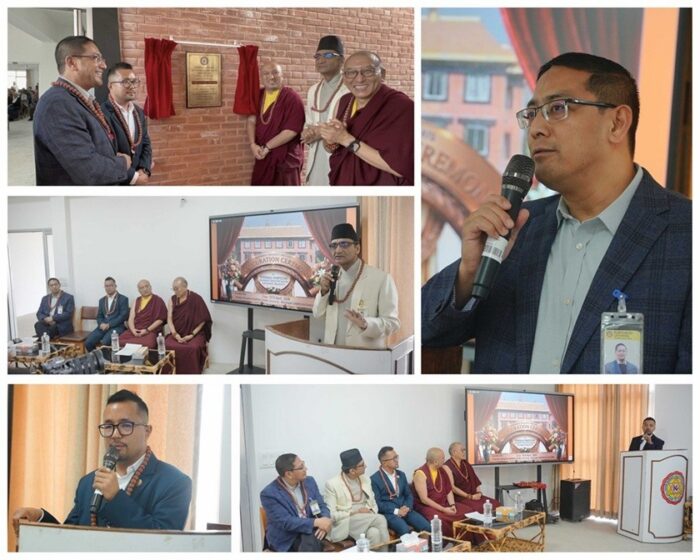
Inauguration of the Thrangu Rinpoche Academia Industry Block at Kathmandu University, April 15, 2026. (Image via Kathmandu University)
Chinese pressure over Kathmandu seminar
In a meeting on July 21 with Nepal’s Foreign Secretary Amrit Bahadur Rai, Chinese Ambassador to Nepal Zhang Maoming raised China’s concerns about presumed statements critical of China. Citing a senior Nepalese foreign ministry official, the Kathmandu Post on July 22 reported that the Chinese Ambassador raised concerns that “some individuals could speak against China and in support of Tibet and urged officials to make sure that no such things happen.” Although no formal diplomatic protest or written demand for cancellation was submitted, China’s démarche led to the withdrawal of CTA researchers.
“The significance of this incident extends well beyond a single academic conference. Beijing is institutionalizing a system in which diplomacy, repressive domestic legislation implemented outside China’s borders, and state-directed academic scholarship reinforce one another,” said Tencho Gyatso, President of the International Campaign for Tibet. “The new Ethnic Unity and Progress Law, together with China’s efforts to recast Tibetology as a vehicle for ‘forging a strong sense of the Chinese national community,’ is designed to advance the forced assimilation of Tibetans while reshaping international understanding of Tibet. Global governments and academic institutions must recognize this as part of Beijing’s broader pattern to eliminate Tibetan identity and expand its transnational repression and call for the repeal of this repressive law,” she added.
Nepal’s balancing act on Tibet
Nepal hosts a sizeable Tibetan refugee community, but more importantly, most of the Nepali citizens who hail from its northern region bordering Tibet share a common cultural and religious tradition with the Tibetan people. Historically, Tibetan Buddhist studies were central to the lives of these Nepali citizens.
At the same time, Beijing has been exerting enormous pressure on Nepal to curb any activities it deems and characterizes as “pro-Tibet,” including Tibetan cultural and religious ceremonies, even to the point of denying the rights of Nepali citizens who follow Tibetan Buddhism.
Even though it is an independent academic conference to which China itself sends delegates, Beijing’s latest intervention over the IATS seminar, therefore, fits a broader pattern of Chinese pressure on Nepal and efforts to control all international discussions on matters relating to Tibet.
First IATS seminar in Nepal
The International Association of Tibetan Studies (IATS) is a non-political academic association formally founded at the University of Oxford in 1979 after the first seminar at the Ethnographic Museum of the University of Zurich in June 1977. The association is dedicated to promoting research on Tibetan history, religion, linguistics, and arts. Its seminars, mostly held every three years, are widely regarded as the leading global forum on Tibetology.
The 2026 seminar will be hosted for the first time in Nepal by Kathmandu University’s Himalaya Centre for Asian Studies (HiCAS) and the KU Centre for Buddhist Studies at Rangjung Yeshe Institute.
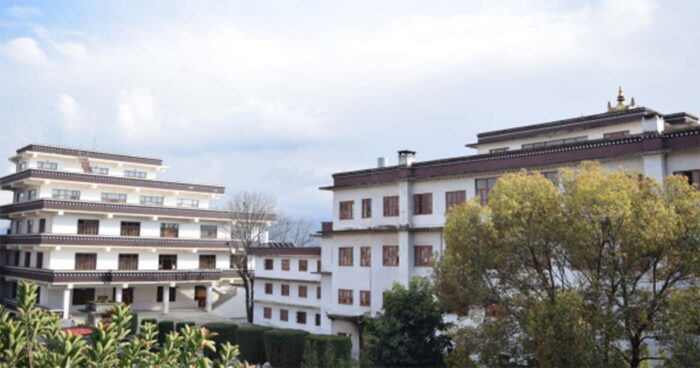
Kathmandu University Center for Buddhist Studies at Rangjung Yeshe Institute. (Source: IATS)
More than 700 scholars from about 39 countries, with a large delegation of around 100 from China, including from the China Tibetology Research Center, are expected to participate in the 17th seminar in Nepal, according to India Today. The opening is scheduled at Kathmandu University’s Dhulikhel campus, with main panels at Hotel Soaltee in Kathmandu.
The reported participation of the state-controlled China Tibetology Research Center at an independent academic forum is a cause of major concern as the center has been mandated by the Chinese Communist Party (CCP) to drive a narrative that advances its forced assimilation agenda.
This is consistent with Beijing’s efforts to use Tibetan studies as an instrument to advance CCP ideology, boost political legitimacy, and shape global narratives about Tibet.
China’s efforts to manipulate Tibetology
This shift was particularly evident last month when senior Chinese officials and state-controlled Tibetology scholars marked the 40th anniversary of the China Tibetology Research Center in Beijing on June 3, during which they cast state-led research as a key instrument in building “an independent knowledge system of Tibetan studies with Chinese characteristics.”
Speakers repeatedly highlighted the need to “influence on Tibet-related matters” and boost China’s “international discourse power” on Tibet, underscoring how Tibetology is being positioned as a political and ideological tool rather than an arena for independent scholarship.
At the symposium, United Front Work Department cadres and state-controlled academics stressed that Tibetan studies must be guided by “Xi Jinping Thought on Socialism with Chinese Characteristics for a New Era” and tasked with “forging a strong sense of the Chinese national community,” a central mission in China’s new “Ethnic Unity and Progress Law.” The new legislation, which came into effect on July 1, requires government agencies, educational institutions, religious organizations, enterprises and society at large to promote a unified Chinese national identity.
Although framed as a milestone in academic development, the anniversary event showcased the extent to which Tibet-related research in China now functions primarily to reinforce official narratives and tighten state control over representations of Tibet.
Beijing seminar on Tibet studies mirrors official CCP framing
That same trend was on display earlier at the 7th Beijing International Symposium on Tibetology, themed “Prosperity and Development of Tibetology and an Open Tibet,” held on Aug. 14, 2023, which revealed China’s manipulation of academic platforms to legitimize the CCP’s approach in Tibet.
While presented as a scholarly exchange co-hosted by entities like the China Association for the Preservation and Development of Tibetan Culture, the 7th Beijing International Symposium on Tibetology masked its real objective of pushing forward a state-centric narrative under the guise of academic discourse. Speaking at the opening ceremony, Chinese state media quoted Chen Zongrong, Party Secretary and Deputy Director-General of the China Tibetology Research Center, as instructing Tibetan studies research institutions at home and abroad to establish academic platforms in various forms, carry out extensive exchanges and cooperation, and “contribute to building a community with a shared future for humankind,” mirroring language associated with the CCP’s key foreign policy messaging.
At the same event, Li Decheng, Deputy Director-General of the China Tibetology Research Center, pushed forward the state narrative on Tibetan Buddhism’s reincarnation practice, stating that the recognition of the Dalai Lama is a prerogative of the Chinese government and not the 14th Dalai Lama and arguing that religious affairs are part of state affairs, and the management of religious affairs should be in accordance with state-promulgated laws.
China’s reported pressure on Nepal over the IATS conference therefore represents more than a diplomatic objection to potential criticism.
It illustrates the convergence of three parallel developments: Beijing’s growing willingness to project influence over any Tibet discourse abroad; the transformation of Tibetology into an instrument of Party ideology; and the institutionalization of Xi Jinping’s ethnic policy through the new Law on Promoting Ethnic Unity and Progress.
As Article 63 asserts jurisdiction over individuals outside of China deemed to undermine ethnic unity, and as state-directed Tibetology is increasingly tasked with strengthening China’s international discourse power, Beijing is attempting to extend its domestic governance framework into international academic spaces.
Beijing Symposium on Tibetan Studies to date
| Symposium | Place | Dates | Host and Organizer |
|---|---|---|---|
| 7th Beijing Symposium on Tibetan Studies | Beijing | Aug 14-16, 2023 | Jointly hosted by the China Association for the Protection and Development of Tibetan Culture, the China Tibetology Research Center, and the Tibet Autonomous Region Academy of Social Sciences, and organized by the China Tibetology Research Center. |
| 6th Beijing Symposium on Tibetan Studies | Beijing | Aug 2-4, 2016 | Jointly hosted by the China Association for the Protection and Development of Tibetan Culture, the China Tibetology Research Center, and the Tibet Autonomous Region Academy of Social Sciences, and organized by the China Tibetology Research Center. |
| 5th Beijing Symposium on Tibetan Studies | Beijing | Aug 2-4, 2012 | Jointly hosted by the China Association for the Protection and Development of Tibetan Culture, the China Tibetology Research Center, and the Tibet Autonomous Region Academy of Social Sciences, and organized by the China Tibetology Research Center. |
| 4th Beijing Symposium on Tibetan Studies | Beijing | Oct 14-17, 2008 | Jointly hosted by the China Association for the Protection and Development of Tibetan Culture, the China Tibetology Research Center, and the Tibet Autonomous Region Academy of Social Sciences, and organized by the China Tibetology Research Center. |
| 3rd Beijing Symposium on Tibetan Studies | Beijing | Jul 25-28, 2001 | Jointly organized by the China Tibetology Research Center and the Tibet Autonomous Region Academy of Social Sciences. |
| 2nd Beijing Symposium on Tibetan Studies | Beijing | Aug 20-23, 1997 | Jointly organized by the China Tibetology Research Center and the Academy of Social Sciences of the Tibet Autonomous Region. |
| 1st Beijing Symposium on Tibetan Studies | Beijing | Sept 13-16, 1991 | Hosted by China Tibetology Research Center |
International Association of Tibetan Studies to date
| Seminar | Place | Convener | Dates |
|---|---|---|---|
| 1st IATS Seminar | Ethnographic Museum of the University of Zürich, Zürich | Per Kværne, Martin Brauen | JUN 26–JUL 1, 1977 |
| 2nd IATS Seminar | St John’s College, Oxford | Michael Aris | JUL 1–7, 1979 |
| 3rd IATS Seminar | Columbia University, New York | Barbara Nimri Aziz | JUL 25-31, 1982 |
| 4th IATS Seminar* | Schloss Hohenkammer, Munich | Helga Uebach, Jampa L. Panglung | JUL 21–27, 1985 |
| 5th IATS Seminar | Naritasan Institute for Buddhist Studies, Narita | Zuihō Yamaguchi, Shōren Ihara | AUG 27–SEP 2, 1989 |
| 6th IATS Seminar | ICRHC (Oslo), Fagernes | Per Kværne | AUG 21–28, 1992 |
| 7th IATS Seminar | IKGA (Wien), Schloss Seggau | Ernst Steinkellner | JUN 18–24, 1995 |
| 8th IATS Seminar | Indiana Bloomington University, Bloomington | Elliot Sperling | JUL 25–31, 1998 |
| 9th IATS Seminar | Leiden University, Leiden | Henk Blezer | JUN 24–30, 2000 |
| 10th IATS Seminar | St Hugh’s College, Oxford | Charles Ramble | SEP 6–12, 2003 |
| 11th IATS Seminar | Bonn University (Seminar for Central Asian Studies), Königswinter | Peter Schwieger | AUG 27–SEP 2, 2006 |
| 12th IATS Seminar | University of British Columbia, Vancouver | Tsering Shakya | AUG 15–21, 2010 |
| 13th IATS Seminar | Mongolian Academy of Sciences & National University of Mongolia, Ulanbaatar | S. Chuluun (MAS),D. Bum-Ochir (NUM), U. Bulag (Cambridge), U. Roesler (Oxford) | JUL 21–27, 2013 |
| 14th IATS Seminar | University of Bergen, Bergen | Hanna Havnevik | JUN 19–25, 2016 |
| 15th IATS Seminar | INALCO, CNRS, EPHE & EFEO, Paris | Fabienne Jagou, Matthew Kapstein, Françoise Pommaret, Françoise Robin, Nicolas Sihlé | JUL 7–13, 2019 |
| 16th IATS Seminar | Charles University (Faculty of Arts) & Oriental Institute of the Czech Academy of Sciences, Prague | Daniel Berounský, Jarmila Ptáčková | JUL 3–9, 2022 |
| 17th IATS Seminar | Dulikhel, Kathmandu | 2026 |