


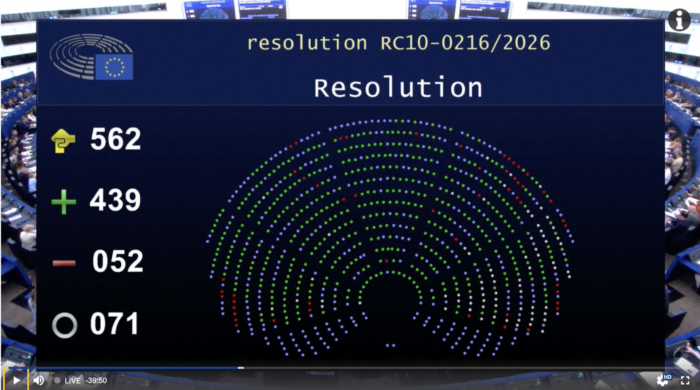
The result of the vote on the resolution in plenary on 30 April. (Photo: Screenshot from European Parliament Webcast)
The European Parliament on April 30 adopted a resolution on China’s new law on “ethnic unity”, expressing grave concern over its impacts for the rights of ethnic groups including Tibetans, and warning its enforcement will carry “severe consequences” for EU-China relations.
Adopted with a strong majority, the resolution urges China to repeal the law, which it says openly promotes assimilation policies and restricts the cultural, religious and linguistic freedoms of various groups. It also denounces its extraterritorial reach, calling on the EU and its Member States to protect those at risk of transnational repression arising from its provisions, and seeks targeted EU sanctions against those responsible for drafting and implementing it.
On Tibet specifically, the text reaffirms the Parliament’s rejection of China’s interferences in the Dalai Lama’s succession and calls for the immediate release of Tibetan political prisoners Choktrul Dorje Ten Rinpoche, Palden Yeshi and the 11th Panchen Lama.
Following the adoption of the resolution, scrutiny of the legislation in the European Parliament continued on May 6 with a dedicated exchange of views held by the Subcommittee on Human Rights (DROI), in association with the Delegation for Relations with China.

ICT President Tencho Gyatso addressing the Subcommittee on Human Rights on 6 May. (Photo: ICT)
ICT President Tencho Gyatso, who was invited to contribute, spoke to MEPs about the impacts of the law on the rights and culture of Tibetans. Drawing on key findings from ICT’s analysis of the legislation, she explained how the law aims to erase Tibetan identity and promote policies which further assimilate Tibetans into a homogenous Chinese state. She also raised concerns about the law’s extraterritorial reach on the many Tibetans living in exile, stating “My speaking here before you today could certainly be seen as contravening the Ethnic Unity Law, as could the presence of all of you in this room today.” She concluded with several recommendations, including a call for the EU and its Member States to adopt a public statement denouncing the law, and to appoint an EU Special Representative for Tibet critical to effective coordination and coherence of EU policies on Tibet.
Ahead of the April 30 vote, Members of the European Parliament debated the legislation in plenary, with speakers from across the political spectrum contrasting China’s approach with Europe’s own experience of cultural and linguistic diversity, stressing that the protection of ethnic identities is a core European value rather than a threat to be eliminated. “Our main message is that enforcement of this law has inevitably to lead to severe consequences for EU-China relations, because it follows from the Treaty on the European Union that we must promote the protection of human rights and the respect to international law in our external relations,” the Chair of the European Tibet Friendship Group Dainius Žalimas said.
In her remarks, EU Commissioner Hadja Lahbib reiterated the EU’s concern about the human rights situation in Tibet and its call on China to respect both its international and constitutional commitments. “While one of the stated objectives of the law is that of promoting high-quality development in ethnic minority regions, let me recall that development can only be sustainable and inclusive when it respects the dignity, identity, and rights of all people and persons belonging to different communities,” she said.
The resolution – adopted under the European Parliament’s urgency procedure, which allows for rapid debates and votes on urgent human rights, democracy and rule of law issues – comes shortly after eight UN Special Rapporteurs sent a communication to the Chinese authorities in which they expressed concerns about compatibility of the law with China’s international human rights obligations.
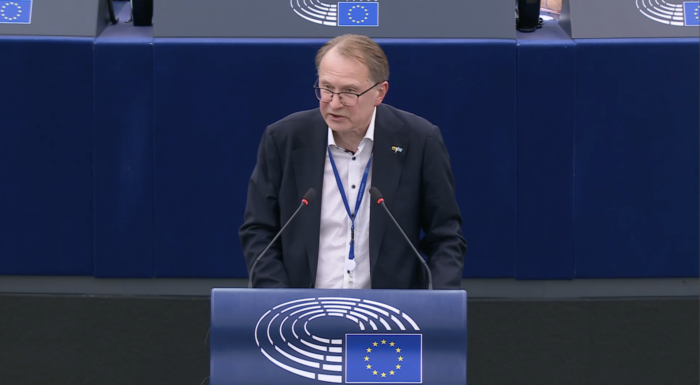
The Chair of the European Parliament’s Tibet Friendship Group MEP Dainus Žalimas speaking during the debate on 29 April. (Photo: Screenshot from European Parliament Webcast)
Other speakers on May 6 included Sarah Brooks, China Director at Amnesty International, who warned the law should be a wake-up call and that pursuing dialogue and cooperation with China should not come at the expense of accountability for serious and systemic human rights violations; and Kerry Brown, a Professor at London’s King’s College who provided broader historical perspective on the legislation. A representative from the European External Action Service – the diplomatic service of the European Union – also repeated the EU’s concern over the law’s consequences for the cultural, linguistic and religious rights of ethnic communities, underlining that the EU will monitor its implementation closely and raise these concerns with China both bilaterally and in international fora such as the UN.
ICT had presented its analysis of the law at a meeting of the European Parliament’s Tibet Friendship Group in March, and together with the Office of Tibet in Brussels had encouraged parliamentary action on the issue. ICT thanks its members and other Members of the European Parliament for their role in prioritizing this issue on the parliamentary agenda.
Click here to read the full resolution of the European Parliament.