


In partnership with the Asian Network for Free Elections (ANFREL), the International Campaign for Tibet (ICT) conducted an election observation mission during the second round of the 2026 Central Tibetan Administration (CTA) elections. From April 21-30, 2026, ICT and ANFREL staff joined seven international expert election monitors in India as they observed election processes and interviewed local stakeholders.
In Dharamsala, Mcleod Ganj, Bir, Bylakuppe, Dehradun and Mussoorie, the observers witnessed campaign activities, voter education, polling and vote tabulation. Based on their observations and the data collected, ANFREL produced a report reviewing the election procedures and providing recommendations to the CTA for further improving their democratic institutions and electoral systems.
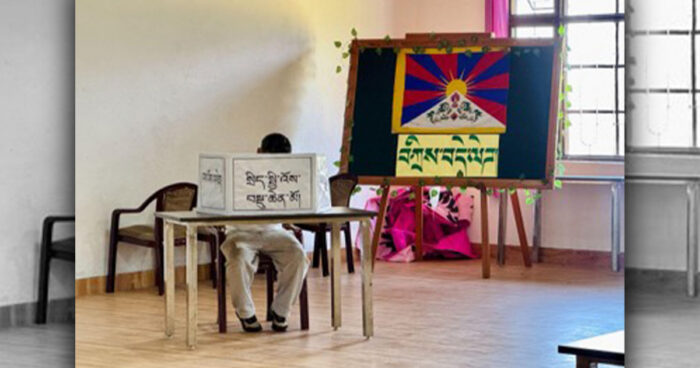
A Tibetan voter casts his ballot during the 2026 election for the 18th Tibetan Parliament-in-Exile. Photo: ©Manjesh Rana/ANFREL.
ANFREL, established in 1997, regularly conducts election observation missions, develops capacity building programs, and advocates for governments to address electoral issues. Despite a decades-long track record observing elections across Asia, monitoring the Tibetan government-in-exile’s electoral process was a unique and meaningful experience for ANFREL. The geographic spread of the Tibetan diaspora requires electoral processes that are implemented internationally and are sensitive to the laws of the countries in which Tibetan exile communities reside.
The April 2026 CTA elections took place across 27 countries and included 91,042 registered voters. The Central Election Commission (CEC) relied on collaboration with hundreds of election officers, volunteers, settlement offices, community networks and other stakeholders to spread information about the election, encourage participation and smoothly administer electoral proceedings according to the CEC’s rules and guidelines.
Overall, the election observers saw an organized and credible democratic election from the campaign period, voting, vote tabulation, and final results. The Code of Conduct and guidelines served as clear frameworks to guide the electoral process. Many Tibetan voters also expressed strong levels of civic commitment, viewing participation in the election as important for strengthening the CTA’s legitimacy as a democratic government in exile.
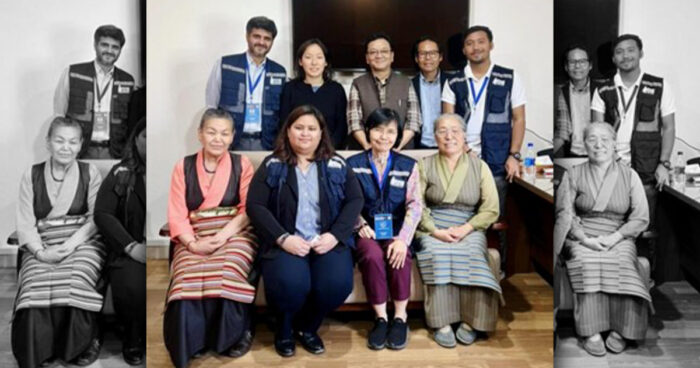
The election observation team in Dharamsala met with Chief Election Commissioner Mr. Lobsang Yeshi, Additional Election Commissioners Ms. Tsering Youdon and Ms. Nangsa Choedon, and Election Commission Secretary Mr. Lobsang Choedak. Photo: ©ANFREL
ANFREL’s report notes where improvements could be made in further strengthening the elections. Stronger engagement in voter education for youth, first-time voters, and others who are not being reached by current communication methods would help increase voter confidence and turnout. While misinformation did not compromise the April election, it is a growing challenge that the CEC should address when developing guidelines for future elections.
Reflecting on her experience observing the elections in Dharamsala and Mcleod Ganj ANFREL Executive Director Brizza Rosales shared the deep meaning she found in the Tibetan government-in-exile’s democratic process: “We witnessed generations carrying forward a democratic tradition that has endured in exile. Most of all, we witnessed hope. The Tibetan elections are not simply about choosing representatives. They are about preserving a nation’s voice. They are about ensuring that identity, culture, and democratic values continue to thrive regardless of geography. They are a powerful testament to the belief that democracy can survive, and even flourish, when sustained by conviction, participation and collective purpose.”
“It was very encouraging to see the Tibetan public seriously taking up their responsibilities under democratic governance, whether as voters or as officials involved in the conduct of the elections,” said Bhuchung K. Tsering, a member of the ICT Team that accompanied the ANFREL mission to three Tibetan settlements in South India. “It was very encouraging to see the Tibetan public seriously taking up their responsibilities under democratic governance, whether as voters or as officials involved in the conduct of the elections.”
Beyond the election observation mission in India, Tibetans living in South Korea voted for the first time in the CTA’s general election in an important step in expanding the reach and representativeness of the Tibetan government-in-exile.
Across Europe, Tibetans voted for two Tibetan Parliament-in-Exile (TPiE) seats. ICT Europe’s office in Amsterdam, Netherlands, served as a polling location.
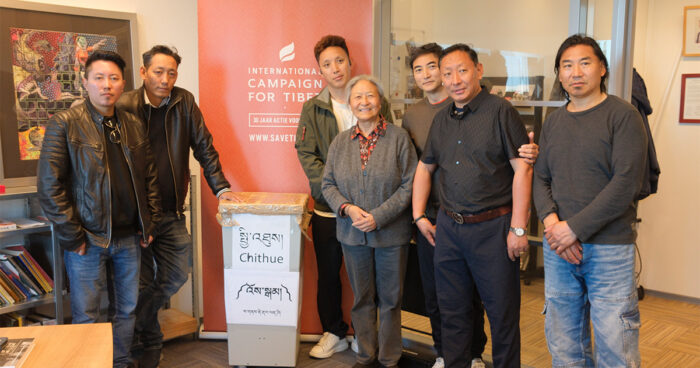
Members of the local election commission pose at the ballot box at ICT Europe’s office in Amsterdam, Netherlands.
Similarly, Tibetans living in North America also voted for two TPiE seats. Tibetans in the United States and Canada had an opportunity to cast their ballots at multiple polling locations across each country, organized and implemented by local Tibetan Associations in collaboration with the Central Tibetan Administration.
Sherap Therchin, Executive Director of the Canada Tibet Committee, observed the elections firsthand in Canada and had the following observations: “Watching the Central Tibetan Administration election unfold here in Canada, what struck me most was the quiet determination of Tibetan-Canadians, generations and continents removed from their homeland, who still showed up to cast their ballots. Whether born in exile, arriving as children, or growing up entirely on Canadian soil, they had not forgotten their roots and took their responsibility to choose leadership seriously. There is something quietly profound in the fact that Tibetans exercise this democratic right freely in exile, voting for a leader of their own choosing, when that same right is categorically denied to Tibetans living inside Tibet.
“It’s also impressive that the election is conducted, with very little or no budget, on the same day across the world wherever the Tibetan diaspora is present—in living rooms, community halls, and polling stations from Toronto to Tokyo, from Washington to Paris—where Tibetans scattered across the globe act as one people with one voice,” Therchin continued. “A nation without a state, dispersed by force, nonetheless conducts a coordinated democratic exercise across every time zone it inhabits – a living rebuttal to the claim that Tibetans need to be governed rather than allowed to govern themselves.”
The Tibetan elections demonstrate the resilience of the Tibetan exile movement and provide optimism for the future of Tibetan democracy. As ANFREL’s report underscores, the 2026 CTA elections were credible and well-administered, a testament to His Holiness the Dalai Lama and other Tibetan leaders’ decades of work on and dedication to fostering democratic values and practices. Despite the challenges inherent in governing and holding elections in exile with a global diaspora, Tibetans in exile are steadfastly committed to supporting and strengthening their democratic institutions.
ANFREL’s Final Report: https://anfrel.org/the-long-road-home-sustaining-democracy-in-exile/
Online launch: https://www.youtube.com/watch?v=14UxKXmNrTI