


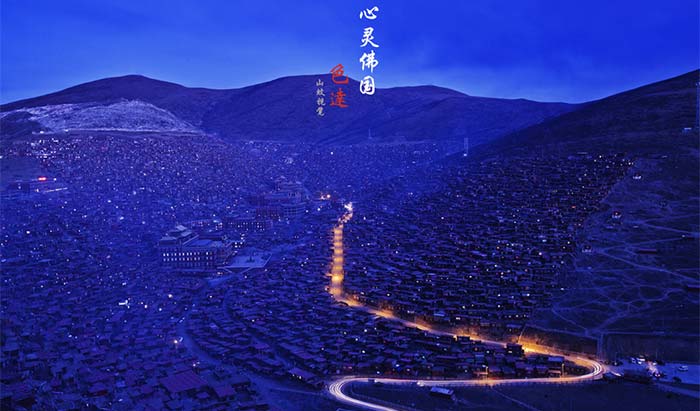
A 2016 file photo of Larung Gar Buddhist Academy at night.
A new round of demolitions that will impact at least 1060 residences of monks and nuns has begun at Serthar Larung Five Sciences Buddhist Academy, popularly known as Larung Gar, in eastern Tibet in Serthar (Chinese: Seda), Kardze (Ganzi) Tibetan Autonomous Prefecture, in Sichuan province, a source with knowledge of the matter told the International Campaign for Tibet (ICT).
ICT is concerned that this latest round of demolitions at one of the largest Tibetan Buddhist centers in the world represents a further tightening of restrictions of religious practice and comes amid an escalation in the Chinese government’s coercive assimilation policies in Tibet after China’s new Ethnic Unity and Progress Law went into effect on July 1.
The demolitions began around July 13, 2026 and are being carried out at nighttime, the source said, in what is seen as a move by authorities to evade public documentation, reporting, and satellite surveillance. As of July 15, 2026, six residences have been demolished, said the source, who requested anonymity for fear of reprisals.
Authorities have earmarked at least 1,060 residences of monks and nuns for demolition as part of this latest round of demolitions, the source told ICT.
Given the strict control of information, the source could not provide more details, including on the reasoning given by authorities for the demolitions. Earlier this year, a traveler to Serthar, where Larung Gar is located, confirmed this in a vlog in Chinese saying, “Let me briefly summarize the biggest changes in Serthar in 2026. The one word that stands out to me is restrictions. There are restrictions everywhere: restrictions on where you can go, restrictions on how long you can stay, and even restrictions on the operating hours of the shuttle buses. Altogether, these measures don’t make the experience particularly visitor friendly.”

Screenshot of a video posted by a traveler to Larung Gar in 2026, in which he confirmed the tight restrictions in Serthar.
Since 2001, Chinese authorities have repeatedly targeted Larung Gar for demolitions, forcing monks, nuns, and lay practitioners to leave and destroying vast swaths of living quarters in an effort to severely reduce the size of the center, which was founded by the late charismatic Tibetan Buddhist master, Khenpo Jigme Phuntsok.
Founded in 1980 to revive Buddhist scholarship and meditation in the wake of Mao Zedong’s turbulent Cultural Revolution, Larung Gar grew in size and reputation over the decades as one of the most influential centers for the study of Tibetan language, culture and religion, attracting thousands of Chinese Buddhist practitioners in addition to Tibetans.
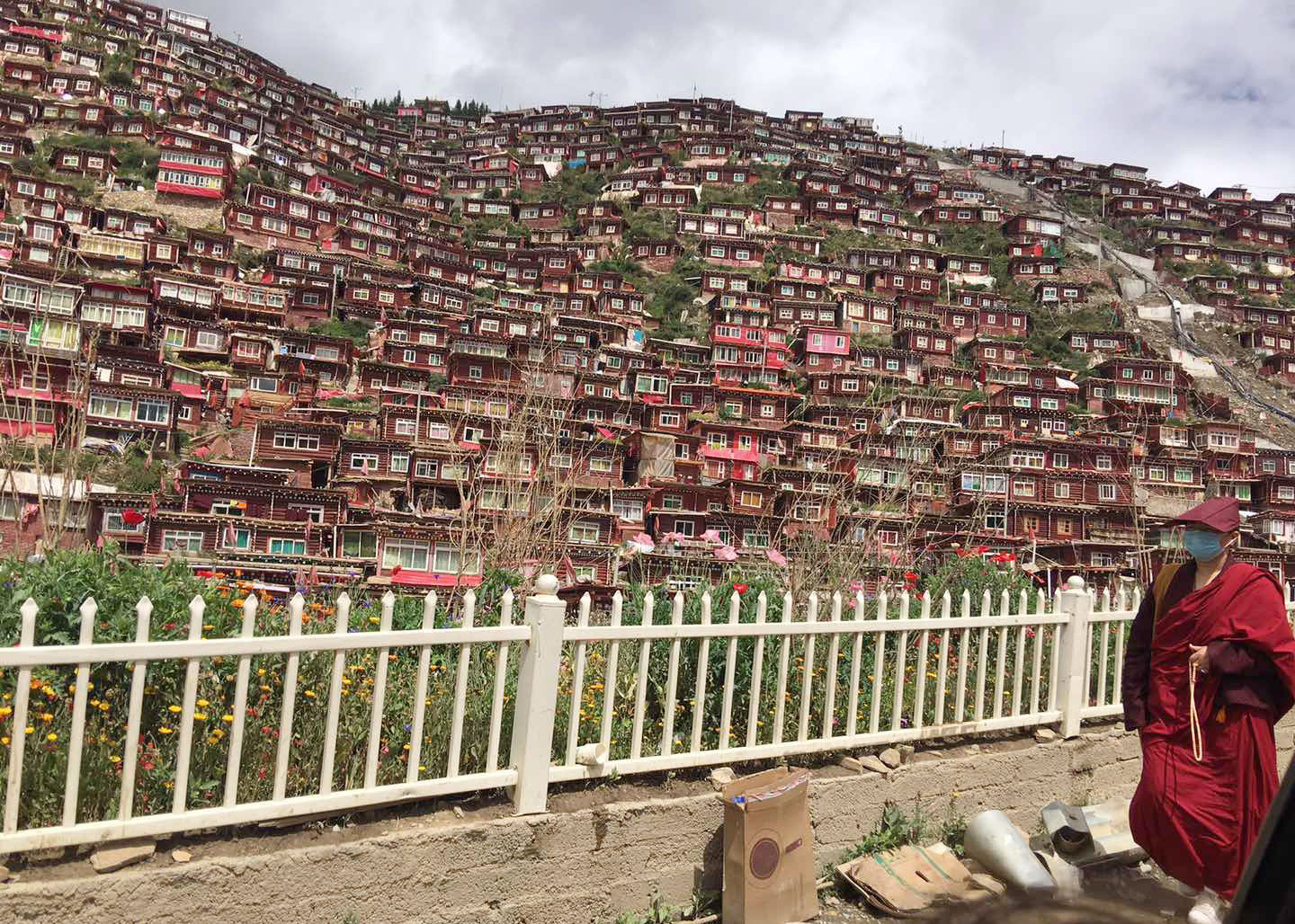
An undated photo of Larung Gar with large empty space made vertically by demolitions carried out by Chinese authorities.
In 2001, Chinese authorities forcibly downsized Larung Gar by half through demolishing the dwellings of the then estimated 8,000 monks and nuns, including Chinese practitioners. Thereafter, the Academy was able to recover from the demolitions and undertake some of its activities, despite continued restrictions imposed in the movement of Khenpo Jigme Phuntsok.
However, in 2016 and 2017, close to 5,000 dwellings were demolished again, with the then-10,000 resident population halved in accordance with a central government order, a copy of which was obtained and translated by Human Rights Watch. About 5,000 monks and nuns were evicted at the time.
In February 2017, six UN experts reported that they had made a joint submission to China stating that the developments at Larung Gar violate international human rights law and “seem to be concerted attacks on tangible and intangible cultural heritage, which constitute serious violations of cultural rights of current and future generations.”
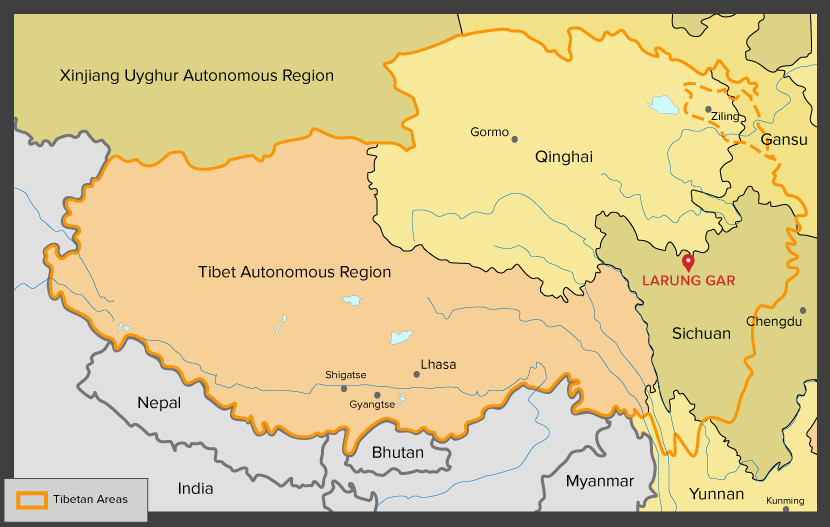
This map is intended to show the location of Larung Gar and does not equate Tibet with only the Tibet Autonomous Region as Tibet includes Tibetan areas in Sichuan, Qinghai, Gansu, and Yunnan as well.
Since mid-2019, Chinese authorities have also resorted to measures aimed at mitigating the influence of Tibetan religious leaders and restricting activities of Larung Gar by imposing restrictions on the participation of Chinese students in the academy. As a result, the once-burgeoning Chinese practitioner population has trickled to a minuscule number. This campaign was further bolstered in November 2021, with coercive separations of Chinese Buddhist practitioners from others.
With around 30 to 40 Han Chinese with semi-permanent residences at Larung Gar in 1991, the number grew to an informal quota of around 2,000 Han Chinese monks and nuns in residence among the academy’s roughly 5,000 practitioners — after the government’s ceiling to halve the earlier 10,000 practitioners — in recent years. In addition to imparting Buddhist teachings to the Chinese practitioners in Larung Gar, Khenpo Jigme Phuntsok had been giving teachings in many cities across China.
The Khenpo had also traveled abroad in the early 1990s, including to India where he met with His Holiness the Dalai Lama. However, since the mid-1990s, Chinese authorities had denied him permission to travel abroad until he passed on January 7, 2004 in Chengdu, Sichuan province at the age of 70. “Khenpo Jigme Phuntsok worked very hard for the preservation and promotion of the unique religious faith of all Tibetans,” Lodi Gyari, then Special Envoy of the Dalai Lama, said at the time.