

As Chinese President Xi Jinping traveled to Washington for a state visit Sep. 23-25, the International Campaign for Tibet (ICT) joined Tibetan organizations, Tibet supporters, human rights groups and members of the U.S. Congress in a coordinated campaign calling for Tibet and human rights to be prioritized both during Xi’s visit and in the broader U.S.-China relationship.
Through advocacy with policymakers, coalition initiatives and participation in protests, rallies, press conferences and other public actions, ICT worked alongside partners to highlight Tibetan political prisoners, the disappearance of the 11th Panchen Lama, Chinese government interference in Tibetan Buddhist succession, coercive assimilation, transnational repression and China’s repressive new so-called “Ethnic Unity and Progress Law.”
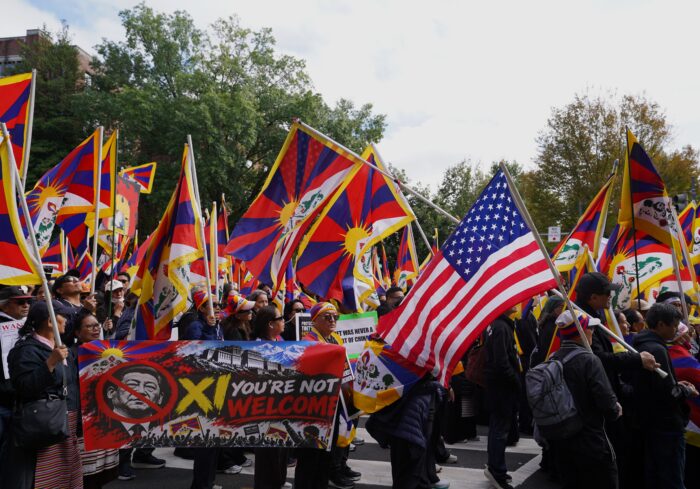
Hundreds of Tibetans from across North America gathered at Washington D.C. on Sep. 24 to protest Chinese President Xi Jinping’s visit. (ICT)
The campaigns culminated in a day-long mobilization on Sep. 24 by Tibetans and Tibet supporters that brought together over 2,000 Tibetan Americans from across North America, including Toronto, Minnesota, New York, Indiana, and many other locales. ICT joined the Tibetan-led protests outside the Chinese embassy and the peaceful march to the U.S. Capitol, where protestors were joined by congressional and human rights supporters. The Tibetan Youth Congress and Capital Area Tibetan Association led the Tibetan American mobilization, with participation and support from ICT, Students for a Free Tibet, Tibetan National Congress and other Tibetan organizations.
ICT also participated alongside Uyghurs, Hong Kongers, Taiwanese, Southern Mongolians and Chinese democracy activists and dissidents in broader coalition protests during Xi’s visit, with a candlelight vigil at Franklin Park.
The public mobilization was part of a broader advocacy effort before and during Xi’s visit. Ahead of Xi’s arrival on September 23, ICT called on President Donald Trump to make Tibet and human rights central to his discussions with Xi and to raise these issues both privately and publicly. ICT urged renewed substantive dialogue between Chinese authorities and Tibetan representatives, the release of the Panchen Lama, Gedhun Choekyi Nyima, and a repeal of the so-called “Ethnic Unity and Progress Law” (EUPL) and other policies threatening Tibetan religion, language, culture and identity.
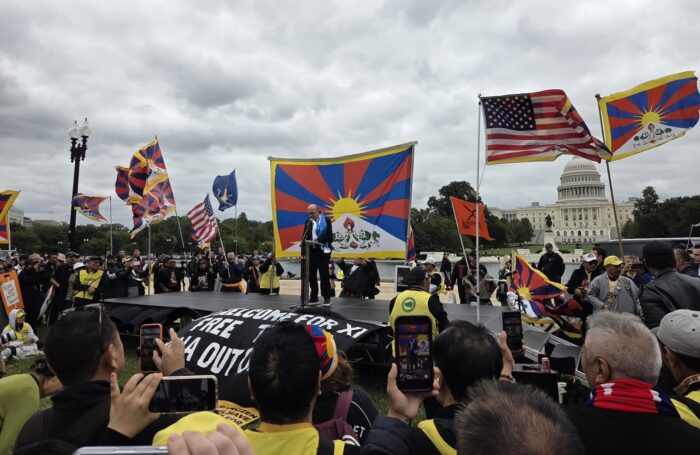
On Sep. 24, Rep. Jim McGovern addresses hundreds of Tibetans gathered outside the U.S. Capitol to protest Xi’s visit to Washington. (ICT)
ICT simultaneously worked through broader coalitions. On Sep. 16, it joined a coalition of 30 human rights, democracy and religious-freedom organizations in an open letter calling on Xi to release prisoners of conscience, end transnational repression and undertake legal reforms. The coalition included International Tibet Network, Campaign for Uyghurs, Uyghur Human Rights Project, Human Rights Foundation, Freedom House, Amnesty International USA, Hong Kong Watch, ChinaAid, Reporters Without Borders and the Committee to Protect Journalists, among others.
ICT also participated in a Religious Freedom Institute and International Religious Freedom Summit event on CCP repression. ICT Executive Director Ryan Fioresi and Head of Research and Monitoring Bhuchung K. Tsering spoke alongside former U.S. Ambassador-at-Large for International Religious Freedom Sam Brownback and representatives of other affected communities. Speakers addressed imprisonment, surveillance, forced labor, family retaliation and pressure reaching people outside China.
Fioresi focused on restrictions on Tibetan Buddhism, and said restrictions have entered “the most intimate spaces of religious conviction,” affecting who may pursue monastic life, how teachings are transmitted and how Tibetan communities practice their faith. Fioresi also addressed Chinese government interference in religious succession, citing the case of Gedhun Choekyi Nyima, who was disappeared by the Chinese authorities after he was recognized by the Dalai Lama as the 11th Panchen Lama.
Fioresi argued that the case offers a warning about how Chinese authorities could seek to influence the eventual succession of the Dalai Lama. “Those decisions belong to Tibetan Buddhists themselves,” he said.
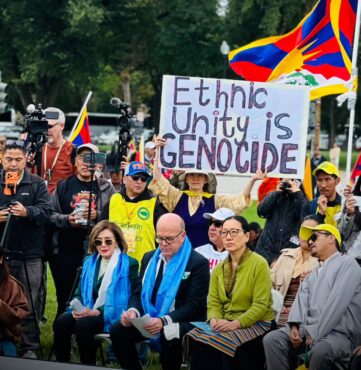
At the U.S. Capitol grounds on Sep. 24, Speaker Emerita Nancy Pelosi and Rep. Jim McGovern join hundreds of Tibetan protesting Xi’s visit to Washington. (ICT)
ICT Head of Research and Monitoring Bhuchung K. Tsering focused on the concerns around the new EUPL and emphasized that the legislation codifies Sinicization and coercive assimilation and “further undermines Tibetans’ fundamental freedom to preserve their unique culture, religion and way of life.”
Tsering said policies implemented in Tibetan areas over more than a decade helped test an approach later incorporated into national legislation. His remarks highlighted four areas of concern: increased emphasis on a single Chinese national identity and Mandarin-language education; the treatment of ethnic affairs through a national-security framework; ideological influence extending into family life; and the law’s reach beyond China’s borders through Article 63.
Tsering called on Trump to urge Xi to repeal the new law, protect Tibetan cultural and religious rights and seek the release of, or independent access to, the Panchen Lama.
As Xi arrived in Washington, ICT President Tencho Gyatso also participated in a campaign organized by the Human Rights Foundation to call for the release of the 11the Panchen Lama. The campaign formed part of the broader human rights mobilization surrounding the visit and followed the joint call by ICT and other organizations for the release of prisoners of conscience, including Gedhun Choekyi Nyima.
Congressional partners amplify calls on Tibet and human rights
Members of Congress amplified these concerns as Xi arrived in Washington.
A joint congressional letter signed by 37 members of the House of Representatives urged President Trump to raise the EUPL directly with Xi during their meetings and to press for its repeal. In the Sep. 23 letter — led by Jamie Raskin (D-MD), Jim McGovern (D-MA) and Gregory Meeks (D-NY) — lawmakers cited concerns about the EUPL’s implications for Tibetans, Uyghurs, other ethnic and religious communities, human rights advocates and critics of the Chinese government living outside China.
On Sep. 23, Rep. Jim McGovern also convened a press conference with representatives of Tibetan, Uyghur, Hong Kong and Chinese communities. McGovern called on the administration to raise political prisoners, fundamental freedoms and other human rights issues directly with Xi and specifically criticized the EUPL, arguing that it threatens the distinct cultural and linguistic identities of non-Chinese communities.
“Our call today is ‘no Xi in DC without human rights’,” McGovern said. “Our call must also be ‘no US foreign policy without human rights’.”
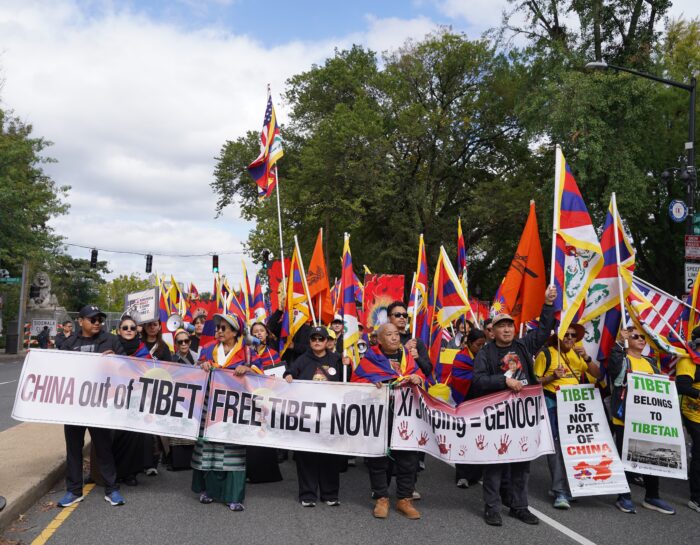
Tibetans protest Xi visit to Washington on Sep. 24 (ICT)
ICT President Tencho Gyatso joined McGovern at the press conference, urging the administration to raise Tibetan political prisoners, the Panchen Lama, the forced assimilation of Tibetan children and the need to resume meaningful dialogue on Tibet. Her message ahead of the Trump-Xi meeting was direct: “Put human rights on the agenda. Put Tibet on the agenda and ask where is the Panchen Lama?”
Gyatso also spoke personally about carrying a connection to Tibet despite never having seen her homeland, saying the issues at stake concern whether Tibetan language, religion, culture and identity will survive.
Gyatso connected the Panchen Lama’s disappearance to the broader question of who has the right to determine Tibetan Buddhist leadership, including the eventual succession of the Dalai Lama. She also warned that repression increasingly reaches beyond China through technology, surveillance and transnational pressure against people exercising their rights in the United States.
Congressional support was also visible at the Sep. 24 Capitol rally, where Speaker Emerita Nancy Pelosi and Congressman McGovern stood with Tibetan leaders, activists and representatives of other communities.
Pelosi emphasized the preservation of Tibetan identity, religion, language and culture, and on following the message and example of His Holiness the Dalai Lama to continue striving for Tibet. “We have to demand and insist,” she said, “that the religion, the language, the faith, the community, the sense of community, in Tibet be respected.”
Rep. McGovern reiterated four priorities: freeing prisoners of conscience, countering transnational repression, rejecting the EUPL, and ensuring that Tibetans, Uyghurs and others are not deported to China.
A day of Tibetan and coalition protest
The Sep. 24 mobilization extended across Washington. After gathering outside the Chinese Embassy, Tibetan protesters marched toward the Capitol for the afternoon rally. Participants in the Rangzen Walk, organized by Tibetan National Congress New York/New Jersey, joined the mobilization after walking from New York to Washington. Students for a Free Tibet organized additional protest actions, including demonstrations outside the Waldorf Astoria and at Joint Base Andrews, ensuring that Tibetan voices were visible at multiple locations associated with Xi’s visit.
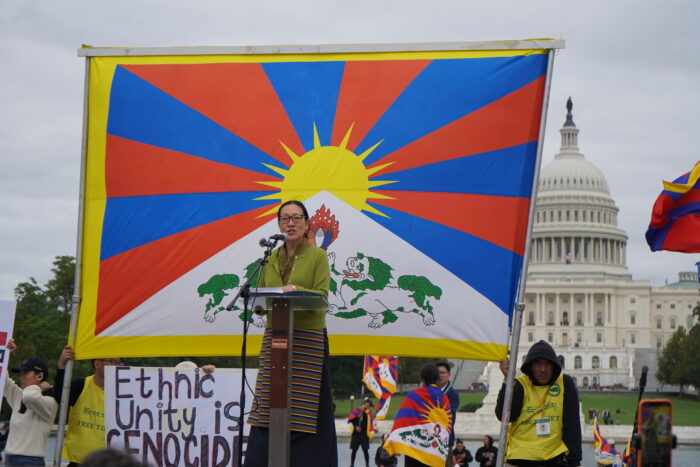
On Sep. 24, ICT President Tencho Gyatso addresses hundreds of Tibetans gathered outside the U.S. Capitol to protest Xi’s visit to Washington. (ICT)
At the Capitol rally, Capital Area Tibetan Association President Tenzing Norbu emphasized both Tibetan resilience and solidarity with other affected communities. Uyghur Human Rights Project Executive Director Omer Kanat highlighted parallels between Tibetan and Uyghur experiences and the transnational pressure faced by diaspora communities, while Hong Kong democracy advocate Frances Hui urged policymakers not to allow political prisoners and human rights to disappear behind discussions of trade.
Together, the speeches underscored one of the central themes of this week’s mobilization: Tibetans were not advocating in isolation, but in solidarity with other communities who have been impacted by Beijing’s repression. Through all of the actions this week, these collective voices highlighted the urgency of placing human rights and fundamental freedoms at the center of the U.S.-China relationship.