


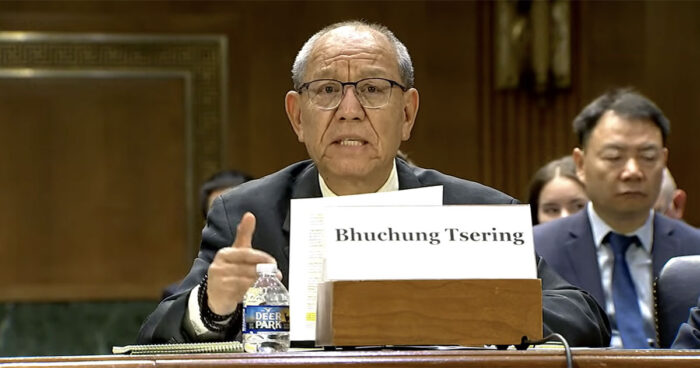
ICT’s Bhuchung Tsering speaks during the hearing.
The Congressional-Executive Commission on China’s latest hearing featured testimony from Chinese Christians, a Hui Muslim, and a Tibetan Buddhist – including ICT’s Bhuchung K. Tsering. It also included resounding calls for new initiatives to take a tougher stance on China’s ongoing occupation of Tibet.
The hearing, entitled “China’s War on Religion: The Threat to Religious Freedom and Why It Matters to the United States,” took place on November 20, 2025. The other witnesses included Sam Brownback, former Ambassador at Large for International Religious Freedom, Ismail Juma, a Hui Muslim human rights advocate, Bob Fu, founder and president of ChinaAid, and Grace Jin Drexel, daughter of Pastor Ezra Jin.
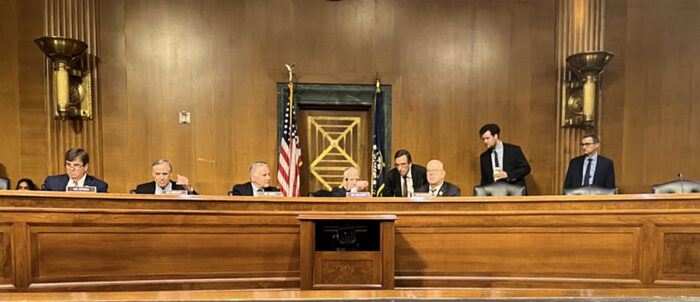
The hearing was chaired by CECC chairman Sen. Dan Sullivan (R-AK) and attended by co-chair Rep. Chris Smith (R-NJ), Rep. Jim McGovern (D-MA), Sen. Jeff Merkley (D-OR), Rep. Dale Strong (R-AL), and Rep. Jen Kiggans (R-VA).
Need to establish consequences for China
Tibet came up repeatedly during the hearing, with panelists and legislators alike in agreement on the need to impose consequences for China’s refusal to resume dialogue with representatives of the Dalai Lama and the Central Tibetan Administration.
“There is a cultural genocide in Tibet going on today, and we need to call it out,” Brownback said in his opening comments.
“We should categorically reject the Chinese government’s claim to the right to appoint the next Dalai Lama,” he continued, saying that Vice President Vance or Secretary of State Marco Rubio should travel to Dharamsala to meet with the Dalai Lama.
“I believe we should announce our support for the Dalai Lama’s Middle Way Approach for Tibet,” Brownback announced, “and if China will not agree to this within a set period of time, say 60 days, we should announce our recognition of an independent Tibet.”
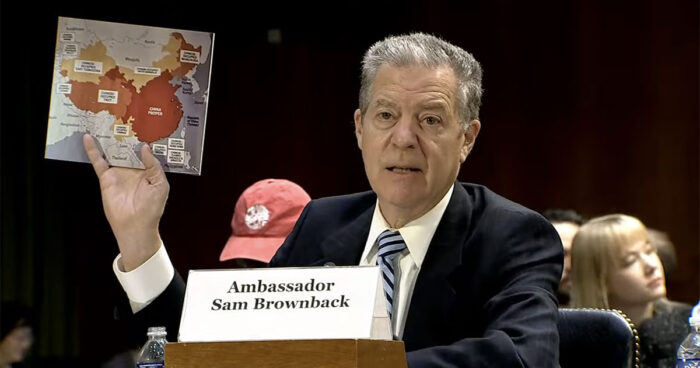
Former Ambassador Sam Brownback holds a map showing occupied regions within the PRC, such as Tibet.
Rep. Jim McGovern (D-MA) expressed agreement. “I share, by the way, Ambassador Brownback, a kind of impatience on the Tibetan issue,” he stated.
“We need to be thinking in terms of consequences, of responses that are more than just words of condemnation but that have an impact. I actually like the idea of putting deadlines on some of this stuff, and if China doesn’t comply, then we formally recognize Tibet as an independent country,” McGovern continued.
Asked about this proposal by McGovern, ICT’s Bhuchung Tsering highlighted the need for international support.
“The Dalai Lama and the elected leadership of the Tibetan people have been earnestly working for a solution,” Tsering said, “and the path of peaceful struggle they have led needs international support to be fulfilled. If there is enough international pressure on China, whether through such acts that you describe or any other way of strengthening American policy, that can only help if the Chinese government responds by sitting down and resolving the issue of Tibet.”
“I appreciate that,” McGovern replied. “We need to step it up here in Congress, and we need to encourage the administration to use the tools that we have given them to pressure China even more.”
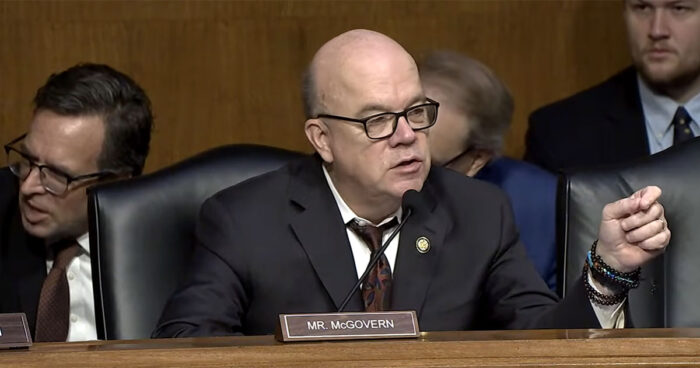
Rep. McGovern speaks in the hearing, wearing prayer beads given to him by the Dalai Lama.
Testimony of ICT’s Bhuchung K. Tsering
Testimony of Bhuchung K. Tsering, Head of Research & Monitoring Unit of the International Campaign for Tibet at the Congressional-Executive Commission on China Hearing on “China’s War on Religion: The Threat to Religious Freedom and Why it Matters to the United States”
November 20, 2025
I would like to thank the Congressional-Executive Commission on China for giving me the opportunity to testify on China’s policies and tactics for coercively controlling Tibetan Buddhism and its relevance to the United States.
Tibetan Buddhism has a sizable following throughout the world, including here in the United States, as well as in the Indian subcontinent. Tibetan Buddhism is linked to the security of the Indian subcontinent through its historical ties and its cultural and ethnic connections across the Himalayan region. The cultural influence of Tibetan Buddhism in the Indian subcontinent has also been a factor in regional stability. The Indian subcontinent is also a major player in the Indo-Pacific region and matters to the United States due to its massive economic importance, strategic security interests, and its role in global stability and the rules-based order.
His Holiness the Dalai Lama is revered by communities in the Indo-Pacific region, as well as in the United States where opinion polls have clearly shown that a majority of Americans embrace him as both a religious leader and globally respected statesman. Americans have shown that they care deeply about what happens in Tibet and successive Congresses and Administrations have reflected that through legislative and policy initiatives.
The Chinese government’s actions in Tibet have created a complex security dynamic, with India attempting to stabilize a sensitive frontier with Chinese-controlled Tibet. For its part, China has been blatantly using Tibetan Buddhism as a vehicle to not only control the Tibetan people, but also to influence the international community, including the citizens of India, Nepal, Bhutan as well as the United States.
Over the years China has been increasing putting pressure on Nepal to restrict Tibetan religious activities, leading to a climate of fear and limited freedoms for Tibetans in Nepal. This pressure includes having Nepal crackdowns on protests, surveillance of the community, refusal to register refugees, and increased security cooperation with Chinese authorities.
Lhasa is the most sacred place of pilgrimage for all followers of Tibetan Buddhism throughout the world, and Chinese authorities are politicizing access to Tibet to further their agenda. China continues to impose restrictions on Tibetan Buddhists, including American citizens, who wish to travel to Tibet, the PRC. At the same time it is providing selective access to journalists and other influencers to drive its own narrative. China has also used the Confucius Institutes in the United States to spread its propaganda on Tibet.
China not only restricts the religious freedom of Tibetans in Tibet but also attempts to interfere in the activities of Tibetans and Tibet supporters abroad. In a report on “Chinese Transnational Repression of Tibetan Diaspora Communities,” the Dharamsala-based Tibetan Centre for Human Rights and Democracy (TCHRD) says China is attempting “to control the actions of exiled Tibetans, Chinese authorities weaponise their relatives in Tibet by harming, threatening, or otherwise manipulating them. The looming threat resulting from ubiquitous surveillance also fosters a constant feeling of unease that spreads fear and disempowers exiled communities. Knowing that spies are planted among their members undermines the trust essential to the survival of diaspora networks. Transnational repression poses increasing threats to Tibetan diaspora communities and, thereby, to the future of the Tibetan freedom movement.”
The head of the Central Tibetan Administration, Sikyong Penpa Tsering, also said he faced transnational repression from China, which tries to stop his visits to different countries, including a direct attempt to stop a major Australian TV station from broadcasting a discussion program with him. More egregiously, in July this year, the Chinese authorities disappeared Zhang Yadi (Tara), a Chinese student and a follower of Tibetan Buddhism who had been advocating peacefully in France for Tibet and Tibetan rights. Zhang had been on a visit to China when she was disappeared in Yunnan. Reports indicate she was taken away by state security officers and is being held incommunicado on suspicion of “inciting separatism”.
Therefore, the Chinese Communist Party’s attitude towards religion in general and on Tibetan Buddhism in particular becomes a national security interest for the United States.
In this testimony I will highlight China’s policy of altering the very identity of Tibetan people as part of President Xi Jinping ‘s overall strategy to co-opt and eventually eliminate Tibet’s unique religious, linguistic, and cultural identity.
I am submitting the full text of my testimony for the record and will provide an overview at the hearing.
The Chinese government’s policy on Tibetan religion has moved from total destruction of Tibetan religious institutions and systems to one of insidious control and erosion. Initially China launched major attacks on the physical structure of Tibetan Buddhism destroying almost all of the monasteries and temples. Subsequently, China altered its policy to allowing a semblance of Tibetan Buddhist practice while simultaneously using it as a vehicle to exert influence over the Tibetan people as well as followers of Tibetan Buddhism throughout the world.
Over the years, the Chinese state has promulgated various regulations to bring Tibetan monasteries and monastics under tighter control by the State. To be clear, while these measures apply to all religious communities in the People’s Republic of China, in Tibet the effect is increasingly intense due to the defining role religion plays as the cultural and social foundation of Tibetan society. The mechanisms of control inflicted by the Xi Jinping regime are designed to contort genuine Tibetan Buddhism and its institutions into another tool of autocratic control and eventual replacement of the Tibetan people’s unique civilization with one defined by the Communist Chinese Party.
The Buddhist Association of China (BAC), a supposedly non-political organization, is becoming a key instrument in the Chinese Communist Party’s strategy to assimilate and transform Tibetan Buddhism. This process is intended to break down Tibetan Buddhism’s unique characteristics and to change it into a tool of the Chinese state.
The most critical area where the BAC contributes to the CCP agenda is in the search and recognition of Tibetan reincarnations. CCP has a strategy to use the opportunity of the ageing of the Dalai Lama to use the deeply spiritual process of his reincarnation to promote its political agenda in Tibet and the region.
Since China has failed to place the current Dalai Lama under its control, it plans to ensure the next incarnation will be subservient to the Communist Party of China. China’s atheist, authoritarian government is claiming authority to select the next Dalai Lama. They attempted this identical strategy with the reincarnation of the Panchen Lama, the second most well-known Tibetan Buddhist leader, by kidnapping him when he was six years old (the youngest political prisoner ever). The CCP subsequently “appointed” a patently false substitute in his place. Not only do the Chinese government’s claims completely disregard centuries-old Tibetan religious tradition; they also violate the universal principle of religious freedom.
The Chinese government’s interference in the Dalai Lama reincarnation issue has clear geopolitical implications on many Tibetan Buddhist institutions in the United States, the Indian subcontinent, Mongolia and other parts of the world. If not challenged vigorously by free countries, this decision threatens religious freedom, not only of Tibetans, but also of millions of followers of Tibetan Buddhism worldwide, including in the United States. If China achieves its goal of co-opting and controlling Buddhism in the region and globally with impunity, then it will only embolden Beijing to further its other expansionist and authoritarian ambitions.
The CCP has introduced the following measures, regulations and initiatives to exercise control over the recognition of reincarnations. In 2019, the Chinese spokesperson responded to the Dalai Lama’s assertion about his authority to decide on his reincarnation by stating that the process must adhere to Chinese law.
The “Management Measures for the Reincarnation of Living Buddhas in Tibetan Buddhism” (Order No. 5) passed by the State Administration of Religious Affairs on July 18, 2007, that came into force on Sept. 1, 2007. It articulates in detail the CCP role in selection, installation and education of reincarnate lamas.
The 2010 “Tibetan Buddhism Living Buddha Certificates” provided by the BAC to reincarnations who have been approved by the Chinese government.
The 2016 “Tibetan Buddhism Living Buddha Inquiry System” launched by the BAC to verify legitimacy of reincarnations. In January 2016, the database started with 870 names, while in April the same year, it increased to 1,300.
The “Revised Religious Affairs Regulations” (Order No. 686) passed by the State Council on June 14, 2017 that came into force on Feb. 1, 2018. It mandates that the religious community shall “practice the core socialist values; and preserve the unification of the country, ethnic unity, religious harmony and social stability.”
The “Measures for the Administration of Religious Clergy” (Order No. 15) passed by SARA on Jan. 8, 2021, regulating the administration of religious clergy. The measures, which came into force on May 1, 2021, standardize state management of clergy to serve the ideological and political interests of the state and legally underpins the “Sinification” of religion policy in China. Article 15 in the regulation explicitly reaffirms the state’s role in management and approval of Tibetan reincarnate lamas.
“Administrative Measures for Religious Activity Venues” (Order No. 19) that came into force on Sept. 1, 2023.
The Chinese authorities realize that Tibetan Buddhism is the core of Tibetan identity. Thus, to the CCP, Sinification serves to make Tibetan Buddhism conform to the CCP ideology and be an active agent of its promotion and implementation.
In a formal statement on September 24, 2011, the Dalai Lama categorically maintained that only he can make a decision regarding his reincarnation and the process in which he intends to handle the issue of his succession and on July 2 this year, he reiterated his position. I would like to submit these two statements for the record.
In the past more than 60 years, the Chinese authorities have adapted from a policy of destruction of Tibetan religious institutions and system to one of controlling them to serve its own political objectives. For the first several years leading to and after the Chinese invasion and occupation of Tibet, there was a policy of complete annihilation of Tibetan religion, including its institutions.
After the Cultural Revolution, there was a brief period of liberalization in the 1980s, leading to a resurgence of Tibetan religious expression. In an apparent realization of the failure of its policy to eliminate Tibetan Buddhism, the Chinese leadership slowly began to change its policy to one of subversion and mounting erosion.
Tibetan Buddhists inside and outside Tibet will not accept China’s plans to control the Dalai Lama’s reincarnation. Nor will the international community endorse such a blatant assault on not only Tibetan religious freedom, but also the fundamental right of any religion to choose its own leaders.
Tibet is within the parameters of US security interests in the Indo-Pacific region. Tibet occupies an Asian fault zone of clashing cultures and big power politics. Tibet is where Russia, China and British India played the Great Game in the past. A stable Tibet where the human rights and religious freedom of Tibetans is respected would contribute greatly to peace and stability in this sensitive region.
Recommendations
- The Trump Administration must monitor, as per the Tibetan Policy and Support Act of 2020, Chinese officials’ violation of Tibetan religious freedom, including interference in recognizing a successor or reincarnation of the 14th Dalai Lama and any future Dalai Lamas and consider imposing sanctions with respect to such officials under the Global Magnitsky Human Rights Accountability Act (22 U.S.C. 2656 note) and applying the relevant section of the Immigration and Nationality Act (8 U.S.C. 1182(a)(2)(G)) with respect to such officials.
- The Trump Administration should continue to engage multilaterally with like-minded countries and international bodies to undertake coordinated initiatives and develop a united policy on religious freedom of the Tibetan people, including within the European Union and at United Nations.
- The Administration should publicly demand release Tibetan political prisoners, including those who have been imprisoned for upholding their religious rights, including the 11th Panchen Lama, Gedhun Choekyi Nyima.
- China should be asked to stop transnational repression and release those who have been detained for peaceful advocacy of Tibetan rights, including Zhang Yadi.
- The State Department should make greater use of the Reciprocal Access to Tibet Act by publicly releasing the names of Chinese officials sanctioned under the Act in the hopes of gaining greater access to monitor the conditions in Tibet, including the practice of Tibetan Buddhism and the situation in Buddhist monastic establishments.
- Relevant Congressional Committees should request access to Tibet and ask American diplomats as well as organizations, including representatives of multilateral organizations, to seek access to Tibet to as part of the implementation of the Reciprocal Access to Tibet Act.
- Denial of religious freedom for Tibetans is merely a symptom of a bigger problem, which is political, and needs to be addressed. The United States has a policy of encouraging unconditional negotiations between the Tibetan leadership and the Chinese leadership. The Trump Administration should urge Beijing at senior levels, both privately and publicly, to return to substantive dialogue with the Dalai Lama or his representatives, without pre-conditions, to negotiate a resolution to the Tibet-China conflict, in line with the 2002 Tibetan Policy Act and 2020 Tibetan Policy and Support Act.