
Wang Huning, one of the most senior Chinese Communist Party leaders, made a rare visit to Tibet, just weeks after Beijing’s new Ethnic Unity and Progress Law came into effect on July 1, signaling China’s determination to accelerate implementation of the law that provides the legal framework for deeper assimilation, ideological control, and security governance across Tibet.
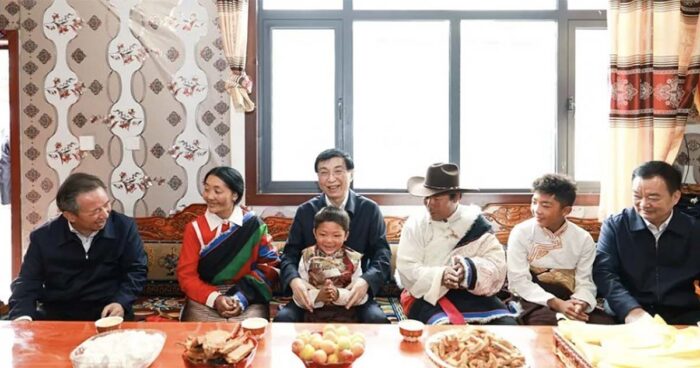
Wang Huning made a rare visit to Tibet from July 19-22, 2026. Wang is seen here on July 21during his visit to a village in Tsamdha (Zanda) County in Ngari Prefecture. (Source: Chinese state media)
Wang Huning, a member of the Politburo Standing Committee and Chairman of the Chinese People’s Political Consultative Conference (CPPCC), made the visit to Tibet from July 19-22, 2026, conducting inspections at the capital city of Lhasa and surrounding areas like Ngari. During his visit, according to Chinese state media, Wang emphasized that the core governance priorities in Tibet must focus on the implementation of the new ethnic unity law and on accelerating efforts to Sinicize Tibetan Buddhism as well on ensuring “social stability maintenance,” a term Beijing uses to refer to a system of policies and security measures established to suppress dissent.
“We must ensure the effective implementation of the Law on Promoting Ethnic Unity and Progress, improve the ability and level of governing ethnic affairs according to law, and promote the meaning of ethnic unity and progress in all development. In accordance with the requirements of systematically promoting the Sinicization of religion in my country and strengthening the rule of law in religious affairs, we must continuously guide Tibetan Buddhism to adapt to socialist society,” Wang repeatedly emphasized during his tour, according to Chinese state media.
Wang’s visit comes mere weeks after Tibetan activist Lobga Rangzen self-immolated outside the United Nations headquarters in New York on July 2, a day after China’s enactment of the new ethnic unity law. As the Party’s chief ideologue and one of Xi Jinping’s political advisers, Wang’s inspections are closely watched as they indicate the Party leadership’s highest policy priorities.
“Wang Huning’s visit underscores Beijing’s continued reliance on increasingly sophisticated legal and political mechanisms to accelerate its forced assimilation policies in Tibet. Coming just weeks after the Ethnic Unity and Progress Law took effect, this high-level inspection and Wang’s repeated emphasis on ‘ethnic unity’ throughout his visit demonstrates the high priority the Chinese government places on institutionalizing policies aimed at erasing Tibetan identity under the guise of ethnic unity,” said International Campaign for Tibet President Tencho Gyatso.
“The international community and governments should recognize this law for what it is — a dangerous legal framework designed to undermine and ultimately erase Tibet’s distinct language, religion, culture and identity — and must call on China to repeal it,” she added.
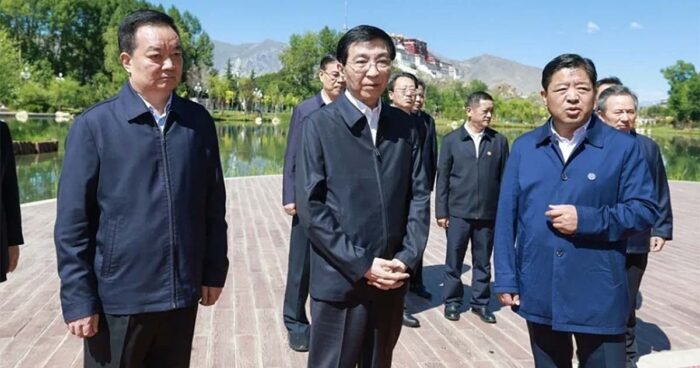
Wang Huning during his July 19-22, 2026 visit to Tibet, where he conducted inspections in Lhasa and other surrounding areas in Ngari. (Source: Chinese state media)
During Wang’s latest July 2026 visit — which included inspections of Sera Monastery in Lhasa and Tholing Monastery, one of the oldest monasteries in Ngari Prefecture — authorities imposed severe security restrictions, sources told ICT.
Wang also inspected a ‘xiaokang’ or border village, and other villages in surrounding counties of Purang, Tsamdha (Zanda), and Gar. Main roads were cordoned off, public movement was strictly limited, and security checkpoints were heavily reinforced across Lhasa and Ngari, sources told ICT. In Ngari, local authorities went so far as to ban pilgrims from visiting the sacred Mount Kailash during the visit, they added.
During this visit, Wang stressed on the need to secure and develop the border regions, where China has prioritized building ‘dual purpose’ (civilian-military) villages to advance its expansionist objectives in the region. In line with the CCP’s ongoing efforts to reshape historical narratives and portray Tibet as an integral part of China ‘since ancient times,’ he called on local authorities to “… strengthen the protection and utilization of Tibetan historical documents, archaeological artifacts, and cultural relics, showcasing the historical process of exchanges, interactions, and integration among ethnic groups and demonstrating the vastness and brilliance of Chinese civilization.”
Wang — who was accompanied by United Work Front Department Head Li Ganjie — also called for intensified propaganda aimed at “forging a strong sense of community for the Chinese nation,” promoting the construction of “a national model area for ethnic unity and progress,” and deepening the creation of such model areas. His directives reflect another requirement under the new ethnic unity law, particularly Article 56, which mandates publicity about the law and designates the fourth week of September every year as the national propaganda week for the new law.
Visits to Tibet by members of the Politburo Standing Committee generally occur when Beijing is reinforcing major political initiatives or strategic priorities in the region. For example, during Wang’s prior Tibet visits in 2023 and 2024, he promoted Xi Jinping’s “new era” strategy for governing Tibet and emphasized ethnic unity, border security, and the Sinicization of Tibetan Buddhism.