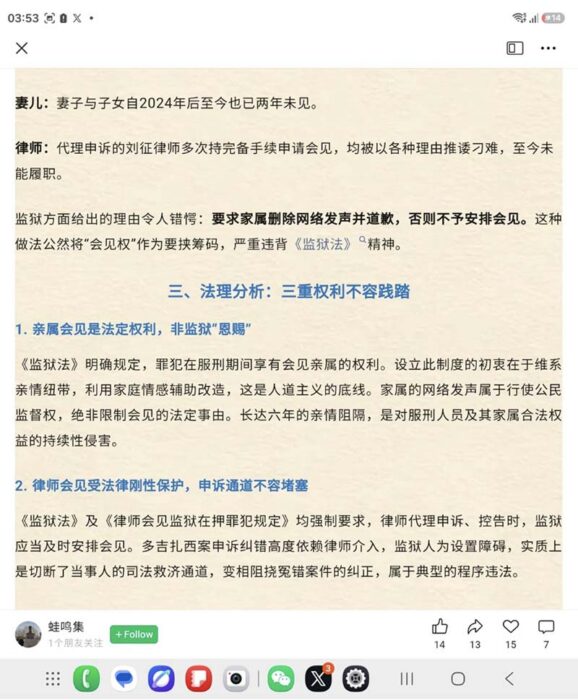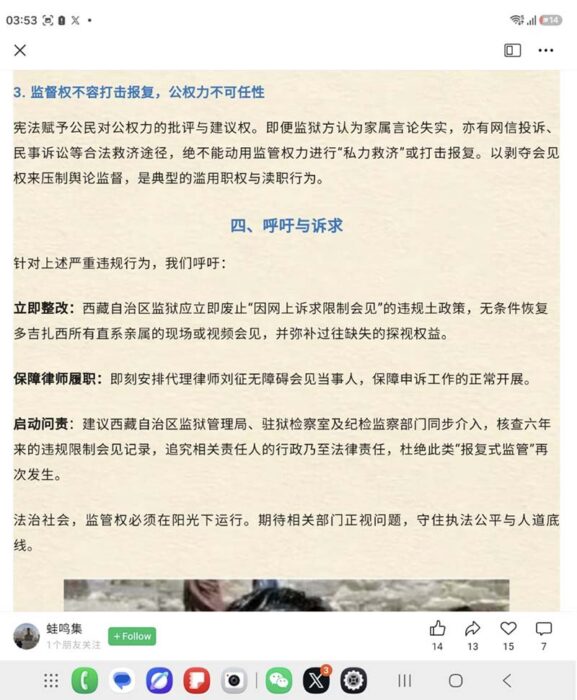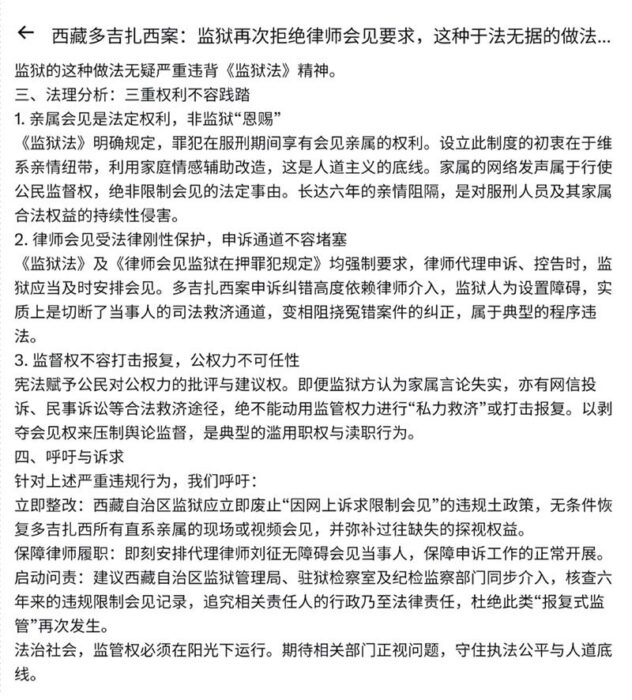


Despite guarantees under China’s Prisons Law, Chinese authorities have repeatedly denied requests by lawyers of imprisoned Tibetan businessman Dorjee Tashi (Duoji Zhaxi) to visit him, including requests made as recently as July-August, according to an August 12, 2026-dated post on Chinese social media describing lawyers’ failed attempts to arrange such visits. Authorities have also been censoring information about the denial of Tashi’s visitation rights and have sought to silence any advocacy online on his behalf.
Once a successful businessman and philanthropist in Tibet, Dorjee was first arrested in 2008, amid the wide-scale protests in Tibet that year, for allegedly “funding activities that endanger national security.” He is currently serving a life sentence in Lhasa’s Drapchi Prison, formally known as the Tibet Autonomous Region (TAR) Prison number 1, on politically motivated charges of “loan fraud.” In August 2021, ICT published Dorjee’s testimony detailing the torture he suffered during his pre-trial detention. Advocacy by Chinese rights advocates, legal observers, and family members on behalf of Tashi on Chinese social media continues to be censored by authorities, ICT found. Shortly after an August 1 post argued that Tashi’s life imprisonment constitutes a “profound miscarriage of justice,” Chinese censors removed the post. It was reposted on August 12, but authorities took it down again shortly afterwards.
The latest suppression of online advocacy on behalf of Dorjee Tashi has left the family, lawyers, and supporters even more frustrated with the Chinese legal system, as it follows years of authorities thwarting his family’s activism through sit-ins and lawyers’ challenges to his wrongful imprisonment and efforts to secure a retrial.
When the previously taken-down August 1 post was reposted on August 12 on Chinese social media platform WeChat, the International Campaign for Tibet archived the page. The original WeChat link now displays a message in Chinese stating: “This content cannot be viewed due to violations. Following related complaints, this content violates the ‘Cybersecurity Law of the People’s Republic of China’”. The post’s repeated removal highlights the authorities’ persistent efforts to silence online discussion of the case after dismissing years of grassroots advocacy that called for due process and a retrial.

Dorjee Tashi before his imprisonment in 2008.
Due process violations in Tashi’s case
Tashi’s supporters lamented in the August 12 social media post that authorities had refused to grant a retrial, despite repeated appeals by family members and lawyers over ten years. This, they add, reflects authorities’ politically motivated violation of the legitimate rights and interests of prisoners and their families, as provided under China’s Prisons Law, and is not a case of the defense lacking evidence for a retrial.
Supporters argue that the “loan fraud” conviction that Tashi was charged with has no real basis. They note that Tashi’s company had put up assets worth about 16.09 million yuan as collateral for a 1.5-million-yuan bank loan and that the principal and interest were repaid in full by 2013. They argue it was a civil loan dispute, not criminal fraud, as there was no intent to cheat the bank and the collateral far exceeded the loan.
In addition to the broader legal issues surrounding his case, Tashi’s family and lawyers face severe restrictions on prison visits. In the initial years after his sentence began, family visits were allowed, but prison authorities began to limit the visits starting in 2019, without citing any clear legal reason.
Dorjee Tashi’s elder brother and eldest sister have not seen him since their last visit in 2019 and his second sister since 2021. His wife and children have been denied visits for about two years since 2024.
Prison officials demand deletion of digital advocacy posts and an apology
Defense lawyers Liu Zheng and Wang Fei have repeatedly submitted formal requests to meet Tashi but have faced delays, refusals, additional conditions or “retaliatory law enforcement” for exercising their right to demand justice through online channels.
According to a social media post citing the lawyers, prison authorities denied lawyer Wang Fei his request to visit Tashi because he had informed the family that Tashi reported being beaten in prison during their last meeting which took place in October 2025, as reported by ICT.
Prison officials also reportedly demanded that the family delete online posts about the case and issue an apology before authorities would consider allowing any visits. Tashi’s supporters say this turns a legal right into a bargaining chip and punishes people for speaking out.
They demand that the TAR prison immediately stop linking visitation rights to online speech and allow the family and lawyers to visit. The supporters also urged prison officials, prosecutors, and disciplinary bodies to investigate the repeated denial of visits over the years and hold accountable those responsible.
With Tashi having spent about 18 years in prison under a life sentence on spurious and politically motivated charges, his supporters have made renewed calls for a full retrial and the return of basic visitation rights that Chinese authorities have denied him for far too long, in clear violation of China’s own laws.
Screenshot of online advocacy on Chinese social media now taken down