
The International Campaign for Tibet, in partnership with the Central Tibetan Administration, Tibet Action Institute, and other Tibetan and rights groups, raised the rights of Tibetan children, enforced disappearances, arbitrary detention and the implications of China’s new “Law on Promoting Ethnic Unity and Progress,” among other human rights concerns, during the ongoing 63rd session of the UN Human Rights Council in Geneva this month.
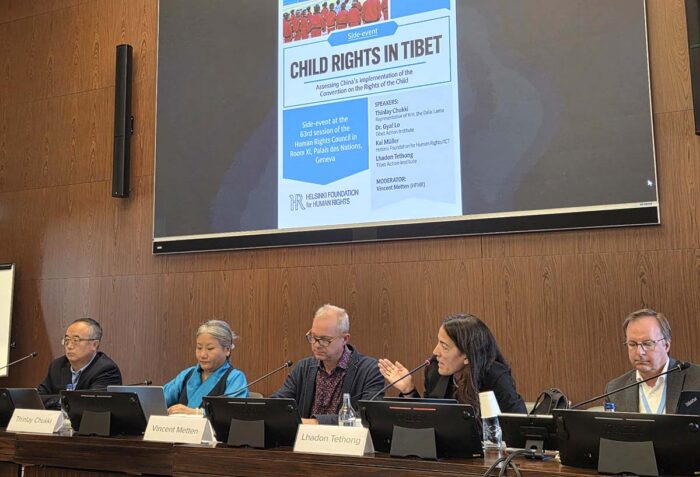
The panel of the side event on children’s rights in Tibet, organized by the Helsinki Foundation for Human Rights on Sep. 24, 2026. (Source: FIDH)
Opening the session with his oral update to the Council, UN High Commissioner for Human Rights Volker Türk renewed his criticism of Beijing’s policies in Tibet. “In China, tightening restrictions on the rights of the Tibetan people, including their freedom of religion, are deeply troubling,” he said, while calling for an “urgent U-turn” on these policies.
High Commissioner for Human Rights Volker Turk’s intervention on China and his call to repeal Beijing’s repressive policies in Tibet.
During the session, a number of states and the European Union echoed concerns about the human rights situation in Tibet, with several also raising the potential impact of China’s repressive new so-called “ethnic unity law.” States that specifically addressed Tibet included Australia, Denmark, Finland, Germany, Ireland, Japan, Sweden, Switzerland and the United Kingdom (see below for more details).
Side-event highlights systematic violations of Tibetan children’s rights
Ahead of the upcoming review of China by the UN Committee on the Rights of the Child, scheduled for 2027, ICT participated in a side event focused on the worsening human rights situation faced by Tibetan children and organized by the Helsinki Foundation for Human Rights (HFHR) on Sept. 24. Speakers at the side event included Thinlay Chukki, Representative of His Holiness the Dalai Lama in Geneva; Lhadon Tethong and Dr. Gyal Lo of the Tibet Action Institute (TAI); and Kai Müller of ICT. ICT’s Vincent Metten moderated the discussion on behalf of the HFHR.
In his presentation, Müller, who serves as Executive Director of ICT Germany, highlighted how China’s recently adopted “Ethnic Unity and Progress Law” further entrenches policies and practices that violate the rights of Tibetan children by Chinese authorities in Tibet, as documented by ICT. Müller also pointed to the increasing indoctrination and militarisation of Tibetan children, alongside systematic restrictions on their freedom to practice their religion.
The side event was attended by representatives of states, observer delegations, and a number of civil society groups.
Oral statements address enforced disappearances and arbitrary detention
ICT representatives also delivered three oral statements by video on behalf of the Helsinki Foundation for Human Rights during the Council session, drawing attention to enforced disappearances, arbitrary detentions and the serious implications of China’s repressive new “ethnic unity law.
“When Tibetans disappear into custody, many do not come back alive,” Kai Müller warned in his statement on Sep. 15 during the Interactive Dialogue with the UN Working Group on Enforced or Involuntary Disappearances. Müller highlighted the case of Tibetan Buddhist teacher Choktrul Dorje Ten Rinpoche, who was detained by Chinese authorities on Dec. 4, 2025 and whose whereabouts remain unknown. He also cited an ICT report documenting the cases of 16 Tibetans who died in custody or shortly after their release between 2014 and 2026.
ICT’s Vincent Metten’s intervention on China’s systematic use of arbitrary detention in Tibet.
The following day, Vincent Metten highlighted the “systematic use of arbitrary and incommunicado detention in Tibet” in his statement during the Interactive Dialogue with the UN Working Group on Arbitrary Detention. He drew attention to the arbitrary detentions of Tibetans for peacefully defending their language, culture, religion and environment. Metten called on China to release all those arbitrarily detained, disclose the fate and whereabouts of disappeared Tibetans, guarantee detainees access to lawyers and their families, and investigate allegations of torture and ill-treatment.
On Sep. 22, during the General Debate under Item 4 — Human rights situations that require the Council’s attention — ICT President Tencho Gyatso delivered a video statement in which she highlighted concerns over China’s new “Ethnic Unity Law,” which entered into force on July 1, 2026 and codifies China’s forced assimilation and Sinicization of Tibetans and other non-Chinese people. Gyatso welcomed Türk’s call for the law to be abolished, saying that his appeal reflected the absence of fundamental rights to which the Tibetan people are entitled.
ICT President Tencho Gyatso giving a video statement on behalf of the Helsinki Foundation for Human Rights during the General Debate on Item 4 on Sep. 22, 2026. (Source: UN Web TV)
In another oral statement, Phuntsok Topgyal of the Tibet Bureau in Geneva, speaking on behalf of the Society for Threatened Peoples, raised the case of Lobga Rangzen, who died on July 2, 2026 after self-immolating outside the UN Headquarters in New York, one day after China’s new ethnic unity law entered into force.
Governments and EU raise Tibet at Human Rights Council
The following states and observers specifically mentioned Tibet in their statements during the Sep. 22 General Debate on human rights situations requiring the Council’s attention:
Australia: “We remain gravely concerned by ongoing human rights violations against Uyghurs and Tibetans. Consistent with international law and norms, governments should not interfere in the selection of religious leaders including the Dalai Lama.”
Denmark: “We reiterate our serious concerns over the human rights situation in China, in particular in Xinjiang, Tibet and Hong Kong”
Finland: “Finland remains concerned about the erosion of civil and political rights in Xinjiang and Tibet as well as restrictions in Hong Kong.”
Germany: “In China the space for freedom of speech and peaceful assembly is as restricted as ever. With great concern we note that the law on promoting ethnic unity and progress further reinforces existing restrictions on cultural and religious freedoms, particularly in the Tibet Autonomous Region and the Xinjiang Uyghur Autonomous region.”
Ireland: “On China we remain concerned over restrictions on civic spaces in Hong Kong, the treatment of Tibetans, repression of Uyghur people in Xinjiang, and the potential impact of the new law on promoting ethnic unity and progress.”
Japan: “On China, Japan is concerned about the recent trend of tightening restrictions on human rights defenders, intellectuals and other individuals. Freedom, respect for fundamental human rights and the rule of law must be ensured in China, including Hong Kong, Xinjiang and Tibet. We strongly urge China to take further constructive and concrete action including enhancing transparency.”
Sweden: “We also remain seriously concerned about the situation in China, not least in Hong Kong, Tibet and Xinjiang. We urge China to implement the recommendations from the UPR, the OHCHR report on Xinjiang and Special Procedures.”
Switzerland: “Switzerland expresses its concerns about the consequences of the new law on ethnic and progress in China. Implemented in its current form, it will seriously undermine linguistic, cultural and religious autonomy of ethnic minorities especially Tibetans Uyghurs and Mongols.”
European Union (with Albania, Montenegro and Liechtenstein aligning): “We reiterate concerns about the situation in China including in Tibet, Xinjiang and Inner Mongolia and about the ethnic unity law.”
In addition, the UK delivered the following statement during the Item 2 General debate on the oral update of the High Commissioner on Sept. 8:
United Kingdom: “Evidence of violations in Xinjiang and Tibet persists, freedom of religion or belief is being further restricted, and the Law on Promoting Ethnic Unity and Progress risks undermining the rights of individuals belonging to minorities. We welcome the High Commissioner’s continued engagement on these issues.”