


Recent photographic evidence and satellite imagery show Chinese authorities are continuing their latest round of demolitions of monastic residences at the Serthar Larung Five Sciences Buddhist Academy, popularly known as Larung Gar, in Serthar (Chinese: Seda), Kardze (Ganzi) Tibetan Autonomous Prefecture, Sichuan province in eastern Tibet. The International Campaign for Tibet (ICT) first reported the new demolition drive launched by authorities on July 13 at Larung Gar, one of the world’s largest Tibetan Buddhist academies. Images and video taken on August 13 and satellite images — from July 27, obtained by ICT and from August 14, obtained by Radio Free Asia (RFA) — reveal the systematic destruction of monastic residences at Larung Gar.
ICT Research found that the physical destruction of monastic residences at Larung Gar is occurring alongside a sustained ideological campaign to “Sinicize” Tibetan Buddhism and erode Tibetan religious and cultural identity, while imposing a state-mandated national identity centered on loyalty to the Chinese Communist Party (CCP). Combined with sustained political indoctrination, these demolitions disrupt collective study and practice at Larung Gar and undermine the academy’s capacity to operate as an autonomous center of Tibetan Buddhist learning.
“The destruction at Larung Gar is not simply the demolition of buildings; it is part of a wider systematic campaign to bring Tibetan Buddhism under the control of the CCP,” said Tencho Gyatso, President, International Campaign for Tibet. “By demolishing the residences that sustain collective Buddhist study while subjecting monastics to relentless political indoctrination, the Chinese government is attacking both the physical foundations of religious life and the Tibetan beliefs, identity, and community they support.”
“ICT calls on the international community to intervene urgently by pressing for an immediate halt to the demolitions, independent access to Larung Gar and protection for its monastics and residents. ICT also urges global leaders to raise Larung Gar directly with Chinese authorities and hold them accountable for violations of religious freedom and Tibetan cultural rights,” Gyatso added.
The August 13 photographs show demolition crews targeting monastic residences, while high-resolution satellite imagery from July 27 shows that the demolitions were concentrated around the center of the academy. The August 14 imagery obtained by RFA shows a demolished area around the center, with the curved road leading to the central structures cleared — further evidence that the demolitions continued after July 27.
Sources told ICT that the current phase of demolitions was scheduled to conclude by August 20. ICT is concerned that another phase may follow, as the authorities’ stated target was the demolition of at least 1,060 residences. Despite intensified surveillance and restrictions on communications and movements, ICT will continue to monitor developments at Larung Gar.
Visual evidence of demolitions
The following photographs of Larung Gar emerged a month after the demolitions began. Collectively, these images provide visual confirmation of large-scale, mechanized demolition involving multiple excavators and work crews. They show that the demolitions took place during both daytime and nighttime and affected residential areas in the center of the academy.
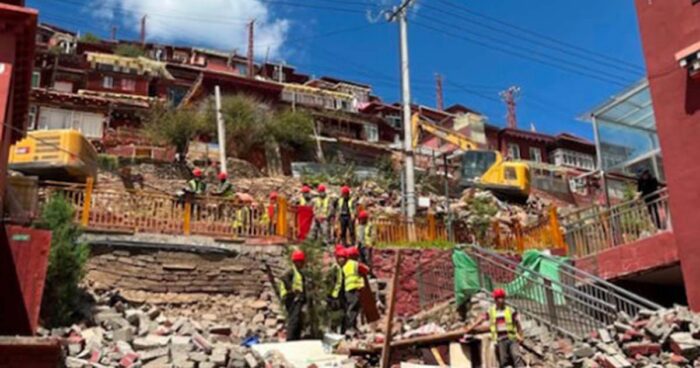
An August 13-dated photograph shows Chinese authorities continuing their latest round of demolitions at Larung Gar, a month after they began on July 13, 2026. (ICT sources)
One daytime photograph shows the demolition activity amid densely packed red monastic residences that are characteristic of Larung Gar. Multiple excavators stand on a slope amid large piles of rubble and debris from destroyed buildings. Workers wearing red hard hats and high-visibility yellow vests can be seen standing along a yellow-railed pathway and among the ruins.
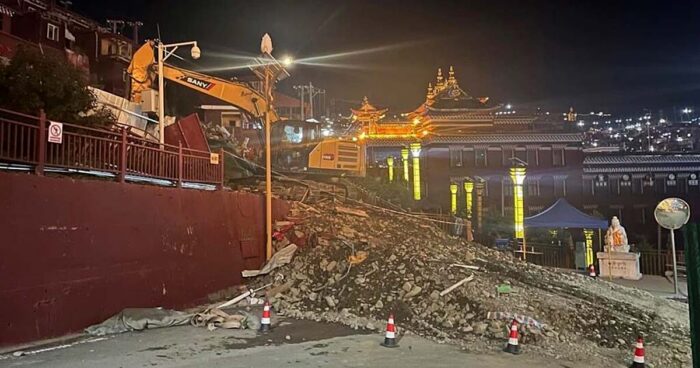
Another August 13-dated photograph shows proximity of the latest round of demolition work being carried out at Larung Gar to the center of the Buddhist academy. (ICT sources)
Another photograph taken at night shows a large SANY excavator operating under bright lights on a steep, rubble-strewn incline amid piles of broken concrete, bricks, and other debris. In the background, a large structure with illuminated golden roofs, most likely the main assembly hall at the center of the academy, remains standing, highlighting the proximity of the demolition work to the center of the complex.
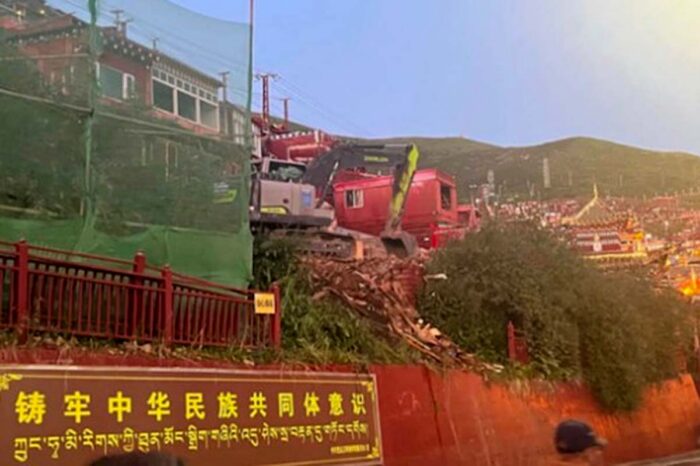
A photograph showing the latest round of demolition of monastic residences at Larung Gar. (ICT sources)
Another photograph shows a Zoomlion excavator high on a hillside, dismantling structures or clearing debris. Green safety netting covers part of a nearby building. In the foreground, a bilingual banner in Chinese and Tibetan reads “Forge a strong sense of community for the Chinese nation”. The background reveals the extensive spread of Larung Gar’s red wooden huts across the valley and hillsides, underscoring that the demolitions are taking place within the heart of the monastic complex.
High-resolution satellite imagery from July 27 obtained by ICT shows that the demolitions are concentrated around the center of Serthar Academy. When compared with freely available Google Earth imagery from August 10, 2019, significant changes are visible around the academy’s central area. Later imagery from August 14, obtained by Radio Free Asia (RFA), shows a cleared area around the center, with the curved road leading to the central structures cleared and dump trucks and excavators visible. Overall, the satellite imagery and the photographs together confirm that Chinese authorities are continuing this latest round of demolitions at Serthar Buddhist Academy, which ICT first reported on July 17.
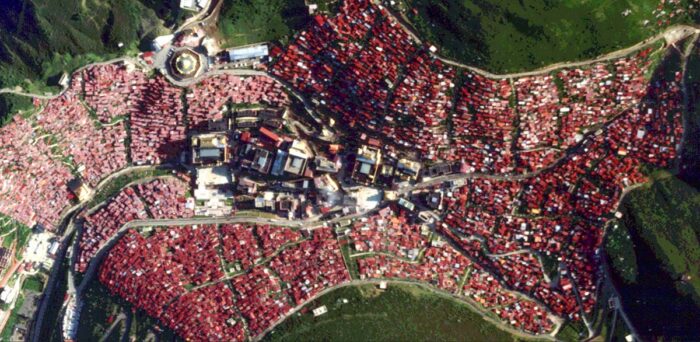
Planet Labs satellite imagery of Larung Gar on July 27, obtained by ICT.
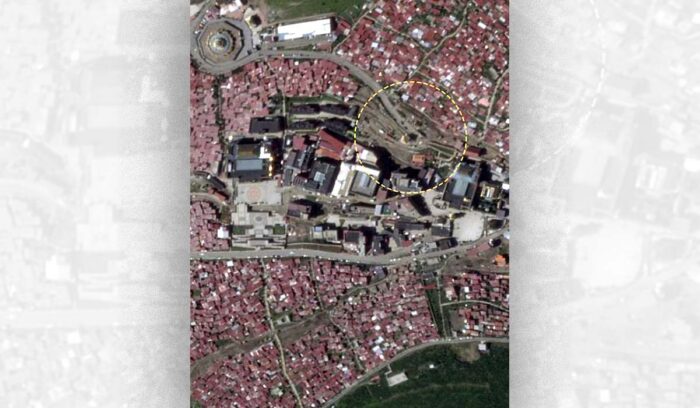
Planet Labs satellite imagery of Larung Gar on August 14, obtained by RFA.
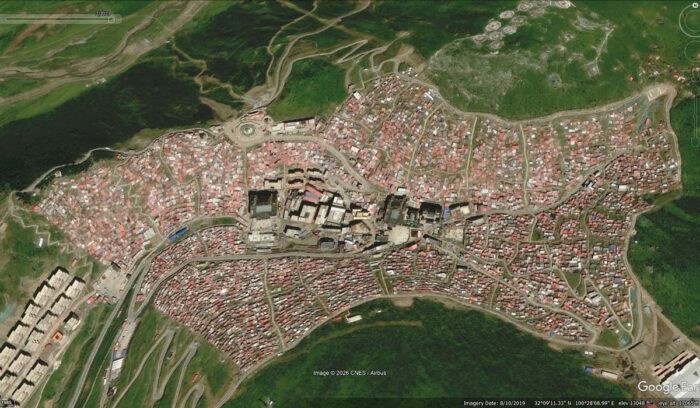
Google Earth imagery of Larung Gar on August 10, 2019.
Sinicization and “forging a sense of Chinese national community”
These demolitions are occurring against the backdrop of the Chinese government’s new so-called “Ethnic Unity and Progress Law,” which took effect on July 1, 2026, and longstanding policies emphasizing the “Sinicization” of Tibetan Buddhism and its subjugation under the leadership of the CCP.
Earlier demolition campaigns in 2001 and 2016 similarly involved work teams accompanied by security personnel, homes marked for destruction, residents forced to sign documents agreeing not to return, and monastics bused away from the academy. The cumulative impact of these successive rounds of demolition campaigns has been a substantial reduction in the physical footprint and population of Serthar Academy, transforming parts of what was once a densely inhabited religious valley that accommodated around 40,000 practitioners at its height.
The current demolitions at Serthar Larung Gar are not merely administrative or logistical measures; they are a physical expression of a repressive Chinese state policy aimed at forging “a sense of Chinese national community” and ensuring the “Sinicization of religion.” The visual evidence documents the ongoing physical destruction, but these changes are inextricably linked to a parallel ideological campaign designed to transform the academy from an autonomous center of Buddhist learning into a tightly managed institution aligned with CCP priorities.
The ideological blueprint: “Sense of Chinese national community”
The Chinese state’s physical intervention is driven by mandates requiring monastics to prioritize political reliability over traditional Buddhist study. This is framed through the Chinese party-state’s concept of the “sense of community for the Chinese nation,” a directive explicitly delivered to senior religious leaders.
During a January 2022 “tea reception” for Tibetan New Year celebrations, religious leaders — including Khenpo Tsultrim Lodro, the academy’s executive vice dean and Khenpo Sodargye, executive deputy director of its management committee — were instructed by Party officials to deepen the “Sinicization of religion” and play an active role in safeguarding national unity.
Such public rituals serve a specific purpose: to enlist prominent Tibetan Buddhist figures to legitimize state policies. By demanding pledges of loyalty and broadcasting their compliance on state television, the authorities aim to project an image of harmony while reinforcing a strict hierarchy of subordination.
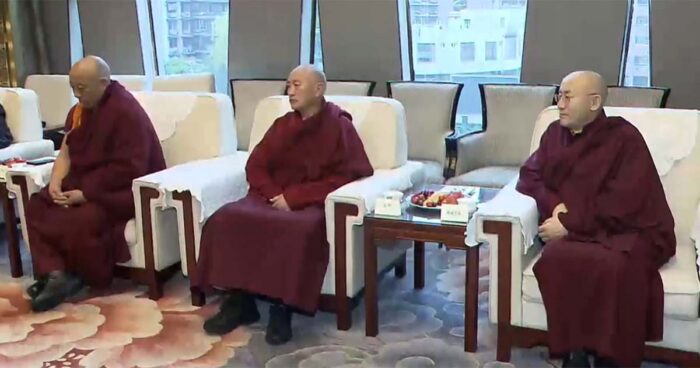
Serthar Larung Gar’s two Khenpos were required to attend the then-Kardze (Ganzi) prefecture party secretary Shen Yang’s New Year “tea reception” in 2022. (State media Kardze TV broadcast screenshot, Jan. 2022)
“Patriotic re-education” and the “Five Identifications”
The physical dismantling of Larung Gar has consistently been preceded by political indoctrination, often referred to by the Chinese state as “patriotic re-education.” These sessions are designed to instill absolute loyalty to the Chinese state and the CCP.
A key component of this indoctrination is the affirmation of the “five identifications,” which require monks and nuns to identify with “the great motherland, the Chinese nation, Chinese culture, the CCP and socialism with Chinese characteristics,” as represented in this May 2021 report on activities in the academy. This ideological framework seeks to ensure that the monastic community functions as a subset of the broader Chinese national identity rather than as part of a distinct Tibetan cultural or religious entity.
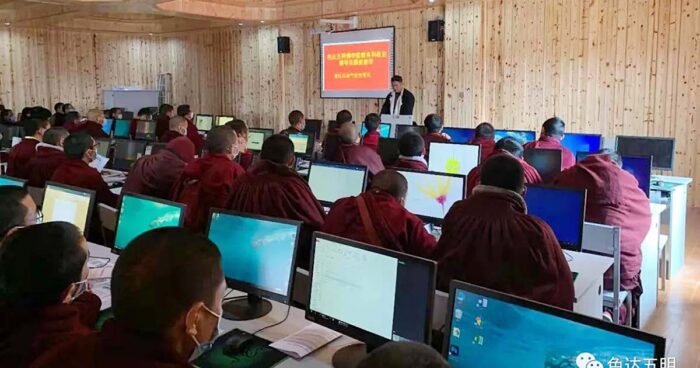
Political indoctrination session at Serthar Buddhist Academy where monastics were required to affirm the “five identifications”. (State media handout, May 2021)
Legal hierarchy: National law over religious rule
In January 2026, the state-controlled Serthar County Buddhist Association intensified this campaign by launching a drive focused on the “Three Consciousnesses”; national consciousness, citizen consciousness, and rule-of-law consciousness. Its primary goal is to force monastics to internalize the principle that “national law is greater than religious rules.” By embedding this hierarchy into the daily life of the academy, the state aims to align the thoughts and actions of religious practitioners with the decisions of central and provincial Party committees.
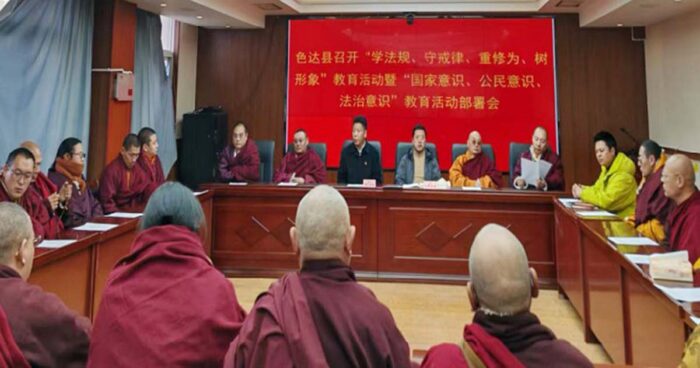
A political meeting convened by the state-controlled Serthar County Buddhist Association in session. (State media handout, January 2026)
Securitization and national identity
Chinese authorities’ push to forge a national community is also framed as central to national security. In mid April 2026, the academy was subjected to a series of “National Security Education” activities, including mandatory flag-raising ceremonies and oath-taking events. These sessions are designed to cultivate a “collective sense of responsibility” among both monks and cadres to ensure the state’s security.
This campaign has also reached deep into monastics’ private lives through “outreach activities” that bring legal and political propaganda directly into their living quarters. By distributing handbooks on national security and anti-espionage laws, the state attempts to cultivate support for its Chinese national security agenda and effectively turn the monastic community into a monitored and self-monitoring unit of the state.
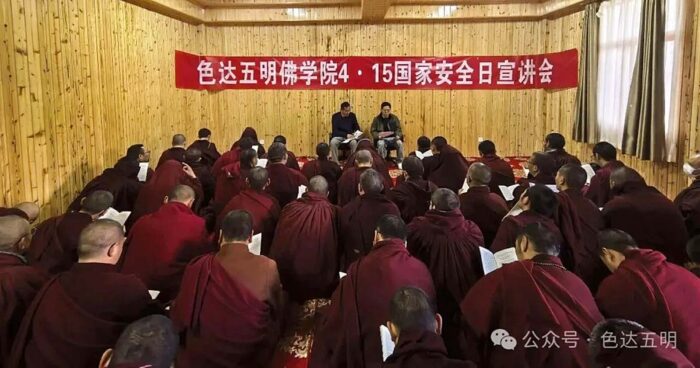
Officials speaking about national security to a group of Serthar monks on China’s National Security Education Day. The red banner in Chinese reads “Serthar Larung Gar Buddhist Academy’s National Security Day Publicity Meeting, April 15”. (State media handout, April 2026)
Demolition and indoctrination erode Larung Gar’s autonomy
The physical demolitions of monastic residences and the sustained ideological indoctrination sessions are taking place in parallel at Larung Gar.
The destruction of residential housing systematically dismantles the physical infrastructure that sustained it as an autonomous religious center, dispersing its community, disrupting collective monastic life, and making it far more difficult for the academy to function as an independent hub of Buddhist learning and practice. At the same time, the indoctrination sessions work to replace traditional religious identity with a state-mandated national identity, requiring monastics and residents to internalize party ideology, loyalty to the Chinese state, and a redefined sense of belonging that prioritizes political allegiance over spiritual lineage and Tibetan cultural identity.
By forcing Larung Gar to “adapt” to a socialist society, the Chinese government is not merely changing an institution but is systematically eroding its autonomy. Material destruction and ideological indoctrination work together to significantly restrict the academy’s ability to operate according to its own religious and communal traditions. Instead, it is being reshaped to serve the singular goal of a unified, “sinicized” national community in which independent centers of Tibetan Buddhist authority are subordinated to state and Chinese Communist Party control.