Executive Summary
As the Chinese Communist Party (CCP) prepares for its 21st Party Congress in 2027, developments in 2025–2026 indicate that Beijing is cultivating a more repressive leadership in Tibet to deepen political control and accelerate its policies of forced assimilation of Tibetans. Leadership appointments, new legislation such as the “Promoting Ethnic Unity and Progress Law,” and Party directives centered on “Xi Jinping Thought on Party Building” signal further consolidation of centralized Party authority through an emphasis on ideological loyalty and implementation of central policy, reinforcing a governance model where political conformity takes precedence over meaningful Tibetan representation.
Since the International Campaign for Tibet’s (ICT) May 2025 annual report on the status of leadership in Tibet, the Chinese authorities have undertaken a series of concerning steps, including the introduction of political and legal measures, that will reshape the framework within which future Party leaders will govern Tibet. The most harmful among these is the controversial “Promoting Ethnic Unity and Progress Law,” widely known as the ethnic unity law, which entered into force on July 1, 2026. The law codifies China’s forced assimilation and Sinicization of Tibetans and other non-Chinese peoples.
The ethnic unity law, together with the Party’s emphasis on the implementation of “Xi Jinping Thought on Party Building” and the priorities outlined in the 15th Five Year Plan (2026-2030), will impact the regional Party congresses in the Tibetan areas, ahead of the 21st Party Congress which is scheduled in the latter half of 2027. At the same time, the major personnel changes anticipated at the national level in 2027 will also shape how the leadership in the Tibetan areas will be transformed.
ICT’s 2026 report examines the current status of leadership in Tibet, identifies likely leadership changes in the run up to and at the 21st Party Congress, analyzes the political and legal developments that have emerged since 2025, and assesses how these developments are likely to impact the new Chinese leadership and its policy on and governance of Tibet. Drawing on new appointment data and institutional analysis, the report argues that Beijing is not simply defining who governs Tibet; rather, it is engineering a new generation of Party leaders in Tibet by prioritizing political reliability, ideological conformity, and implementation of forced assimilation policies over meaningful Tibetan representation.
At a Glance
- Continued Xi Jinping dominance even after 21st Party Congress in 2027: Xi Jinping is expected to remain China’s dominant leader beyond the 21st Party Congress, ensuring continuity in his security-driven approach to Tibet. Leadership changes in Tibet are likely to reinforce Xi’s Tibet policy, with promotions favoring officials aligned with Xi’s governance model.
- Lack of Tibetans in senior Party leadership positions: The absence of Tibetans in the higher echelons of the CCP leadership is a trend seen well beyond the Politburo. Even in the powerful United Front Work Department (UFWD), which oversees Beijing’s Tibet policy, there has not been a Tibetan at the senior leadership level since Sithar (Si Ta) retired as Vice Minister in 2016.
- Two guiding principles for the seventh-generation leadership in Tibet — Xi Jinping Thought on Party Building and the Ethnic Unity and Progress Law: Together, they form the ideological and legal framework shaping the next generation of governance in Tibet — one that prioritizes Beijing’s forced assimilation policies and embedding national security into the governance of education, language, religion and culture, as well as Party loyalty, political conformity, and centralized authority.
- Impact of Ethnic Unity Law on the new Tibetan leadership: The Ethnic Unity Law further weakens the protections nominally guaranteed under China’s regional ethnic autonomy system. Its implementation is expected to accelerate Mandarin-medium education; further restrict space for Tibetan language, culture and identity; and leave future Tibetan leaders with little scope to uphold the autonomous rights guaranteed under the Constitution and the Law on Regional Ethnic Autonomy.
- Centralized CCP governance of Tibet by Non-Tibetans to continue: Currently, the highest CCP leadership positions in the Tibetan areas are held by non-Tibetans, and there is no indication that Tibetans will assume leadership positions in the coming years.
- Tibetans in the national-level leadership: In the 20th Party Congress, Yan Jinhai (born 1962), former Tibet Autonomous Region (TAR) Chairman and current Chair of the TAR People’s Congress, is the only Tibetan in the CCP Central Committee. Yan Jinhai and all three Tibetans in the 171 alternate members of the 20th Party Central Committee — Karma Tseten (Chinese: Gama Cedain, born 1967), Phurbu Dhondup (Pubu Dunzhu, born 1972), and, Tsering Thar (Cering Tar, born 1969), are eligible, in terms of age limits, to continue serving in the 21st Party Congress.
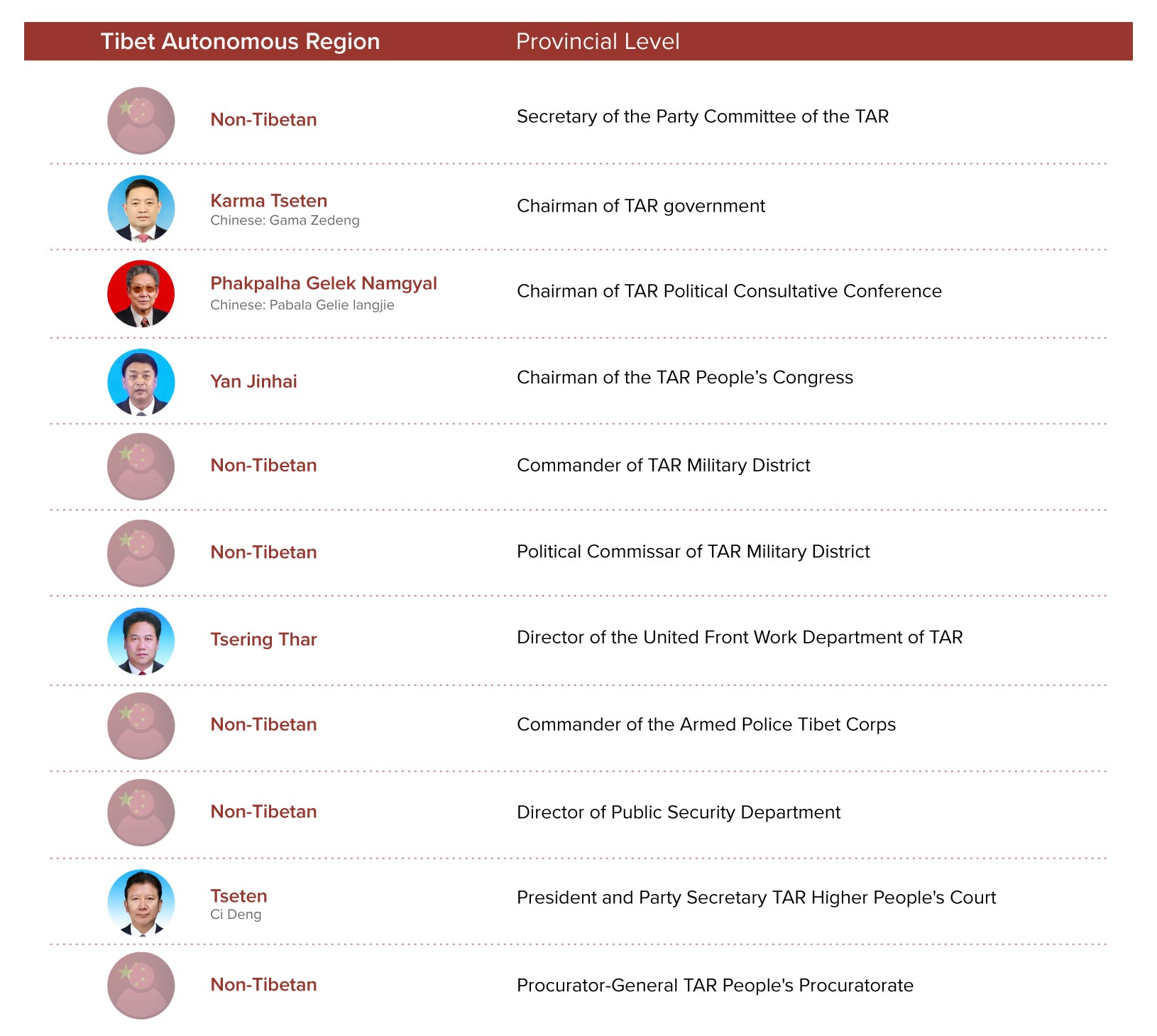
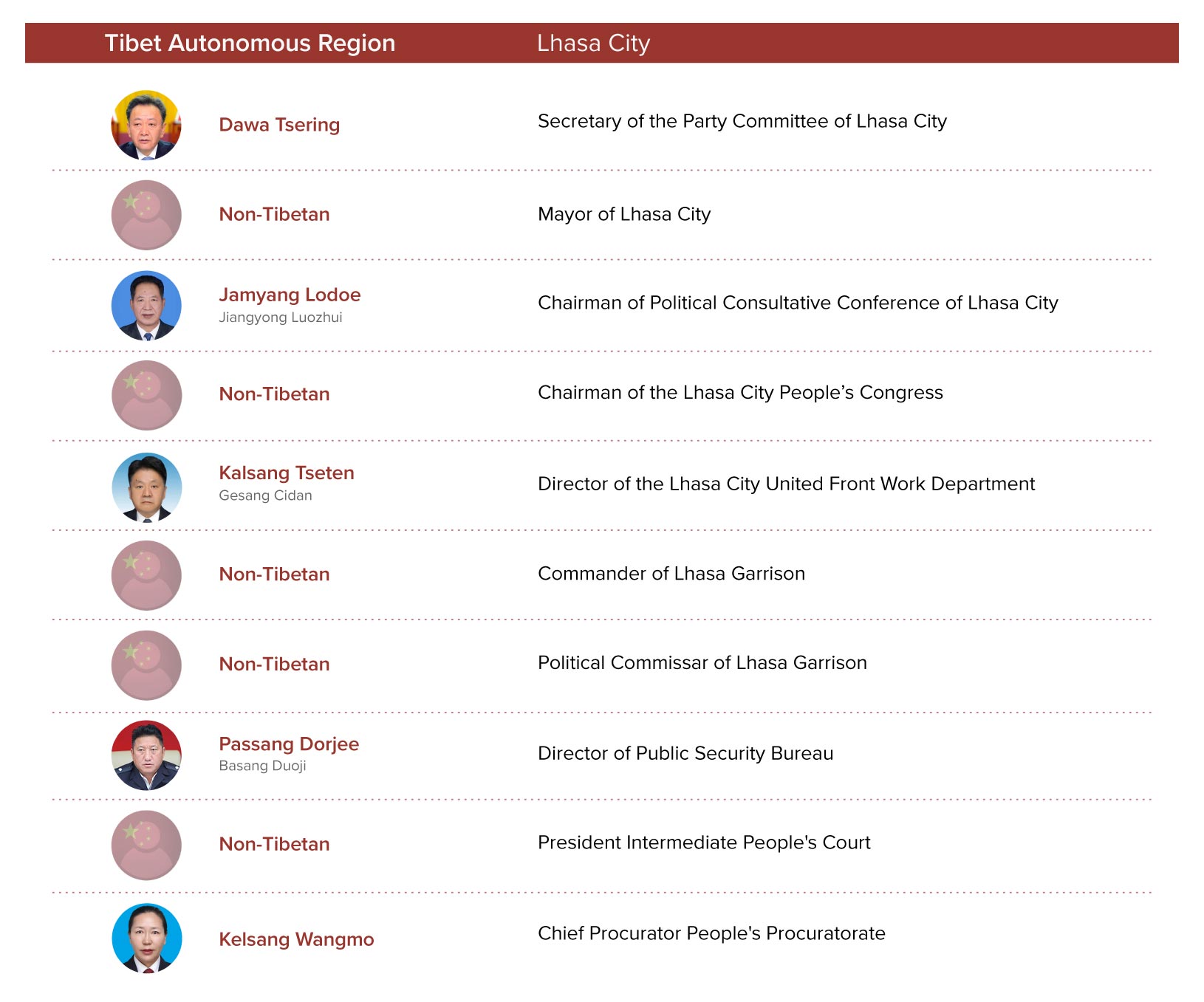
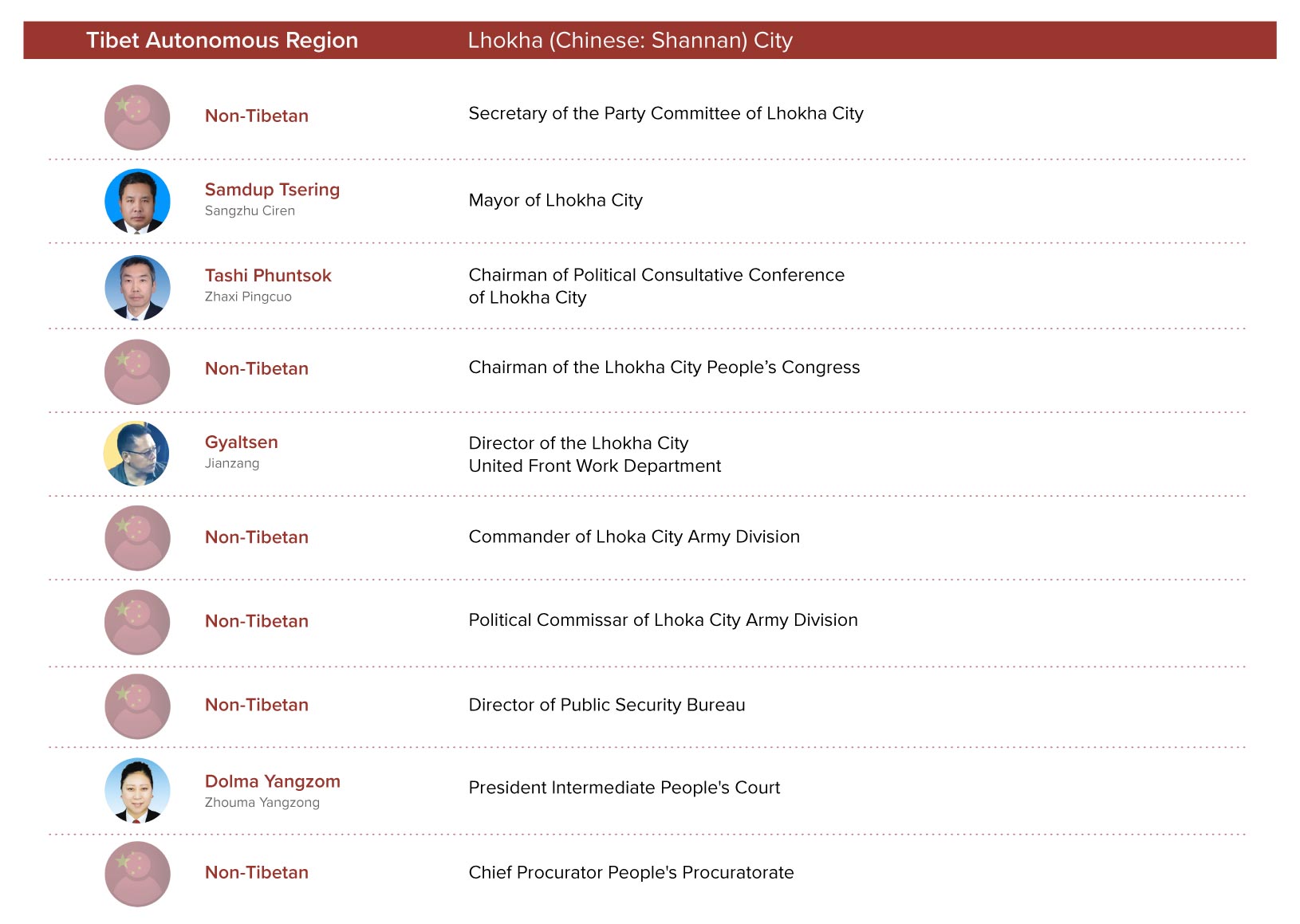
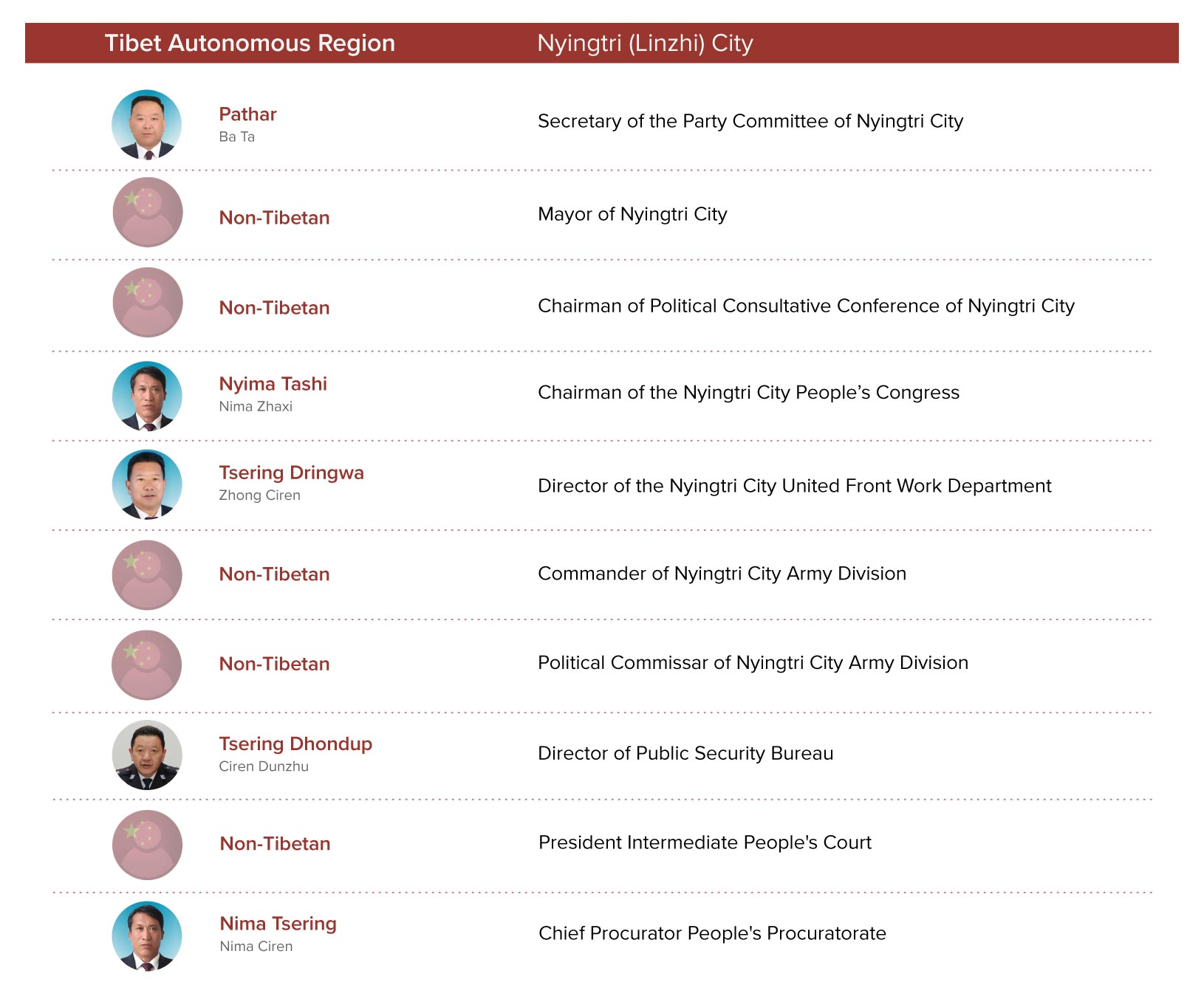
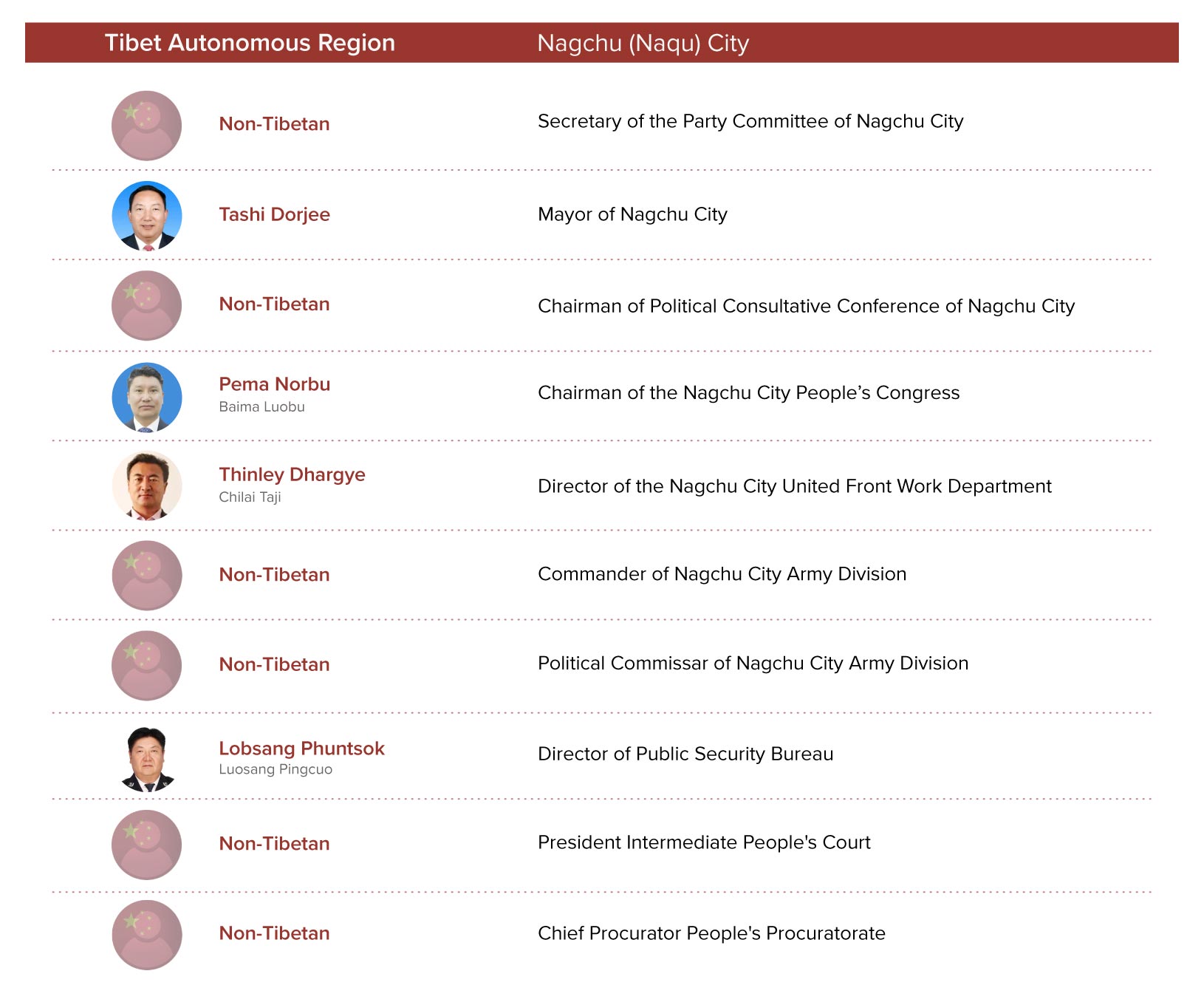
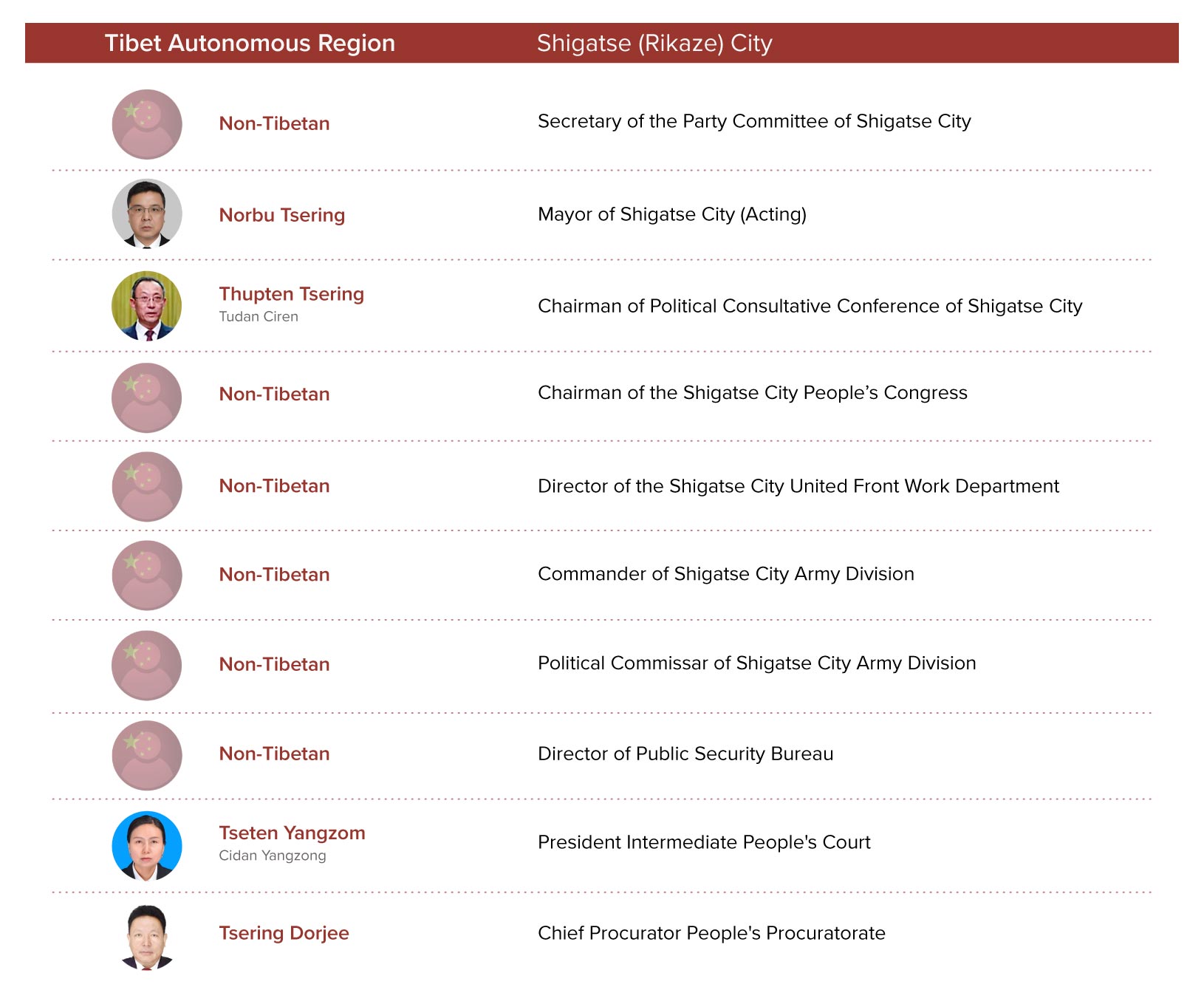
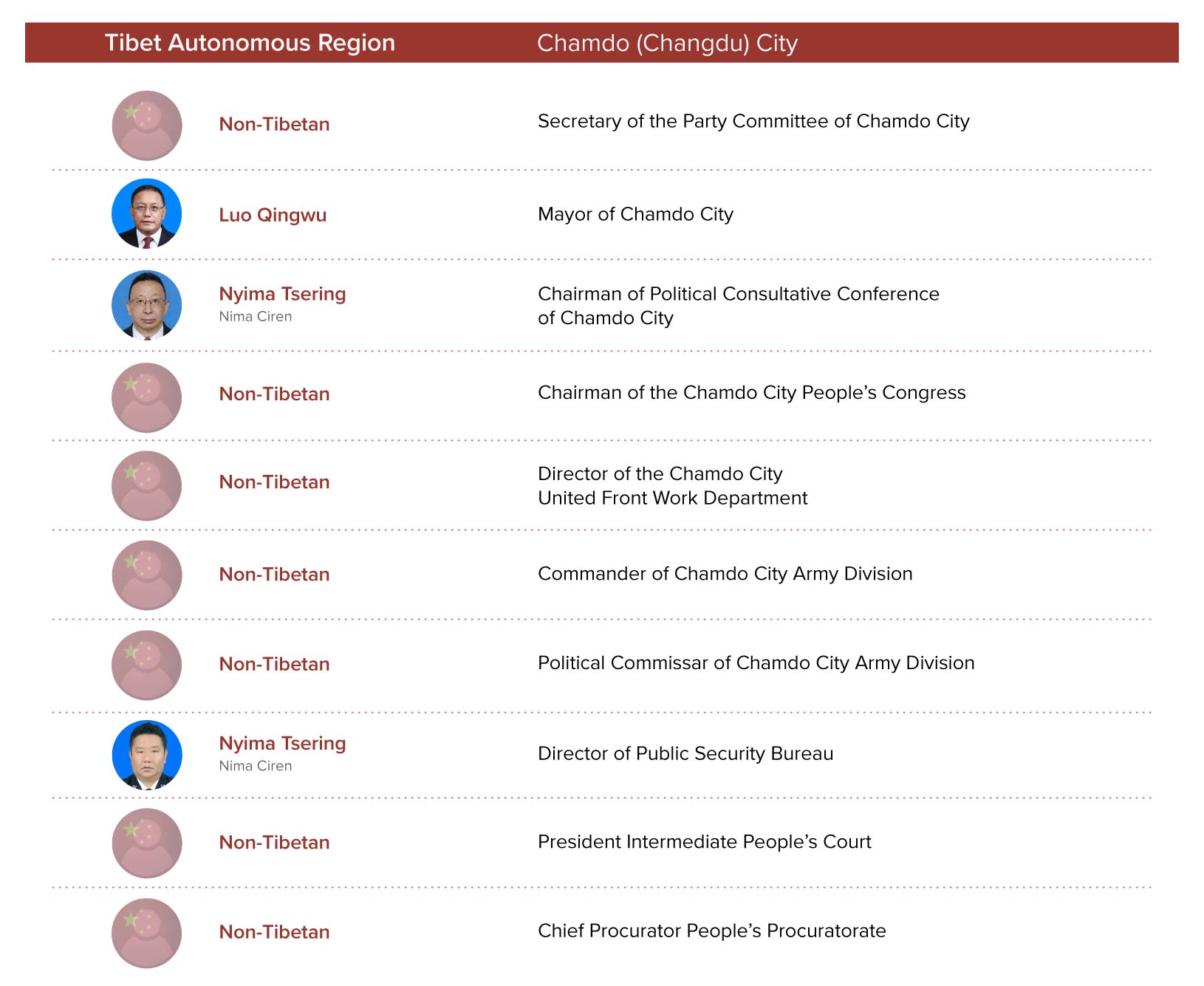
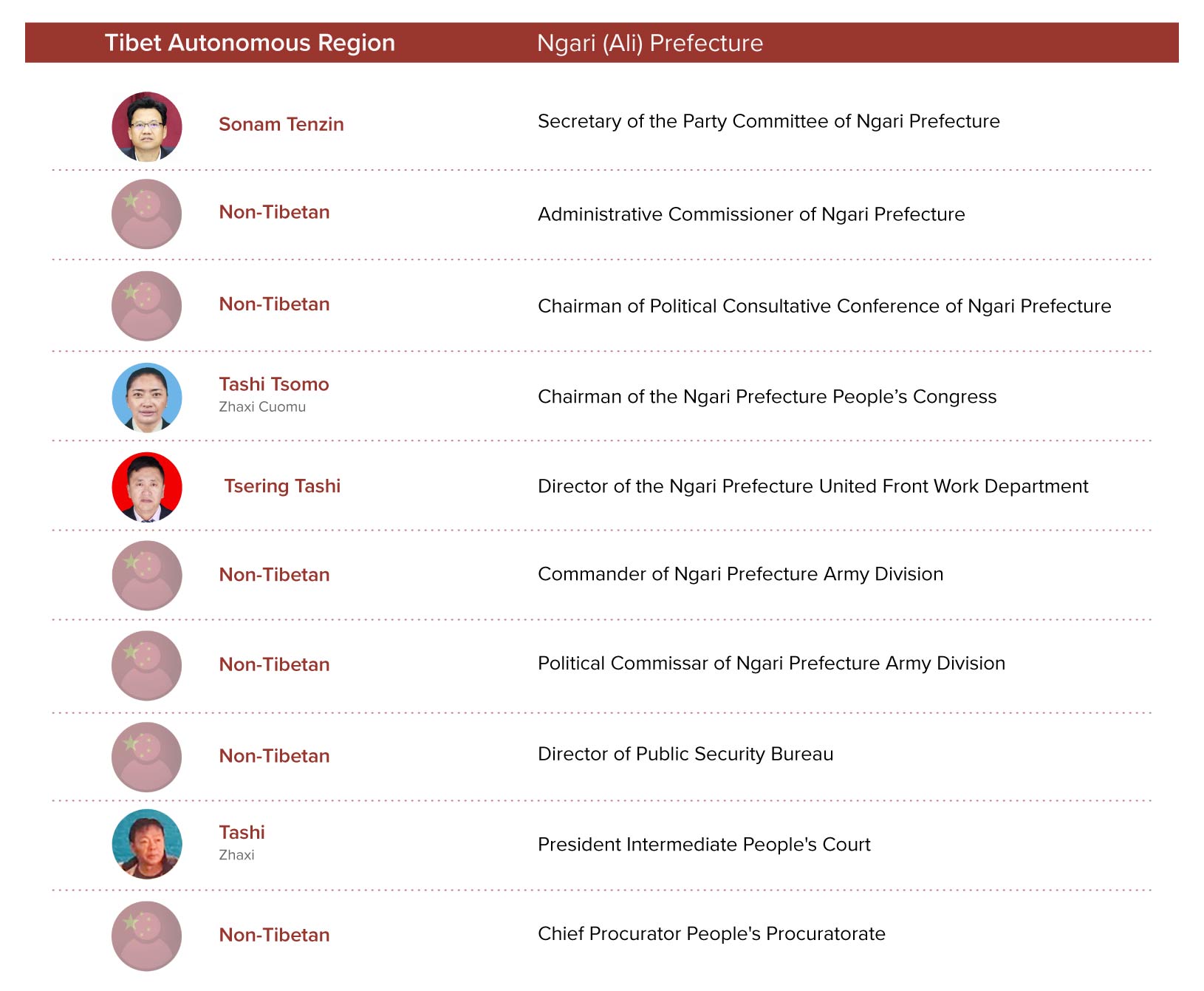
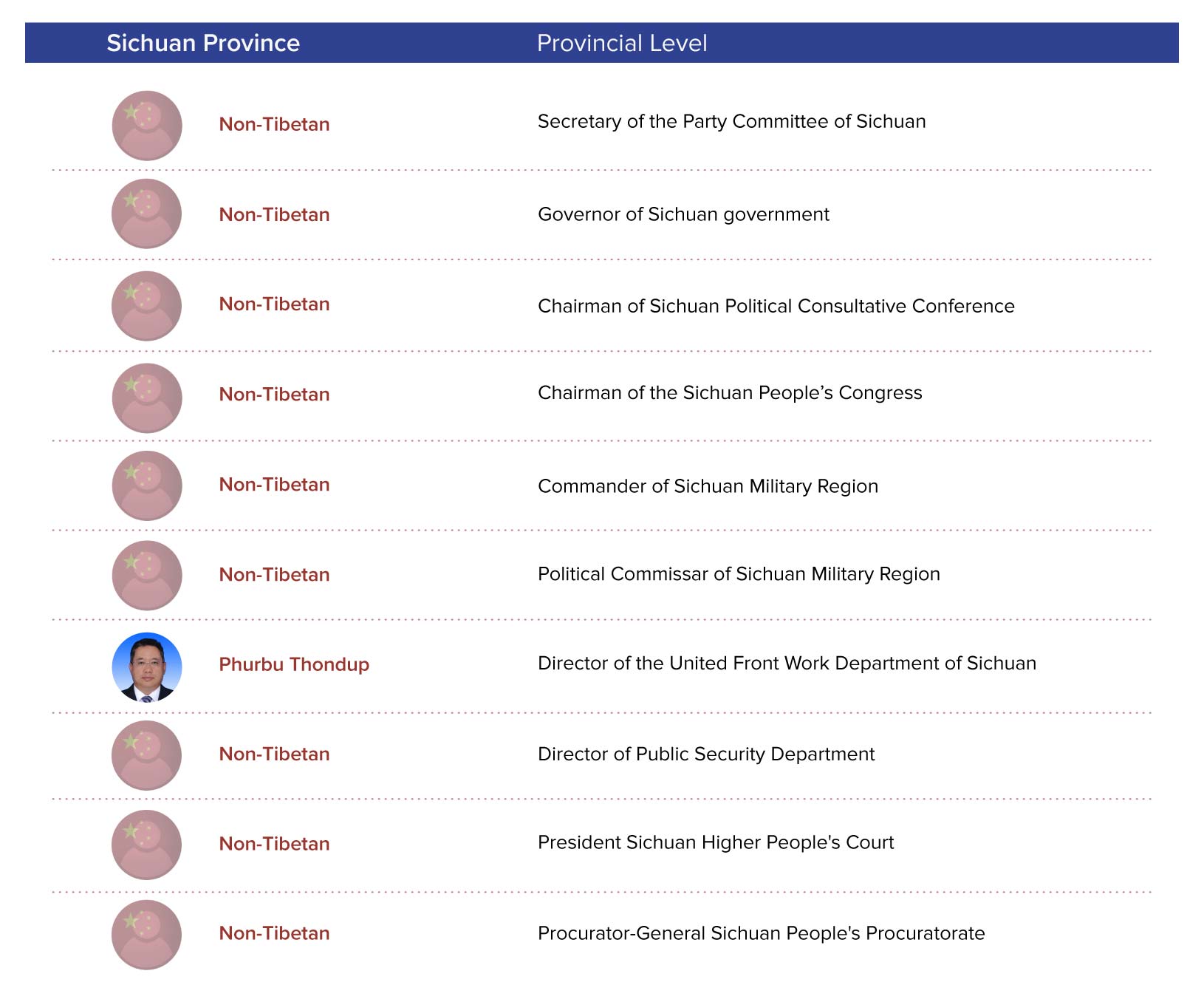
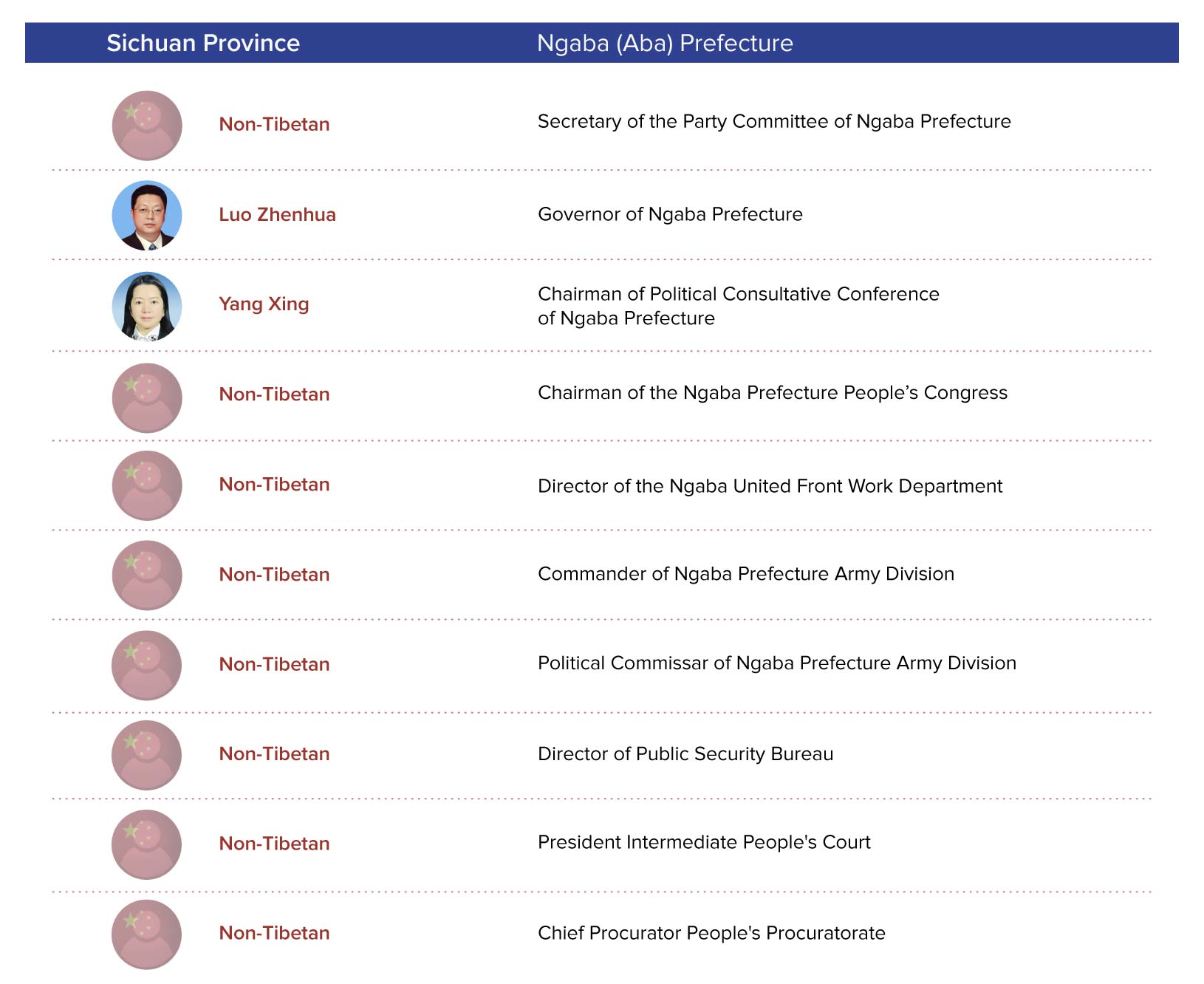
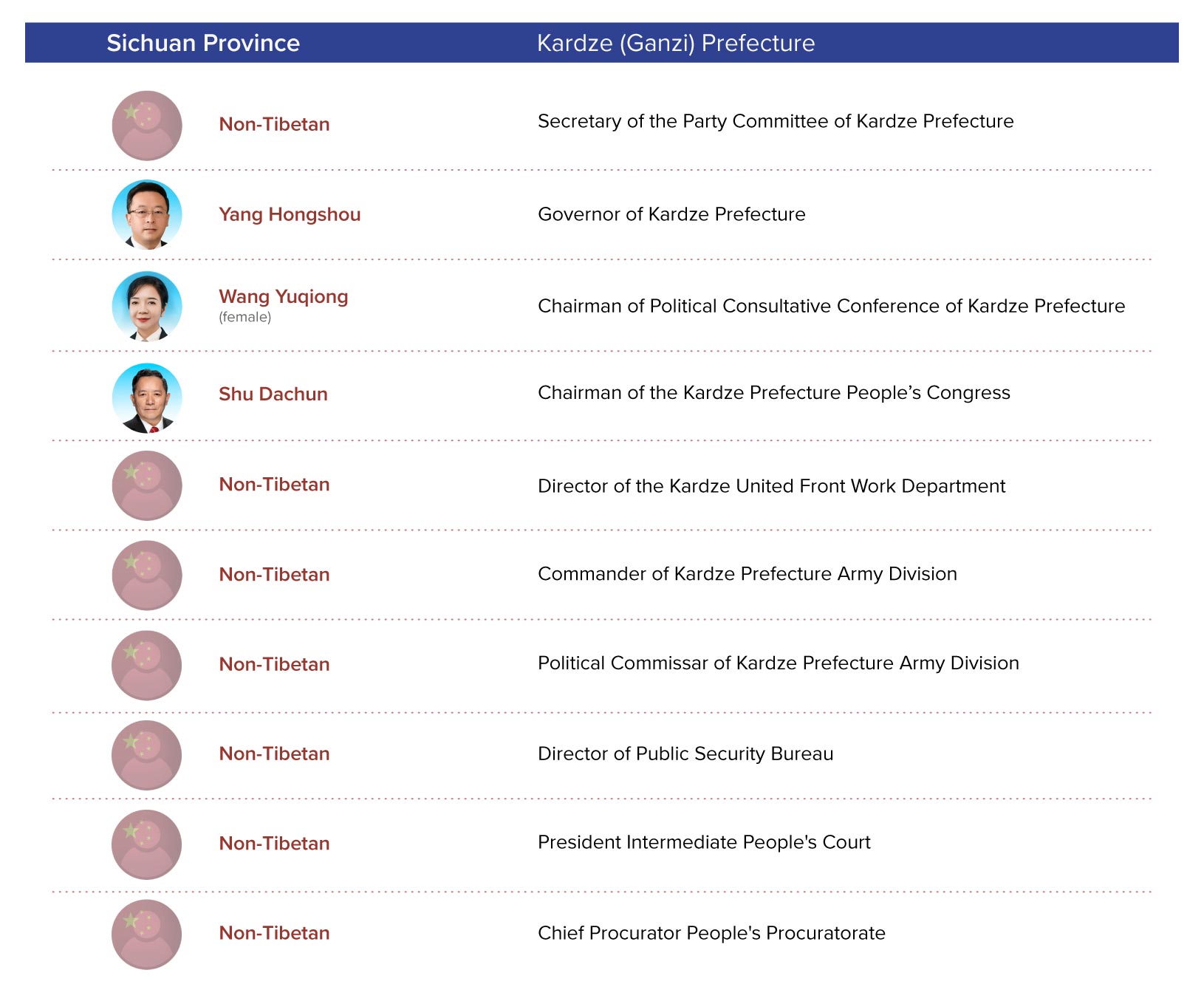
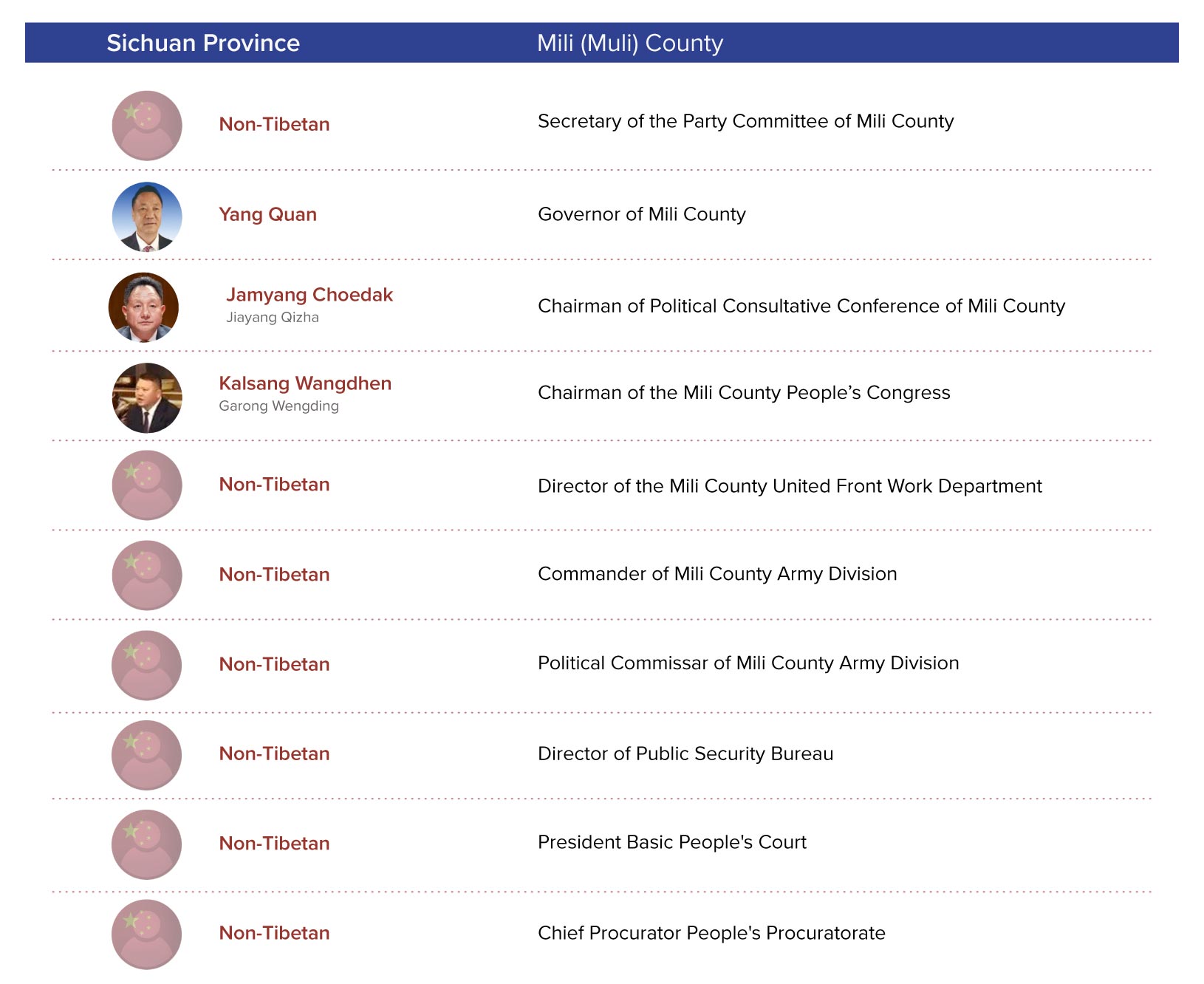
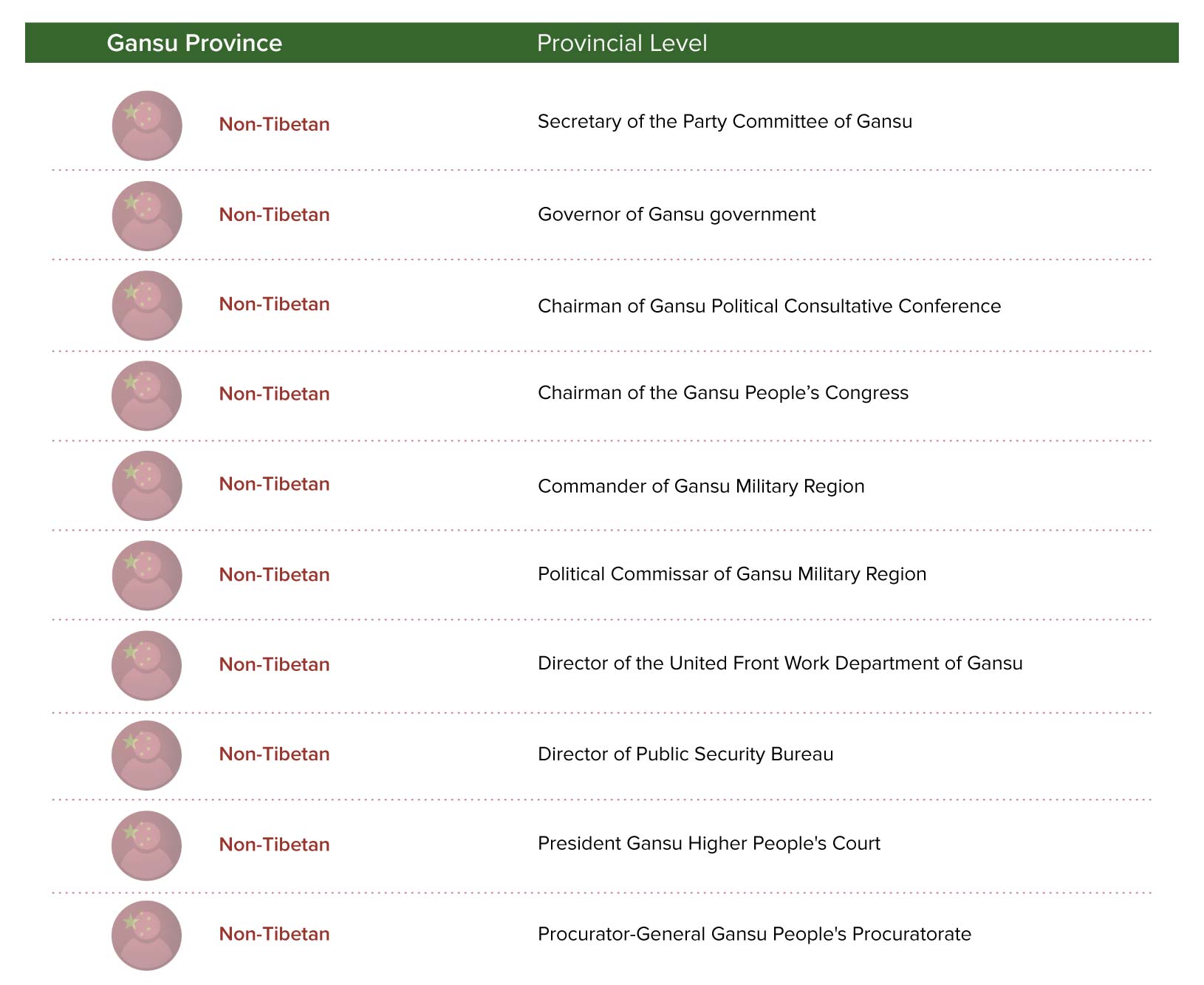
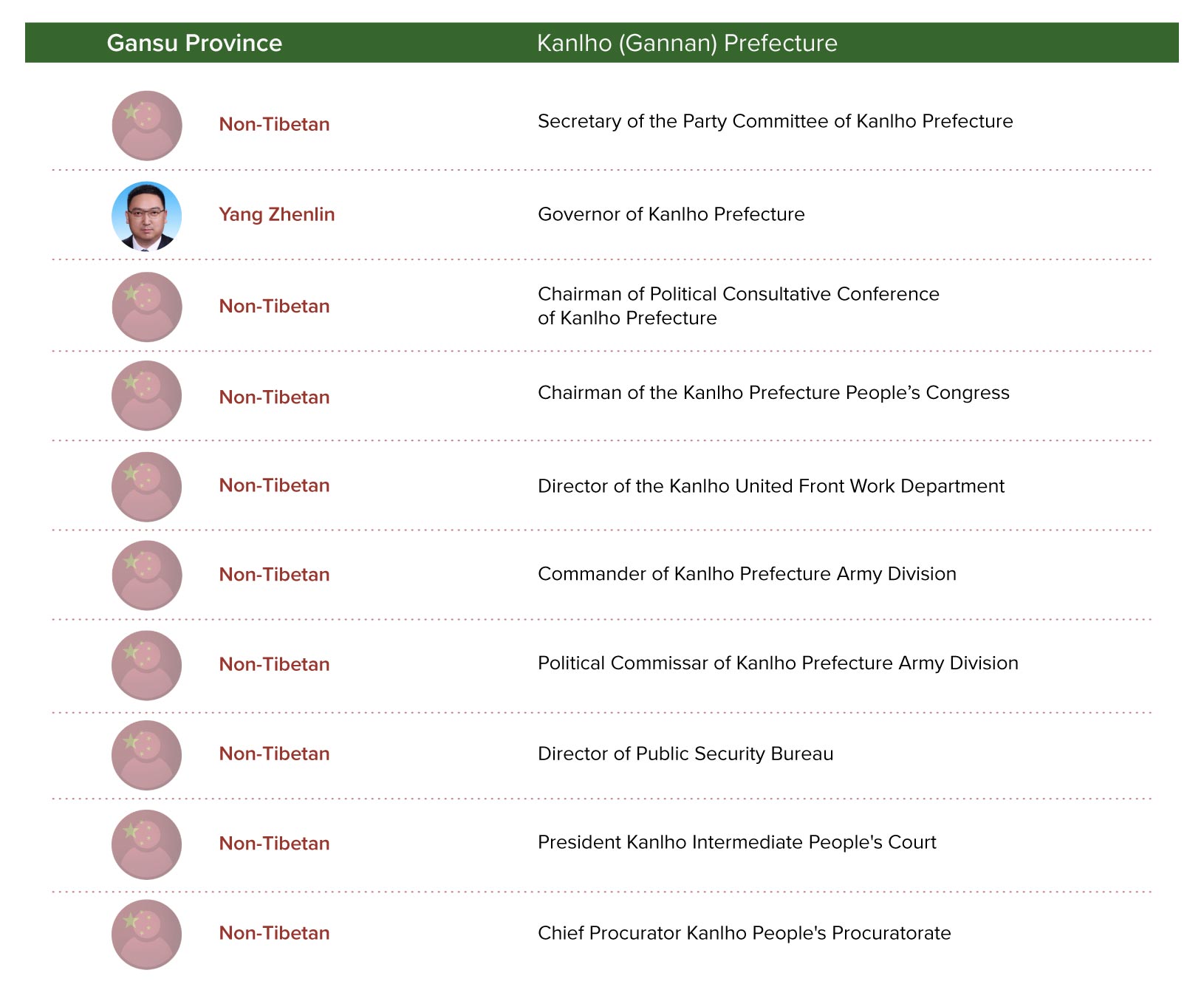
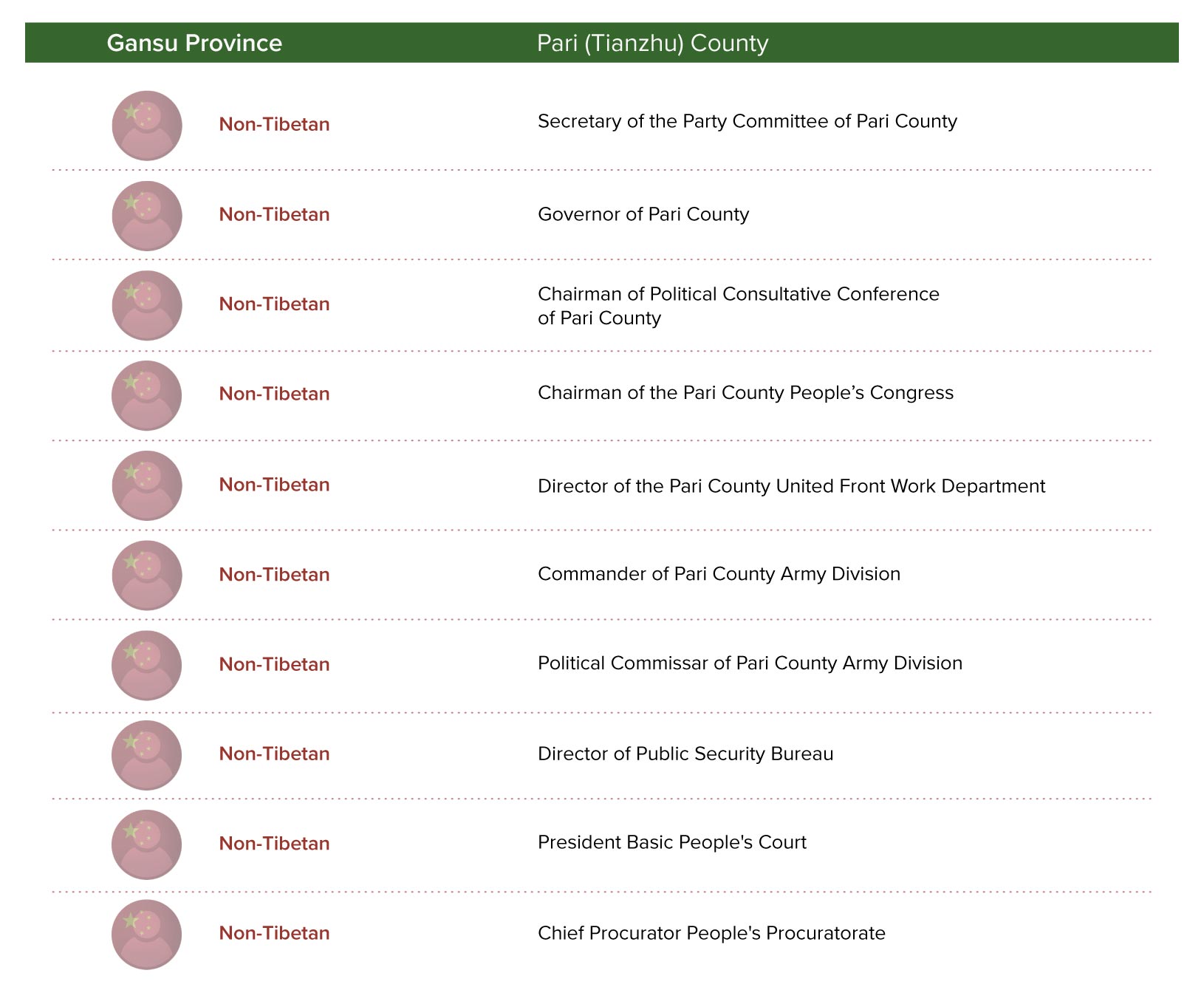
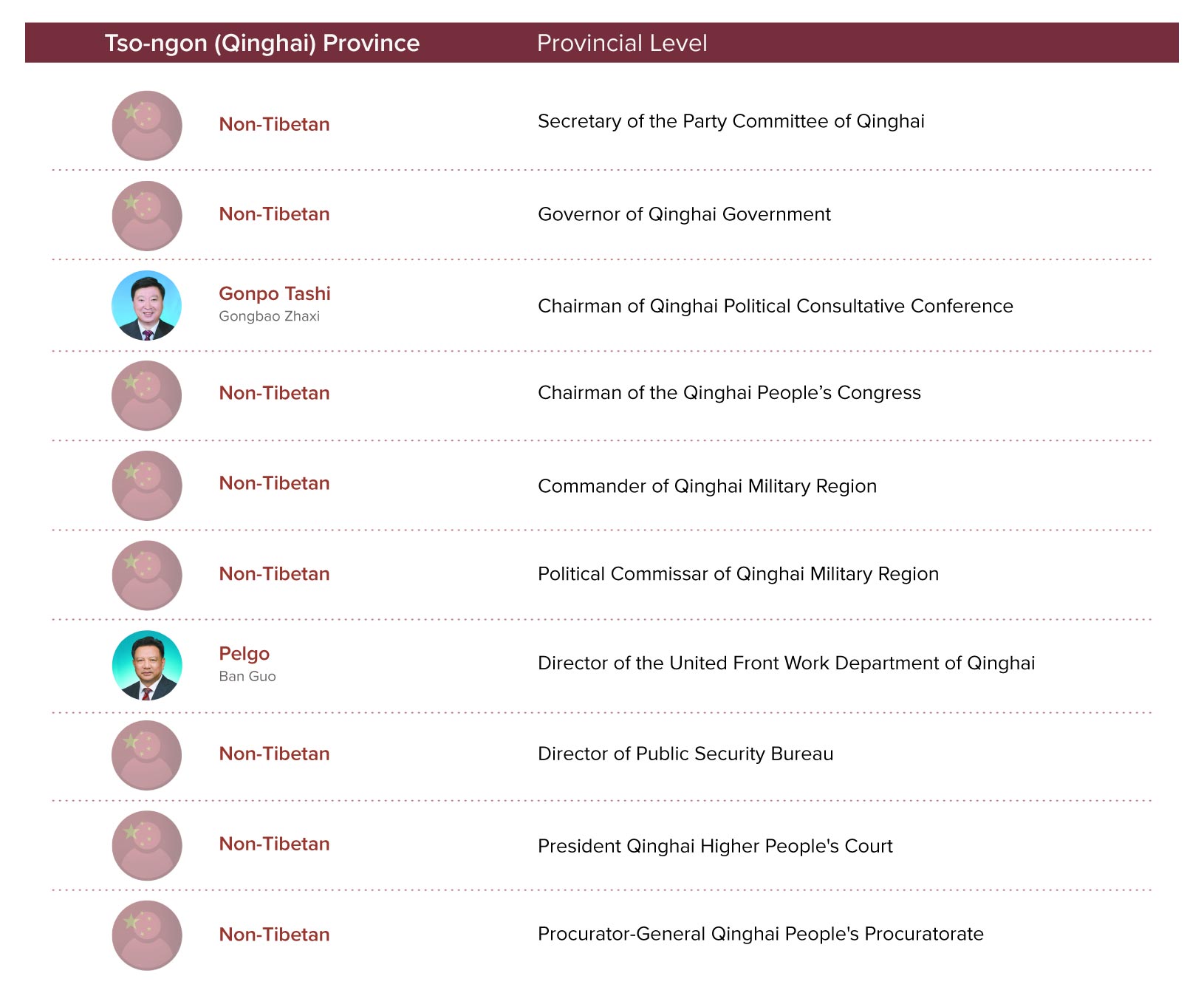
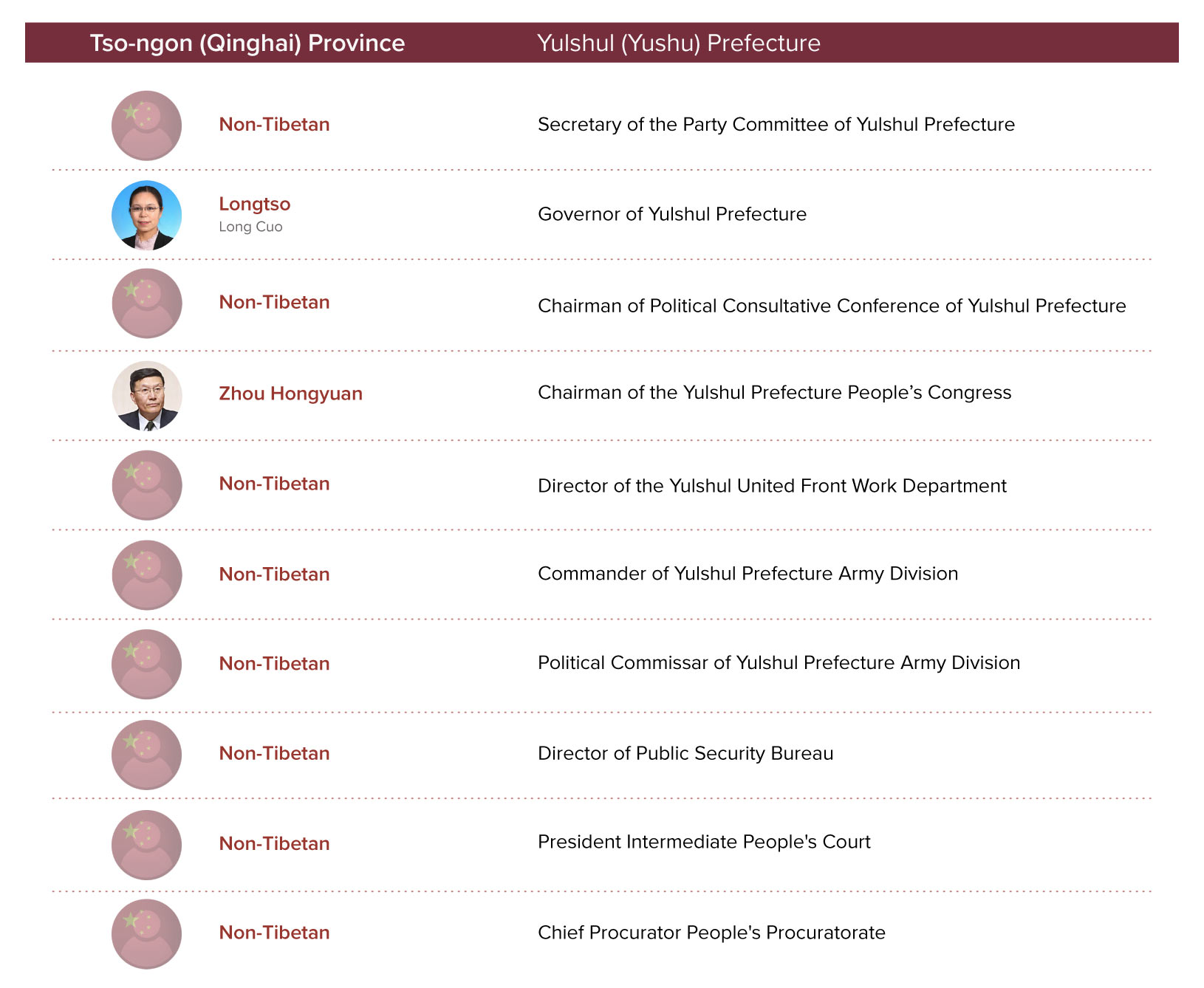
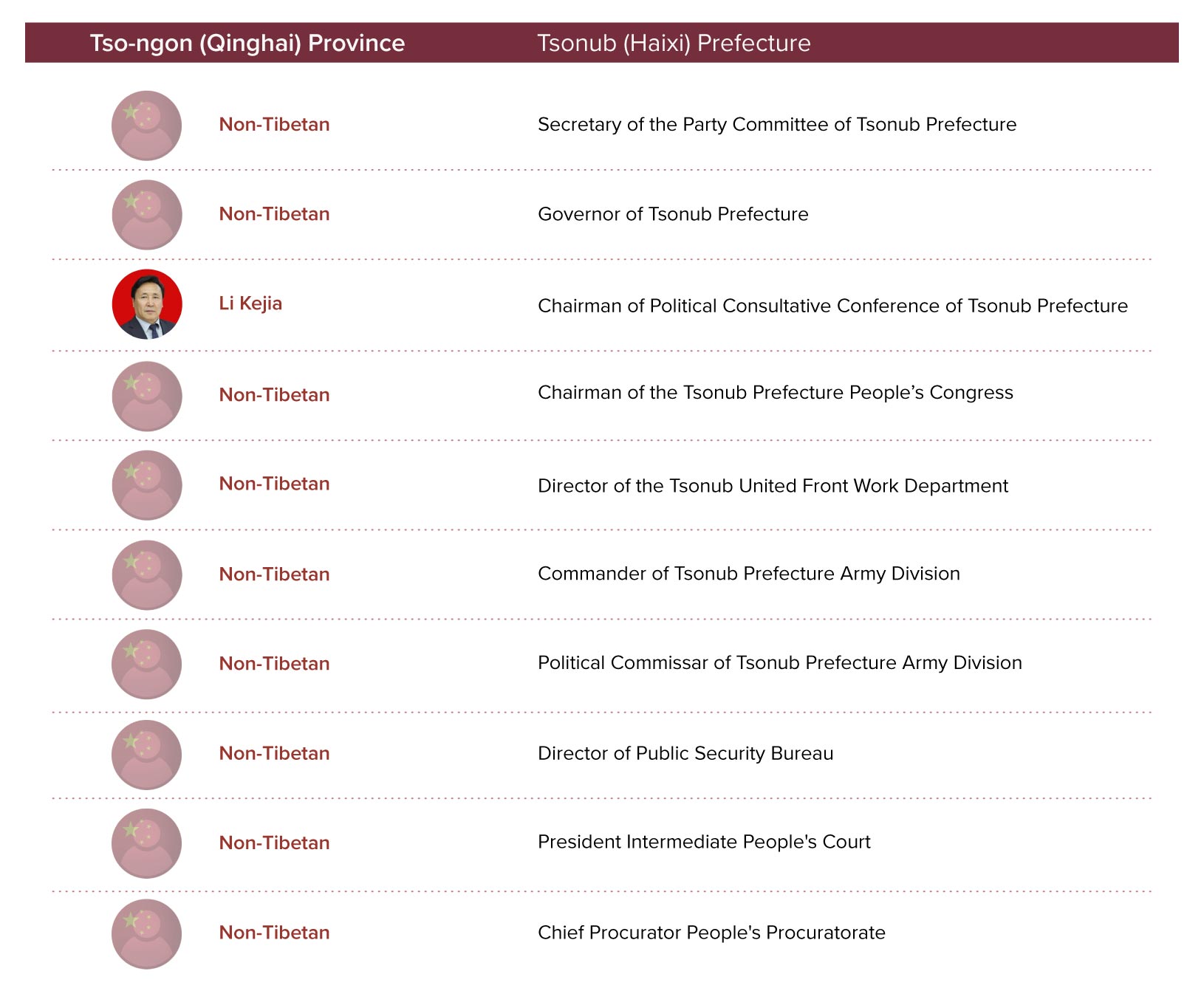
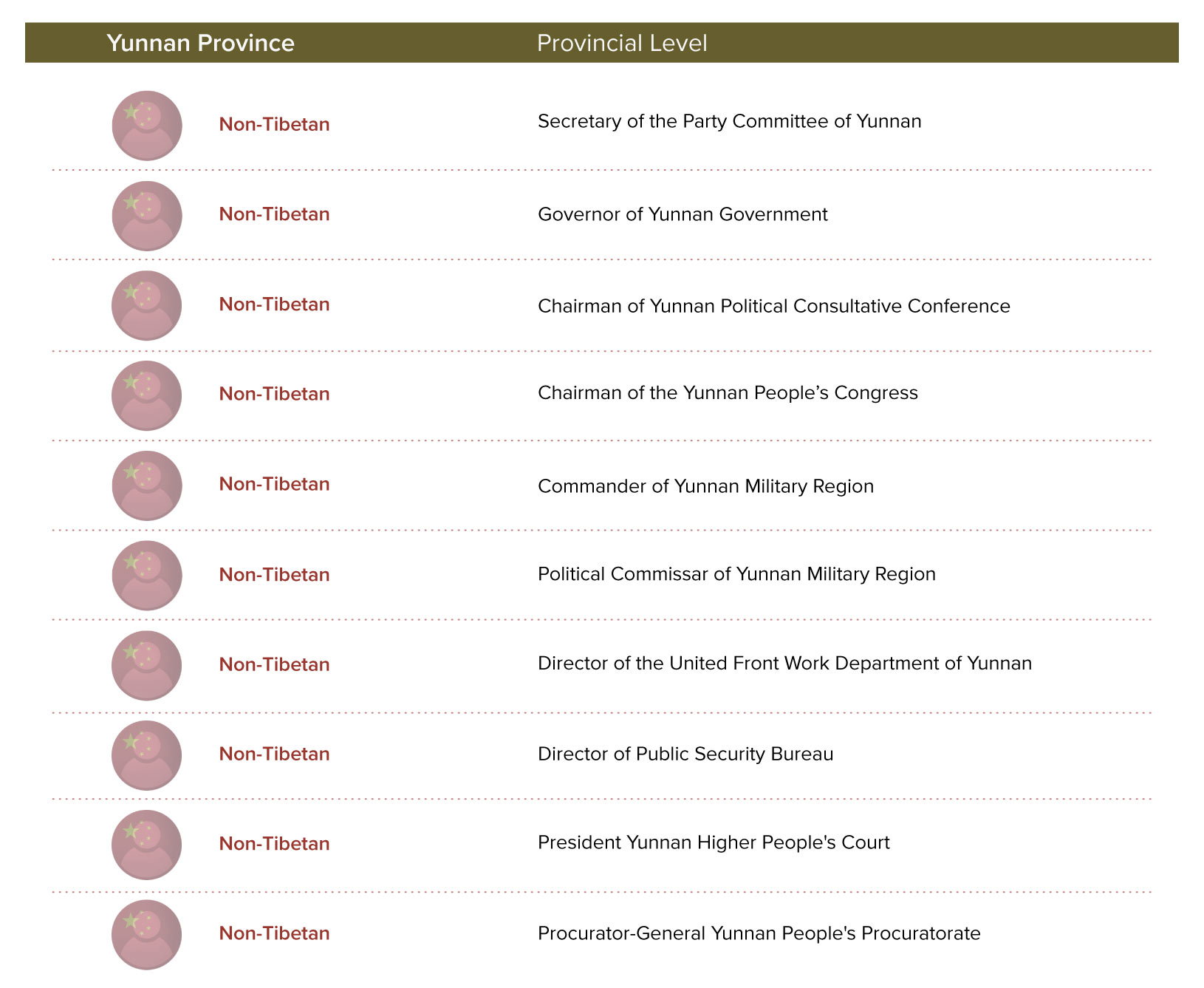
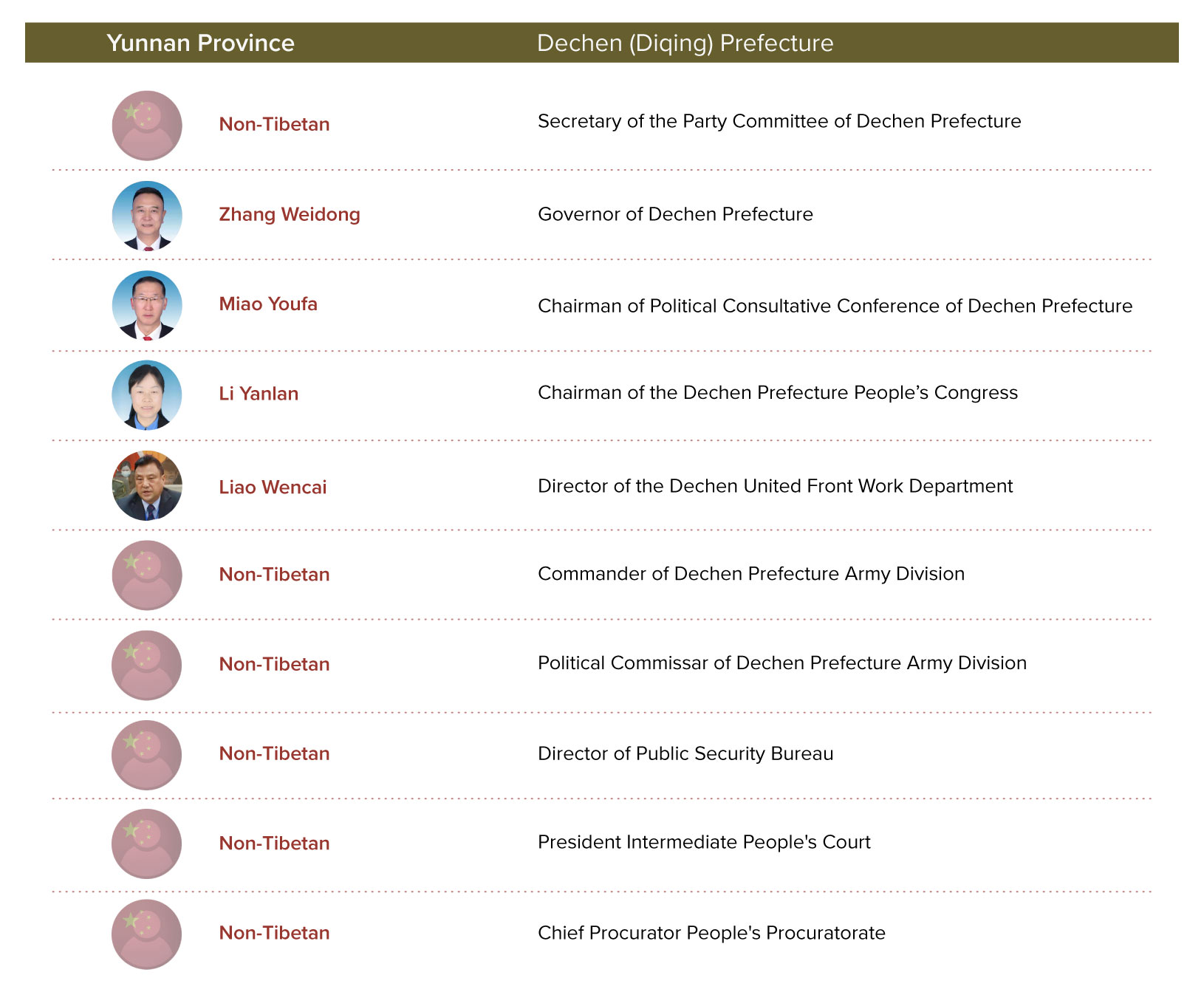
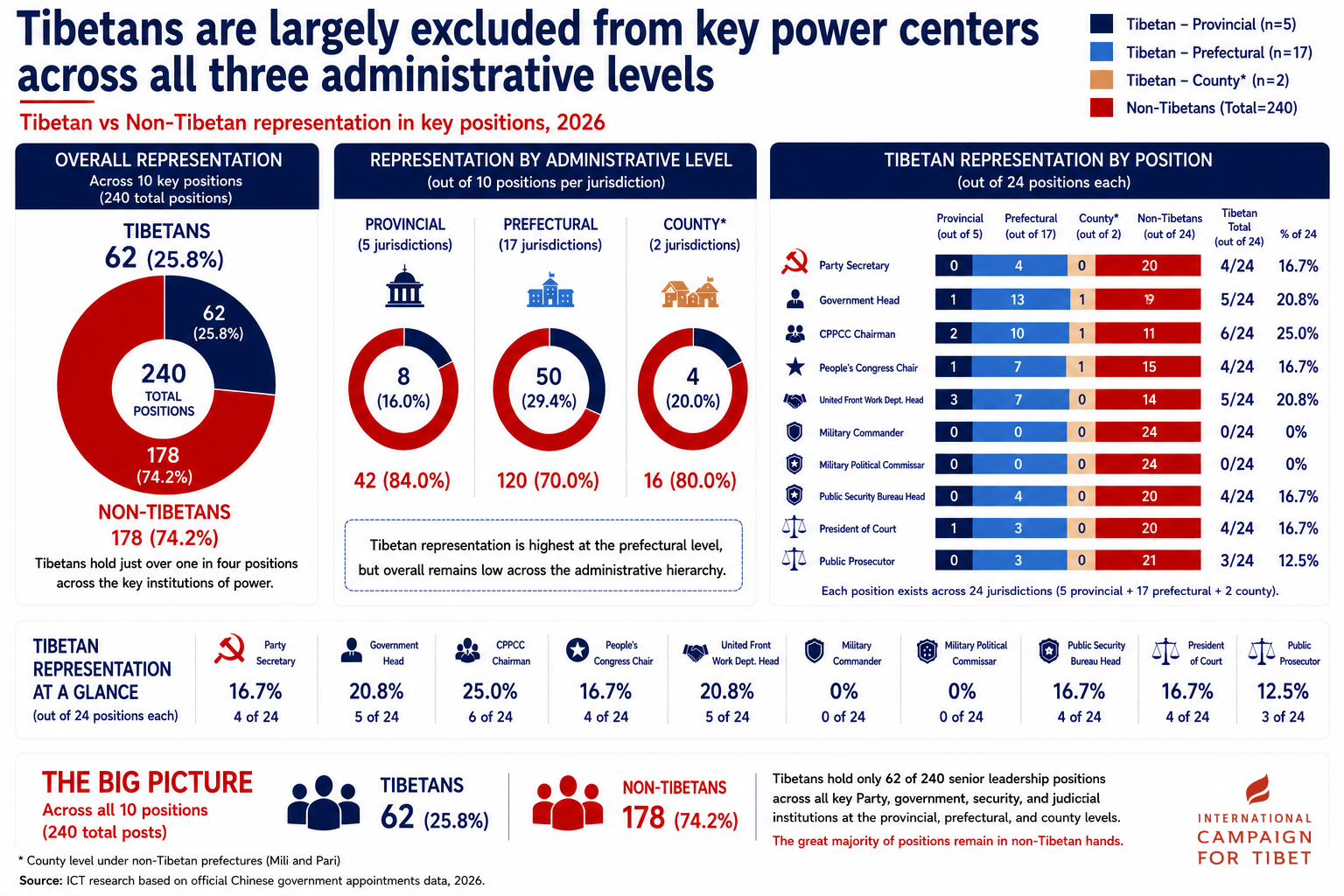
- Non-Tibetans continue to dominate CCP leadership at the provincial, prefectural, and county level: Tibetans remain excluded from positions of real political power, while non-Tibetan Party officials continue to dominate decision-making. In 2026, Tibetans occupy only 62 (or 25.8%) out of the 240 senior leadership positions across all 10 Party, government, security, and judicial institution-level positions at the provincial (5), prefectural (17), and county (2) levels. By contrast, non-Tibetans hold the majority 178 (74.2%) of the 240 positions.
- Empowerment of Tibetan leadership in exile: The stark contrast between Beijing’s increasingly centralized control over Tibet and the CTA’s democratic governance highlights two competing visions of Tibetan leadership. As China further marginalizes Tibetan participation in decision-making inside Tibet, the international community should strengthen engagement with the CTA as a democratic partner and representative of the Tibetan people.
Continued Xi Jinping dominance even after 21st Party Congress in 2027
At the national level, Xi Jinping is widely expected to remain at the helm even after the 21st Party Congress and effectively enter his fourth term as leader of the Chinese Communist Party. At the prior 20th Party Congress in 2022, Xi successfully secured a third term. In 2018, he had already abolished the term limit for the presidency.
On the other hand, China’s Politburo Standing Committee will likely see a few of its current members retire on account of the age limit factor, prompting a leadership reshuffle within China’s highest decision-making body. However, the composition of the new Politburo leadership would depend largely on how Xi Jinping will use the Party Congress: whether to appoint an heir apparent or further consolidate his own power.
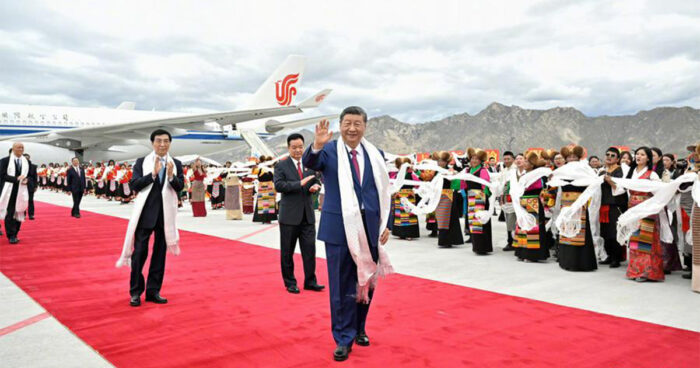
Chinese President Xi Jinping during his 2025 visit to Tibet. (Source: Chinese state media)
Given the developments under Xi Jinping, “ethnic minority” leadership heading into the 21st Party Congress in 2027 is expected to wield diminished political influence and face increasing pressure to implement Beijing’s stricter assimilation agenda.
One certainty is that there will not be any surprises in terms of Tibetans within the central leadership. The CCP has never elevated its Tibetan cadres to the seniormost levels in Beijing and so there is no expectation that the upcoming 21st Party Congress will change this dynamic.
Currently, the only Tibetan official who has some visibility in Beijing is Lobsang Gyaltsen (Luosang Jiangcun), whose formal position is Vice Chairman of the Standing Committee of the National People’s Congress (NPC), the Chinese rubber stamp parliament. While he has represented China internationally, mainly on visits to Africa where he served as an envoy of Xi Jinping, there is no visible involvement of him in Tibet policies in Beijing. In addition, having been born in 1957, Gyaltsen’s age leaves him out of consideration for any position in 2027, even if his loyalty to the CCP remains unquestioned.
Lack of Tibetans in senior Party leadership positions
The absence of Tibetans in the higher echelons of the CCP leadership is a trend seen well beyond the Politburo. Even in the powerful United Front Work Department (UFWD), which oversees Beijing’s Tibet policy, there has not been a Tibetan at the senior leadership level since Sithar (Si Ta) retired as Vice Minister in 2016.
At the provincial level, Tibetans currently head the UFWD in three of the five regions that traditional Tibet has been incorporated into. However, the absence of Tibetans in senior leadership roles in Beijing, including within the UFWD, reflects their complete exclusion from the formulation of national policy on Tibet.
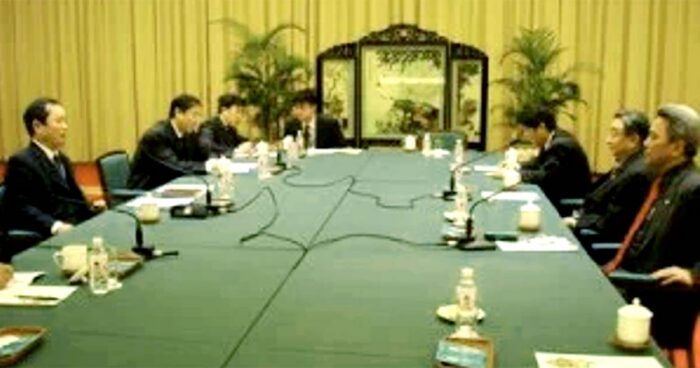
Sithar’s rise within the Party remains the only rare exception to this longstanding pattern. Incidentally, his rise within the Chinese leadership could be ascribed to and coincided with the 2002-2010 dialogue process between envoys of the Dalai Lama and the Chinese leadership. During the first three rounds of talks, the Dalai Lama’s Special Envoy Lodi Gyari directly raised with his Chinese counterpart the issue of absence of any Tibetan in senior leadership positions in Beijing. While China did not publicly acknowledge the envoy’s concern, they established a dedicated Seventh Bureau for Tibetan Affairs within the UFWD in 2005, effectively moving Tibetan Affairs away from the Second Bureau dealing with religion and ethnic affairs, and promoted Sithar, who was until then in a junior position, as its first director. The very next year, in 2006, Sithar was further promoted to Vice Minister, making him the first Tibetan to occupy a position at that level.
Nevertheless, the CCP has failed to cultivate a new generation of influential and capable Tibetan officials, both at the national level as well as in all Tibetan areas.
In the initial decades following China’s occupation of Tibet, Tibetan leaders such as Baba Phuntsok Wangyal, Ngabo Ngawang Jigme, and the 10th Panchen Lama, while working within the CCP system, contributed to the socio-economic welfare of the Tibetan people and the preservation and promotion of Tibet’s linguistic, cultural, and religious identity in their respective ways. For example, the late 10th Panchen Lama, a firm critic of Chinese policies in Tibet and a fierce advocate for the preservation of the Tibetan language, worked alongside Ngabo Ngawang Jigme to promote and safeguard the use of Tibetan. Their efforts contributed to the introduction in 1987 of the “Stipulations of the Tibet Autonomous Region on the Learning, Use and Promotion of the Tibetan Spoken and Written Language,” which stipulated that Tibetan and Chinese be accorded equal legal status in the Tibet Autonomous Region, while establishing Tibetan as the primary language. Around 13 years after the 10th Panchen Lama’s passing, in 2002, the Regulations of the Tibet Autonomous Region on the Study, Use and Development of the Tibetan Language of 1987 was amended to do away with the mandatory requirement making Tibetan the medium of instruction.
The passing of Yangling Dorjee in April 2026 at the age of 95 most likely marked the end of the past generation of Tibetan leaders who had some standing in the Tibetan public and the willingness to voice concerns over Beijing’s Tibet policies. Dorjee served in several senior positions, including as Vice Governor of Sichuan Province (1979-1981), Chairman of the Tibet Autonomous Region CPPCC (1981–1986), Deputy Party Secretary of Tibet, and Vice Chairman of the Sichuan CPPCC (1986-1999).
Over a career spanning several decades, he launched initiatives aimed at the development of Tibetan language and culture, establishing organizations dedicated to their promotion. He was outspoken about many of the Chinese policies toward the Tibetan people, even petitioning the Beijing leadership and continuing to pay interest to matters relating to Tibetan affairs long after his retirement in 1999.
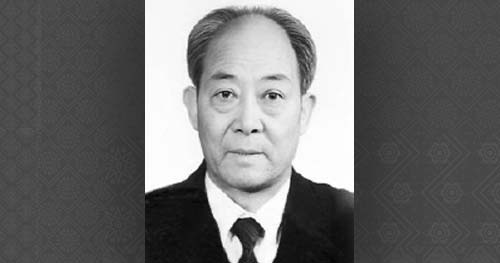
Yangling Dorjee
Dorjee’s passing highlights how the locus of influence over Tibet policy has changed, given little indication today that Tibetan officials will have any meaningful role in working for the welfare of Tibetans.
Looking ahead to the 21st Party Congress in 2027, it is more likely that some Chinese cadres who have been involved in Tibetan affairs might receive promotions. Among them is Zhang Guoqing, who could be considered the point person on Tibet in the current Chinese government. He is currently a member of the Politburo and serves as a Vice Premier. Born in 1964, Zhang will be 63 years old by the time of the 21st Party Congress, placing him below the informal retirement age limit and making him a possible candidate for promotion to the Politburo Standing Committee. China watchers have long regarded Zhang as a member of the sixth generation of Chinese leadership.
Ever since he was designated a deputy from the Tibet Autonomous Region (TAR) to the 14th National People’s Congress in January 2023 — shortly after being promoted to national leadership in Beijing — Zhang has been the main representative from Beijing on Tibet. In this capacity, he has visited Tibet several times and has also met Tibetan delegations, on behalf of the government, during the annual Two Sessions.
Zhang’s approach aligns with Xi Jinping’s emphasis of viewing Tibet from a national security angle. During the July 2025 launch of the Yajiang Group, the company responsible for executing China’s controversial downstream hydropower project on the Yarlung Tsangpo River, Zhang described the project as “a strategic move to safeguard both national energy security and overall national security.”
Zhang, who appears to be in the good graces of Xi Jinping, is also widely believed to be a member of the secretive Central Tibet Work Coordination Group, the Chinese Communist Part’s principal coordinating agency for issues relating to Tibet. If he is promoted to the Standing Committee in 2027, he may well assume a leading role in that group.
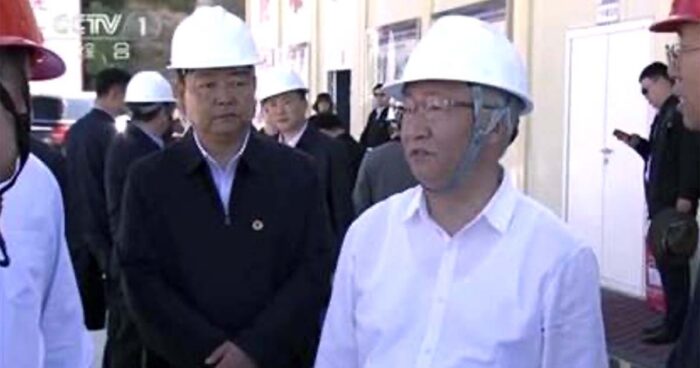
Vice Premier Zhang Guoqing during a visit to Tibet in 2023.
There is some historical precedent. Hu Jintao, the former CCP General Secretary and President of the People’s Republic of China (PRC) who had previously served in the TAR, was also designated a deputy from TAR to the National People’s Congress in 1992. Unlike Hu, however, Zhang does not have any known prior connection to Tibet before 2023 and is more well known for being a technocrat. Indeed, Zhang’s technocratic background could be the reason why Xi Jinping assigned him to oversee Tibetan affairs as economic development has become one of the central pillars of China’s strategy to consolidate its control over Tibet and gain public support for Chinese rule.
Guiding principles for the seventh-generation leadership in Tibet
The next generation of Chinese leaders governing Tibet will operate within a significantly more centralized political and legal framework than their predecessors.
This seventh-generation leadership will have to abide by two overarching principles: “Xi Jinping Thought on Party Building,” including his specific thoughts on the governance of Tibet, and implementation of China’s new “Ethnic Unity and Progress Law.” Together, they establish the ideological and legal foundations that will shape governance in Tibet beyond the 21st Party Congress.
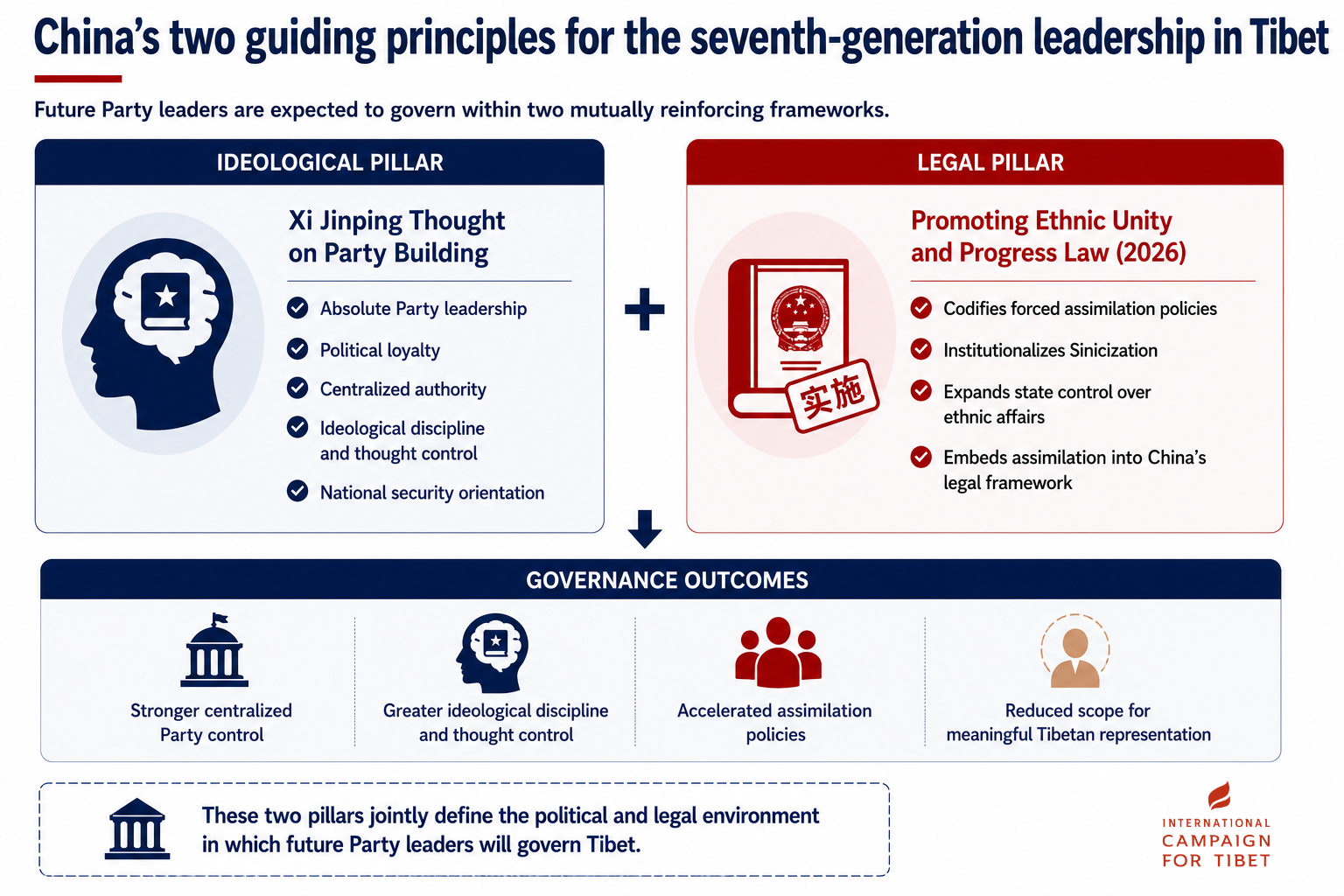
Formally announced as the official Party doctrine in June 2026, Xi Jinping Thought on Party Building has been described by the Chinese state media as “the fundamental guideline for strengthening Party building in the new era.” This Thought calls for absolute centralization of authority and ideological control, entrenching strong centralized control from Beijing. At its core are the “14 Upholds,” a set of guiding principles that institutionalize political loyalty to Xi Jinping and the Party, and is aimed at ensuring Xi Jinping’s control over the political system. One of the “14 Upholds” is to fulfil the Party’s “original aspiration and mission,” which Xi defined as seeking “happiness for the Chinese people and rejuvenation for the Chinese nation.” This indicates that the Chinese leadership will have to promote its assimilationist policy at a broader, nationwide scale.
Rather than replacing Xi’s governance model in Tibet, some of these “14 Upholds” build upon the existing framework.
Several of the “14 Upholds” reinforce principles articulated earlier in the “10 Musts” that were laid out during the 7th Tibet Work Forum in 2020, particularly the emphasis on upholding leadership of the CCP and strengthening party building. The “10 Musts” also includes the Tibet policy that Xi had outlined on March 9, 2013: “To govern the country, one must govern the border; to govern the border, one must first stabilize Tibet”. This policy equates governance of Tibet as a matter of national security.
In the years that followed, Xi further expanded this policy to advance his security-driven economic and nationalist agenda in Tibet. In 2020, Xi expanded this agenda to include an emphasis on the “Sinicization” of Tibetan Buddhism and on improving the ability of CCP organizations and members at all levels “to deal with major struggles and prevent major risks.”
China has divided Tibet into 17 prefectural-level and two county-level (under non-Tibetan prefectures) autonomous administrative divisions under five provincial level administrations: seven prefectural level areas under the Tibet Autonomous Region; two prefectural-level and one county area under Sichuan Province; six prefectural-level areas under Qinghai Province (Qinghai also has some sub-county level Tibetan areas without any “Tibetan autonomous governance” status); one prefectural and one county level area under Gansu Province; and one prefectural-level area under Yunnan Province.
Impact of Ethnic Unity Law on the new Tibetan leadership
If Xi Jinping Thought provides the ideological foundation for governing Tibet, China’s new “Ethnic Unity and Progress Law” provides its legal framework.
The law, which came into force on July 1, 2026, will have a considerable impact on the governance of Tibet, as it marks “Beijing’s decisive turn away from ethnic autonomy and toward enforced assimilation.” As an analysis by the Council on Foreign Relations puts it, “Structurally, it reflects a deepening merger of Party ideology and state law.” Similarly, Prof. James Leibold, a scholar on China’s ethnic policy, says that “by folding ethnic affairs into national security, the law expands the scope for surveillance and intervention in domains previously treated as social or cultural.”
Therefore, even though this law contravenes the Constitution of China, the new leadership in both Beijing and the provincial levels is expected to enforce it rigorously across Tibetan areas to further tighten the CCP’s stranglehold over Tibet.
The authorities in the TAR have already planned a campaign akin to the earlier “Patriotic Reeducation” plan to “comprehensively promote the implementation of the Law.” According to a “Work Plan on Studying, Publicizing and Implementing the Law of the People’s Republic of China on Promoting Ethnic Unity and Progress,” the law will be incorporated into the theoretical study curriculum for Party cadres at all levels as also into the teaching programs of Party schools (administrative colleges), in-service training for leading cadres, and the training plans for ideological and political education teachers in all universities as well as primary and secondary schools throughout the region. The plan also states that grassroots publicity teams will be deployed to ensure that the law is integrated into the daily lives of the Tibetan people.
The most significant concrete indication of the law’s impact on the ground is the formalization of the change in bilingual education in Tibetan areas from Model 1 – in which Tibetan language serves as the primary medium of instruction — to Model 2 — which prioritizes Chinese as the principal medium of instruction. In some Tibetan areas, such as those in Ngaba (Aba) Tibetan Autonomous Prefecture in Sichuan Province, the Chinese government had already informed parents of this decision as early as 2020, even before this controversial law was introduced. That same year in 2020, a teacher in Khyungchu (Chinese: Hongyuan) county in Ngaba, had said that there were 41,137 students enrolled in primary and middle schools in Ngaba and that more than 70% of them, at the time, were still being taught under Model 1.
This change has significant implications for the very survival of Tibetan language and culture. A 2025 report said that as a result of Chinese being made the medium of instruction, 95 percent of books and reading materials in schools in Tibet were in Chinese. Teachers who have previously been teaching in Tibetan are being sent by the Chinese authorities to undergo training to become fluent in Chinese, while others have either been fired or replaced by Chinese teachers.
This new law builds upon local regulations on ethnic unity and progress that have already been in place and implemented in Tibetan areas for the past several years. Going forward, the leadership in Tibetan areas are unlikely to have any political authority or incentive to uphold the autonomous rights guaranteed to the Tibetan people under the Constitution and the Law on Regional Ethnic Autonomy.
In the past, several Tibetan officials at the prefectural and sub-prefectural levels have sought to take advantage of the autonomy provisions to create a space for the promotion of Tibetan language and culture in the areas within their jurisdiction. Accordingly, some local officials, at the time, had allowed the opening of private schools and summer camps and other initiatives dedicated to the study of Tibetan language and culture.
In recent years, however, even before the new law formally came into effect, several of such schools and camps were shut down by the Chinese authorities under various pretexts. As such, the enactment of this law is likely to discourage officials from undertaking similar initiatives in the future.
Centralized CCP governance of Tibet by Non-Tibetans to continue
The CCP, the military and the government constitute the three pillars of China’s governance system, with both the government and the military being subordinate to the Party. Within the Party, the three important organs are its Central Committee, the Politburo, and the Politburo Standing Committee, with the Standing Committee the most powerful decision-making authority. The extent to which Tibetans are represented in all these different organs at the national, provincial and prefectural levels of administration provides an indication of the discriminatory nature of China’s governance of Tibetans.
Currently, the highest CCP leadership positions in the Tibetan areas are held by non-Tibetans, and there is no indication that Tibetans will be empowered to do so in the coming years.
At the provincial level, in the TAR, the current TAR Party Secretary, Wang Junzheng, who is Han Chinese, has served in this position since October 18, 2021. His term is scheduled to end in October 2026, as provincial Party secretaries in the Chinese political system typically serve terms of around five years. Having been born in 1963, Wang will still be at an age in which he is likely to serve in another Party position somewhere, even if not in Lhasa. Unless an individual from outside the region is appointed to the position, it is likely that Liu Jiang (born June 1967) would replace Wang as the next TAR Party Secretary. Liu currently serves as the Executive Deputy Secretary of the TAR CCP.
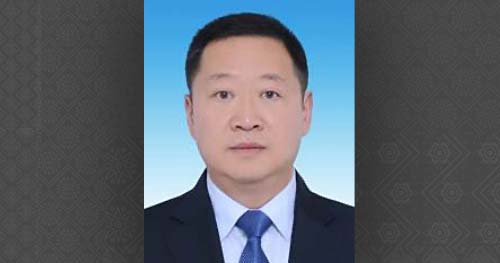
Liu Jiang
In Qinghai Province, which has a sizable Tibetan population, no Tibetan has ever been appointed to serve as the provincial Party Secretary.
Within the governmental structure, Tibetans have occupied some leadership positions, although this has mainly been confined to the TAR. In other Tibetan areas, non-Tibetans continue to dominate key government positions. At present, all three of TAR’s main state bodies — government, People’s Congress, and Political Consultative Conference — are headed by Tibetans. Yan Jinhai (born March 1962) is the head of the TAR People’s Congress, Karma Tseten (born December 1967) is head of the TAR government, and Phakpalha Gelek Namgyal (Pabala Gelie Langjie, born 1940), despite being 86 years old, continues to hold his dual positions as Vice Chair of the National CPPCC and Chairman of the TAR CPPCC.
By contrast, in Qinghai province, no Tibetan has held the head of government post, although a few have served as head of the provincial CPPCC. The current Chairman of the Qinghai Provincial CPPCC is Gonpo Tashi (born October 1962).
Apart from Phakpalha Gelek Namgyal, none of the other Tibetans working for the Chinese system possess any significant public recognition or influence among the Tibetan public. Phakpalha is a high-ranking Tibetan Buddhist reincarnate from the pre-1959 era, giving him a degree of historical and religious legitimacy that other Tibetan officials do not possess. This could be the reason why the Chinese authorities have continued to retain him in office even though he is long past the retirement age.
Tibetans in the national-level leadership
In the 20th Party Congress, Yan Jinhai (born 1962), former TAR Chairman and current Chair of the TAR People’s Congress, is the only Tibetan in the CCP Central Committee. He is eligible, in terms of age limit, to continue holding this position in the next Party Congress.
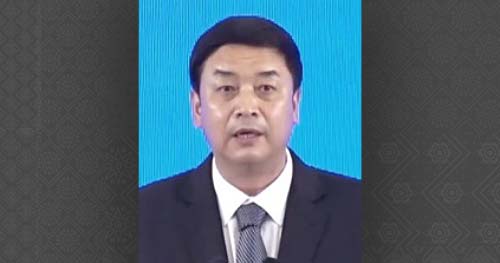
Yan Jinhai
All three Tibetans in the 171 alternate members of the 20th Party Central Committee — an increase from the 19th Party Congress when only two Tibetans were alternates — Karma Tseten (Chinese: Gama Cedain, born 1967), Phurbu Dhondup (Pubu Dunzhu, born 1972), and, Tsering Thar (Cering Tar, born 1969), are also eligible to continue serving in the 21st Party Congress. Thus, all four may continue in the 21st Party Congress unless the Chinese authorities feel the need to reassign Yan Jinhai to another position or increase the number of Tibetan members.
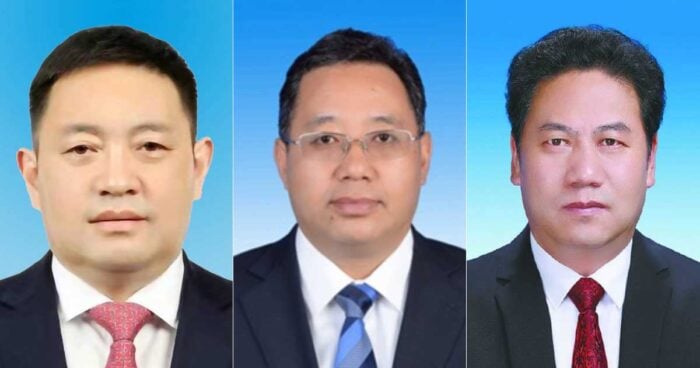
Alternate members of the 20th Party Central Committee: Karma Tseten, Phurbu Dhondup, and Tsering Thar.
Although the 15th National People’s Congress will convene in March 2028, personnel changes in 2027 will have an impact on its composition. In the current 14th NPC, one Tibetan, Lobsang Gyaltsen (Luosang Jiangcun, born 1957) is among the 14 vice chairs. Gyaltsen was until January 2025 also the chair of the TAR People’s Congress.
In the 159-member NPC Standing Committee, there is only one Tibetan, Jamyang Shepa, (born April 1948) who is from Labrang Tashikyil Monastery in Kanlho (Gannan). While both Gyaltsen and Shepa could be replaced due to the terms of age limit, Shepa may be retained because of his spiritual standing as a senior reincarnated lama in Tibetan Buddhism. In fact, Jamyang Shepa’s role might be used more aggressively in China’s quest to assert authority over the Tibetan Buddhist reincarnation process. In December 2025, he was elected as the Chairman of the Advisory Committee of the 11th Council of the Buddhist Association of China, the organization that the CCP has been using, under the UFWD, to manage religious affairs.
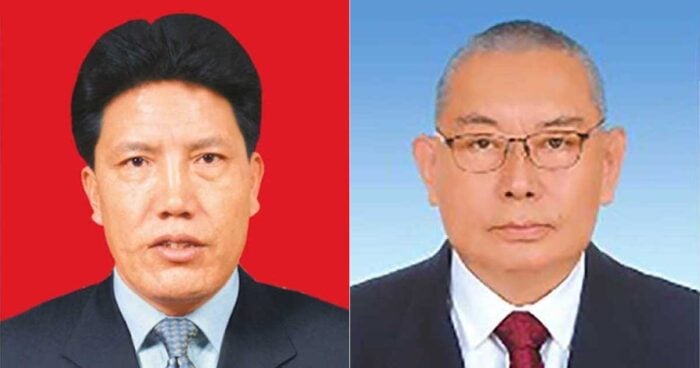
National People’s Congress Vice Chair Lobsang Gyaltsen and Standing Committee member Jamyang Shepa.
Similarly, the 15th Chinese People’s Political Consultative Conference, the highest advisory body in China, will convene only in 2028 but we may see changes here too. In the current CPPCC, only one Tibetan holds a position at the Vice Chair level: Phakpalha Gelek Namgyal. He was re-appointed as one of the CPPCC’s 23 vice chairs in March 2023. For reasons best known to the Chinese authorities, he has been retained in office longer than any other Tibetan official, having been among the first generation of Tibetan officials under Chinese rule.
There are four other Tibetans on the 299-member CPPCC Standing Committee: Tashi Dawa (Zhaxi Dawa, born 1959) from Bathang in Kardze (Ganzi) Tibetan Autonomous Prefecture in Sichuan, who is a prominent writer; Dorjee Rapten (Douji Redan, born 1956), who is Deputy Director of the Ethnic and Religious Affairs Committee of the CPPCC; Drupkhang Thubten Khedrup (born 1955), who is Vice Chairman of the TAR CPPCC; and the CCP-selected Panchen Lama, Gyaltsen Norbu. This is the highest position that has been assigned to Gyaltsen Norbu (born 1990), whom the CCP selected in November 1995 as its Panchen Lama after disappearing Gedhun Choekyi Nyima, the Panchen Lama recognized by the Dalai Lama. While Drupkhang and Gyaltsen Norbu have been publicly active on Tibetan affairs, Tashi Dawa and Dorjee Rapten have not been active.
Although not a member of the CPPCC Standing Committee, Penpa Tashi (Bianba Zhaxi, born 1964) serves as Deputy Director of the CPPCC Ethnic and Religious Affairs Committee. In December 2025, he was removed from his position as a vice chairman of the State Ethnic Affairs Commission, to which he had been appointed in July 2020. Having been born in 1964, he may continue to hold his CPPCC position in the coming year.
No Tibetan serves on any committee of the current NPC.
Non-Tibetans continue to dominate CCP leadership
Currently, non-Tibetans hold most Party leadership positions in the Tibetan areas at both the provincial and prefectural levels of administration. No Tibetan holds the position of Party Secretary in any of the five provincial-level administrations, nor has any Tibetan ever held such a position.
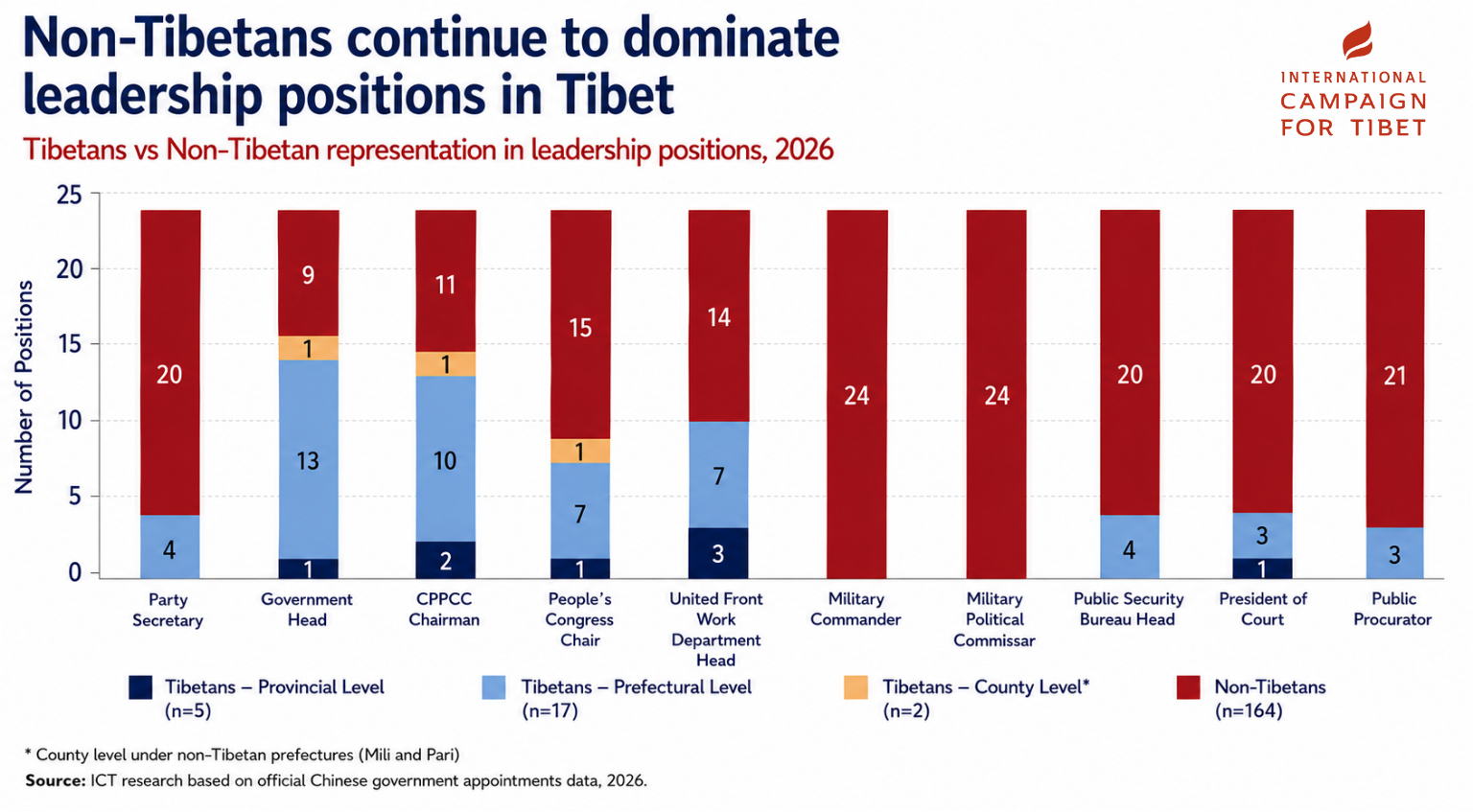
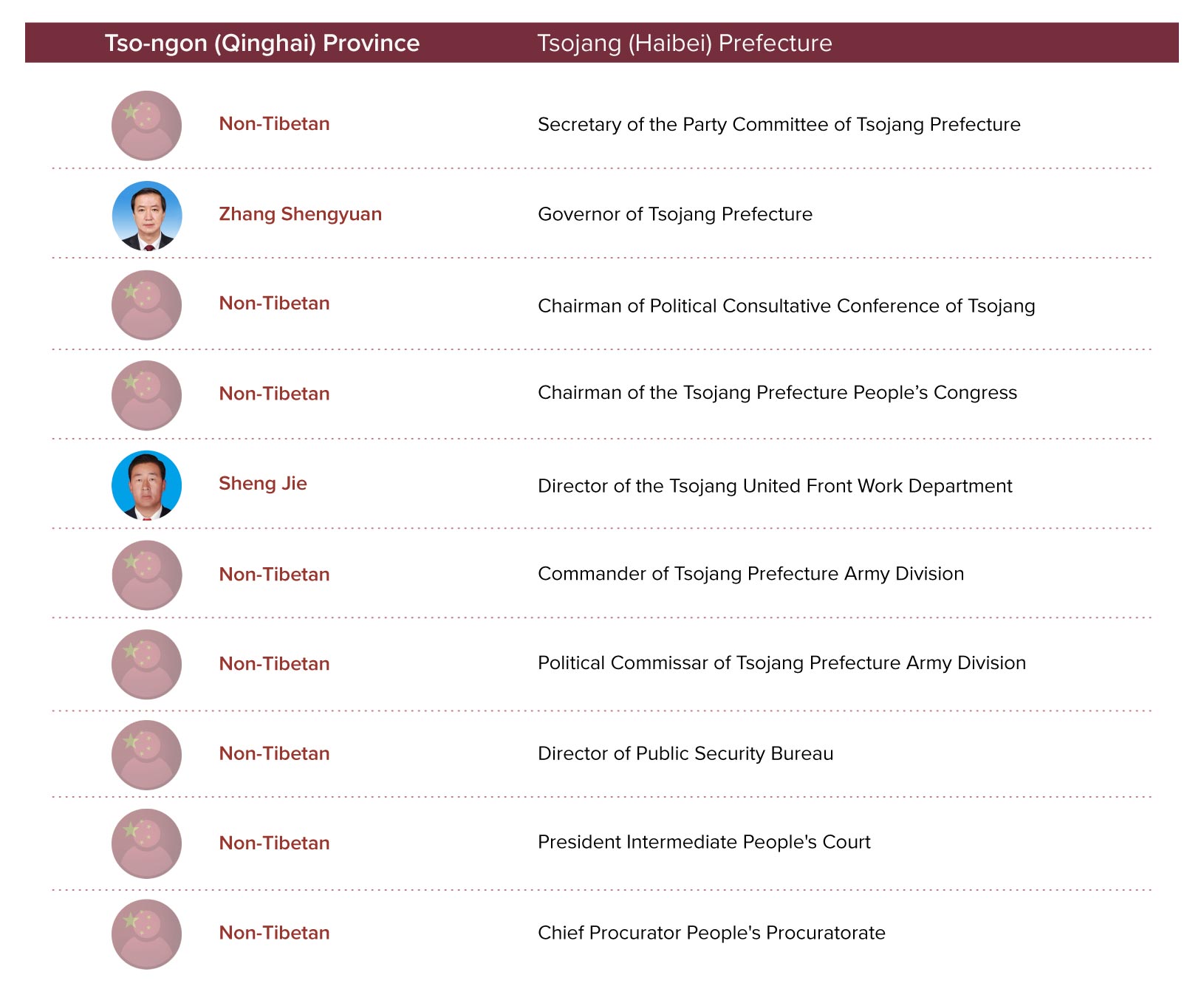
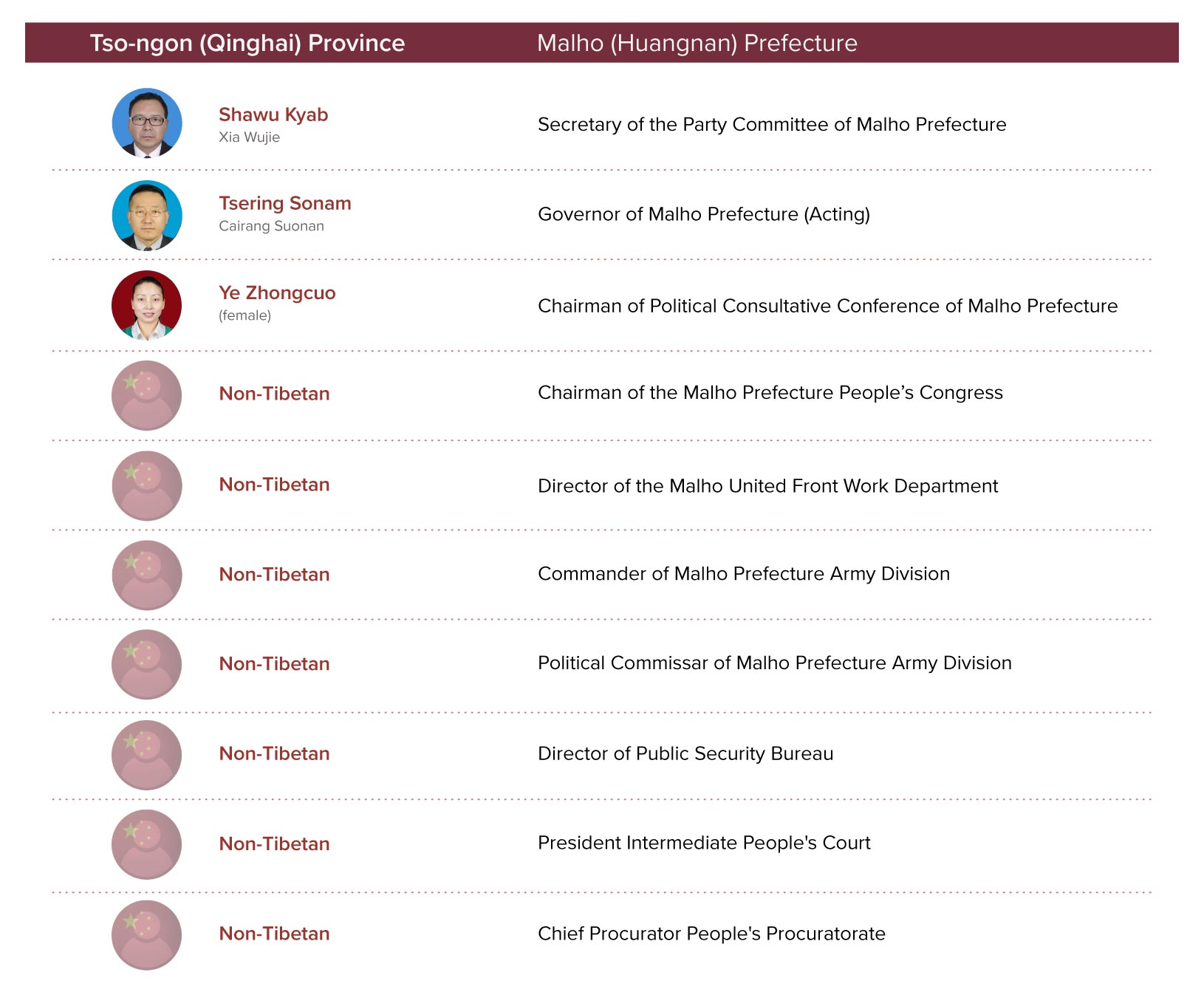
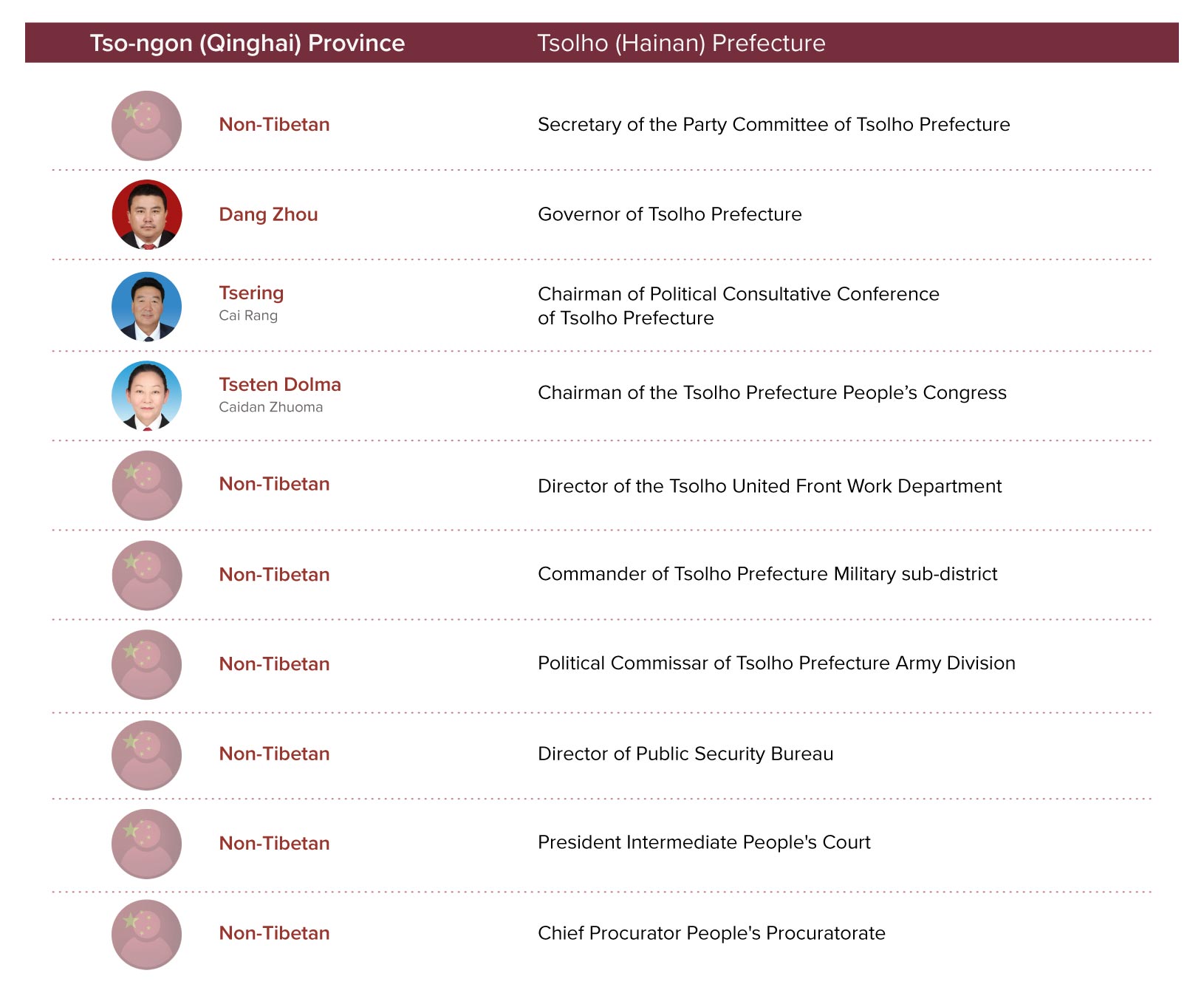
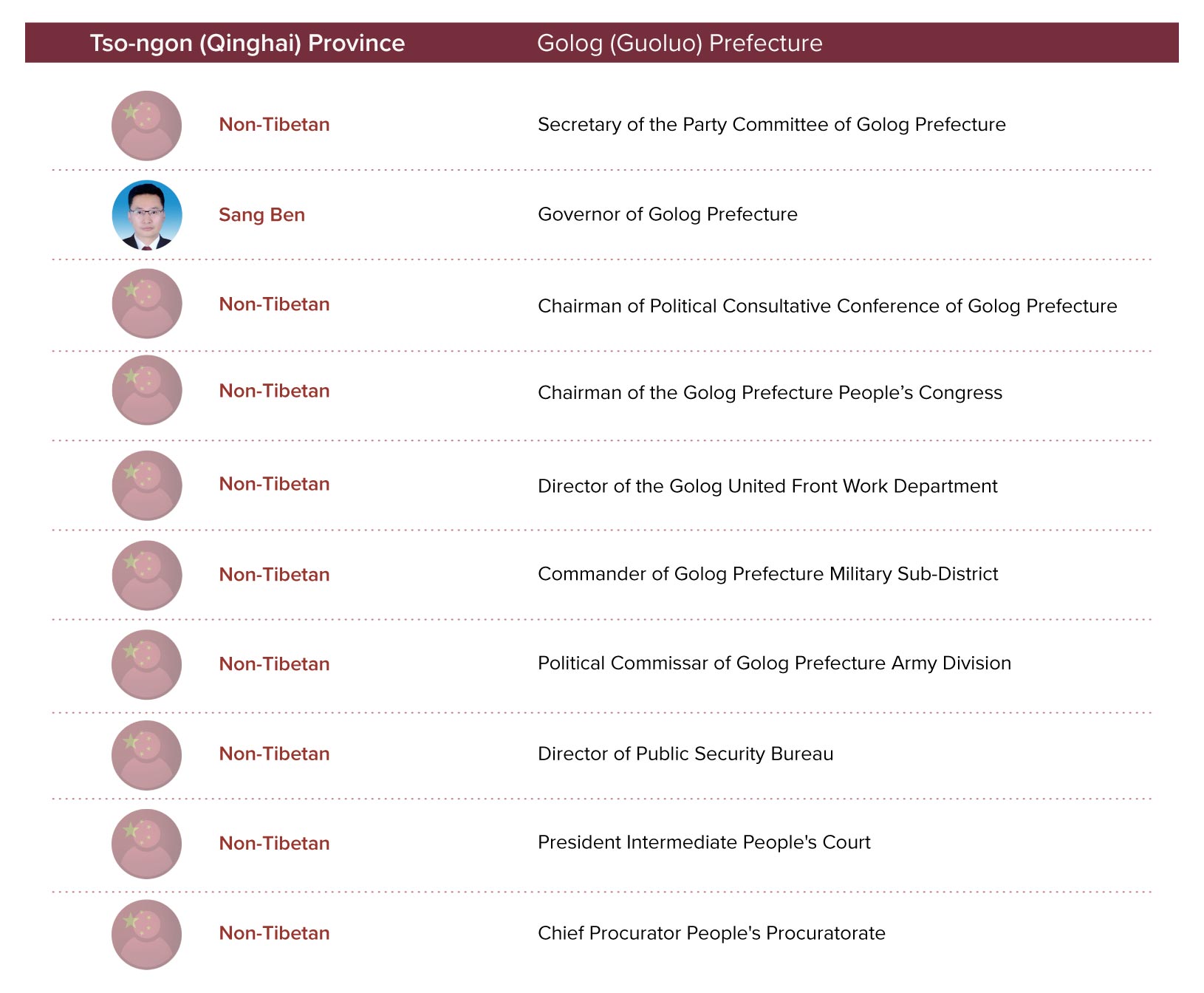
At the prefectural level, of the 17 Tibetan prefectural-level and two county-level administrations, only four — Lhasa, Nyingtri, and Ngari in the TAR and Malho (Huangnan) in Qinghai — have Tibetans serving as Party secretaries. This number remains unchanged from 2025, although there have been changes in the prefectures, with Nyingtri and Malho replacing Shigatse in the TAR and Tsojang (Haibei) in Qinghai.
In terms of Tibetan representation at the head of prefectural-level governments, 13 of the 17 prefectural positions and one of the two counties are held by Tibetans. This number remains unchanged from 2025. In Pari (Tianzhu) Tibetan Autonomous County in Gansu, no Tibetan holds any leadership position in this period, also similar to 2025.
The fact that not all the Tibetan autonomous regions’ governance positions are headed by Tibetans constitutes a violation of Article 114 of the PRC Constitution, which states: “The offices of governor of an autonomous region, prefect of an autonomous prefecture and head of an autonomous county shall be filled by a citizen belonging to the ethnic group that exercises regional autonomy there.”
Article 17 of the Law on Regional Ethnic Autonomy similarly provides that all of these positions ought to be held by Tibetans. It categorically states: “The chairman of an autonomous region, the prefect of an autonomous prefecture or the head of an autonomous county shall be a citizen of the nationality exercising regional autonomy in the area concerned. Other posts in the people’s government of an autonomous region, an autonomous prefecture or an autonomous county should, as far as possible, be assumed by people of the nationality exercising regional autonomy and of other minority nationalities in the area concerned.” (emphasis added)
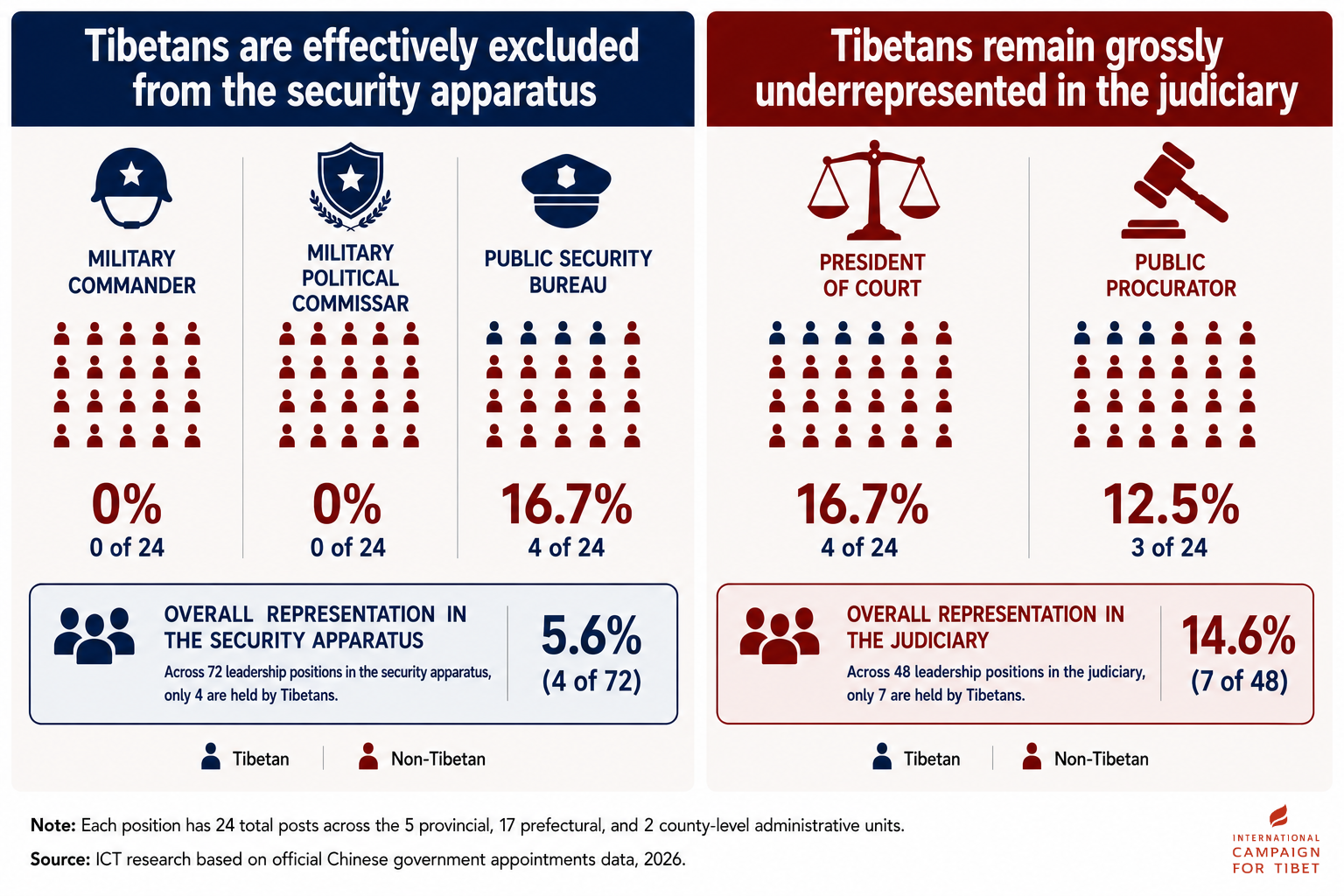
The pattern is equally evident in the security apparatus. If we look at the security entities in Tibetan areas, no Tibetan occupies the military commander or political commissar positions. At the prefectural level, the majority of the Public Security Bureau (PSB) positions are held by non-Tibetans, while no Tibetan occupies such a position at the provincial level.
A similar pattern exists within the judiciary. Only the TAR has a Tibetan serving as the president of the High People’s Court, while only 3 out of the 17 prefectural level intermediate courts are headed by Tibetans.
Tibetan officials who may be promoted in 2027
In all likelihood, current TAR People’s Congress Chairman Yan Jinhai will be transferred to a position in Beijing next year. In such a scenario, he is likely to be succeeded by Karma Tseten, present Chair of the TAR Government. Before his transfer to Lhasa in 2012, Karma Tseten spent 12 years in then Nagchu (Naqu) Tibetan Autonomous Prefecture, his only provincial-level posting experience. His responsibilities in Nagchu included heading its Political and Legal Affairs Commission and Public Security Bureau.
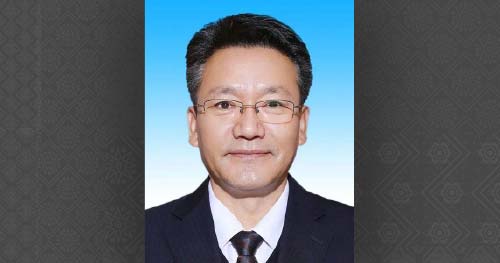
Tenpa
If Karma Tseten is promoted, the Chair of the TAR Government may pass to Tenpa, (born September 1969) currently a member of the Standing Committee of the Tibet Autonomous Region Party Committee and Executive Vice Chairman of the TAR Government. Promoted to his current position in February 2025, Tenpa spent over 15 years working at various levels within the provincial UFWD and served in the politically sensitive Nagchu city government. He also has experience in Beijing, having served as Director-General of the Department of Policy and Law, State Administration for Religious Affairs, from 2010-2015.
If we go by previous trends, Tenpa may first be appointed as a CCP Deputy Secretary in October 2026, before succeeding Karma Tseten as TAR Chairman in January 2027. Given his age, he has several years of service left before reaching retirement.
Should the Chinese authorities choose to relieve Phakpalha from his position as TAR CPPCC Chairman, the most likely successor may be Sonam Nyima (born February 1966), currently a vice chair of the TAR CPPCC. In June 2026, he was removed as a member of the Standing Committee of the CPC Tibet Autonomous Region Committee and Minister of the TAR UFWD. He was made a vice chair of the TAR CPPCC in January 2025.
Hailing from Nangchen in eastern Tibet (now incorporated in Qinghai Province), Sonam Nyima has served in the TAR for several years, starting his service in Chamdo. In 2011, he became Deputy Secretary-General of the TAR government and subsequently served as Executive Deputy Mayor of Lhasa.
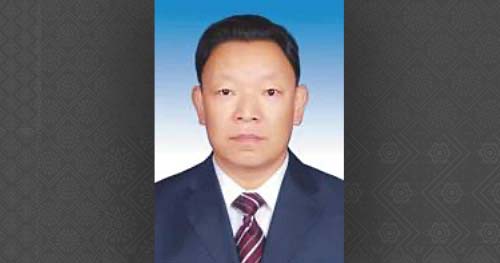
Sonam Nyima
A third Tibetan who may be promoted is Tsering Thar. In June 2026, he was transferred to Lhasa from Qinghai and made the head of the UFWD. As an alternate member of the CCP Central Committee, he already occupies a high Party position and hence may be regarded as being trustworthy enough to warrant senior government positions. To date, he has served in the Tibetan areas of Kham and Amdo, now incorporated in Qinghai.
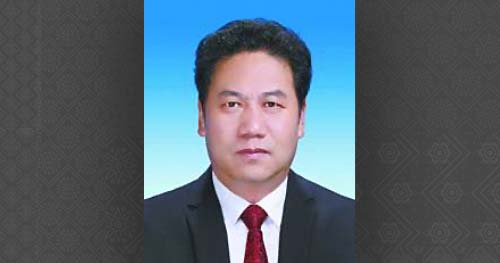
Tsering Thar
It will now be the post-1959 generation of Tibetans who will assume almost all of the leadership positions in Tibet. Given that this new generation was born and raised entirely under the Communist system, the CCP hopes that these officials will serve as its voice and act as its instrument to effectively control the Tibetan people. Whether these Tibetan leaders ultimately advance the CCP’s agenda or use their position to uphold the rights guaranteed to the Tibetan people under the PRC’s own Constitution is something that remains to be seen. Merely being born under the Chinese system does not mean unquestioning adherence to the CCP line.
Indeed, recent Tibetan history shows that the majority of the Tibetans who have courageously advocated for Tibetan rights, including those who have self-immolated in protest against Chinese rule, have been from the younger generation who were born under CCP rule. Thus, China’s enduring trust deficit among Tibetans remains a fundamental challenge, compounded by the continuing lack of legitimacy to Chinese rule and control of Tibet.
Empowerment of the Tibetan leadership in exile
In contrast to the situation in Tibet — where the Tibetan people are being denied the right to determine their own future, including the right to elect their own leaders — in the small Tibetan community in exile, the Dalai Lama has established a democratic system of governance in the form of the Central Tibetan Administration (CTA).
The vitality of this democratic system was most recently demonstrated in action in the February-April 2026 Tibetan elections that led to the re-election of Penpa Tsering as Sikyong, or the President of the CTA, and the election of the new Tibetan Parliament-in-Exile. The Asian Network for Free Elections (ANFREL), which conducted an independent observation of the elections, described them as “peaceful, orderly, community-driven, and credible.”
Since its inception, the CTA has played a central role in preserving the Tibetan people’s distinct cultural, linguistic, and religious heritage. Given its political significance, the international community should strengthen engagement with the CTA, which would reinforce its legitimacy as the democratically elected representative of the Tibetan people, strengthen a democratic partner committed to peaceful engagement, and increase pressure on Beijing to pursue meaningful dialogue with the Dalai Lama or his representatives.
Recommendations
- The U.S. Congress should pass the bipartisan “Assuring the Future of Tibet Act,” which provides greater legitimacy to the CTA by recognizing the institution as the democratically elected representative of the Tibetan people.
- The U.S. State Department – as mandated by bipartisan appropriations legislation – should reinstate full funding for humanitarian assistance and other support to Tibetan communities in India and Nepal as well as for capacity building efforts within the CTA.
- The European Union should appoint a Special Representative for Tibet to improve coordination and coherence in EU policy on Tibet, including regular consultations with the CTA, similar to the role of the U.S. Special Coordinator for Tibetan Issues.
Lists of leaders
This report lists Tibetan officials who currently head offices from the prefectural level upwards as well as the two separate counties. Please note that some of the names of officials listed below appears to be Chinese, but their biography lists them as being Tibetan.