

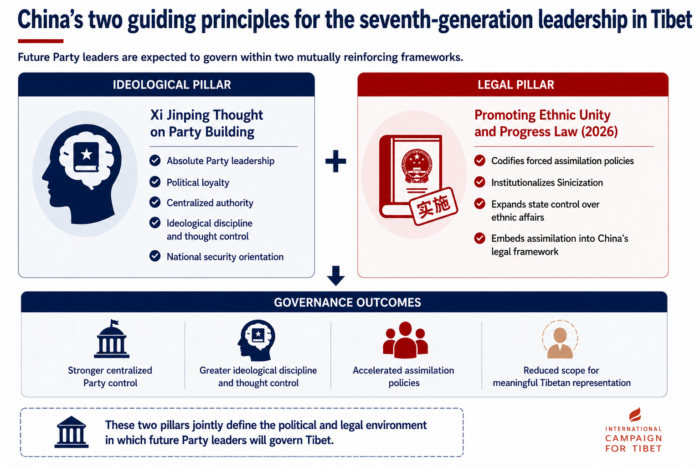
Seventh-generation leadership in Tibet will be shaped by two guiding principles that institutionalize centralized Party control and accelerate Beijing’s forced assimilation of Tibetans: the Ethnic Unity and Progress Law and Xi Jinping Thought on Party Building.
The International Campaign for Tibet (ICT) released its 2026 Tibet Leadership Report, an annual report on the status of governance of Tibet, in which it states that Beijing is cultivating a more repressive leadership in Tibet, ahead of the Chinese Communist Party’s (CCP) pivotal 21st Party Congress in 2027. Through leadership appointments, new legislation, and Party directives, China is deepening political control over Tibet and accelerating its policies of forced assimilation of Tibetans, amid a continued lack of any meaningful Tibetan representation in senior leadership positions, ICT said.
ICT 2026 Tibet Leadership Report
The report finds that the “Promoting Ethnic Unity and Progress Law” and “Xi Jinping Thought on Party Building” together form the legal and ideological foundations of a new governance model that prioritizes political loyalty, centralized Party authority, national security, and implementation of assimilation policies over meaningful Tibetan representation. Rather than replacing existing policies, these developments institutionalize them, embedding assimilation into the governance of education, language, religion, culture, and ethnic affairs.
The report argues that the Ethnic Unity Law is Beijing’s most significant legal codification of assimilation policies to date, expanding Party authority over education, language, religion and culture while accelerating the shift toward Mandarin-medium education and restricting space for Tibetan identity.
While leadership changes are expected across China and Tibet in 2026–2027, the report concludes that these changes are more likely to reinforce than alter existing policy.
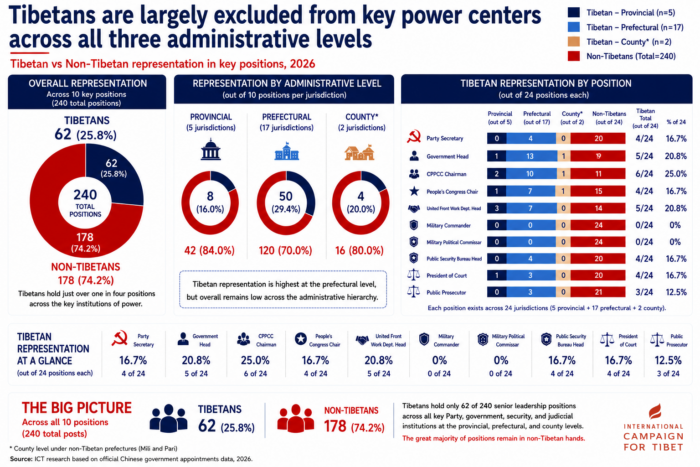
Drawing on new leadership data, the report finds that Tibetans remain largely excluded from positions of real political authority, with meaningful decision-making continuing to rest overwhelmingly in the hands of non-Tibetan Party leaders. As of July 31, 2026, Tibetans hold only 62 of 240 (25.8%) senior leadership positions across provincial, prefectural, and county levels, while non-Tibetans occupy 178 (74.2%). The absence of Tibetans is most pronounced in the Party, security, military, and judicial institutions that exercise the greatest political authority.
The CCP’s 21st Party Congress in 2027 is expected to be a defining political moment for Xi Jinping’s next phase of leadership. Whether Xi Jinping chooses to elevate a potential successor or further consolidate his personal authority, the Congress will shape China’s senior leadership and policy direction for the next five years. The report argues that the leadership transition surrounding the 21st Party Congress is not simply about personnel changes, but about institutionalizing a new model of governance in Tibet. As leadership, ideology, and law become increasingly intertwined, Tibet offers an early indication of Xi Jinping’s governing vision for the post-2027 era – one that will guide the anticipated new seventh generation leadership of Tibet and have implications for the rights, identity and future of the Tibetan people.
ICT 2026 Tibetan Leadership Report: At a Glance
- Continued Xi Jinping dominance even after 21st Party Congress in 2027: Xi Jinping is expected to remain China’s dominant leader beyond the 21st Party Congress, ensuring continuity in his security-driven approach to Tibet. Leadership changes in Tibet are likely to reinforce Xi’s Tibet policy, with promotions favoring officials aligned with Xi’s governance model.
- Lack of Tibetans in senior Party leadership positions: The absence of Tibetans in the higher echelons of the CCP leadership is a trend seen well beyond the Politburo. Even in the powerful United Front Work Department (UFWD), which oversees Beijing’s Tibet policy, there has not been a Tibetan at the senior leadership level since Sithar (Si Ta) retired as Vice Minister in 2016.
- Two guiding principles for the seventh-generation leadership in Tibet — Xi Jinping Thought on Party Building and the Ethnic Unity and Progress Law: Together, they form the ideological and legal framework shaping the next generation of governance in Tibet — one that prioritizes Beijing’s forced assimilation policies and embedding national security into the governance of education, language, religion and culture, as well as Party loyalty, political conformity, and centralized authority.
- Impact of Ethnic Unity Law on the new Tibetan leadership: The Ethnic Unity Law further weakens the protections nominally guaranteed under China’s regional ethnic autonomy system. Its implementation is expected to accelerate Mandarin-medium education; further restrict space for Tibetan language, culture and identity; and leave future Tibetan leaders with little scope to uphold the autonomous rights guaranteed under the Constitution and the Law on Regional Ethnic Autonomy.
- Centralized CCP governance of Tibet by Non-Tibetans to continue: Currently, the highest CCP leadership positions in the Tibetan areas are held by non-Tibetans, and there is no indication that Tibetans will assume leadership positions in the coming years.
- Tibetans in the national-level leadership: In the 20th Party Congress, Yan Jinhai (born 1962), former Tibet Autonomous Region (TAR) Chairman and current Chair of the TAR People’s Congress, is the only Tibetan in the CCP Central Committee. Yan Jinhai and all three Tibetans in the 171 alternate members of the 20th Party Central Committee — Karma Tseten (Chinese: Gama Cedain, born 1967), Phurbu Dhondup (Pubu Dunzhu, born 1972), and, Tsering Thar (Cering Tar, born 1969), are eligible, in terms of age limits, to continue serving in the 21st Party Congress.
- Non-Tibetans continue to dominate CCP leadership at the provincial, prefectural, and county level: Tibetans remain excluded from positions of real political power, while non-Tibetan Party officials continue to dominate decision-making. In 2026, Tibetans occupy only 62 (or 25.8%) out of the 240 senior leadership positions across all 10 Party, government, security, and judicial institution-level positions at the provincial (5), prefectural (17), and county (2) levels. By contrast, non-Tibetans hold the majority 178 (74.2%) of the 240 positions.
- Empowerment of Tibetan leadership in exile: The stark contrast between Beijing’s increasingly centralized control over Tibet and the CTA’s democratic governance highlights two competing visions of Tibetan leadership. As China further marginalizes Tibetan participation in decision-making inside Tibet, the international community should strengthen engagement with the CTA as a democratic partner and representative of the Tibetan people.