


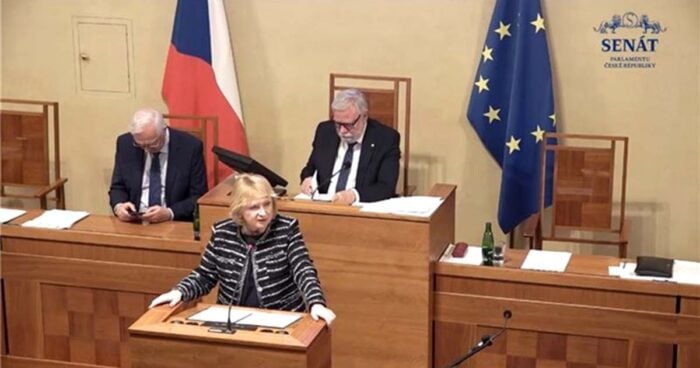
Senator Jitka Svietlova, Vice-President of the Czech Senate, presenting the resolution on 25 March. (Photo: Screenshot from the Czech Senate webcast)
The Senate of the Czech Republic last month adopted a resolution opposing Chinese interference in the succession of the Dalai Lama and affirming the Tibetan people’s right to choose their own spiritual leader.
The resolution, adopted on March 25 with 40 votes in favor and none opposed, clearly states that the People’s Republic of China has no legitimate authority to select the successor to the 14th Dalai Lama, and calls on the Czech government to support the Tibetan people’s free choice of the 15th Dalai Lama. It also expresses grave concern over China’s recently adopted Law on Promoting Ethnic Unity and Progress, which the Senate described as an instrument “openly advocating assimilation” that restricts cultural, religious and linguistic freedoms, including for Tibetans.
Wangpo Tethong, Executive Director of ICT Europe, welcomed the adoption of the resolution, stating: “With this resolution, the Czech Senate has made clear that Czech support for Tibet remains steadfast. It sends a strong signal that the selection of the Dalai Lama’s reincarnation is solely the prerogative of the Tibetan people, and that Beijing’s unacceptable attempts to control it will face international scrutiny.”
The adoption of this resolution reflects a collective effort, made possible through the sustained engagement of Tibet support groups like Czechs Support Tibet, as well as the Office of Tibet in Geneva and committed Czech parliamentarians.
With this move, the Czech Senate joins a growing list of governments and parliaments that have publicly affirmed Tibetan religious freedom and the right of Tibetans to determine their spiritual leadership, including in the United States, Germany, Belgium, the Netherlands and the European Union. In July 2025, UN independent human rights experts expressed their concern over the Chinese government’s stated intention to appoint a person of their choice as the next Dalai Lama.
The resolution is the latest expression of the Czech people’s longstanding solidarity with Tibet, illustrated by regular parliamentary delegations’ visits to Dharamshala, India (the seat of the Central Tibetan Administration) and an historic meeting between Czech President Petr Pavel and His Holiness the Dalai Lama in India in July 2025. The recent re-establishment of the Czech parliamentary group for Tibet following elections further demonstrates sustained and broad-based political support for Tibet and a renewed commitment to stand firmly with the Tibetan people in their struggle for freedom and justice.
Read below the full resolution of the Czech Senate (also available here). Please note that this is an unofficial ICT translation of the draft version. The final version will be available on the Senate’s website shortly.
The video recording of the debate on the resolution is available here (in Czech).
Resolution of the Senate
Delivered at the 22nd session held on March 25, 2026
On the selection of the new 15th Dalai Lama and the situation of minorities following the adoption of the Law on Promoting Ethnic Unity and Progress in the People’s Republic of China
The Senate
- recalls the long-standing warm relations between the people of the Czech Republic and the people of Tibet, as well as the private meeting of the President of the Republic on 27 July 2025 in Leh, Ladakh and the meeting of the Czech parliamentary delegation in Dharamsala on 10 December 2025 with the Nobel Peace Prize winner the 14th Dalai Lama;
- recalls that the Constitution of the People’s Republic of China (PRC) guarantees the rights of national minorities, including the right to use their own language and to develop their own culture, which also applies to the inhabitants of the Tibet Autonomous Region;
- considers Buddhism and the spiritual traditions of Tibet as a unique expression of culture, which must be protected and developed, inter alia, in the spirit of the commitments voluntarily undertaken by the PRC as a Member State of UNESCO, in particular through its adherence to the Universal Declaration on Cultural Diversity (2001) and the ratification of the 2005 Convention on the Protection and Promotion of the Diversity of Cultural Expressions, which establishes the principle of equal dignity and respect for all cultures (Article 2(3)), the obligation to create conditions for the cultural expressions of indigenous peoples (Article 7(1)(a)), and certain limits on the formulation of cultural policy by States Parties (Article 2(2)), since State sovereignty should not restrict or erase cultural diversity but rather protect and promote it;
- notes with concern information that the People’s Republic of China adopted, on 12 March 2026, a new Law on Promoting Ethnic Unity and Progress, which openly promotes assimilation and imposes restrictions on culture, religious freedom and education in minority languages, which was also criticised by the UN High Commissioner for Human Rights;
- expresses concern regarding reports of long-term efforts by the People’s Republic of China to influence the selection of the incoming 15th Dalai Lama and shares the concerns of the Central Tibetan Administration, the Tibetan Diaspora and the Tibetan Buddhist community about interference by the People’s Republic of China in the Tibetan people’s free choice of the 15th Dalai Lama;
- respects the religious freedoms of the Tibetan people within their unique Buddhist tradition, including the freedom to choose their religious leaders without interference from the People’s Republic of China;
- supports free discussion by the Central Tibetan Administration and the Tibetan people on the selection of the next spiritual leader, the 15th Dalai Lama, without pressure or interference from the People’s Republic of China; and
- declares that the People’s Republic of China has no legitimate authority to appoint the successor to the 14th Dalai Lama and that the selection of the 15th Dalai Lama is the exclusive matter of the Tibetan people;
- recommends that the Government of the Czech Republic support the free selection of the 15th Dalai Lama with regard for the religious freedom of the Tibetan people; and
- authorizes the President of the Senate to forward this Resolution to the Prime Minister of the Czech Republic and the Minister of Foreign Affairs of the Czech Republic.
Miloš Vystrčil, acting President of the Senate
Martin Krsek, acting Auditor of the Senate