
Foundational Information
China’s Occupation of Tibet
China has illegally occupied Tibet since its annexation in 1951, tightening its repressive rule while refusing since 2010 to negotiate with Tibetan leaders and representatives of His Holiness the Dalai Lama.
What you need to know
Tibet was an independent, self-governing state before the Chinese People’s Liberation Army’s (PLA) invaded it in 1949. After the PLA defeated the small Tibetan army, China forced Tibetan government representatives to sign the “17-Point Agreement for the Peaceful Liberation of Tibet” under duress in May 1951. The Dalai Lama escaped into exile in India in 1959 and the Chinese Communist Party’s repressive occupation and control of Tibet continues to this day.

ILLEGAL OCCUPATION
International law prohibits the acquisition of a territory by force and affirms the right of people to self-determination. China’s military invasion and continued occupation of Tibet are in direct violation of international law and agreements on sovereignty and autonomy and constitute an illegal occupation.
THE MIDDLE WAY APPROACH
Proposed by the Dalai Lama and democratically adopted by the Tibetan exile movement, the Middle Way seeks genuine autonomy for all Tibetans living in the three traditional provinces of Tibet within the framework of the People’s Republic of China, rather than complete independence.
CHINA’S FORCED ASSIMILATION POLICIES
China’s repressive assimilation policies target the foundations of Tibetan identity by prioritizing Mandarin over Tibetan-language education, requiring the Sinicization of Tibetan Buddhism, and recasting Tibet’s history, culture, and identity through Chinese state-approved narratives.
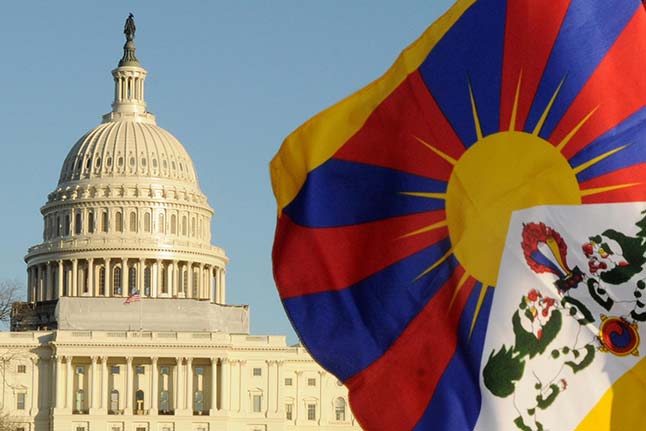
The Resolve Tibet Act
Enacted in 2024, the Resolve Tibet Act made it official U.S. policy that the Tibet-China dispute remains unresolved, and Tibet’s legal status must be determined under international law. The law affirms Tibetans’ right to self-determination and calls for the resumption of Sino-Tibetan dialogue without preconditions.
1951
The year China illegally annexed Tibet
0/100
Tibet’s Freedom House ‘Global Freedom Score’ for 2024, 2025 and 2026
2010
China walked away after nine rounds of formal Sino-Tibetan dialogue
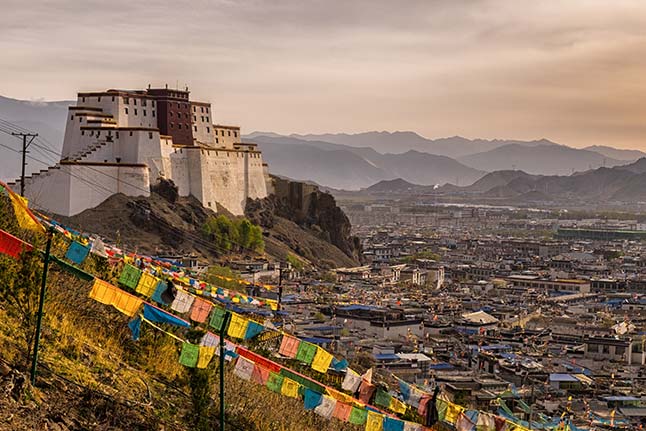
International Support & Recognition
During a UN General Assembly debate on Tibet in 1959, Ireland’s then Minister for Foreign Affairs Frank Aiken described Tibet’s history: “Tibet has fallen into the hands of the Chinese People’s Republic for the last few years. For thousands of years, or for a couple of thousand years at any rate, [Tibet] was as free and as fully in control of its own affairs as any nation in this Assembly, and a thousand times more free to look after its own affairs than many of the nations here.”
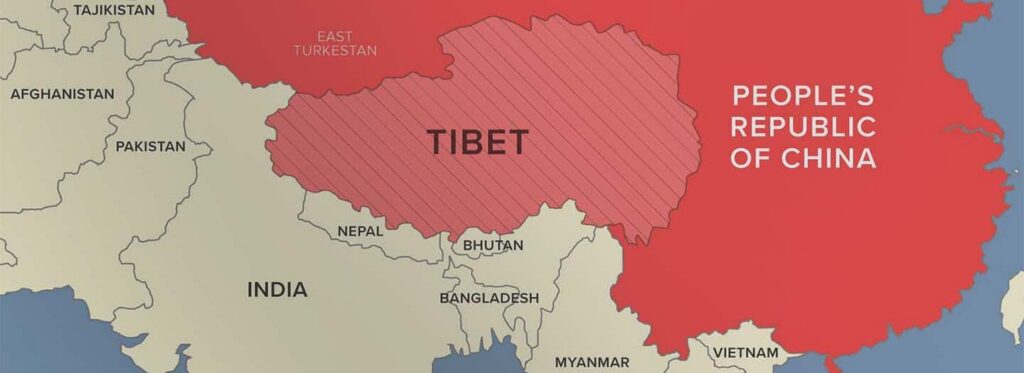
A history of sovereignty and self-rule
2,000 YEARS OF HISTORY
Tibet has a unique history that dates back more than two millennia. Chinese records from centuries ago refer to Tibet as a strong state that China had to interact with on an equal footing.
In 821–822, the Tibetan Empire and China under the Tang Dynasty concluded a formal peace treaty defining their frontier and pledging mutual nonaggression. Preserved in Tibetan and Chinese on a stone pillar in Lhasa, the treaty documents Tibet conducting state-to-state relations with China as a distinct political power.
UNDISPUTED INDEPENDENCE
Tibet’s history as an independent, self-governing state is irrefutable and firmly established by historical record. There is no serious academic debate about the historical independence of Tibet, nor any basis for Beijing’s claim that Tibet has been an inseparable part of China since antiquity. Tibet’s documented record as a distinct state and political entity, with its own government, laws, language, foreign relations, and treaty-making authority, long predates the People’s Republic of China.
TIMELINE
1911-1949: Independent scholars agree that Tibet was a fully independent state during this period, which ended when the People’s Liberation Army invaded and illegally occupied Tibet.
1959: After the Dalai Lama was forced to escape into exile and China dissolved the Tibetan government, the United States passed a joint Congressional resolution listing Tibet as a country whose national independence had been violated.
1998: U.S. President Bill Clinton said he urged then-Chinese leader Jiang Zemin to “assume a dialogue with the Dalai Lama in return for the recognition that Tibet is a part of China and in recognition of the unique cultural and religious heritage of that region.”
2002-2010: The Chinese government held nine rounds of formal dialogue and one round of informal talks with the envoys of the Dalai Lama. But after the last round of talks in January 2010, China walked away from the dialogue process.
2021: The U.S. State Department removed language recognizing Tibet as part of China from its annual report on human rights.
2022: U.S. Congress passed a funding bill that prohibits the State Department from producing maps or statements that portray Tibet as a part of China.
2024: The Resolve Tibet Act is signed into law by U.S. President Joe Biden.

The United Nations Must Stand up for Tibet
UN General Assembly Resolution 1723, adopted in 1961, called for the “cessation of practices which deprive the Tibetan people of their fundamental human rights and freedoms, including their right to self-determination.” The UN must urgently heed its past calls to stand up for Tibet’s autonomy and urge China to cease its human rights abuses and forced assimilation of the Tibetan people.
ICT’s Role
ICT has been the leading international advocacy organization on Tibet for over three decades.
Our Impact
- ICT’s close involvement in introducing the Assuring the Future of Tibet Act in 2026, which reaffirms the U.S. commitment to Tibetan democracy in exile.
- ICT’s central role in the introduction and passage of the 2024 Resolve Tibet Act, which challenges China’s historical claim to Tibet and empowers the U.S. government to refute China’s misinformation on Tibet’s historical status.
- ICT’s June 2022 testimony to the Central Executive Commission on China invalidated Beijing’s claim that Tibet has always been a part of China and asserted that China’s invasion of Tibet has no legitimate historical, diplomatic, or popular basis.
Essential Reading

Common Questions
Why did China invade and occupy Tibet?
China invaded Tibet in 1950 to bring the country under the newly formed People’s Republic of China, consolidate control over a strategically important frontier, secure its geopolitical borders, spread its communist ideology, and advance the Chinese Communist Party’s expansionist agenda. The Chinese government portrayed Tibet as a historically Chinese territory requiring “liberation” by and “unification” with the motherland. Tibetans rejected that claim, and on March 10, 1959, thousands rose up against China’s occupation in a historic national uprising.
Was Tibet an independent nation prior to the Chinese invasion?
Yes. Tibet operated as an independent, self-governing nation before the Chinese invasion of 1949. It maintained its own government, laws, taxation, currency, army, postal system, and external relations.
What was the “17-Point Agreement for the Peaceful Liberation of Tibet”?
The 17-Point Agreement was a 1951 accord which Tibetan representatives signed under duress, accepting Chinese sovereignty in exchange for promises of keeping the Tibetan government’s authority over religion, language and political institutions intact. The agreement provided guarantees to respect mutual needs and establish a relationship between the two governments.
Eight years after the Agreement was signed, in March 1959, tens of thousands of Tibetans were killed after they rose up against Chinese rule in an attempt to protect the Dalai Lama and defend their freedoms. Both the Tibetan and Chinese governments repudiated the Agreement, and cooperation effectively concluded with the Dalai Lama’s escape into exile.
When and why did the Dalai Lama escape Tibet?
The Dalai Lama escaped into exile in India in March 1959, nine years after China invaded and occupied Tibet. His escape followed a national uprising against Chinese rule and a subsequent military crackdown in Lhasa.
He undertook a grueling, dangerous two-week trek across the Himalayas on foot and horseback. On March 31, 1959, he successfully crossed the border into India, where he was granted political asylum. He has lived in exile in Dharamshala, India, ever since. After reaching India, he formally repudiated the “17-Point Agreement” and reestablished the Tibetan government in exile, now known as the Central Tibetan Administration.
How is Tibetan culture and daily life impacted by Chinese rule?
Tibetan culture and daily life are heavily restricted under Chinese rule, which relies on a policy of forced assimilation and intense surveillance.
Independent watchdog Freedom House consistently ranks Tibet among the least free regions in the world, with a “Global Freedom Score” of 0/100. The Chinese government imposes severe restrictions on the Tibetan people’s political rights and civil liberties, suppressing dissent and enforcing assimilationist policies aimed at erasing Tibet’s distinct religious, cultural, and linguistic heritage.
While Beijing points to its massive investments in infrastructure, railways, and economic modernization as evidence of “peaceful liberation,” a vast majority of the benefits from these development projects flow mostly to the Han Chinese and operate alongside Beijing’s forced-assimilation policies that seek to erode Tibet’s distinct national identity.