Key Issue
Refugees
China’s brutal occupation of Tibet has forced tens of thousands of Tibetans into exile.
What you need to know
In 1959, the Dalai Lama escaped into exile in India, followed by about 80,000 Tibetans fleeing Chinese occupation and repression in Tibet. Thousands more continued to escape in the subsequent decades, seeking safety, education, and religious freedom in exile. Today, intensified Chinese border controls, pervasive surveillance, and movement restrictions have significantly reduced the number of Tibetans able to escape repression and seek safety abroad.

WHY TIBETANS ESCAPE
China’s repressive assimilation policies and sweeping restrictions on Tibetans’ rights to education, religion, movement, and cultural expression force them to seek safety and freedom beyond their homeland.
A DANGEROUS CROSSING
Tibetans fleeing repression face a perilous journey across the Himalayas and risk extreme weather, treacherous terrain, heavily guarded borders, and forcible return.
GLOBAL TIBETAN DIASPORA
About 150,000 strong, Tibetans around the world have built resilient communities in exile that sustain their language, culture, religion, and democratic institutions.
Seeking freedom from repression
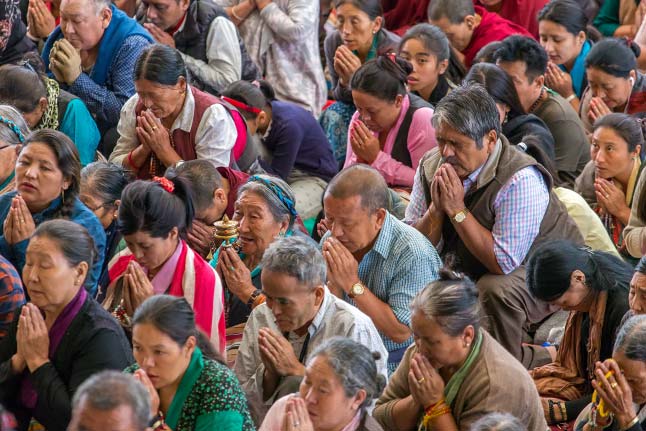
Tibetans have sought refuge abroad to escape severe restrictions on the exercise of their basic rights and the expression of their Tibetan identity. Exile offers them the possibility of greater freedom to practice the Tibetan way of life but it comes at a profound cost: separation from family, community, and homeland, as well as uncertainty and the challenge of rebuilding their lives in a foreign country.
~150,000
Number of Tibetans in exile — the majority in India
81
Number of Tibetans who escaped Tibet in 2020-2025
260+
Tibetan Buddhist monasteries and nunneries in exile in India, Nepal and Bhutan
China’s Transnational Repression of Tibetans
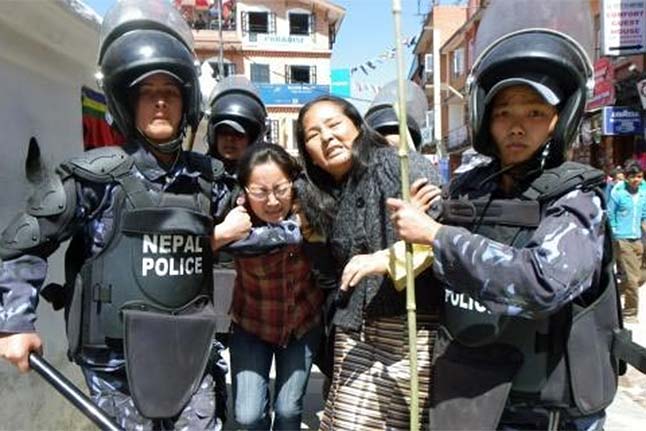
Exile does not place Tibetans beyond Beijing’s reach. Tibetans living in exile face surveillance and intimidation by Chinese authorities, including threats against relatives who remain in Tibet, to silence their advocacy abroad. China also pressures foreign governments, the United Nations, and cultural institutions to restrict Tibetan participation and political expression, effectively exporting its repression and creating a culture of fear and self-censorship across borders.

Tibetan resilience and cultural preservation in exile
Monasteries and nunneries: Continuing religious traditions
Tibetan refugees rebuilt monastic institutions destroyed or severed from their communities following China’s occupation of Tibet. Today, the Central Tibetan Administration’s Department of Religion and Culture is affiliated with 253 monasteries and 36 nunneries across India, Nepal and Bhutan, representing the Nyingma, Kagyu, Sakya and Gelug schools of Tibetan Buddhism and Tibet’s indigenous Bon tradition. Their monasteries, nunneries and branches worldwide preserve philosophical study, debate, ritual, meditation, sacred texts and lineage transmissions while educating new generations of monks, nuns and lay practitioners.
Schools: Education rooted in identity
Education was among His Holiness the Dalai Lama’s earliest priorities in exile. The principal Tibetan school systems in exile now encompass 62 schools: 34 administered by the CTA-affiliated Sambhota Tibetan Schools Society, 15 by Tibetan Children’s Villages, four by the Tibetan Homes Foundation and nine by the Snow Lion Foundation in Nepal. Together with schools for Tibetan children with special needs and monastic schools, these institutions provide academic education, residential care and instruction in Tibetan language, history, culture and ethical values. Their graduates have become educators, scholars, health professionals, public servants, entrepreneurs and leaders throughout the global diaspora.
Art, culture and medicine: Transmitting a living heritage
In exile, Tibetans have revived traditions that the Chinese occupation, displacement, and repression threatened to sever and passed them to younger generations through formal training, apprenticeships, and community practice. The Tibetan Institute of Performing Arts preserves regional music, dance, costume, instruments and Ache Lhamo, Tibetan opera and musical theatre. Artists and cultural institutions sustain thangka painting, appliqué, textile arts, wood painting and carving, stone carving and inscriptions, metalwork, sculpture, papermaking and calligraphy. Writers, filmmakers, musicians and theatre artists carry Tibetan expression into contemporary forms, while Men-Tsee-Khang or the Tibetan Medical and Astro Institute trains practitioners and preserves Sowa Rigpa, Tibetan medicine, astronomy and astrology.
Tell Congress: Support Tibetan Democracy
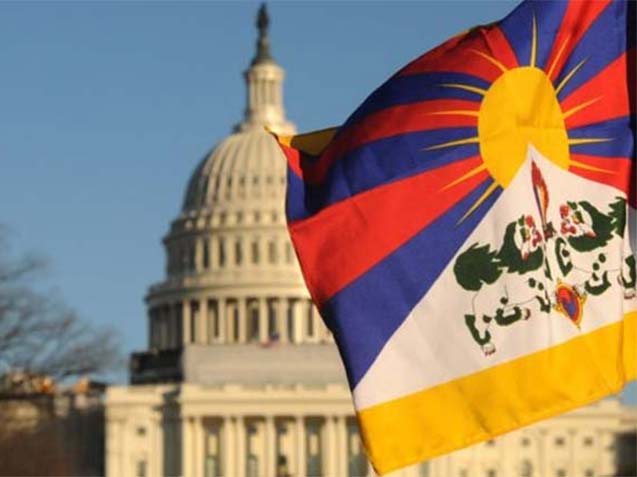
A new pro-Tibet bill introduced in the Senate and House of Representatives, the Assuring the Future of Tibet Act (AFTA), would strengthen U.S. support for the Central Tibetan Administration, increase diplomatic engagement with Tibetan leaders, and help ensure Congress stands with Tibetans’ human rights and self-determination.
Democracy & civic life in exile
Establishing democracy was among His Holiness the Dalai Lama’s first initiatives in exile. On September 2, 1960, the first elected Tibetan representatives took office. In 2011, after decades of gradually transferring authority to elected institutions, His Holiness formally relinquished his political role and devolved his remaining executive powers to the elected Sikyong and Kashag, ending the Dalai Lama’s position as Tibet’s political leader while retaining his spiritual role. Tibetans have since held direct elections for Sikyong and the Tibetan Parliament-in-Exile through a unique, decentralized system spanning 23 countries and numerous polling stations in settlements and diaspora communities worldwide. With voter turnout consistently higher than average for comparable elections, this system is widely regarded as a case study in democratic self-governance by a dispersed, stateless population. The Tibetan Supreme Justice Commission adjudicates civil disputes within the exile community, while national courts retain authority over criminal and property cases.
Civil Society: A global movement for Tibet
Tibetan civil society extends far beyond the Central Tibetan Administration. Tibetan-led organizations develop youth and women’s leadership, document human rights violations and conduct public education, advocacy and nonviolent campaigns. Together with Tibetan associations, student groups, professional networks, and Tibet support groups around the world, they connect local community needs with international action for Tibet.
Media: Source of rare information on Tibet, diaspora
Tibetan media connect and inform the global diaspora while bringing rare information from inside Tibet to the world. Journalists and sources work under serious risks to report on protests, arrests, environmental damage and cultural and religious repression.
Our Impact
- ICT’s sustained advocacy has secured and maintained bipartisan U.S. humanitarian assistance for Tibetan refugees in Nepal and India through the annual Congressional appropriations process, funding the education, health and cultural preservation programs that sustain Tibetan communities in exile.
- ICT helped shaped the refugee provisions of the 2020 Tibetan Policy and Support Act, which authorize humanitarian assistance for Tibetan refugees in South Asia and direct the State Department to encourage Nepal to provide legal documentation to Tibetan refugees residing there.
- ICT has backed successive versions of the Tibetan Refugee Assistance Act, introduced in multiple Congresses as recently as 2015, which would make 3,000 immigrant visas available to displaced Tibetans who have been living in India and Nepal.
Common Questions
Where do Tibetan refugees live today?
Tibetans in exile live across South Asia and an increasingly global diaspora. The Central Tibetan Administration’s 2022 demographic survey estimated about 135,000 Tibetans in exile worldwide, including roughly 72,000 in India, 10,000 in Nepal, 1,200 in Bhutan, and more than 52,000 elsewhere. Significant communities now live in the United States, Canada, Europe, Australia and other parts of the world.
This distribution has changed considerably over recent decades. Fewer Tibetans have been able to escape from Tibet, birth rates in exile have fallen, and many families have moved from South Asia to Western countries. As a result, Tibetans outside Tibet today include refugees and stateless people as well as permanent residents and citizens of the countries where they live.
What is the legal status of Tibetan refugees?
There is no single legal status for Tibetans in exile; it depends on the country in which they live. In India, where the largest Tibetan exile community is based, many Tibetans are registered as foreigners rather than holding conventional refugee status. A Registration Certificate (RC) serves as the principal government registration document for many Tibetan residents. For international travel, eligible Tibetan refugees and stateless people can apply for an Indian Certificate of Identity (IC)—the yellow travel document sometimes informally called the “yellow passport.” It is a travel document, not an Indian passport, and does not itself provide Indian citizenship. Some Tibetans born in India qualify for citizenship under Indian law, but recognition and documentation have often required litigation.
The situation in Nepal is more precarious. Nepal has not issued new refugee identification cards to Tibetans since 1995 and does not recognize Tibetans who arrived after 1989 as refugees. As a result, many Tibetans in Nepal lack government documentation, restricting their ability to work legally, pursue higher education, travel, open bank accounts, obtain licenses or own property. In countries such as the United States, Canada, Australia, and across Europe, Tibetans may instead hold refugee or asylum status, permanent residence or citizenship. Tibetan Americans, Tibetan Canadians and Tibetan Europeans who have acquired citizenship travel on the passports of their respective countries.
What happens if a Tibetan is caught trying to escape Tibet?
If a Tibetan is caught trying to escape Tibet, the consequences are severe, often involving immediate physical violence, imprisonment, torture, and heavy financial extortion.
Because Beijing legally classifies escaping Tibetans as “illegal border crossers” or “separatists” trying to join blacklisted exile organizations, the state treats the act as a major political and national security offense.
Escaping has also become far more difficult. Chinese authorities have tightened controls on movement within Tibetan areas and along the Tibet-Nepal border, sharply reducing the number of Tibetans able to reach Nepal and India. Tibetans apprehended after entering Nepal may also face detention and the risk of forcible return. Returning a person to a place where they face a real risk of persecution or torture is known as refoulement and is prohibited under international law. In 2003, Nepal deported 18 Tibetan asylum seekers to China despite urgent UNHCR appeals, illustrating the potentially grave consequences.
What is the Green Book?
The Green Book is a document issued by the Central Tibetan Administration (CTA) to Tibetans who participate in Chatrel, the system of voluntary financial contributions that supports the Tibetan government in exile. Established in 1972, Chatrel created a regular source of community support for Tibetan institutions and became an important expression of participation in Tibetan civic life. The Green Book records an individual’s contributions and has developed into a significant form of documentation within the Tibetan exile community. An up-to-date Green Book may be required for certain CTA-administered opportunities and civic rights, including scholarships, employment and participation in Tibetan elections.
The Green Book is not a passport, proof of citizenship or a residence document issued by a sovereign state. It should not be confused with India’s Registration Certificate, which records a foreign resident’s registration, or its Identity Certificate, which is used for international travel by eligible Tibetan refugees and stateless residents.