
Updated: November 2, 2026
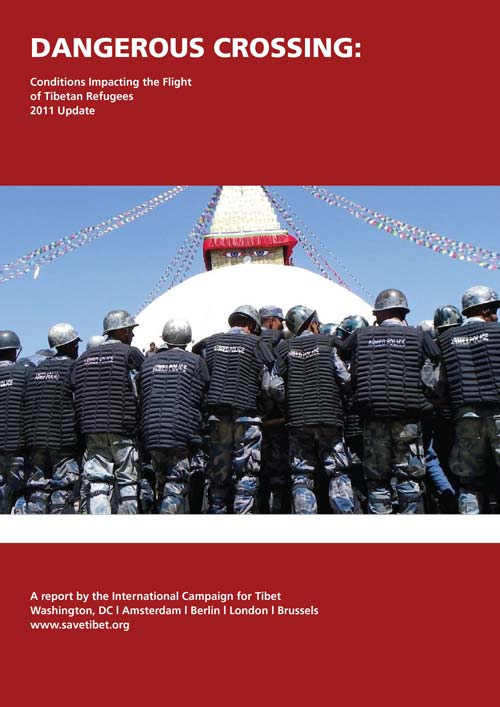
The situation for the 20,000 or so long-staying Tibetans in Nepal – many of whom have lived as refugees in Nepal since the early 1960s – has worsened dramatically since 2008. During the same period, the dangers for Tibetans escaping Tibet via Nepal have intensified as China seeks to close this essential gateway into exile. This report examines the situation for Tibetans living in and transiting through Nepal. It shows that beyond the economic and political factors that impact the lives of all in post-conflict Nepal, Tibetans experience a second tier of challenges brought about by substantial and increasing Chinese influence on the Nepal state.
Tibetans in Nepal are on the frontline of a high-stakes battle for regional influence between the two Asian giants, India and China. In 2008, Nepal’s Maoist Prime Minister Pushpa Kama Dahal (nom de guerre Prachanda), made his first foreign trip to Beijing, bucking a Delhi-first tradition and opening the flood gates to a steady stream of official Chinese visitors to Kathmandu. A counter indication of influence would not be signaled until 2011 when Nepal Prime Minister Baburam Bhattarai made his maiden visit to Delhi.
Since the People’s Liberation Army moved into Tibet in 1949, Nepal has taken on the role of buffer zone between India and China. As the two Asian powers compete for regional influence, Nepal’s position has become less ‘buffer’ and more battered. China’s acquired leverage in Nepal is used to control its interests in Tibet and Tibetan activities in Nepal; India’s influence, based on a traditional, some would say anachronistic, ‘special relationship’ is largely political and party-based, supported by ancient ties of ethnicity, culture and religion between the Nepali and Indian peoples.
Tibet and Nepal also have a long history of cultural and religious exchange, intermarriage and trade across the Himalayas. More than ten percent of Nepalis practice Tibetan Buddhism, and the Hindu majority follows variants of Hinduism that incorporate many aspects of Tibetan Buddhism. Nepal’s Sherpa people share with many other Himalayan peoples a devotion to the Dalai Lama. Many Nepalis express support for the Tibetan struggle, but they too are struggling – against significant economic, social and political challenges following a decade-long armed conflict between government forces and Maoist fighters.
Pressure on Nepal to comply with China’s dictates on Tibet is significant given the resources and promises of much-needed assistance flowing to Nepal from its northern neighbor. China’s engagement on Tibetan issues in Nepal was stepped up in Beijing’s 2008 Olympic year, when exposure to international scrutiny intensified and the Tibetan plateau erupted with demonstrations. Since then, Nepal has become a part of China’s strategic imperative to maintain and enforce political ‘stability’ in Tibet. Although Chinese police and security forces put down the protests, their scale is a testament to the level of unrest and depth of grievances among Tibetans across Tibet. Events since 2008 have compounded China’s fear of instability and loss of control. Since February 2009, dissent in Tibet has taken on a new form – Tibetan self-immolations.
China responded to the widespread but overwhelmingly peaceful protests that rocked Tibet in 2008 by framing them as violent riots, thus attempting to justify a clampdown that would build up and deepen its security and military presence in Tibet. Today a highly technical state surveillance system monitors Tibetans’ everyday lives and significantly limits their freedoms of movement, expression, and religion.
Such restrictions are meant to control Tibetans in Tibet but also to control representations to outside audiences of the situation in Tibet. Since the crackdown and as self-immolations continue, an international community already deeply troubled by China’s human rights record is intensifying its scrutiny in Tibet. To control discourse on Tibet, the Chinese government has ramped up information blackouts across Tibet. Phone networks and internet are monitored and can be cut off or censored. Access to Tibet by diplomats, foreign journalists and tourists has been largely blocked, particularly during times deemed politically sensitive. Tibetans’ freedom of movement is restricted across Tibet. Border monitoring has increased in a bid to stop Tibetans from fleeing to Nepal and India where they can share their experiences of living under Chinese rule and contribute to global alarm about Tibet. Tibetans who undertake religious pilgrimages to holy sites in Nepal and India are also a source of concern to China for the same reasons.
Life has become harder not just for those Tibetans attempting to cross the Tibetan border. The more than 20,000 long-staying Tibetans in Nepal serve as a physical and at times vocal reminder that all is not well across the border in Tibet. As such, China now seeks to establish an entrenched and more systematic approach to constraining the Tibetan community in Nepal as part of its Tibet stability strategy. Where once Tibetan refugees in Nepal were safe from China’s reach, the Chinese government’s new more complex engagement with Nepal renders Tibetan refugees increasingly vulnerable.
China demands that all governments with whom it has relations commit to a ‘oneChina policy,’ and it sees any assertion by Tibetans of their unique identity as a threat to its sovereignty and territorial integrity. In Nepal’s case, China has sought to stipulate the form of this commitment. Since 2008, China-Nepal interaction has been characterized by Chinese financial or other support given in return for Nepal’s pledge to condemn, prevent or physically quash ‘anti-China’ activities on Nepali soil. But what constitutes ‘anti-China’ activity has never been defined – by either China or Nepal – leaving the term dangerously open to interpretation.
So-called ‘Free Tibet’ activities – a phrase employed by both Chinese and Nepali officials to refer to protests, gatherings and events which have an overtly political tone – are assumedly within the ‘anti-China’ category. But repression of Tibetans in Nepal since 2008 has gone beyond the political to include many aspects of Tibetans’ cultural, religious, social, civil and economic lives. This report demonstrates that the widespread interpretation of ‘anti-China’ activities by the Nepali authorities leaves Tibetans dangerously vulnerable to political exploitation.
In an interview with The Kathmandu Post, China’s Ambassador to Nepal, Yang Houlan, said: the “Chinese side highly appreciates that all administrations of Nepal have firmly pursued one-China policy, recognizing Tibet as an integral part of China and holding the position that the territory of Nepal would never be allowed to be used for anti-China activities by any forces.”
Positive Nepal-China relations are certainly within Nepal’s sovereign interests; especially given the strong influence that some believe India has had over Nepal for decades. But Nepal has not fully sided with China on Tibet, and it maintains an agreement with the U.N. High Commissioner for Refugees and has been generally responsive to international concern about its treatment of Tibetan refugees. Nonetheless, Tibetans living in Nepal face socio-economic, cultural, civil and political challenges that undermine their human rights and their long-term security in Nepal.