
Key Issue
Racism & Discrimination
Tibet is one of the clearest cases of institutional racism and systemic discrimination in the world today.
What you need to know
Chinese authorities subject Tibetans to institutional discrimination in education, religion, freedom of movement, employment, and traditional livelihoods. Policies promoting “Sinicization” privilege Chinese language, Communist Party ideology and state-approved cultural norms while treating distinct expressions of Tibetan identity as backward, threatening or disloyal. This colonial system marginalizes Tibetans in their own homeland and steadily erodes their ability to preserve their identity.

FORCED RELOCATION
China has forcefully relocated Tibetan nomads from ancestral lands, disrupting traditional livelihoods, community ties and stewardship of the Tibetan Plateau.
RELIGIOUS SUPPRESSION
Authorities impose sweeping controls on Tibetan Buddhism, punishing expressions of devotion to the Dalai Lama and subjecting monasteries and nunneries to surveillance and political indoctrination.
LANGUAGE ERASURE
The Chinese government is systematically restricting the Tibetan language. Mandarin-centered education and the closure of Tibetan-language schools are weakening Tibetans’ ability to learn and speak their mother tongue.
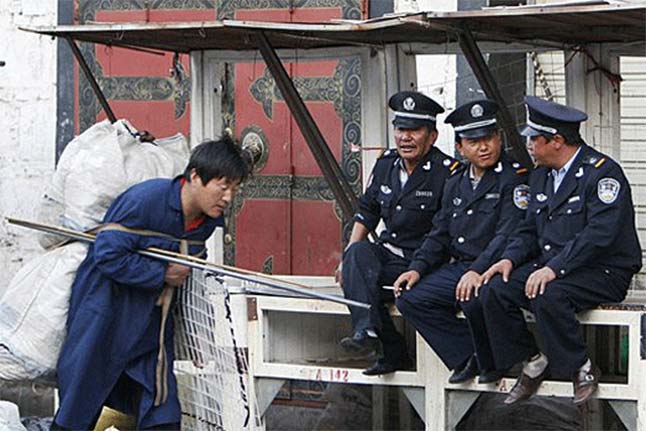
Discrimination in daily life
Tibetans face disproportionate restrictions on passports, domestic and international travel, and access to various parts of their own homeland. Checkpoints, digital and physical surveillance, and policing subject everyday movement and communication to heightened scrutiny, while a Tibetan identity can create barriers to employment and education, and risk other forms of discrimination, including lower wages than Han workers performing similar work.
159+
Tibetans inside Tibet and China have self-immolated in protest of Chinese rule since 2008
3+ mil
Number of Tibetans affected by government relocation and labor transfer programs from 2020-2025
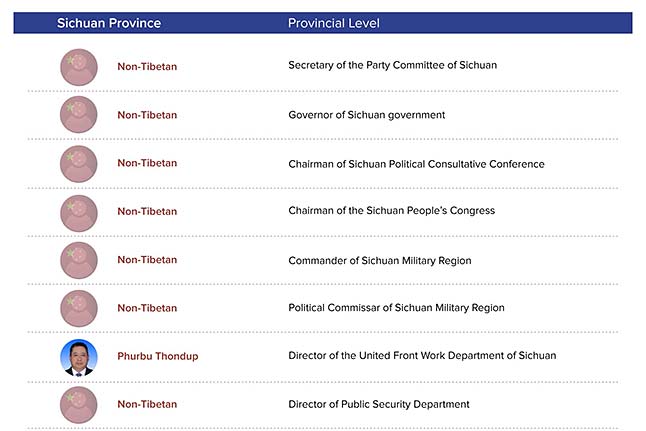
25.8%
The small share of Tibetans in senior leadership positions in Tibet in 2026, per ICT Research
Tibetans under-represented in key leadership roles
Tibetans remain underrepresented in senior leadership roles and administrative institutions governing their homeland. ICT’s Tibet Leadership Reports show that Tibetans have held only a minority of senior positions in Party, government, security and judicial institutions, with the most politically powerful posts consistently dominated by non-Tibetan officials. The pattern is especially pronounced in the military, United Front and other security-related institutions. These findings show that Tibetans remain largely excluded from meaningful decision-making authority in their own homeland.
The human cost of systemic discrimination
FORCED ASSIMILATION
The “Ethnic Unity and Progress” law subordinates Tibetan identity to Communist Party ideology. Residential schools separate children from families while relocation programs sever nomads from ancestral lands.
SELF-IMMOLATIONS
Since 2009, over 159 Tibetans have self-immolated inside Tibet and China, in addition to 11 Tibetan self-immolations in exile.
POLITICAL PRISONERS
Tibetans are detained for peaceful activities including advocating for language rights, practicing religion, and sharing information abroad.
Tibetans’ fundamental rights
The Chinese Communist Party’s racist policies violate China’s domestic laws and international human rights obligations, including under the International Convention on the Elimination of all Forms of Racial Discrimination (CERD), to which China has been a State Party since 1981.
China’s legal obligations
The Chinese government’s discriminatory policies toward Tibetans stand in direct conflict with protections contained in China’s own Constitution and its international human rights commitments. Article 4 of the Chinese Constitution prohibits discrimination and oppression against any ethnic group and guarantees ethnic minorities the freedom to use and develop their own languages. China is also a State Party to the International Convention on the Elimination of All Forms of Racial Discrimination (ICERD), which requires governments to eliminate racial and ethnic discrimination and protect equality before the law.
Equality and Dignity
Tibetans have the right to participate fully in economic and social life without discrimination and to freely speak their language, practice their religion and cultural traditions, remain on their ancestral lands, travel, and participate meaningfully in decisions affecting their future. Governments and international institutions should press China to end discriminatory policies, permit independent monitoring across Tibet and ensure that Tibetans can exercise their rights without punishment, surveillance or forced assimilation. ICT works to challenge policies that marginalize Tibetans, hold Chinese authorities accountable to their human rights obligations, and ensure that governments and international institutions continue to press for meaningful protections for the Tibetan people.


Stand with the people of Tibet
For 40 years, ICT has uncovered the truth China tries to hide. Your gift keeps that work alive.
Thank you.
Our Impact
- ICT has campaigned against China’s residential boarding school system, which separates roughly one million Tibetan children from their families, supporting a resolution within the European parliament decrying the practice, correspondence from UN special procedures criticizing the policy, and a petition by 100 Tibetan scholars to the UN High Commissioner for Human Rights calling for the system’s abolishment.
- ICT’s 2018 submission to the UN Committee on the Elimination of Racial Discrimination (CERD), delivered in Geneva ahead of China’s review, called on the committee to press Beijing to abolish laws that discriminate against Tibetans and to end official propaganda promoting derogatory narratives about Tibetan “backwardness.”
- ICT’s 2001 report “Jampa: The Story of Racism in Tibet,” released ahead of the UN World Conference against Racism, was the first comprehensive analysis of how racist and paternalistic language is embedded in China’s constitution, laws and policy statements toward Tibetans.
Common Questions
What makes China’s policies toward Tibetans racial or ethnic discrimination?
Discrimination occurs when people are denied equal rights, opportunities or treatment because of their ethnicity, language, religion or cultural identity. In Tibet, state policies impose disproportionate restrictions on Tibetans and subordinate Tibetan language, religion and culture to Chinese political and cultural norms.
These policies specifically target institutions, including monasteries and Tibetan language private schools, and practices through which Tibetans maintain a distinct collective identity.
Do Tibetans have freedom of movement?
No, Tibetans do not have freedom of movement and face severe restrictions on their freedom of movement, both within Tibet, China and across China’s borders. Access to passports has been systematically restricted for Tibetans, making international travel extraordinarily difficult for many.
Movement within Tibetan areas is also subject to extensive security controls. Checkpoints, police presence, surveillance systems, and restrictions around politically sensitive locations allow authorities to monitor where Tibetans travel and with whom they associate. These controls intensify during religious anniversaries, political events, and other periods deemed “sensitive periods” by the Chinese government.
How does the CCP profile and monitor Tibetans?
ICT Chinese authorities have built an extensive surveillance system across Tibet that combines physical policing with biometric and digital monitoring. The CCP profiles Tibetans using an invasive, bio-digital surveillance architecture that treats their entire ethnic and religious identity as a potential state security threat. Facial recognition, video surveillance, police databases, and monitoring of phones and online communications further expand the state’s ability to identify and track individuals. These technologies operate alongside neighborhood “grid management,” village-level policing, household monitoring, and systems that encourage residents to report activities considered politically suspicious. Tibetans may face particular scrutiny for religious activity, contact with relatives abroad, possession of prohibited material, or expressions of support for Tibetan identity and culture.
This comprehensive web ensures that a Tibetan’s biology, movements, relationships, and communications are permanently tracked and profiled by the state.
What is happening to the Tibetan language and why is it significant?
Chinese government policy is rapidly reducing the space for Tibetan-language education and accelerating the use of Mandarin as the dominant language of instruction. China’s new so-called “Ethnic Unity and Progress Law,” which took effect on July 1, 2026, further institutionalizes assimilationist policies; ICT’s analysis finds that it formalizes the transition from Tibetan-medium education toward a model in which Chinese is the principal language of instruction. Independent and private Tibetan-language schools have also faced increasing restrictions and closure.
Tibetan children are separated from their families and communities and placed in the state-run residential school system, where UN experts have warned that predominantly Mandarin education is weakening children’s ability to communicate in Tibetan with their families. Language carries Tibet’s literature, history, religious scholarship, and cultural memory; its erosion threatens the transmission of Tibetan identity from one generation to the next.
What are the implications of Tibetan nomads being resettled?
The forced resettlement of Tibetan nomads has catastrophic implications, destroying Tibet’s traditional economy, dismantling a multi-millennial cultural identity, and permanently scarring the alpine environment.
Under the CCP’s sweeping relocation policies, roughly three million Tibetan nomads have been systematically cleared off their ancestral lands. This state-engineered demographic shift has profound, cascading impacts across three major areas: social and economic marginalization, the collapse of indigenous cultural identity, accelerated environmental degradation.
Human rights organizations have documented coercive measures used to secure participation in whole-village relocations. Although Chinese authorities justify many relocations as environmentally necessary, ICT and researchers have challenged policies that exclude Tibetan pastoralists and disregard their longstanding role in managing the Tibetan grasslands.